外研版初一英语下册短语及句型讲解
- 格式:doc
- 大小:82.50 KB
- 文档页数:13
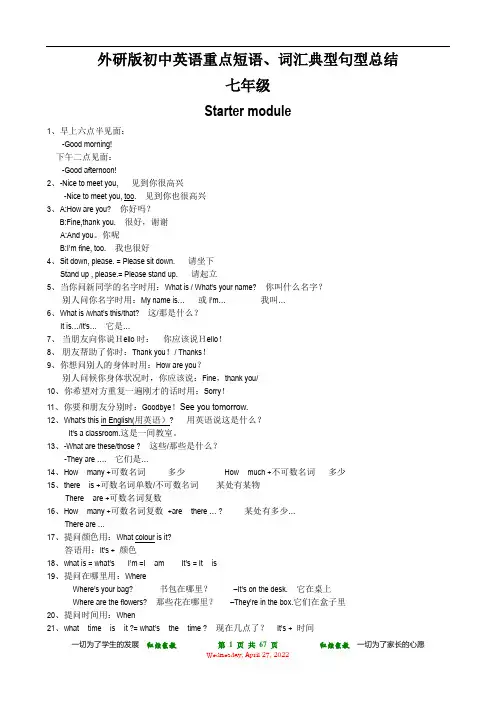
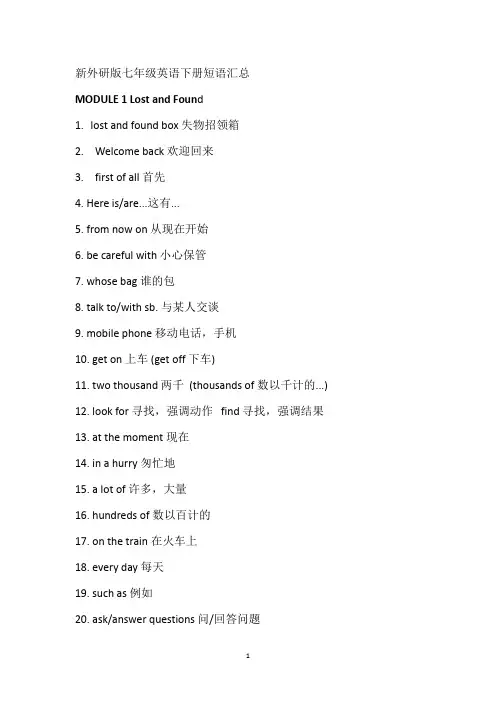
Module 1 短语: 1、Welcome back to+地点名词 欢迎回到... Welcome to +表示地点的名词 欢迎来到某地 Welcome to Beijing. Welcome +表示地点的副词 Welcome home! 欢迎回家 (home/here/there 是地点副词,前面不与介词连用。) 2、lost and found 失物招领 in the lost and found box 在失物招领箱里 at the lost and found office在失物招领处 3、first of all 首先 at first 起初,首先(M8) firstly 首先 secondly 其次 4、here is/are...这有.. 5、Thank you 的几种回答: You are welcome. 不用谢 That's all right. That's OK. Not at all. It's my pleasure! /My pleasure. 6、look at 看(不一定看见 ) look是不及物动词,后面 不直接加名词 eg. look at the blackboard 看黑板 see 看见 see sb. do sth. 看到某人做过某事 see sb. doing sth.看到某人正在做某事 watch 观看,仔细地看(比赛、电视等) watch TV 看电视 read 看、阅读(书、报纸、杂志等) read the book 读书 7、be careful with 注意.../小心(对待)... careful 形容词 careless care carefully 8、from now on 从现在开始 from then on 从那时开始 9、Let me see. 让我想想。 10、talk to sb 和某人说话(侧重主动说) talk with sb 和某人说话(侧重两人都说) talk about sth 谈论某事 say 说,强调说的内容 He can’t say a word. speak 说,后面可以直接加语言 speak English/Chinese My sister can speak three languages. speak to sb 和某人说话 tell 告诉 tell sb. sth=tell sth to sb.告诉某人某事 tell sb. to do sth.告诉某人去做某事 tell sb. not to do sth.告诉某人别做某事 11、look for 寻找(强调过程,不一定找到) I’m looking for my dog. find 找到 (强调结果) I can’t find it. find out +事情(经过努力)查明,弄清某事 search 搜索,调查 look over仔细检查w W w .x K b 1.c o M look after =take care of 照顾 look like 看起来像 look through 浏览 look up 查阅,查考 look forward to doing sth. 期盼,期待 12、get on the bus 上公交车 get off the bus 下公交车 get in the car get out of the car 13、in a hurry 匆匆忙忙 hurry up=come on 快点儿,赶紧 hurry to do sth 匆忙去做某事 (there’s)no hurry 不忙,不必着急 P83 14、hundreds of 成百的,许多(大约数加s,加of) hundred、thousand、 million、billion的用法: (1).前面有具体数词时,不变复数 : two thousand mobile phones (2).后面加of时,本身变复数: hundreds of people 15、every day 每天 时间状语 everyday 每天的,日常的(形容词,后面接名词) 16、many other things 许多其他的东西 17、mobile phone 移动电话,手机 18、at the moment=at this moment=now 此时此刻,现在 at that moment=then 在那时 19、a lot of =lots of许多 既可以修饰可数名词,也可以修饰不可数名词。 a lot 很,非常 修饰动词 eg. He earns a lot of money. 他赚很多钱。 We go to Europe a lot for holidays. 我们经常去欧洲度假。 20、fifteen kilos of sausages 十五公斤香肠 21、on the /a train在火车上 22、call sb. at +号码 给某人打电话拨打… 23、everyone/everybody 做主语,谓语动词用单数. 16、such as 例如,后面不加逗号 for example 例如,后面加逗号 17、帮助某人做某事help sb.(to)do sth help sb. with sth 18、thing of 思考,考虑;想起 19、ask/answer questions about… 问/回答关于…的问题 20、make a list of… 列一张...的清单 句子: 1.Everyone, please be careful with your things from now on.从现在开始,请每个人小心保管自己的物品。 2. People often lose things when they are travelling or when they are in a hurry.人们在旅行中或是匆匆忙忙时经常丢东西。 when 当…时,引导时间状语从句, 3. They leave things on planes, on trains, on buses and in taxis.他们把东西落在飞机、火车、公交车和出租车上。 leave v.离开 leave+地点 离开某地 leave for+地点(目的地 出发去某地 v.丢下,遗忘 leave sth+地点状语 把某物落在某地 n.假期,休假 I have to ask for a three days’ leave. 我得请三天假。 forget 忘记,遗忘 forget sth forget doing sth 忘记做过某事 forget to do sth 忘记去做某事 4. That’s why there are lost and found offices at airports and stations.这就是机场和火车站都有失物招领处的原因。 That’s why 是…的原因,后面加结果。 eg. He got up late, that’s why he was late for work. 结果 原因 5. Hundreds of people come here everyday.每天都有许多人来到这里。 hundred、thousand、 million、billion的用法: (1).前面有具体数词时,不变复数 : two thousand mobile phones (2).后面加of时,本身变复数: hundreds of people 语法: 名词性物主代词 . Whose bag is this? It’s mine. / It’s Betty’s. 物主代词分形容词性物主代词与名词性物主代词。 (1).形容词性物主代词相当于一个形容词,在句中作定语用,其后一定要接名词。 如: my pen我的钢笔 your bag你的书包 his bike他的自行车 her desk她的书桌 its name它的名字 Is that your bike? 那是你的自行车吗? Those are our books. 那些是我们的书。 如果名词前有形容词性物主代词,就不能同时用冠词(a, an, the)或指示代词(this, that, these, those)修饰此名词。 This is my pen. (T) This is my a pen.(T) This is a pen. (T) This is a my pen.(T) 形容词性物主代词与形容词一起修饰名词时,要放在形容词之前。 如: his English books 他的英语书 their Chinese friends 他们的中国朋友 (2).名词性的物主代词相当于一个名词,在句中作主语、表语或宾语,能单独使用。 名词性物主代词 =相应的形容词性物主代词+名词 人称代词与物主代词
数 人称代词 物主代词 人称 主格 宾格 所有格,形容名词性物主代 Module 2 1、play the+西洋乐器 play the piano/violin play+中国乐器 play erhu 接球类、棋类名词时,不加the: playtable tennis/football/basketball 2、ride a /the bike 骑自行车 3、the new clubs for this term 这学期的新俱乐部 4、would like =want 想要 would like sth=want sth 想要某物 would like to do sth=want to do sth 想要做某事 would like to be=want to be 想要成为... would like sb. to do sth= want sb. to do sth 想要某人做某事 5、join加入(团体、组织、俱乐部、入党、入团、参军等),并成为其中一员 join (sb.)in sth 加入活动 take part in 参加群众性活动、会议等(侧重发挥积极作用) attend 出席会议,到场,上课等 6、what about you?=how about you?=and you? 你呢? what about doing sth?=how about doing sth?做某事怎么样?(提建议) 7、that’s all 仅此而已,就这么多 8、worry about =be worried about 担心... Don’t worry 不用担心 9、 teach you Chinese 教你汉语 teach sb sth =teach sth to sb 教某人某事 10、in different ways 用不同方式 11、the start of…=the beginning of… ...的开始 start to do sth = start doing sth 开始做某事 12、run really fast real 形容词,修饰名词 real story 13、get on well/badly with sb.= get along well/badly with sb. 和某人相处的好/