
群体的遗传平衡和结构
- 格式:ppt
- 大小:2.02 MB
- 文档页数:78


群体遗传结构的理解_cropped林学科业 Vol138 , No12 第 38 卷第 2 期SCIENTIA SILVAE SINICAE Mar. , 2 0 0 2 2 0 0 2 年 3 月3群体遗传结构的理解胡新生( )中国林业科学研究院林业研究所北京 100091摘要 : 一个植物种群体的空间分布大致可划分为两类 :离散分布与连续分布。
然而隐藏在这种表观物理分布内部的遗传变异是十分复杂的。
这种变异是如何分布的呢 ? 这种分布又是如何维持的呢 ? 因此 , 认识一个种的群体遗传结构有助于我们理解该种的进化过程 ,并提供为遗传资源保护做出决策的重要信息。
本文() 对三大经典遗传结构模型岛屿模型、步石模型及距离隔离模型与渐变群理论及它们的异体和发展进行了详细的分析和评述。
目前获得的许多不同类型的遗传标记使这些理论的应用得到不同程度的实现 ,但由于这些理论结论涉及到许多假设 ,在实际应用时应十分慎重。
作者认为许多已建立的适合于动物群体遗传结构理论不能简单地直接应用于植物群体上 ,今后一个重要的研究内容就是要建立适合于植物群体的遗传结构理论。
关键词 : 群体遗传结构 , 岛屿模型 , 步石模型 , 距离隔离模型 , 渐变群理论A REVIEW O N UND ERSTAND ING THE GENETIC STRUCTURE OF POPUL ATIO NHu Xinsheng ( )The Research Institute of Forestry , CA F Beijing 100091Abstract : Population distribution of a species in space can be generally classified two types : discrete and continuous dis2 tribution , but the genetic variation underlying this physical distribution is very complicated. How does the genetic variation partition between and within populations ? How can this genetic variation be maintained in realworld ? Thus , knowledge of population genetic structure may help us to understand the evolutionary process of the species and assist us in decision2mak2 ing on conservation of genetic resources.So far insight into population genetic structure is very restricted , and theoretical studies are mainly confined to the( ) ( ) three classical models of genetic structure : island model Wright ,1931, stepping2stone model Kimura ,1953and isola2 ( ) tion by distance model Wright ,1943. The first two models can be used to address the case of discrete distribution in space , and thethird one to the case of continuous distribution. Since the introduction of these three models , many limitati2 ons involved in them have been relaxed and their variants have been developed and analyzed using a variety of statistical ge2 netic methods. In this paper , the three models and their variants and cline theory , a specific geneticstructure of popula2 tions in terms of the change of genetic variation with geographical distance , were remarked in detail , including theirkernel ideas , application limitations and relaxation , development ,and testing of our understanding using the naturally occurring genetic markers within taxa .In the end , the author highlighted the requirement of exploring appropriate theory suitable for genetic structure of plant populations because there are many obvious differences between plant and animal population genetic structure . Firstly , vec2 tors of gene flow in plant species are different from those in animals. Secondly , the migration rate contained in the formulae of traditional population structure models cannot be substituted linearly by seed and pollen flow if ratesof seed and pollen flow are not too small , which is highly likely in many plant species. Thirdly , population genetic structures of three plant genomes with contrasting modes of inheritance are different . Fourthly , differences in population structure among three plant genomes can provide important information on estimation of seed and pollen flow , on inferring colonization history , etc . . The integration of the impacts of seed and pollen flow with the interaction between cytonuclear genes probably can gain deep insight into the genetic structure ofnatural plant populations.Key words : Population genetic structure , Island model ,Stepping2stone model , Isolation by distance model , Cline theory 收稿日期 :1998209228 。
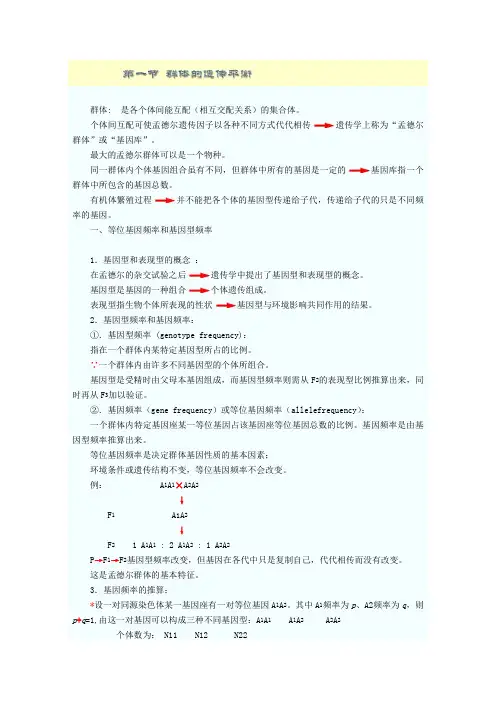
群体: 是各个体间能互配(相互交配关系)的集合体。
个体间互配可使孟德尔遗传因子以各种不同方式代代相传遗传学上称为“孟德尔群体”或“基因库”。
最大的孟德尔群体可以是一个物种。
同一群体内个体基因组合虽有不同,但群体中所有的基因是一定的基因库指一个群体中所包含的基因总数。
有机体繁殖过程并不能把各个体的基因型传递给子代,传递给子代的只是不同频率的基因。
一、等位基因频率和基因型频率1.基因型和表现型的概念:在孟德尔的杂交试验之后遗传学中提出了基因型和表现型的概念。
基因型是基因的一种组合个体遗传组成。
表现型指生物个体所表现的性状基因型与环境影响共同作用的结果。
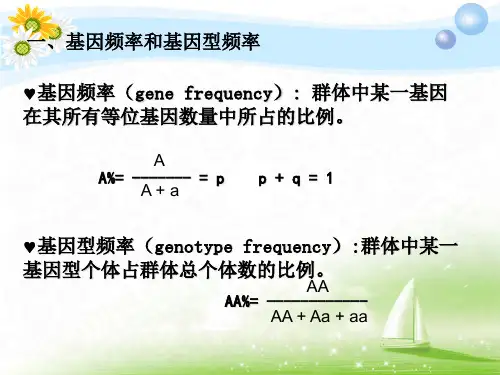
2.基因型频率和基因频率:①.基因型频率 (genotype frequency):指在一个群体内某特定基因型所占的比例。
∵一个群体内由许多不同基因型的个体所组合。
基因型是受精时由父母本基因组成,而基因型频率则需从F2的表现型比例推算出来,同时再从F3加以验证。
②.基因频率(gene frequency)或等位基因频率(allelefrequency):一个群体内特定基因座某一等位基因占该基因座等位基因总数的比例。
基因频率是由基因型频率推算出来。
等位基因频率是决定群体基因性质的基本因素;环境条件或遗传结构不变,等位基因频率不会改变。
例:A1A1×A2A2↓F1A1A2↓F2 1 A1A1 : 2 A1A2 : 1 A2A2P→F1→F2基因型频率改变,但基因在各代中只是复制自己,代代相传而没有改变。
这是孟德尔群体的基本特征。
3.基因频率的推算:*设一对同源染色体某一基因座有一对等位基因A1A2。
其中A1频率为p、A2频率为q,则p+q=1,由这一对基因可以构成三种不同基因型:A1A1A1A2A2A2个体数为: N11 N12 N22*设群体总个体数为N,即N11+N12+N22=N∵二倍体生物各基因型由两个等位基因组成如A1A1、A1A2、A2A2,其中:A1基因有2N11+N12,A2基因有N12+2N22。
