
clt and tblt in china
- 格式:ppt
- 大小:547.00 KB
- 文档页数:39
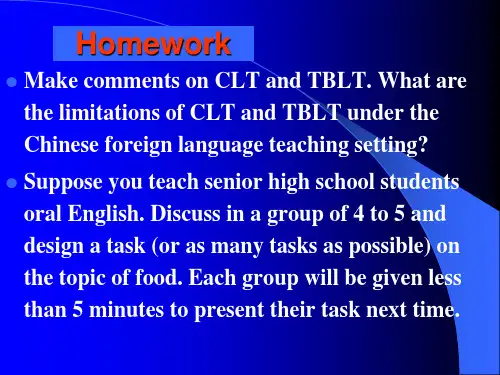

PPP教学法和 TBLT任务型教学法的比较与对比探究1.引言在当今语言学习与教学领域,任务型教学(TBLT)已经成为讨论最广泛的方法之一,被该领域众多学者认为是交流语言教学(CLT)方法的有力版本(Ellis,2003;Nunan,2004)。
然而,虽然TBLT是外语教学的推荐方法,它并没有充分引入到课堂实践中。
演示-实践-产出(PPP)在语言教学方面有较长的历史,但最近的研究相对较少。
虽然PPP在激励机制方面似乎不如TBLT,但教师往往不确定TBLT的效果。
本文将试图比较和对比TBLT和PPP两种教学法。
2.PPP与TBLT从20世纪60年代开始,PPP作为一种有效的教学法被推荐给语言教师。
该领域的许多学者,如Byrne(1986)探索了PPP的实施步骤。
首先,老师提出新的语言项目;然后学习者重复练习;最后学生自己产出语言表达。
Byrne还指出,顺序不必严格遵循,根据学生的水平、需求和教学材料,也可以从产出到演示再到实践。
Richards和Rodgers对TBLT的定义如下:“基于任务作为语言教学规划和教学核心单元的方法(Richards&Rodgers,2001,p.223)”。
它被视为交际语言教学的新发展,因为它建立在许多原则之上,比如,TBLT涉及真正交流的活动,对语言学习至关重要。
任务的目标通常与现实世界中语言使用的特定领域有关,即学术、专业、社会、商业、技能。
更具体地说,一些任务是为了发展参与学术学习所需的技能。
一些任务试图帮助学习者用目标语言进行社会交流。
除了上述列出之外,某些任务的目标是帮助学习者能够阅读目标文化的文献。
TBLT中的输入数据是学习者在任务开始时所面对的初始文本(口语或书面文本)、指令、图表、地图、图片。
难度是根据文本类型和文本结构进行分级的。
活动或程序是学习者必须完成的实际任务。
重要方面包括信息的分发,如群体中有多少成员能够获得关键知识;信息交换是任务的核心;是关注机构互动或社会互动的任务。

英语教学主张和思想总结In recent years, English teaching has undergone significant changes with the aim of improving students' language skills and proficiency. Several teaching approaches and philosophies have emerged, each with its own strengths and weaknesses. In this essay, I will summarize some key ideologies and approaches in English teaching, highlighting their core principles and the impact they have on students' learning.Communicative Language Teaching (CLT) is one of the most influential philosophies in English teaching. It emphasizes the importance of communication and interaction in language learning. CLT encourages students to engage in real-life situations and use the target language in meaningful ways. It focuses on developing students' fluency rather than accuracy, providing them with opportunities to practice authentic language use. Through pair work, group discussions, and role-plays, students can enhance their ability to express themselves and understand others.Task-Based Language Teaching (TBLT) is another methodology that places a strong emphasis on authentic language use. According to TBLT, language learning is most effective when it is embedded in meaningful tasks. Students are presented with real-world problems or situations that require them to use English to complete the task. By working collaboratively, students not only practice language skills but also develop problem-solving abilities and critical thinking.Another approach is the Content-Based Language Teaching (CBLT), which integrates language learning with subject matterlearning. It recognizes that language is best acquired when learners are engaged in meaningful content related to their interests or academic disciplines. By using English as a medium of instruction, students can develop both language skills and knowledge in different subjects. CBLT promotes integrated learning, helping students make connections between different disciplines and enhancing their overall cognitive development.In contrast to the above approaches, Grammar-Translation Method (GTM) focuses on explicit grammar instruction and translation. Its main goal is to improve students' reading and writing skills, often placing little emphasis on oral communication. GTM views language learning as a process of memorizing grammatical rules and vocabulary. Although GTM has faced criticism for its lack of communicative practice, it still plays a role in teaching grammar structures and expanding students' vocabulary.In recent years, there has also been a shift towards student-centered teaching approaches. This move aims to empower students and promote their active involvement in the learning process. One example is the Inquiry-Based Learning (IBL) approach, where students construct their knowledge through inquiry and exploration. IBL encourages critical thinking, problem-solving, and self-directed learning. By challenging students to ask questions and seek answers, IBL fosters a deeper understanding of the English language and ensures long-term retention of knowledge. Regardless of the teaching approach or philosophy embraced, it is crucial to create a positive and inclusive learning environment. Teachers should facilitate open communication, respect students'diverse backgrounds, and provide individualized support. They should also employ a variety of teaching strategies to cater to different learning styles and needs, ensuring that all students can actively participate and benefit from the English learning process. In conclusion, English teaching has witnessed various approaches, each with its own focus and ideology. From communicative approaches like CLT and TBLT to content-based learning and student-centered philosophies, the aim is to foster effective language acquisition and meaningful language use. Ultimately, the success of English teaching lies in the ability of educators to create an engaging and supportive learning environment, where students can develop their language skills and become confident and competent English communicators.。
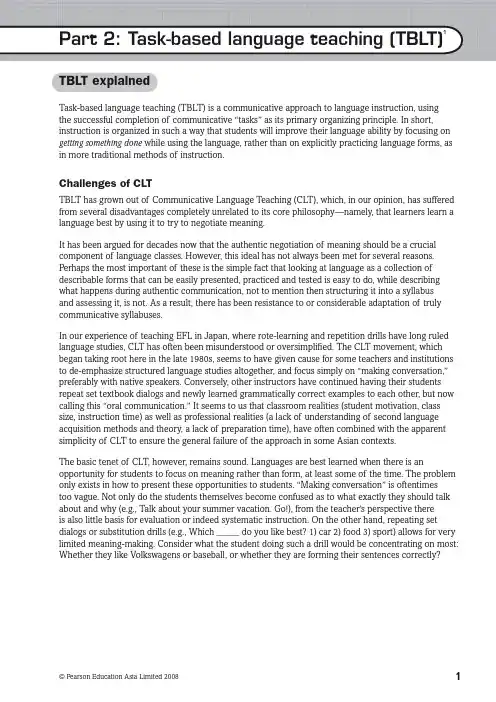
Part 2: Task-based language teaching (TBLT)1 TBLT explainedTask-based language teaching (TBLT) is a communicative approach to language instruction, usingthe successful completion of communicative “tasks” as its primary organizing principle. In short, instruction is organized in such a way that students will improve their language ability by focusing on getting something done while using the language, rather than on explicitly practicing language forms, as in more traditional methods of instruction.Challenges of CLTTBLT has grown out of Communicative Language Teaching (CLT), which, in our opinion, has suffered from several disadvantages completely unrelated to its core philosophy—namely, that learners learn a language best by using it to try to negotiate meaning.It has been argued for decades now that the authentic negotiation of meaning should be a crucial component of language classes. However, this ideal has not always been met for several reasons. Perhaps the most important of these is the simple fact that looking at language as a collection of describable forms that can be easily presented, practiced and tested is easy to do, while describing what happens during authentic communication, not to mention then structuring it into a syllabusand assessing it, is not. As a result, there has been resistance to or considerable adaptation of truly communicative syllabuses.In our experience of teaching EFL in Japan, where rote-learning and repetition drills have long ruled language studies, CLT has often been misunderstood or oversimplified. The CLT movement, which began taking root here in the late 1980s, seems to have given cause for some teachers and institutions to de-emphasize structured language studies altogether, and focus simply on “making conversation,” preferably with native speakers. Conversely, other instructors have continued having their students repeat set textbook dialogs and newly learned grammatically correct examples to each other, but now calling this “oral communication.” It seems to us that classroom realities (student motivation, class size, instruction time) as well as professional realities (a lack of understanding of second language acquisition methods and theory, a lack of preparation time), have often combined with the apparent simplicity of CLT to ensure the general failure of the approach in some Asian contexts.The basic tenet of CLT, however, remains sound. Languages are best learned when there is an opportunity for students to focus on meaning rather than form, at least some of the time. The problem only exists in how to present these opportunities to students. “Making conversation” is oftentimestoo vague. Not only do the students themselves become confused as to what exactly they should talk about and why (e.g., Talk about your summer vacation. Go!), from the teacher’s perspective thereis also little basis for evaluation or indeed systematic instruction. On the other hand, repeating set dialogs or substitution drills (e.g., Which _____ do you like best? 1) car 2) food 3) sport) allows for very limited meaning-making. Consider what the student doing such a drill would be concentrating on most: Whether they like Volkswagens or baseball, or whether they are forming their sentences correctly?Advantages of TBLTA task-based approach solves many of the criticisms traditionally associated with Communicative Language Teaching. To begin with, consider these characteristics of tasks:2•Meaning is primary.•Learners are not restricted in their use of language forms.•Tasks should bear a relationship to real-world activities.•The priority is on achieving the goal of the task.•Tasks are assessed based on their outcome.TBLT provides a structured framework for both instruction and assessment. Using tasks as thebasic building blocks of syllabus design allows teachers to both sequence lessons and assess their outcomes, while at the same time creating reasonably authentic parameters within which students can communicate with each other for a purpose. Most importantly, it allows them to focus on what it is that they are saying to each other, rather than on how they are saying it. A task may be short and self-contained (e.g., ordering a pizza by telephone) or longer and more complex (e.g., organizing and publishing a student newspaper), but the tasks always involve a clear and practical outcome (e.g., The pizza arrives with the correct toppings, or the newspaper is printed and is recognizably a newspaper). In a task-based approach, specific language forms should never be the primary focus, because it is important that students be allowed to make meaning in whichever way they see fit, at least at first. Teachers may assist or even correct students when asked, of course, but may not restrict the students’ choice of which forms to use by explicitly teaching, say, the present continuous before the task is attempted. A post-task phase, on the other hand, is generally recognized by TBLT practitioners as useful. During this segment of the lesson, after the students have attempted the task, the teachermay choose to go over the language used, correcting specific errors and/or highlighting particularly well-suited forms that students may have attempted to use.When considering TBLT, it is crucial to focus on the fundamental notion of authenticity, as tasks attempt to simulate, in a way that is as authentic as possible, what happens when students attempt real-world activities.This has several advantages:•Authentic tasks are intrinsically motivating. That is, students attempt them because they see that the task is, in itself, interesting and applicable to their lives.•Targeted real-world tasks have much clearer outcomes that can be more easily assessed, unlike more general, or “open,” tasks such as having a conversation. For example, when aperson attempts to order a pizza on the telephone in a second language, that person knows ifhe or she has “passed” or “failed” within a very short time—when the pizza does or does notarrive, with the correct toppings or not.•Real-world activities can be looked at and sequenced in much the same way as grammar forms can—from simpler to more complex. For instance, ordering from a menu at arestaurant is easier than ordering by telephone for several reasons—students can usegestures, text and sometimes pictures; there is less information to convey (e.g., no addressor credit card number); students may resort to single-word utterances. In the same way,telling a story is more complex than both examples above, because students now need touse connected sentences, time markers, pronouns and so on. It can be reasonably assumedthat a student who can tell a story in English can also telephone for a pizza or order at arestaurant (but not vice-versa), in much the same way as we can reasonably assume thata student who can use conditionals can also use the present continuous (but again, notvice-versa).Therefore, when a series of connected, themed tasks are sequenced in such a way as allows studentsto simulate a real-world context and perform at an increasing level of complexity, a variety of benefits occur. These include a purpose-driven recycling of vocabulary and language forms, a heightened sense of overall motivation, a marked increase in communicative confidence, scaffolded autonomy-building and a truly student-centered classroom. Much of the language learning thus occurs implicitly, as noticing on the part of the student, rather than as explaining on the part of the teacher.A “strong” approach to TBLTIt has been argued that TBLT may not be the best way to develop basic language skills in the lowest ability levels, nor for very young learners. Because ours is a “strong” approach to TBLT, we generally agree with this perspective. Although many textbooks on the market today claim to be task-based,and are targeted across many levels including children and beginners, we should stress that these are, almost without exception, and often admitted to by the authors, a “weak” approach to TBLT. In other words, they make compromises with some of the tenets of TBLT in order to target children and beginners, especially by providing language-based activities such as embedded grammar points. We do not find fault with this practice beyond simply articulating the fact that these are not, strictly speaking, task-based courses. In fact, we think that many of these courses are very well designed in their own right and serve their purposes well.We believe that a strong TBLT approach is built squarely upon a foundation of authenticity. Tasks must be as realistic as possible in order to engage students so that their meaning-making is also as authentic as it can be. A “weak” approach may be effective in an ESL environment, since the forms students learn in class may be authentically used outside the classroom almost immediately. In an EFL environment, however, such opportunities are usually limited, and therefore the more authenticity created inside the classroom, the better. For this to happen, tasks must not simply be authentic in their own right, but they must be authentically linked to each other as well, thus creating a sustained authenticity which allows for the recycling and reinforcement of the language forms used.Task complexityOne other important aspect of TBLT is the underlying assumption that task complexity is somehow linked to language complexity. This is supported by various “language descriptor” systems developed over the years in different countries. Perhaps the first and best known of these is the ACTFL Guidelines. We recommend the Canadian Language Benchmarks (CLB) and the Common European Frameworkof Reference for Languages (both available online). The CLB document—The Canadian Language Benchmarks 2000: English as a Second Language for Adults—is especially clear and accessible for teachers new to TBLT.The idea of task complexity as an organizing feature for language instruction is simple and intuitively clear, though the possibility of objective correlations between task and language complexity are still sometimes disputed by researchers. Briefly, however, we can generally assume that the complexity of any task is linked to the language needed to perform it. As an example, and at a very basic level, most teachers may agree that, if a student can successfully describe a photo of familiar, concrete items, then that student can: Make simple sentences (e.g., It’s a dog.); modify nouns with adjectives (e.g., It’s a redshirt.); use a couple of basic verb forms (e.g.; He is walking.); etc. This student would not necessarily, however, be able to tell a story because he or she may not be able to use more complex language, such as connecting sentences together coherently (e.g., The man walks to the store. He buys a drink there. Later, he goes home.). Certainly, there is no indication that this student may be able to give a formal presentation using a variety of verb forms and an expanded vocabulary, since that is, again, a more complex type of task. Thus, by organizing a syllabus according to increasing task complexity, even though there is no specific focus on language, we can slowly increase the language complexity attempted by students.However, there are shortcomings to this approach. The debate continues on how tasks should be sequenced in terms of linguistic, cognitive and other complexities. There is also no strong consensus on whether students being able to perform one particular task are necessarily proficient at performing all tasks of the same type. Despite these and other such caveats, however, we strongly believe that, from the perspective of the classroom teacher, TBLT presents a clear and easy-to-use resolution to some of the problems inherent in Communicative Language Teaching.Much more can, and indeed should, be considered with regards to TBLT, but we hope that the above will be enough to get teachers into the right frame of mind to approach Widgets.TBLT and WidgetsOur primary consideration when organizing Widgets has been authenticity, which means that where there has been a conflict with the conventional interpretation of the literature, we have tended toward what “felt” more real. For example, we did not follow an explicit form of the pre-task/task/post-task structure, because we felt that by doing this we would be breaking some of the illusion of authenticity provided by the overall simulation. However, we have tried to stay true to the spirit of this framework by making our tasks fit into and support each other incrementally, so that each individual task serves to some extent as the pre-task phase for the one following it, and also as the post-task phase for the one which came before.Regarding the “openness” or “closedness” of tasks,3 we have looked at the issue from a more complex perspective. Although most tasks in Widgets may appear to be open, in fact they “draw to a close,” so to speak. In Stage 2, for example, the smaller sub-tasks building up to having students create a new product idea allow a necessary freedom of discussion at first, but at the same time begin to converge students onto a range of outcomes that are more restricted. For instance, the product idea must be original, safe, useful, etc. While these may appear at first to be subjective criteria, students almost invariably come to the realization that there is indeed general agreement as to which products are safe and which are not, effectively creating “correct” and “incorrect” outcomes.In other words, we have let the content re-inform our understanding of the theory rather than let theory dictate the content. We feel that our ideas have been supported by the positive results we and our colleagues have seen in the classroom.Task-based assessmentWe, like most teachers today, take it as a given that communicative ability in a second language must be considered as a whole. That is, communicative ability includes not only vocabulary, pronunciation and grammar skills, but also the capacity to use these in real-world contexts. It is this last point which is often missed by traditional assessment tools, such as university entrance exams, often because it is considered too time-consuming and subjective to try to assess communicative ability. We hope to show you that task-based assessment is neither time-consuming nor subjective, and in fact includes many other advantages as well.Task-based assessment is easy, straightforward and, above all, meaningful for students and teachers alike. Simply put, one begins by looking at the appropriate completion of any given task first, and at the accuracy of the language used to complete it second. If the student can achieve a particular goal, or “outcome,” using English, then the student passes. Conversely, if they cannot achieve the outcome in a generally acceptable manner, then they fail.Here is a hypothetical task, including some specific parameters to be met:Task Tell a storyParameters •On a simple, familiar topic (e.g., family trip)•To a single sympathetic listener (e.g., a friend)•For a certain length of time (e.g., two minutes)Note that the parameters are important in order to keep tasks at a specific level. For example, ifyou were to change the “single sympathetic listener” to “an audience of English teachers during an entrance interview” it would make the same basic task far more challenging.Now, let us say you are grading the task outcome on a 10-point scale. If the student has appropriately completed the task (i.e., They have managed to tell a story according to these parameters, regardless of how “good” it actually was.), they pass, and now have a score of between 6 and 10.If they could not accomplish the task (e.g., They could not be understood at all, or if what they produced would not reasonably be called “a story.”) then they fail. If they spoke reasonably well but did not stay completely within the parameters (e.g., If they spoke for only one minute or they spoke on an entirely different kind of topic.) then they did not complete the task, and they fail. Of course, as the teacher, you may always choose to make allowances in such cases, but strictly speaking, in a task-based assessment model, this student would indeed fail.The next step is to assess how well the task was achieved. Now we can look at things such as pronunciation, vocabulary and grammar. Remember, if an appropriate outcome was achieved, then we already know that the student’s pronunciation, vocabulary and grammar are at an “acceptable” level for the task, communicatively speaking. They would not have managed to complete the task otherwise.Thus, task-based assessment works something like this:The underlying principle at work in task-based assessment is that tasks can be organized in a hierarchy which parallels “steps” in language proficiency because the language necessary to perform any particular task ultimately indicates an ability to perform that task’s “type.”This means two things:1.the restaurant” is easier than “ordering a pizza by phone,” which in turn is easier than “givingone’s impromptu opinion in a TV interview.” This is because the language required for eachis increasingly more difficult. At a restaurant, one needs only to speak in single words aidedby gestures to be reasonably understood. On the phone, it is necessary to be able to ask andrespond to simple complete questions with no visual cues. Finally, to participate in a TVinterview might require speaking for an extended period on an unprepared topic, requiring afacility with grammar and a large, generalized vocabulary.2. We can think of tasks as representative of certain “types” of communicative acts. It isreasonable to expect that a learner who can order a meal at a restaurant can also functionreasonably well at the dry cleaner’s or rent a car in person. Renting a car by phone, however,would be more like ordering a pizza, since the learner could not rely on gestures and othermeans of communicating. Finally, someone who could give a reasonable TV interview couldalso be expected to, say, participate as a student in a high school algebra course.Although how to rank tasks according to complexity and how to organize them into task types arestill unresolved issues for researchers and theorists, we have chosen to follow the lead of language descriptor systems such as the Canadian Language Benchmarks and the Common European Framework of Reference for Languages in our Student Book. Nevertheless, our tasks do not necessarily correlate with either of these, as our primary concerns were task complexity and authenticity. Widgets has therefore been informed by what has worked in our classes first, and by our knowledge and experience with the literature second. In the end, however, we have noted extremely high correlations with all of the major TBLT tenets proposed by researchers and theorists.Marcos Benevides and Chris ValvonaFurther reading on TBLT•For an excellent short summary of TBLT (here referred to as TBI, or Task-Based Instruction), we recommend Jane Willis’ introductory essay in Betty Lou Leaver andJane R. Willis, Task-Based Instruction in Foreign Language Education (Washington, D.C.:Georgetown University Press, 2004).• A more comprehensive, but very readable survey of TBLT, with an emphasis on classroom applications, is David Nunan, Task-Based Teaching (Cambridge: Cambridge UniversityPress, 2004).•Also comprehensive, but somewhat denser and exhaustively researched, is Rod Ellis, Task-based Language Learning and Teaching (Oxford: Oxford University Press, 2003).•Visit nguage.ca for more information on the Canadian Language Benchmarks.The Canada Language Benchmarks 2000: English as a Second Language for Adults by GrazynaPawlikowska-Smith can be downloaded from nguage.ca/pdfs/clb_adults.pdf. (Youwill need Adobe Reader to view this document.)•The Common European Framework of Reference for Languages can be downloaded from www.coe.int/t/dg4/linguistic/Source/Framework_EN.pdf. (You will need Adobe Readerto view this document.)1. This article is intended to provide a brief explanation of TBLT as it applies to the Widgets course. For a deeper understanding of the theory and research behind the approach, we recommend that teachers read further. The number of articles and books on the topic has been growing exponentially in recent years, but a good starting point would be the three books listed in the “Further reading on TBLT” section.2. From Nunan (2004, pg. 3). Note that Nunan is here drawing on Skehan, Bygate, Swain, Ellis and others, and that these characteristics of a task are in fact now very widely agreed upon.3. In short, open tasks are those which do not have a predetermined outcome, such as a free chat, and closed tasks, such as describing a picture, are those which have one (or a few) “correct” outcomes. Research suggests that closed tasks are generally more useful for language practice (Ellis, 2003).。