
中国文化概论 孙子兵法英文背景共19页
- 格式:ppt
- 大小:2.09 MB
- 文档页数:19

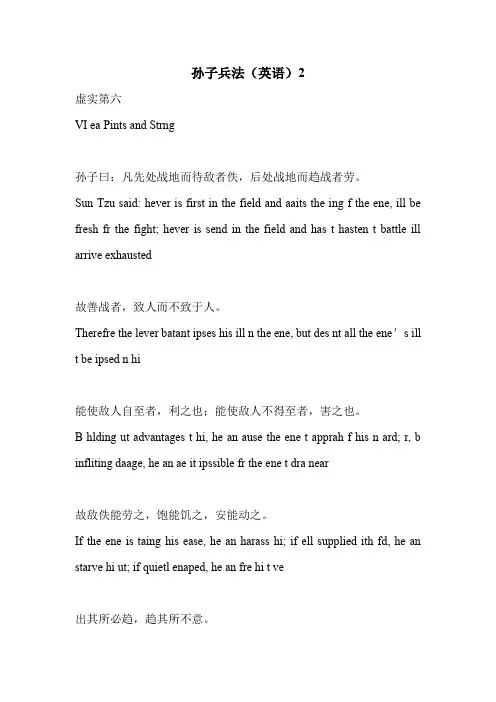
孙子兵法(英语)2虚实第六VI ea Pints and Strng孙子曰:凡先处战地而待敌者佚,后处战地而趋战者劳。
Sun Tzu said: hever is first in the field and aaits the ing f the ene, ill be fresh fr the fight; hever is send in the field and has t hasten t battle ill arrive exhausted故善战者,致人而不致于人。
Therefre the lever batant ipses his ill n the ene, but des nt all the ene's ill t be ipsed n hi能使敌人自至者,利之也;能使敌人不得至者,害之也。
B hlding ut advantages t hi, he an ause the ene t apprah f his n ard; r, b infliting daage, he an ae it ipssible fr the ene t dra near故敌佚能劳之,饱能饥之,安能动之。
If the ene is taing his ease, he an harass hi; if ell supplied ith fd, he an starve hi ut; if quietl enaped, he an fre hi t ve出其所必趋,趋其所不意。
Appear at pints hih the ene ust hasten t defend; arh siftl t plaes here u are nt expeted行千里而不劳者,行于无人之地也;An ar a arh great distanes ithut distress, if it arhes thrugh untr here the ene is nt攻而必取者,攻其所不守也。

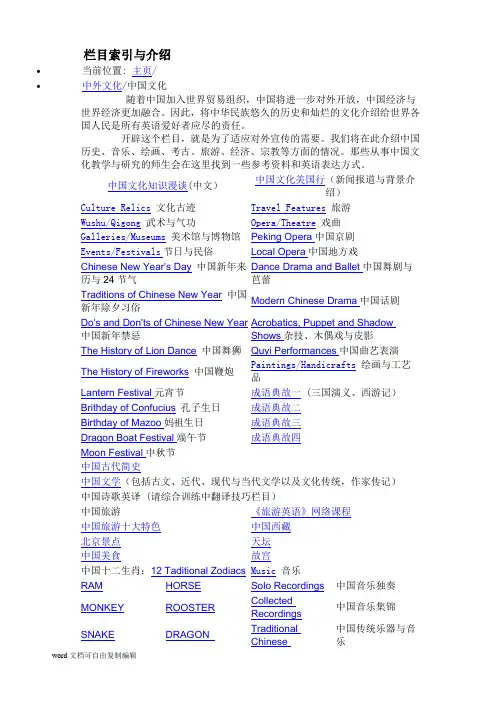
栏目索引与介绍•当前位置: 主页/•中外文化/中国文化随着中国加入世界贸易组织,中国将进一步对外开放,中国经济与世界经济更加融合。
因此,将中华民族悠久的历史和灿烂的文化介绍给世界各国人民是所有英语爱好者应尽的责任。
开辟这个栏目,就是为了适应对外宣传的需要。
我们将在此介绍中国历史、音乐、绘画、考古、旅游、经济、宗教等方面的情况。
那些从事中国文化教学与研究的师生会在这里找到一些参考资料和英语表达方式。
中国文化知识漫谈(中文)中国文化美国行(新闻报道与背景介绍)Culture Relics文化古迹Travel Features旅游Wushu/Qigong武术与气功Opera/Theatre戏曲Galleries/Museums美术馆与博物馆Peking Opera中国京剧Events/Festivals节日与民俗Local Opera中国地方戏Chinese New Year's Day中国新年来历与24节气Dance Drama and Ballet中国舞剧与芭蕾Traditions of Chinese New Year中国新年除夕习俗Modern Chinese Drama中国话剧Do's and Don'ts of Chinese New Year 中国新年禁忌Acrobatics, Puppet and Shadow Shows杂技、木偶戏与皮影The History of Lion Dance中国舞狮Quyi Performances中国曲艺表演The History of Fireworks中国鞭炮Paintings/Handicrafts绘画与工艺品Lantern Festival元宵节成语典故一 (三国演义、西游记)Brithday of Confucius孔子生日成语典故二Birthday of Mazoo妈祖生日成语典故三Dragon Boat Festival端午节成语典故四Moon Festival中秋节中国古代简史中国文学(包括古文、近代、现代与当代文学以及文化传统,作家传记)中国诗歌英译 (请综合训练中翻译技巧栏目)中国旅游《旅游英语》网络课程中国旅游十大特色中国西藏北京景点天坛中国美食故宫中国十二生肖:12 Taditional Zodiacs M usic音乐RAM HORSE Solo Recordings中国音乐独奏MONKEY ROOSTER CollectedRecordings中国音乐集锦SNAKE DRAGON TraditionalChinese中国传统乐器与音乐InstrumentalmusicDOG PIG Classical Music中国古典音乐OX TIGERRABBIT RAT中国文化知识漫谈(一)文化的含义什么叫文化?《易经》上说:“观乎天文,以察时变,观乎人文,以化成天下。

中国文化概论讲解英语Chinese culture is one of the oldest and richest cultures in the world, with a history that spans over 5,000 years. Itis a tapestry of diverse traditions, philosophies, andcustoms that have been shaped by the country's geography, history, and people. This introduction aims to provide an overview of the key elements that make up Chinese culture.Philosophical FoundationsAt the heart of Chinese culture lies a set ofphilosophical teachings that have guided its development. Confucianism, Taoism, and Buddhism are the three main philosophical systems that have influenced Chinese thoughtand behavior.- Confucianism emphasizes moral integrity, social harmony, and filial piety. It has played a significant role in shaping the social structure and ethical standards of Chinese society.- Taoism, or Daoism, is a philosophy that focuses onliving in harmony with the Tao, the natural order of the universe. It advocates for a simple life and a balancebetween seemingly opposite forces.- Buddhism, which originated in India, was introduced to China and has since been integrated with native Chinese beliefs, influencing the spiritual life of many Chinesepeople.Language and LiteratureThe Chinese language is a critical component of Chinese culture. It is characterized by its tonal nature and the use of characters that are pictorial in origin. The language has also given rise to a rich literary tradition, including:- Classical Poetry: A form of expression that captures the essence of the Chinese language's beauty and subtlety.- Prose and Essays: Works that cover a wide range of subjects, from philosophy to daily life.- Novel: The Chinese novel form has produced some of the world's longest and most intricate narratives, such as "Journey to the West" and "Dream of the Red Chamber."Performing ArtsThe performing arts in China are a blend of visual and auditory elements that tell stories and express emotions. Key forms include:- Peking Opera: A traditional form that combines music, vocal performance, mime, dance, and acrobatics.- Music: Traditional Chinese music is often based on the pentatonic scale and uses instruments like the guqin, pipa, and erhu.- Dance: From the elegant fan dances to the energetic dragon dances, Chinese dance is a vibrant part of festivals and celebrations.Visual ArtsChinese visual arts are renowned for their attention to detail and symbolism. Major forms include:- Calligraphy: Considered a high art form, Chinese calligraphy is the art of writing with brush and ink.- Painting: Traditional Chinese paintings often feature landscapes, flowers, birds, and human figures, with an emphasis on the use of space and symbolism.- Ceramics and Pottery: China is famous for its porcelain, particularly from the dynasties of Song, Ming, and Qing.Festivals and CelebrationsChinese festivals are a time for family reunions and cultural traditions. Some of the most important include:- Chinese New Year: The most significant festival,marking the beginning of the lunar new year.- Mid-Autumn Festival: Celebrated with the sharing of mooncakes and appreciating the full moon.- Dragon Boat Festival: Commemorates the life of the poet Qu Yuan and involves dragon boat races and eating zongzi (rice dumplings).CuisineChinese cuisine is diverse and varies by region, but itis generally characterized by its use of fresh ingredients, a wide array of flavors, and a balance of food groups. Staple dishes include:- Peking Duck: A dish from Beijing known for its crispy skin and succulent meat.- Dumplings: Known as jiaozi, these are a staple during Chinese New Year and other celebrations.- Noodles: With countless varieties, noodles are a symbol of longevity and are often served on birthdays.ConclusionChinese culture is a complex and multifaceted entity that has evolved over millennia. It is a culture that values harmony, respect for tradition, and the pursuit of knowledge. As China continues to grow on the global stage, its culture will undoubtedly continue to influence and enrich the world's cultural landscape.This introduction provides a snapshot of the vast and varied landscape of Chinese culture. It is important to notethat this is only a brief overview and that the depth and richness of Chinese culture warrant further exploration and study.。