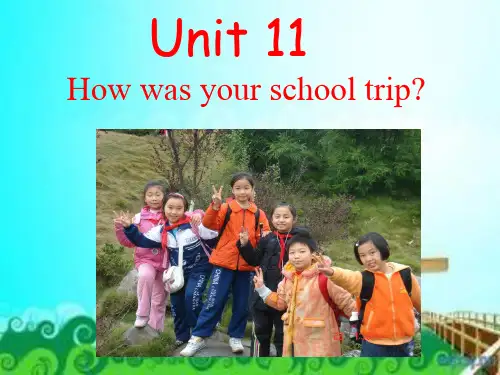
Unit 11 . How was your school tripSection B 2
- 格式:ppt
- 大小:931.50 KB
- 文档页数:21


Unit 11 How was your school trip全单元教案教学设计Unit 11: How Was Your School Trip?XXX Language:How was your school trip?It was great.Did you go to the zoo?Yes。
I did。
/ No。
I XXX't.Were the strawberries good?Yes。
they were.Words。
Phrases。
and Sentences:Regular verbsIrregular verbsKey XXX:How was your school trip?It was great.Did you go to the zoo?Yes。
I did。
/ No。
I XXX't.XXX/Difficult Points:How to discuss XXX.Structures:Simple past XXXHow nsYes/No ns and short answers Adjectives for nDifficulties:Simple past XXXImportance:Learning how to discuss XXX.XXX:XXXPicturesComputer Assisted n (CAI)ds:Four dsd 1 (n A: 1a-1c):Step 1: Warm-up and Lead-inGreet the students and ask them about their XXX.Hello everyone。
Today we will be discussing recent past events。
Let's start by sharing what we usually do on weekends.Student 1: XXX.Student 2: I usually watch TV.XXX: (pointing to the word "weekend") XXX tell me what this word means?Student: XXX XXX.Student 1: Last XXX。

Unit 11 How was your school trip?1. Target language—How was your school trip? — It was great.—Did you go to the zoo? —Yes , Yes, I did. /No, I didn't.—Were the strawberries? —Yes, they were.words , phrases & sentences. regular verb, irregular verb2. Key sentences—How was your school trip? — It was great.—Did you go to the zoo? —Yes, Yes, I did. /No, I didn't.3. Teaching important / difficult pointsHow to listen to and talk about recent past events.4. StructuresSimple past tense; How questions; Yes/No questions and short answers; Adjectives of description.5. Difficulties Simple past tense.6. Importance How to listen to and talk about recent past events7.Teaching aids A tape recorder. Some picture. CAI.8. Periods Four periods.Period 1 (Section A: 1a-1c)Step I Warming up and lead-inGreet the students and talk about weekend activities with them.T: Hello! Everyone. Today we’ll learn to talk about recent past events. Now first please tell me what you often do on weekends.S1: I often play basketball on weekends.S2: I often watch TV.T: (Point to the word “weekend”) What does this word mean?S: Saturday and Sunday are the weekend.S1: I played basketball last weekend.S2: I cleaned my room last weekend.Step II Talking about the picture (1a)1. Ask the students to match the words with the pictures.Check the answers.T: Look at the picture. What did each person in the picture do?S1: She played tennis.S2: She did homework.2. Ask the students to talk about the picture in 1aT: Now please look at the picture on page 53. Suppose you are Lucy in the picture. What did you do last weekend in Picture a?S1: I went to the movies.T: What did you do last weekend in Picture b?S2: I played soccer / football.T: Please ask and answer in pairsStep III Listening and speaking (1b, 1c)1. Ask the students to listen to the conversation and fill in the blanks in the picture.Check the answers.2. Ask the students to read the conversation in 1c and then make conversations in pairs.Sample conversations:S1: What did you do last weekend, Lucy?S2: On Sunday morning, I played tennis.Ask the students to make their own conversations. Show the following.—What did you / he / she / they do last weekend / last Sunday morning / last Monday / yesterday?—I / We / He / she / They went to the beach / played computer games / did my homework / cleaned my room / went to the movies.Step Ⅳ Homework1. Ask the students to do Exercises 1 & 2 in the workbook.2. Ask the students to learn the new words and expression.教学反思:______________________________________________________________________________ ______________________________________________________________________________ ______________________________________________________________________________ ______Period 2 (Section A: 2a-2d)Step I Revision and lead-inCheck the homework.T: Today we’ll go on talking about the recent past events. We know when we talk about the things we did in the past, we must use the past forms of the verbs. For example: clean→cleaned; visit→visited; look→looked; study→studied; do→did; have→had; go→went. Now read after me these words.Then ask the students what they did last weekend.T: What did you do last weekend?S1: I played football last weekend.S2: I did my homework last weekend.S3: I cleaned my room last weekend.T: Well! What did your brother do last weekend?S4: He watched TV last weekend.S5: He went to the movies last weekend.Step II Listening (2a, 2b)1. Listen to the recording and underline the words.T: OK. Do you know what Carol, Ben and Emma did last weekend? Now let’s li sten to a conversation between a teacher and three students. They will talk abot some of the activities and people, but they will not talk about others. Please under-line the words you hear on the recording.Then check the answers.2. Ask the students to listen and write.Check the answers.3. Ask the students to listen to and repeat the conversation after the recording. Step III Pairwork (2c)1. Ask the students to practice the conversation.Ask the students to read the words repeatedly.Ask the students to ask and answer in pairs.Sample conversations:1) S1: What did you do last weekend?S2: I visited my grandmother.S1: What about your friend, Carol?S2: She went to a bookshop. What did you do?S1: I stayed at home and did some reading.2. Ask the students to make conversations.Step IV GrammarAsk the students to read the sentences in the Grammar Focus and underline the verbs in them.Show the following.What did you do last weekend?I played soccer. We went to the beach. She did her homework. He went to the movie. They played tennis.T: The underlined parts in these sentences are called past form. And in English they formed the simple past tense. The simple past tense is one of the most common tenses in English. We use the simple past to refer to an action in the past that is finished. Step V Homework1. Ask the students to learn more past forms of irregular verbs in the dictionary.2. Ask the students to read a short story and pay attention to the verb forms in the story.教学反思:______________________________________________________________________________ ______________________________________________________________________________ ______________________________________________________________________________ __Period 3 ( Section A: 3a-3c)Step I RevisionAsk the students to complete the part of the story from Cinderella.Check the answers by asking some students to read the part of the story. The students may meet some new words during the reading, ask them to try to guess the meaning. T: As we can see, nearly all the verbs are in past forms in the story. In fact, when we keep diary, we always use the simple past.Step II Lead-inTalk about recent past events with the students.T: Good! Now answer my question: What did you do last weekend?S1: I watched TV at home last weekend.S2: I stayed at home last weekend.S3: I played basketball last weekend.T: Well done, everyone. You did many interesting things. But I stayed at home last weekend. I did much housework. I cleaned my room. I washed my clothes. It was not very good, because I was very tired. Now answer: How was your weekend?Help them answer.Ss: It was great / good / OK...Write down and get the students to read the dialogue:—How was your weekend? —It was great.Step III Reading and speaking (3a)1. Ask the students to describe what each person in each scene did.T: Look at the picture in 3a. Tell me what the person in each scene did.S1: In Picture 1: She went to the beach.S2: In Picture 2: He did his homework and watched TV.S3: In Picture 3: She cleaned her room and studied for the math test.2. Ask the students to read the expressions and the conversations.T: Now please read the expressions above the picture and the conversations in the picture. The second part of each conversation is incomplete. They are listed above the picture. Read them and write the correct number on the blank lines in the speech bubbles to complete the conversations.Then check the answers by asking some students to read the completed conversations. Step IV Pairwork (3b)1. Ask the students to read the conversation in 3b first. And then ask them to make conversations.T: Now practice asking and answering questions about what the people in the pictures did last weekend. Practice in pairs. Use the dialogue as an example. Give the students two minutes to read and make the conversations.A: How was Sarah’s weekend?B: It wasn’t ver y good. She cleaned her room and studied for the math test. Sample conversations:1) S1: How was Tony’s weekend?S2: It was OK. He did his homework and watched TV.2) S3: How was Sa rah’s weekend?S4: It wasn’t very good. She cleaned her room and studied for the math test. Step Ⅴ HomeworkAsk the students to finish the exercises.教学反思:_______________________________________________________________________________ _______________________________________________________________________________ _______________________________________________________________________________ __Period 4 ( Section B: 1a-2c)Step I Revision and lead-inCheck the homework.T: Hi, class! Nice to see you again in a new day. Did you finish your homeworkyesterday?S: Yes, we did.T: Good. Who’d like to show us your answers?Ask some students to read the answers and the story. Key to the homework in Period 3:I. 1. got, yesterday morning 2. didn’t do3. What did, do4. How was5. wasII. went, sat, was, was, opened, was, said, said, said, put on, looked, went, was, was, asked, danced, said, was, forgot, rang, said, ran, lost, was, was, didn’t know, lived, went, said, went, opened, said, said, was, wereThen ask the students the following questions.T: What did your parents do yesterday?S1: My mother did some reading and my father watched TV.S2: My father played computer games and my mother helped me with my English.S3: My parents went to visit one of their old friends.T: OK! Look at the pictures. Could you tell me what Lucy did yesterday?S1: She watched TV yesterday.S2: She cooked at home yesterday.S3: She cleaned the car with her friends yesterday.S4: She studied geography yesterday.Help to answer and read the new word geography.Step II Reading and writing (1a, 1b)1. Ask the students to match the words with the pictures in 1a.T: Jim studied geography yesterday, too. He also did other things. Now open your books and turn to page 56. Look at the pictures in 1a. Read the words and then write the letter of each picture in the blank in front of the correct phrase.Check the answers.T: Right. Now ask and answer in pairs, using the question: What did Jim / Sally do yesterday?Sample conversations:1) S1: What did Jim do yesterday?S2: He did his homework.2) S3: What did Sally do yesterday?S4: She played the guitar.2. Ask the students to draw a happy face or an unhappy face under each picture. Help to answer.S: No. I think doing homework is an unhappy thing.T: What about playing the guitar?S: It’s a happy thing.T: In Picture b, the boy played the guitar. It was fun. The happy face shows it was fun. Now please draw a happy face or an unhappy face under each picture a, c and d.Check the answers.Step III Listening (2a)1. Ask the students to listen to the conversation Sally and Jim and write the answers in the chart.Check the answers.Play the recording and ask the following questions.T: First, what did Sally do last weekend?S1: She stayed at home and did lots of things. She cleaned her room and did her homework. And on Sunday, she went to the library.T: Good. What about Jim? What did Jim do last weekend?S2: He played soccer on Saturday morning. On Sunday afternoon, he went to a movie. On Sunday night, he visited his friend’s house.2. Ask the students to repeat after the recording line by line and try to write them down.T: I will play the recording twice again. First repeat after the recording and then try to write the conversations down.Step IV Pairwork (2b, 2c)1. Ask the students to read the dialogue first. And then make a conversation.2. Ask the students to talk about what they did last weekend.3. Then ask the students to write down what they did last weekend.T: OK. You did very well. Now please write down what you did last weekend. Give the students two or three minutes to write.Step V Homework1. Ask the students to do Exercise 6 in the workbook.2. Ask the students to write something about what they did last week.教学反思:______________________________________________________________________________ ______________________________________________________________________________ ______________________________________________________________________________ ______Period 5 Section B: 3a-3c)Step I Revision and lead-inT: Today we will go on talking about the past events. We’ll learn an article about how kids spent the weekend. Now can you tell me what you did last weekend? Sample answers:S: Last Saturday I wen t to my aunt’s house. There I played computer games with T: Well done. Now look at the pictures and say what they did yesterday morning? S1: Lucy listened to the radio. Tom did some reading. Bill and Bob played soccer, and Jim went to school by bike.T: Oh! Which school did Jim go to?S2: He went to No. 4 Middle School.Write down the new words: No.=number, middle, middle school. Teach to read the new words.T: Which school are you in?S3: We’re in No. 3 Middle School.Step II Reading (3a)1. Ask the students to read the article, and then answer the following questions.1) How many students did their homework or studied?2) Did two kids visit friends?2. Read the article again and circle the activities you like. Underline the activities you don’t like.3. Explain the key and difficult points in the passage.1) spend 花费,度过(1)spend money on sth 花钱买某物(在……上花钱)。