
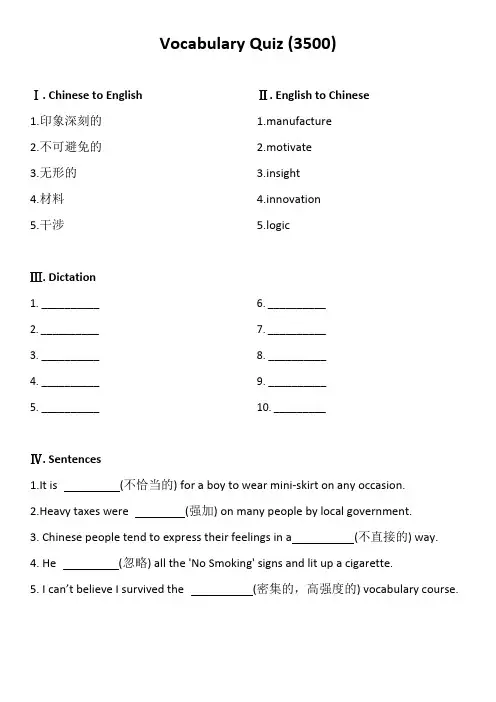
Vocabulary Quiz 16-18
- 格式:docx
- 大小:19.15 KB
- 文档页数:1
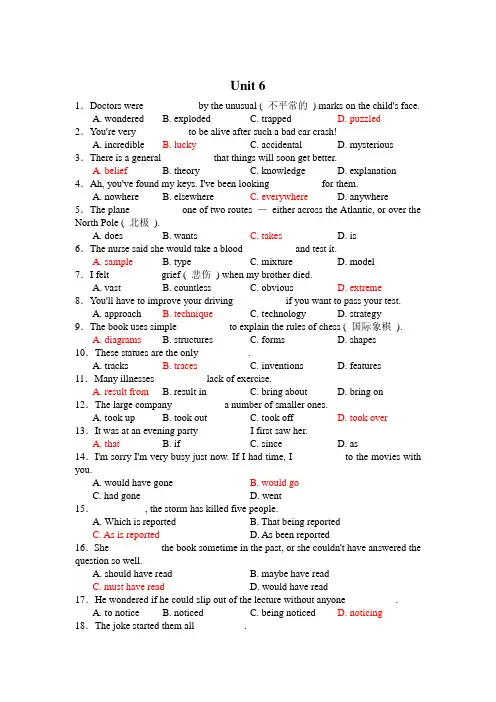
Unit 61.Doctors were __________ by the unusual ( 不平常的) marks on the child's face.A. wonderedB. explodedC. trappedD. puzzled2.You're very __________to be alive after such a bad car crash!A. incredibleB. luckyC. accidentalD. mysterious 3.There is a general __________that things will soon get better.A. beliefB. theoryC. knowledgeD. explanation 4.Ah, you've found my keys. I've been looking __________for them.A. nowhereB. elsewhereC. everywhereD. anywhere 5.The plane __________one of two routes —either across the Atlantic, or over the North Pole ( 北极).A. doesB. wantsC. takesD. is6.The nurse said she would take a blood __________and test it.A. sampleB. typeC. mixtureD. model7.I felt __________grief ( 悲伤) when my brother died.A. vastB. countlessC. obviousD. extreme 8.You'll have to improve your driving __________if you want to pass your test.A. approachB. techniqueC. technologyD. strategy9.The book uses simple __________to explain the rules of chess ( 国际象棋).A. diagramsB. structuresC. formsD. shapes 10.These statues are the only__________.A. tracksB. tracesC. inventionsD. features 11.Many illnesses __________lack of exercise.A. result fromB. result inC. bring aboutD. bring on 12.The large company __________a number of smaller ones.A. took upB. took outC. took offD. took over13.It was at an evening party __________I first saw her.A. thatB. ifC. sinceD. as14.I'm sorry I'm very busy just now. If I had time, I __________to the movies with you.A. would have goneB. would goC. had goneD. went15.__________, the storm has killed five people.A. Which is reportedB. That being reportedC. As is reportedD. As been reported16.She __________the book sometime in the past, or she couldn't have answered the question so well.A. should have readB. maybe have readC. must have readD. would have read17.He wondered if he could slip out of the lecture without anyone__________.A. to noticeB. noticedC. being noticedD. noticing 18.The joke started them all__________.A. laughB. laughedC. laughingD. to laugh 19.He failed the test but promised to do __________better next time.A. moreB. farC. quiteD. so20.I missed the last flight, __________decided to stay the night at the airport.A. thereforeB. and thereforeC. whenD. but whenUnit 51.________ they are doing has never been done before.A. ThatB. WhatC. WhyD. Whether2.________ you disagree with her, she is worth listening to.A. WhetherB. SupposeC. Even ifD. No matter3.________ the time we got to the station, the train had already left.A. ByB. BeforeC. AfterD. Since4.If I hadn't got a cold, I'd be working ________ lying here in bed.A. exceptB. insteadC. besidesD. instead of 5.Trains stop here in order to ________ passengers only.A. get offB. agree onC. deal withD. pick up6.He could not make himself understood because his vocabulary was too ________.A. limitedB. individualC. missingD. lack7.A person who quickly learns and understands has good ________.A. creativityB. institutionC. intelligenceD. brightness 8.There are jobs more dangerous than truck driving; ________ training lions.A. as an instanceB. for instanceC. as instanceD. for an instance9.Haven't you enough ________ sense to know that it's unwise to go swimming just after a big meal?A. commonB. ordinaryC. usualD. general 10.John makes me laugh when he ________ a monkey.A. tumblesB. imitatesC. adoptsD. interacts 11.These plants cannot ________ in very cold conditions.A. surviveB. feedC. blendD. separate 12.The bag was full of precious ________ of different kinds.A. aspectsB. objectsC. subjectsD. features13.I didn't feel very well so I ________ down on the bed and rested for a little while.A. liedB. laidC. layD. lain14.It's perfectly natural that parents feel ________ towards their children, even when they've grown up.A. purposefulB. fierceC. protectiveD. creativeUnit 41.Jim was standing outside the supermarket, ______ a bus.A. waitedB. awaitedC. waitingD. awaiting2.The bus went out of control and ______ against cars and telephone poles.A. crowdedB. crashedC. claspedD. clapped3.I have the ______ to study in the United States for a year. Do you think I should go?A. possibilityB. hesitationC. scheduleD. opportunity 4.______ will be sent to the area as soon as possible.A. AssistantB. AidC. FundD. Helping5.As the boys went down the path they ______ on the wet leaves.A. splashedB. slippedC. skatedD. stressed 6.Kate had ______ returning home on Sunday evening but she couldn't get a flight.A. intendedB. pretendedC. expectedD. thought7.I haven't really had time to ______ everything that she said.A. awaitB. achieveC. listenD. absorb8.He settled back in the ______ of the taxi.A. rareB. rearC. behindD. background 9.Arriving late, they finally ______ at 11:30 when the party was coming to an end.A. put upB. made upC. showed offD. showed up 10.He tried to force me to pay for a bad meal, but I ______ and told him I would not.A. saidB. spoke upC. talkedD. talked upUnit 31.An American diplomat was expelled from the country yesterday.A. trapped inB. forced to leaveC. punished byD. kidnapped by2.It is quite remarkable that no one was hurt in the accident.A. uniqueB. unusualC. specialD. successful3.She does odd jobs, such as painting rooms and fixing cars.A. not regularB. strangeC. excellentD. badly paid4.I applied for a job as a secretary, but I was rejected.A. resentedB. refusedC. resistedD. retired5.This situation does not call for this kind of behavior.A. requireB. takeC. showD. channel6.These tests are beyond the capability of a 12-year-old child.A. securityB. qualityC. abilityD. limitation7.She intends to carry on studying after the course has finished.A. beginB. avoidC. doD. continue8.I've been invited to the party but I haven't got anything appropriate to wear.A. excellentB. adequateC. federalD. suitable9.He refuses to let others speak and dominates every meeting.A. controlsB. winsC. electsD. nominates10.The railways are about to embark on a major program of modernization.A. arrive atB. startC. put onD. expose11.He is reading some medical books because he will have to address a group of doctors.A. write toB. meetC. speak toD. teach12.We stayed in small hotels at night, hitting the road early every morning.A. building the roadB. workingC. waking upD. leaving13.I acknowledged Tom for all his help with the project.A. admittedB. thankedC. provedD. relied on14.The humble man was reluctant to accept the award.A. poorB. famousC. kindD. modestUnit 21.From the way he looked at me, I ____________ that he did not like me.A. includedB. concludedC. consideredD. suggested2.By the way, Tom telephoned to ____________ you about the party on Saturday.A. rememberB. recallC. remindD. repeat3.The airport was foggy ( 有雾的), but our plane ____________ on time.A. turned inB. turned offC. took onD. took off4.I paid for the piano and asked the store to ____________ it to my address in the afternoon.A. deliverB. identifyC. unloadD. delay5.The shops take a lot of trouble over their window ____________ at Christmas.A. groceryB. displaysC. effectsD. style6.The girl was able to give the police a(n) ____________ description of her attacker.A. occasionalB. mentalC. accurateD. accidental7.I shall make up my own mind on the ____________ of the advice I've been given.A. lightB. termC. viewD. basis8.Being a sailor ( 水手) ____________ long periods周期away from home.A. expectsB. affectsC. involves包括D. provides 9.Small ____________ of land ____________ used for keeping animals.A. amount… wasB. amounts… wereC. number… wasD. numbers… were10.I cannot ____________ my family on such a small salary( 薪水).A. offerB. bringC. leadD. support11.The result of the test suggested that I ____________ ill.A. wasB. wereC. beD. to be12.He told me he ____________ his umbrella and asked if I could lend him one.A. had forgotten to bringB. had forgotten bringingC. has forgot to bringD. has forgot bringing13.The teacher described the day's events ____________ detail.A. withB. onC. atD. in14.I had a lot of trouble ____________ the book you wanted.A. to findB. to findingC. findD. findingUnit 11.I rarely ( 不常) drink alcohol —just a(n) ______________ glass of wine.A. regularB. usualC. occasionalD. steady2.I stayed longer than I ______________ intended ( 打算).A. originallyB. firstlyC. obviouslyD. barely3.After all his hard work, he's ______________ to pass his exams.A. evidentB. certainC. apparentD. excellent 4.Thanks for your help. We did ______________ it.A. appreciateB. greetC. respectD. honor5.To use the machine, first ______________ the correct coins then select ( 选择) the drink you want and press the button.A. stickB. insertC. includeD. throw6.The plan didn't really have a ______________ of succeeding.A. luckB. futureC. chanceD. fate7.He ______________ my letter that I sent last month.A. replied toB. repliedC. answered toD. answered for8.We were hoping you could ______________ next Friday.A. drop offB. drop byC. drop onD. drop out9.She ______________ her hair to make sure it was tidy ( 整齐的).A. sortedB. hitC. draggedD. patted10.When you got lost in the forest you ______________ very frightened.A. should have beenB. should beC. must have beenD. must be11.That ______________ the case, we'd better make another plan.A. isB. beingC. to beD. been12.I didn't have much money on me but I gave them ______________ I had.A. oneB. whichC. thatD. what13.I quite like him. I don't like his wife, ______________.A. thoughB. althoughC. yetD. too14.The pale man looked as if he ______________ a ghost ( 鬼).A. was seeingB. sawC. had seenD. should see 15.Fido and Rex played in the park. ______________ wanted to go home.A. None of the dogsB. Neither of the dogC. Neither dogsD. Neither dog。


Test of Lexicology 11. Which of the following words does NOT belong to terminology? ( D )A. Penicillin.B. Algebra.C. Symphony.D. Knife.2. In the sentence “I like to see a movie.”, there are ________ functional words. ( A )A.2B.3C.4D.53. English words can be classified into basic word stock and non-basic word stock by ____C__________.A. originB. level of usageC. frequency of useD. notion4. The English language from 1500 to the present is called _____C______.A. Old EnglishB. Middle EnglishC. Modern EnglishD. Present English5. Which of the following is not a main reason for the frequent appearance of neologisms in English: ( D )A. marked progress of science and technologyB. political and cultural changesC. the influence of other cultures and languagesD. language change6. _____A_______ belong to a relatively small and permanent set of words.A. function wordsB. content wordsC. common wordsD. literary words7. The chief reason for the formation and use of _____B_____ is to secure freshness and novelty.A. technical wordsB. slang wordsC. colloquial wordsD. literary words8. _____A______ are the core of the English vocabulary?A. Native wordsB. Loan wordsC. Literary wordsD. Colloquial words9. The plural morpheme ―-s‖ is realized by /z/ after the following sounds EXCEPT ________. ( A )A./z/B./g/C./d/D./b/10. The word ―recollection‖ comprises ________ morphemes. ( C )A.1B.2C.3D.411. The following words have inflectional affixes EXCEPT ________. ( B )A. worksB. workerC. workingD. worked12. ―Dis-‖ in the word ―disloyal‖ is a ________ prefix. ( A )A. negativeB. reversativeC. pejorativeD. locative13. _____ are bound morphemes because they cannot be used as separate words.( C)A. RootsB. StemsC. AffixesD. Compounds14. Some words in the basic word stock are said to be stable because they _____.( C)A. are complex words.B. are technical wordsC. refer to the commonest things in life.D. denote the most important concepts.15. ______ are those that cannot occur as separate words without adding other morphemes. ( C )A. Free rootsB. Free morphemesC. Bound morphemesD. Meaningful units16. The major factors that promote the growth of modern English are ______.( D)A. the growth of science and technologyB. economic and political changesC. the influence of other cultures and languagesD. all the above17. Which of the following suffixes can be used to form both nouns and adjectives? ( D)A. -ion.B. -ism.C. -ity.D. -ist.18. More often than not, functional words only have ______. ( D)A. lexical meaningB. associative meaningC. collocative meaningD. grammatical meaning19. Which of the following is not an allophone of plurual suffix? ( D )A. /-s/B. /-z/C. /-iz/D. /-æz/20. Both inflectional morpheme and derivational morphemes are ____C______A. suffixesB. prefixesC. bound morphemesD. bound rootsTest of Lexicology 21. Which words belong to the functional words? ( A )A. prepositions, auxiliaries, conjunctionsB. articles, adjectives, pronounsC. adverbs, conjunctions, nounsD. prepositions, auxiliaries, verbs2. _____ are bound morphemes because they cannot be used as separate words.(C)A. RootsB. StemsC. AffixesD. Compounds3. A morpheme that can stand alone as a word is thought to be( C).A.affixational B.derivational C.free D.bound4. A monomorphemic word is a word that consists of a single ( C) morpheme.A. formalB. concreteC. freeD. bound5. Which of the following is NOT true? ( C)A. A word is a sound unityB. A word has a given meaningC. A word is the smallest form of a languageD. A word can be used freely in a sentence6. The following words have derivational affixes Except________. ( D)A. subseaB. prewarC. postwarD. desks7. Which of the following is not a compound? ( D)A. swimming poolB. king-heartedC. greenhouseD. International8. The suffix ―-tion‖ is a ____ suffix. (D)A. adjectiveB. verbC. adverbD. noun9. From the sentences ―Hand in your papers.‖ and ―She papered the room green.‖, we can see such a means of word formation as________. ( C)A. affixationB. compoundingC. conversionD. acronymy10. ―mis-― in ―misunderstand‖ is a ____________ prefix. ( B)A.negative B. pejorative C. reversative D. locative11. Which of the following is not a major word-formation process? ( D )A. CompoundingB. DerivationC. ConversionD. Coinage12. ―Anti-‖ in ―antihero‖ means______. ( B )A. ―against‖B. ―unconventional‖C. ―of or belonging to the hypothetical world of antimatter‖D. ―not‖13. ―-able‖ in ―fashionable‖ is a(an) _____ suffix. ( A)A. denominalB. deadjectivalC. deverbalD. noun-formingII. Complete the following statements with proper words or expressions.1. According to the functions of affixes, we can put them into two groups: inflectional and _derivational__affixes.2. Bound morphemes include two types: bound root and _affixes__.3. Words may fall into _content__words and functional words by notion.4. Generally, prefixes only modify the _lexical __of the stem.5. Sometimes a word may undergo __multiple__ conversion, which enables it to function as a member of several word-classes.6. Affixation can be subdivided into ___ prefixation _ and _ suffixation _.III. Term explanationpounding: It is a word-formation process consisting of joining two or morebases to form a new unit, a compound word.2.Derivation: It is generally defined as a word-formation process by which newwords are created by adding a prefix, or suffix, or both, to the base.3.Conversion: It is a word-formation process whereby a word of a certainword-class is shifted into a word of another word-class without the addition of an affix.4.Word-formation rules: The rules of word-formation define the scope and methodswhereby speakers of a language may create new words.Quiz1. In formal use, ―pot‖ means ―cooking utensil‖. Whereas, when it means―marijuana‖, it is a ______. ( C)A. jargonB. terminologyC. slangD. argot2. There are ______ free morphemic words in the following words:worker, car,impossible,anger, politely. ( A)A. 2B. 3C. 4D. 53. There is/are ______ stem(s)in the word―internationalists‖ ( A )A 1 B. 2 C. 3 D. 44. The past tense marker―-ed‖is pronounced as/t/in the following words EXCEPT______.( A)A. enabledB. workedC. jumpedD. helped5. The most productive ways of word-formation in modern English are the followingEXCEPT ______.( D)A. affixationB. compoundingC. conversionD. blending6. The formation of new words by joining two or more stems is called ______.( B)A. clippingB. compoundingC. acronymyD. back-formation7. The word ―pop‖ belongs to ______ clipping. ( D )A. frontB. backC. front and backD. phrase8. Social, economic and political changes bring about such new words as thefollowing EXCEPT ________. ( C )A. fast foodB. TV dinnerC. tahiniD. Watergate9. The plural morpheme ―-s‖ is realized by /z/ after the following sounds EXCEPT________. ( A)A./z/B./g/C./d/D./b/10. ―Dis-‖ in the word ―disloyal‖ is a ________ prefix. (A)A. negativeB. reversativeC. pejorativeD. locative11. The word ―AIDS‖ is a(n) ________. (B)A. initialismB. acronymC. derivativeD. compound12. The word ―smog‖ is created by blending, with the structure of ________. (A)A. head + tailB. head + headC. head + wordD. word + tail13. Which of the following statement about the classification of words is NOT correct?( D )A. basic word stock and non-basic vocabulary by use frequencyB. content words and functional words by notionC. native words and borrowed words by originD. active words and passive words by formation14. In the word ―reactionist‖, which are bound morphemes except____________.( D)A. reB. ionC. istD. all of the above15. Which of the following underlined affixes is NOT inflectional affix? ( B)A. desk sB. pre warC. hard er. go es16. In the word ―untouchable‖: ―untouch‖ is a(n) ____________. ( C)A. rootB. stemC. baseD. affix17. Which of the following belongs to the word formation of acronym? ( A)A. TOFELB. BBCC. WTOD. CEO18. There are four common types of clipping. The word ―dorm‖ is a ____________word.( B)A. front clippingB. back clippingC. front and back clippingD. phrase clipping19. Which of the following words is a root? (B)A. International.B. Nation.C. National.D. Internationalists.20. ______does not generally change the word-class of the stem but only modifies itsmeaning. (A)A. PrefixationB. SuffixationC. AffixationD. Derivation21. A word is the combination of form and______. (C)A. spellingB. pronunciationC. meaningD. sound22. Grammarians insist that a word be a __________ form that can function in asentence. ( D )A. smallB. largeC. fixedD. free23. ____________consists of technical terms used in particular disciplines and academic areas as in medicine, mathematics, etc. ( A)A. TerminologyB. JargonC. SlangD. Argot24. The development of English vocabulary can be divided into the followingparticular historical period EXCEPT ______. ( C)A. Old EnglishB. Middle EnglishC. New EnglishD. Modern English25. The definition of a word comprises the following points ______ . ( D)(1) a minimal free form of a language(2) a sound unity(3) a unit of meaning(4) a form that can function alone in a sentenceA. (1) and (2)B. (1) (2) and (3)C. (2) (3) and (4)D. (1) (2) (3) and (4)27. In the early period of Modern English, Europe saw a new upsurge of learningancient Greek and ______ classics. This is known in history as the Renaissance.( C)A. IndiaB. GermanC. RomanD. Chinese28. The smallest functioning unit in the composition of words is ______.( A)A. morphemeB. affixesC. rootD. stem29. There is/are ______ monomorphemic word(s) in the following words: hot, dog,feet, matches. ( C )A. 1B. 2C. 3D. 430. The formation of new words by converting words of one class to another class iscalled ______. ( D)A. prefixationB. suffixationC. acronymyD. conversion31. The method of creating words by removing the supposed suffixes is called______. ( A)A. back-formationB. clippingC. blendingD. suffixation32. The symbolic connection between sound and meaning is almost always______.( B)A. motivatedB. arbitraryC. logicalD. unconventional33. There are generally two approaches to the study of words, namely synchronicand______.( C )A. dynamicB. paradigmaticC. diachronicD. syntagmatic34. The popular method of classifying English morphemes is to group them into______ morphemes and ______morphemes.( B)A. derivational, inflectionalB. free, boundC. free, inflectionalD. root, bound35. A______ is the form to which affixes of any kind can be added.( A)A. rootB. stemC. lexemeD. headword36. In English, bound roots are either ______or______ .( C)A. Latin, FrenchB. Greek, ScandinavianC. Latin, GreekD. French, Greek37. The chief function of suffixation is to______ .( A)A. change the word-classB. change the meaning of the stemC. change the semantic function of the stemD. all the above38. Affixation is the formation of words by adding word-forming or ______affixes tostems.( A)A. derivationalB. inflectionalC. boundD. locative39. Back formation is considered to be the opposite process of______.( D)A. prefixationB. compoundingC. clippingD. suffixation40. Words may fall into content words and functional words by ______.(B)A. use frequencyB. notionC. originD. sound41. ______ refers to the specialized vocabularies by which members of particular arts, sciences, trades and professions communicate among themselves. (D)A. TerminologyB. ArchaismsC. SlangD. Jargon42. The word "prisoner" comprises ______ morphemes. (B)A. 1B. 2C. 3D. 443. The following words have derivational affixes EXCEPT ______.(D)A. rereadB. prewarC. bloodyD. harder44. The prefix "over-" in the word "overweight" is a prefix of ______.(B)A. orientation and attitudeB. degree or sizeC. time and orderD. number45. "Champagne", a common noun, comes from a ______.(B)A. name of a personB. name of a placeC. name of a bookD. tradenameII. Analyze and comment on the following. Write your answers in the space given below. (10%)Analyze and comment on the following TWO sentences to illustrate the differences between blending and clipping.The program will be telecast simultaneously to nearly 150 cities.It sounds much better in stereo.Mid-term Exam1. Please illustrate the logical relationships of the following terms: free morphemes,bound root, derivational affixes, affixes, morphemes, inflectional affixes, bound morphemes.Key: The morpheme is the smallest meaningful linguistic unit of language, not divisible or analyzable into smaller forms. Morphemes can be classified in various ways. Morphemes may be classified into free morphemes and bound morphemes.A free morpheme is one that can stand by itself as an independent word while abound morpheme can not be used independently as a word but has to be added to other morphems to form words. Alternatively, morphemes may be divided into roots (or root morphemes) and affixes (or affixational morphemes). A root is the basic unchangeable part of a word, and it conveys the main lexical meaning of the word while affixes are formatives that can be used only when added to another morpheme. Roots can be divided into free root and bound root according to whether it can stand alone to be a word. Affixes may be further divided into inflectional affixes and derivational affixes. An nflectional affix serves to express such meanings as plurality, tense, and the comparative and superlative degree and it does not form a new word when it is added to another word. A derivational affix can be added to other stems to form new words.2. Prefixation and suffixation are two subclasses of affixation. Please define prefixationand suffixation and explain the difference between them. Use ―polite—impolite‖, ―happy—happiness‖ to illustrate your point.Key: Prefixation is the formation of new words by adding a r prefix or combining form to the base. Prefixes modify the meaning of the base. They do not generally alter the word-class of the base. For example, the prefix ―-im‖ is added to “polite”to form a new word ―impolite‖. And suffixation is the formation of a new word by adding a suffix or a combining form to the base, and usually changing the word –class of the base. For example, the suffix ―-ness‖ is added to the adjective ―happy‖ to form a new noun ―happiness‖.3. Comment on the following groups of words to illustrate types of meaning of wordsand their relationship.Group 1: ―took, taught, became‖Group 2: ―have, has, had, had, having‖Key: Word meaning is made up of various components which are interrelted and interdependent. These components are commonlly descrbed as types of meaning. Two main types of meanings are grammatical and lexical meanings. Grammatical meaning consists of word-class and inflectional paradigm. Grammatical meaning is the same in identical sets of individual forms of different words. For example, in Group1, ―took‖, ―taught‖and ―became‖are all in the form of past tense, so they have the same grammatical meaning. While the forms in Group 2 are in different word forms, so they have different grammatical meanings. Lexical meaning is the component of meaning proper to the word as a lexical item. The lexical meaning of a word is the same in all the forms of one and the same word, so the forms in Group 2 have thesame lexical meaning. But the different words in Group 1 have different lexical meanings although they share the same grammatical meaning.4. Analyze and comment on three adjectives used in the following sentences based onsynonym difference in connotation.[A] Look at that little boy.[B] Look at that small boy.[C] Look at that tiny boyKey: A synonym is a word have that same meaning as another word: as one of two or more words of the same language and grammatical category having the same essential or generic meaning and differing only in connotation, application, or idiomatic use. There are two types of synonyms, complete synonyms and relative synonyms. Complete synonyms are fully identical and interchangeable in any circumstance but complete synonyms are rare in English. Relative synonyms differ from in their degree of certain quality, affective meaning, stylistic meaning, collocation or distribution, or so. In above three sentences we can find three synonyms ―little‖, ―small‖ and ―tiny‖. ―little‖has affective meaning, so ―the little boy‖ indicat es sympathy, while ―small‖and ―tiny‖ have no affective meaning. But ―tiny‖ differs from the other two in degree of the quality ―being not big‖, and it means very small in size or amount. So ―that tiny boy‖ means ―the boy is especially small‖.5. The basic form of English negative prefix in- is [in-], as in inaccurate and insecure.In impossible, [n] is changed to match the place of articulation of its following stop [p]. In illiterate, [n] becomes identical to its following [1]. Which phonological rule does this example illustrate? Please define the rule and give one more example.Key: This example illustrates the assimilation rule. The assimilation rule assimilates one sound to another by ―copying‖ a feature of a sequential phoneme, thus making the two phones similar. We know that in English the prefix ―in-―can be added to an adjective to make the meaning of the word negative, e.g. discreet----indiscreet, correct----incorrect. But the [n] sound in the prefix ―in-― is not always pronounced as an alveolar nasal. It varies according to the sound following the ―in-―. For examples, ―in-―in ―incorrect‖is pround as a velar sound because it occurs before the velar sound /k/ but the ―in-― in ―impossible‖ is pronounced [m] because it occurs befor a bilabial sound /m/. Another example is ―un-― in ―unlucky‖ is pronounced [︿n], but ―un-― in ―unpacking‖ is pronounced as [m].。

初中英语教学与评估词组汇总Ah, the hallowed halls of middle school English – a place where grammar meets giggles, and vocabulary takes a vacation to Verbland. Let's dive into a lexicon of laughter, a glossary of guffaws, and compile a list of phrases that'll make your students say, "Eureka, that's the ticket!"1. Noun-tastic Adventures: When your students learn thata noun is a person, place, thing, or idea, they'll be nodding their heads like bobbleheads on a bumpy road.2. Verbal Volleyball: Teach verbs by turning it into a game. "I run, you run, he/she/it runs – let's run through the verb tense together!"3. Adjective Avenue: Where every student becomes a detective, searching high and low for clues on how to describe their world in colorful, creative ways.4. Adverbial Antics: The place where words like "quickly" and "happily" jump in to modify verbs, making sentences as lively as a playground at recess.5. Pronunciation Palooza: A pronunciation party where every "th" sound is a treat and "ough" is a tough cookie to crack.6. Preposition Parade: A march through "on," "at," "in,"and "under" – because every sentence needs a good sense of direction.7. Plural Playground: The fun part where we add "s" or "es" to words and watch them multiply like rabbits in an English sentence.8. Conjunction Connection: Where "and," "but," and "or" play matchmaker, linking ideas together in a beautiful, grammatical union.9. Interjection Island: A place where "Wow!" "Oh no!" and "Yay!" live – the words that make sentences exclaim, shout, and cheer.10. Contraction Corner: The cozy spot where words like "don't" and "can't" snuggle up to save space and look oh-so-chic.11. Tense Tower: A skyscraper of verb tenses where students learn to travel through time, from past to present and beyond with "will" and "have."12. Punctuation Party: A celebration of commas, periods, and question marks – the confetti of the written word.13. Sentence Surgery: The operating room for sentence structure, where fragments are fixed and run-ons are stitched together.14. Idiom Intensive Care: A recovery ward for phraseslike "break a leg" and "raining cats and dogs" – because sometimes English is just plain sick.15. Vocabulary Vault: A treasure trove of words where "serendipity" and "quixotic" hang out, waiting to be discovered.16. Reading Roundup: A rodeo of comprehension, where every paragraph is a bronco and every question a lasso.17. Writing Workshop: The craft fair of sentences and paragraphs, where students build their writing skills from the ground up.18. Grammar Giggles: A comedy club where misplaced modifiers and subject-verb disagreements are the punchlines.19. Assessment Adventure: The quest for understanding, where quizzes and tests are the dragons to be slayed with knowledge and a 2 pencil.20. Feedback Fiesta: A celebration of improvement, where corrections are confetti and progress is the piñata.So, there you have it – a smorgasbord of educational euphoria, a cornucopia of classroom comedy, and a veritable vocabulary vaudeville. Your middle school English class will be the talk of the town, and your students will be the stars of the show. Remember, teaching is a stage, and every student's a player in the grand drama of language learning. Curtain up!。