
信号与系统奥本海姆英文版课后答案chapter1
- 格式:doc
- 大小:1.51 MB
- 文档页数:29
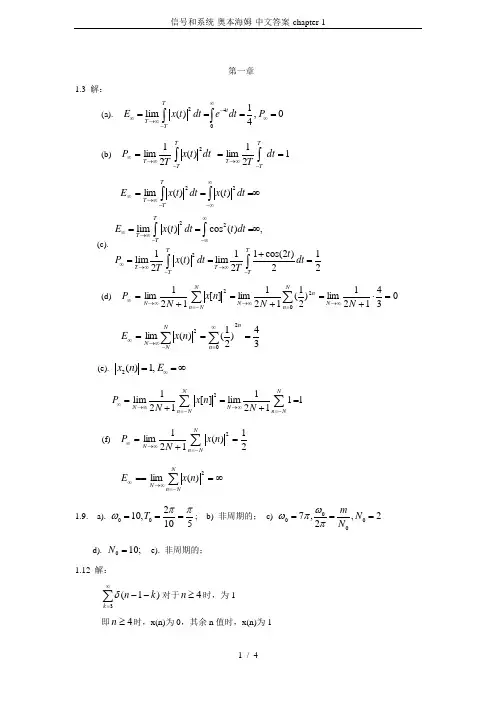
信号与系统奥本海姆英文版课后答案chapter1Chapter 1 Answers1.1 Converting from polar to Cartesian coordinates:111cos 222j e ππ==-111cos()222j e ππ-=-=- 2cos()sin()22jj j e πππ=+= 2cos()sin()22jj j e πππ-=-=- 522jjj e e ππ==4)sin())144jj j πππ+=+9441jjjππ=-9441jjj ππ--==-41jjπ-=- 1.2 converting from Cartesian to polar coordinates:55j e =, 22j e π-=, 233jj e π--=212je π--=,41jj π+=, ()2221jj e π-=- 4(1)j j e π-=, 411jj eπ+=-12eπ-=1.3. (a)E ∞=4014tdt e∞-=⎰,P ∞=0, because E ∞<∞(b)(2)42()j t t x eπ+=,2()1t x =.Therefore,E ∞=22()dt t x +∞-∞⎰=dt+∞-∞⎰=∞,P ∞=211lim lim222()TTTTT T dt dt T Tt x --→∞→∞==⎰⎰lim11T →∞=(c) 2()t x =cos(t). Therefore, E ∞=23()dtt x +∞-∞⎰=2cos()dtt +∞-∞⎰=∞,P ∞=2111(2)1lim lim 2222cos()TTT TT T COS t dt dt TTt --→∞→∞+==⎰⎰(d)1[][]12nn u n x =⎛⎫ ⎪⎝⎭,2[]11[]4nu n n x =⎛⎫ ⎪⎝⎭. Therefore,E ∞=24131[]4nn n x +∞∞-∞===⎛⎫∑∑ ⎪⎝⎭P ∞=0,because E∞<∞.(e) 2[]n x =()28n j eππ-+, 22[]n x =1. therefore,E ∞=22[]n x +∞-∞∑=∞,P ∞=211lim lim 1122121[]NNN N n Nn NN N n x →∞→∞=-=-==++∑∑.(f)3[]n x =cos 4nπ⎛⎫ ⎪⎝⎭. Therefore,E ∞=23[]n x +∞-∞∑=2cos()4n π+∞-∞∑=2cos()4n π+∞-∞∑,P ∞=1limcos 214nNN n NN π→∞=-=+⎛⎫∑ ⎪⎝⎭1cos()112lim ()2122NN n Nn N π→∞=-+=+∑1.4. (a) The signal x[n] is shifted by 3 to the right.The shifted signal will be zero for n<1, And n>7. (b) The signal x[n] is shifted by 4 to the left. The shifted signal will be zero for n<-6. And n>0.(c) The signal x[n] is flipped signal will be zero for n<-1 and n>2.(d) The signal x[n] is flipped and the flipped signal is shifted by 2 to the right. The new Signal will be zero for n<-2 and n>4.(e) The signal x[n] is flipped and the flipped and the flipped signal is shifted by 2 to the left.This new signal will be zero for n<-6 and n>0. 1.5. (a) x(1-t) is obtained by flipping x(t) and shifting the flipped signal by 1 to the right.Therefore, x (1-t) will be zero for t>-2.(b) From (a), we know that x(1-t) is zero for t>-2. Similarly, x(2-t) is zero for t>-1,Therefore, x (1-t) +x(2-t) will be zero for t>-2. (c) x(3t) is obtained by linearly compression x(t) by a factor of 3. Therefore, x(3t) will be zero for t<1.(d) x(t/3) is obtained by linearly compression x(t) by a factor of 3. Therefore, x(3t) will be zero for t<9.1.6 (a) x 1(t ) is not periodic because it is zero for t<0.(b) x 2[n ]=1 for all n. Therefore, it is periodic with a fundamental period of 1.(c) x 3Therefore, it is periodic with a fundamental period of 4. 1.7. (a)()1[]vn x ε={}1111[][]([][4][][4])22n n u n u n u n u n x x +-=--+---- Therefore, ()1[]vn x εis zero for 1[]n x >3.(b) Since x 1(t ) is an odd signal, ()2[]vn x ε is zero for all values of t.(c) (){}11311[][][][3][3]221122vn nn n n u n u n xxxε-⎡⎤⎢⎥=+-=----⎢⎥⎢⎥⎣⎦⎛⎫⎛⎫ ⎪ ⎪⎝⎭⎝⎭Therefore, ()3[]vn x ε is zero when n <3 and whenn →∞.(d) ()1554411()(()())(2)(2)22vt tt t t u t u t x x x e e ε-⎡⎤=+-=---+⎣⎦ Therefore, ()4()vt x εis zero only when t →∞.1.8. (a) ()01{()}22cos(0)tt t x e πℜ=-=+l (b) ()02{()}2cos()cos(32)cos(3)cos(30)4tt t t t x e ππℜ+==+l (c) ()3{()}sin(3)sin(3)2ttt t t x e e ππ--ℜ=+=+l(d) ()224{()}sin(100)sin(100)cos(100)2tttt t t t x ee eππ---ℜ=-=+=+l1.9. (a) 1()t x is a periodic complex exponential. 101021()j tj t t j x e e π⎛⎫+ ⎪⎝⎭==--41-0- 1 1 1 -n (5)…x(b) 2()t x is a complex exponential multiplied by a decaying exponential. Therefore,2()t x is not periodic.(c )3[]n x is a periodic signal. 3[]n x =7j ne π=j ne π.3[]n x is a complex exponential with a fundamental period of 22ππ=.(d) 4[]n x is a periodic signal. The fundamentalperiod is given by N=m(23/5ππ) =10().3m By choosing m=3. We obtain thefundamental period to be 10.(e) 5[]n x is not periodic. 5[]n x is a complexexponential with 0w =3/5. We cannot find any integer m such that m(02wπ ) is also an integer.Therefore, 5[]n x is not periodic.1.10. x (t )=2cos(10t +1)-sin(4t-1)Period of first term in the RHS =2105ππ=. Period of first term in the RHS =242ππ= .Therefore, the overall signal is periodic with aperiod which the least commonmultiple of the periods of the first and second terms. This is equal to π . 1.11. x[n] = 1+74j n e π−25j n e πPeriod of first term in the RHS =1.Period of second term in the RHS =⎪⎭⎫ ⎝⎛7/42π=7 (whenm=2)Period of second term in the RHS =⎪⎭⎫ ⎝⎛5/22ππ=5 (when0 --- 1 2 3 X[n ] n Figure S1.121 0 -12 1 0 -t 1-g ( 2 -3 -3 t x (m=1)Therefore, the overall signal x[n] is periodic with a period which is the least commonMultiple of the periods of the three terms inn x[n].This is equal to 35.1.12. The signal x[n] is as shown in figure S1.12. x[n] can be obtained by flipping u[n] and thenShifting the flipped signal by 3 to the right. Therefore, x[n]=u[-n+3]. This implies that M=-1 and no=-3.1.13y (t)= ⎰∞-tdt x )(τ =dt t))2()2((--+⎰∞-τδτδ=⎪⎩⎪⎨⎧>≤≤--<2,022,12,0,t t t Therefore⎰-==∞224dt E1.14 The signal x (t) and its derivative g (t) are shown inFigure S1.14.Therefore∑∑∞-∞=∞-∞=----=k k k t k t t g 12(3)2(3)(δδ)This implies that A 1=3, t 1=0, A 2=-3, and t 2=1.1.15 (a) The signal x 2[n], which is the input to S 2, is the same as y 1[n].Therefore ,y 2[n]= x 2[n-2]+21 x 2[n-3] = y 1[n-2]+ 21 y 1[n-3] =2x 1[n-2] +4x 1[n-3] +21( 2x 1[n-3]+ 4x 1[n-4])=2x 1[n-2]+ 5x 1[n-3] + 2x 1[n-4] The input-output relationship for S isy[n]=2x[n-2]+ 5x [n-3] + 2x [n-4](b) The input-output relationship does not change if the order in which S 1and S 2are connected series reversed. . We can easily prove this assuming that S 1follows S 2. In this case , the signal x 1[n], which is the input to S 1 is the same as y 2[n].Therefore y 1[n] =2x 1[n]+ 4x 1[n-1]= 2y 2[n]+4y 2[n-1]=2( x 2[n-2]+21 x 2[n-3] )+4(x 2[n-3]+21 x 2[n-4]) =2 x 2[n-2]+5x 2[n-3]+ 2 x 2[n-4]The input-output relationship for S is once againy[n]=2x[n-2]+ 5x [n-3] + 2x [n-4]1.16 (a)The system is not memory less because y[n] depends on past values of x[n].(b)The output of the system will be y[n]= ]2[][-n n δδ=0(c)From the result of part (b), we may conclude that the system output is always zero for inputs of the form ][k n -δ, k ∈ ґ. Therefore , the system is not invertible .1.17 (a) The system is not causal because the output y(t) at some time may depend on future values of x(t). For instance , y(-π)=x(0).(b) Consider two arbitrary inputs x 1(t)and x 2(t).x 1(t) →y 1(t)= x 1(sin(t))x 2(t) → y 2(t)= x 2(sin(t))Let x 3(t) be a linear combination of x 1(t) and x 2(t).That is , x 3(t)=a x 1(t)+b x 2(t)Where a and b are arbitrary scalars .If x 3(t) is the input to the given system ,then the corresponding output y 3(t) is y 3(t)= x 3( sin(t))=a x 1(sin(t))+ x 2(sin(t))=a y 1(t)+ by 2(t)Therefore , the system is linear.1.18.(a) Consider two arbitrary inputs x 1[n]and x 2[n].x 1[n] → y 1[n] =][001k x n n n n k ∑+-=x 2[n ] → y 2[n] =][02k x n n n n k ∑+-=Let x 3[n] be a linear combination of x 1[n] and x 2[n]. That is :x 3[n]= ax 1[n]+b x 2[n]where a and b are arbitrary scalars. If x 3[n] is the input to the given system, then the corresponding output y 3[n] is y 3[n]= ][03k x n n n n k ∑+-==])[][(21k bx k ax n n n n k +∑+-==a ][01k x n n n n k ∑+-=+b ][02k x n n n n k ∑+-== ay 1[n]+b y 2[n]Therefore the system is linear.(b) Consider an arbitrary input x 1[n].Lety 1[n] =][01k x n n n n k ∑+-=be the corresponding output .Consider a second input x 2[n] obtained by shifting x 1[n] in time:x 2[n]= x 1[n-n 1]The output corresponding to this input isy 2[n]= ][002k x n n n n k ∑+-== ]n [1100-∑+-=k x n n n n k = ][01011k x n n n n n n k ∑+---=Also note that y 1[n- n 1]= ][01011k x n n n n n n k ∑+---=.Therefore , y 2[n]= y 1[n- n 1] This implies that the system is time-invariant. (c) If ][n x <B, then y[n]≤(2 n 0+1)B. Therefore ,C ≤(2 n 0+1)B.1.19 (a) (i) Consider two arbitrary inputs x 1(t) and x 2(t). x 1(t) → y 1(t)= t 2x 1(t-1)x2(t) →y2(t)= t2x2(t-1)Let x3(t) be a linear combination of x1(t) andx2(t).That is x3(t)=a x1(t)+b x2(t)where a and b are arbitrary scalars. If x 3(t) is the input to the given system, then the corresponding output y3(t) is y3(t)= t2x3(t-1)= t2(ax1(t-1)+b x2(t-1))= ay1(t)+b y2(t)Therefore , the system is linear.(ii) Consider an arbitrary inputs x1(t).Let y1(t)=t2x1(t-1)be the corresponding output .Consider a second inputx2(t) obtained by shifting x1(t) in time:x2(t)= x1(t-t)The output corresponding to this input is y2(t)=t2x2(t-1)= t2x1(t- 1- t0)Also note that y1(t-t0)=(t-t0)2x1(t- 1- t0)≠y2(t)Therefore the system is not time-invariant.(b) (i) Consider two arbitrary inputs x1[n]and x2[n].x1[n] →y1[n] = x12[n-2]x2[n ]→y2[n] = x22[n-2].Let x3(t) be a linear combination of x1[n]andx2[n].That is x3[n]= ax1[n]+b x2[n]where a and b are arbitrary scalars. If x3[n] is the input to the given system, then the correspondingoutput y3[n] is y3[n] = x32[n-2]=(a x1[n-2] +b x2[n-2])2=a2x12[n-2]+b2x22[n-2]+2ab x1[n-2] x2[n-2]≠ay1[n]+b y2[n] Therefore the system is not linear.(ii) Consider an arbitrary input x1[n]. Let y1[n] =x12[n-2]be the corresponding output .Consider a second inputx2[n] obtained by shifting x1[n] in time:x2[n]= x1[n- n]The output corresponding to this input isy2[n] = x22[n-2].= x12[n-2- n0]Also note that y1[n- n]= x12[n-2-n0 ]Therefore , y2[n]= y1[n- n]This implies that the system is time-invariant.(c) (i) Consider two arbitrary inputs x1[n]and x2[n].x1[n] →y1[n] = x1[n+1]- x1[n-1]x2[n ]→y2[n] = x2[n+1 ]- x2[n -1]Let x3[n] be a linear combination of x1[n] and x2[n].That is :x3[n]= ax1[n]+b x2[n]where a and b are arbitrary scalars. If x3[n] is the input to the given system, then thecorresponding output y3[n] is y3[n]= x3[n+1]- x3[n-1]=ax1[n+1]+b x2[n +1]-a x1[n-1]-b x2[n -1]=a(x1[n+1]-x1[n-1])+b(x2[n +1]- x2[n -1])= ay 1[n]+b y 2[n]Therefore the system is linear.(ii) Consider an arbitrary input x 1[n].Let y 1[n]= x 1[n+1]- x 1[n-1]be the corresponding output .Consider a second input x 2[n] obtained by shifting x 1[n] in time: x 2[n]= x 1[n-n 0]The output corresponding to this input isy 2[n]= x 2[n +1]- x 2[n -1]= x 1[n+1- n 0]- x 1[n-1- n 0] Also note that y 1[n-n 0]= x 1[n+1- n 0]- x 1[n-1- n 0]Therefore , y 2[n]= y 1[n-n 0] This implies that the system is time-invariant.(d) (i) Consider two arbitrary inputs x 1(t) and x 2(t).x 1(t) → y 1(t)= d O {}(t) x 1x 2(t) → y 2(t)= {}(t) x 2d OLet x 3(t) be a linear combination of x 1(t) and x 2(t).That is x 3(t)=a x 1(t)+b x 2(t)where a and b are arbitrary scalars. If x 3(t) is the input to the given system, then the corresponding output y 3(t) is y 3(t)= d O {}(t) x 3={}(t) x b +(t) ax 21d O=a d O {}(t) x 1+b {}(t) x 2d O = ay 1(t)+by 2(t)Therefore the system is linear.(ii) Consider an arbitrary inputs x 1(t).Lety 1(t)= d O {}(t) x 1=2)(x -(t) x 11t -be the corresponding output .Consider a second input x 2(t) obtained by shifting x 1(t) in time:x 2(t)= x 1(t-t 0)The output corresponding to this input isy 2(t)= {}(t) x 2d O =2)(x -(t) x 22t -=2)(x -)t -(t x 011t t --Also note that y 1(t-t 0)=2)(x -)t -(t x 0101t t --≠y 2(t)Therefore the system is not time-invariant. 1.20 (a) Givenx )(t =jte 2 y(t)=tj e 3 x )(t =jt e 2- y(t)=tj e 3- Since the system liner+=t j e t x 21(2/1)(jte 2-) )(1t y =1/2(t j e 3+tj e 3-) Thereforex 1(t)=cos(2t) )(1t y =cos(3t) (b) we know thatx 2(t)=cos(2(t-1/2))= (j e -jte 2+j e jte 2-)/2Using the linearity property, we may once again writex 1(t)=21( j e -jte 2+je jte 2-) )(1t y =(je -jte 3+je jte 3-)= cos(3t-1) Therefore,x 1(t)=cos(2(t-1/2)) )(1t y =cos(3t-1) 1.21.The signals are sketched in figure S1.21. t -0 - 1 2 2 1 3 x(t -1) t 4-1 3 2 1 0 1 2 x ( 10 -1 1 2tx (2tFigure S1.211.22 The signals are sketched in figure S1.221.23 The even and odd parts are sketched in Figure S1.23a 1 1/2 -1/2-1 n7 3 2 1 0 x[3- 0.50.5 t3/2 -3/2 x (4-t1012618 4 1 2 )()]()([t u t x t x -+t 1 0 21 1/2-1/2 -1 n 7 3 2 1 0 x[n (b -11 1/2 -1/2 n 2 1 0 x[3(c 1 -1 2 n 0 x[3n (d 2 1 1 2 n 0 x[n]u[n-(ft-1/2x 0(t)1/2-1 -2 0 21 t1 -1/2x 0(t) 1/2-1 -20 21 -1/2x 0(t) 1/2-1 -2 0 21 tFigure1 1n2 (h-4-1-2 11/2 n20 x[3-n]/2(gx 0(t)-t/2x 0(t)3t/2 -3t/2-01/2 tx 0(t)(a(b7 n 1 0 -xo (10 -1-7 7 -1n x[ 1 (c Figure (c Figure 1/n 1/-7 1 n x e(n 3 (1/0 71/-n x o [35 1 -n x e 03--4 n 1x o1.24 The even and odd parts are sketched in Figure S1.241.25 (a) periodic period=2π/(4)= π/2(b) periodic period=2π/(4)= 2(c) x(t)=[1+cos(4t-2π/3)]/2. periodic period=2π/(4)= π/2(d) x(t)=cos(4πt)/2. periodic period=2π/(4)= 1/2(e) x(t)=[sin(4πt)u(t)-sin(4πt)u(-t)]/2. Not period.(f)Not period.1.26 (a) periodic, period=7.(b) Not period.(c) periodic, period=8.(d) x[n]=(1/2)[cos(3πn/4+cos(πn/4)). periodic, period=8.(e) periodic, period=16.1.27 (a) Linear, stable(b) Not period.(c) Linear(d) Linear, causal, stable(e) Time invariant, linear, causal, stable(f) Linear, stable(g)Time invariant, linear, causal1.28 (a) Linear, stable(b) Time invariant, linear, causal, stable(c)Memoryless, linear, causal(d) Linear, stable(e) Linear, stable(f) Memoryless, linear, causal, stable(g) Linear, stable1.29 (a) Consider two inputs to the system such that[][][]{}111.Se x n y n x n −−→=ℜand [][][]{}221.Sex n y n x n −−→=ℜNow consider a third input x 3[n]= x 2[n]+x 1[n]. The corresponding system outputWill be[][]{}[][]{}[]{}[]{}[][]33121212e e e e y n x n x n x n x n x n y n y n ==+=+=+ℜℜℜℜtherefore, we may conclude that the system isadditiveLet us now assume that inputs to the system such that[][][]{}/4111.Sj ex n y n e x n π−−→=ℜand[][][]{}/4222.Sj ex n y n e x n π−−→=ℜNow consider a third input x 3 [n]= x 2 [n]+ x 1 [n]. The corresponding system output Will be[][]{}()[]{}()[]{}()[]{}()[]{}()[]{}()[]{}[]{}[]{}[][]/433331122/4/41212cos /4sin /4cos /4sin /4cos /4sin /4j e m e m e m e j j e e y n e x n n x n n x n n x n n x n n x n n x n e x n e x n y n y n πππππππππ==-+-+-=+=+ℜℜI ℜI ℜI ℜℜtherefore, we may conclude that the system is additive (b) (i) Consider two inputs to the system such that()()()()211111S dx t x t y t x t dt ⎡⎤−−→=⎢⎥⎣⎦and ()()()()222211S dx t x t y t x t dt⎡⎤−−→=⎢⎥⎣⎦Now consider a third input x 3[t]= x 2[t]+x 1[t]. Thecorresponding system output Will be()()()()()()()()()2333211111211dx t y t x t dt d x t x t x t x t dt y t y t ⎡⎤=⎢⎥⎣⎦⎡⎤+⎡⎤⎣⎦=⎢⎥+⎢⎥⎣⎦≠+therefore, we may conclude that the system is notadditiveNow consider a third input x 4 [t]= a x 1 [t]. The corresponding system output Will be()()()()()()()()2444211211111dx t y t x t dt d ax t ax t dt dx t a x t dt ay t ⎡⎤=⎢⎥⎣⎦⎡⎤⎡⎤⎣⎦=⎢⎥⎢⎥⎣⎦⎡⎤=⎢⎥⎣⎦=Therefore, the system is homogeneous.(ii) This system is not additive. Consider the fowling example .Let δ[n]=2δ[n+2]+2δ[n+1]+2δ[n] and x 2[n]= δ[n+1]+ 2δ[n+1]+ 3δ[n]. The corresponding outputs evaluated at n=0 are[][]120203/2y and y ==Now consider a third input x 3 [n]= x 2 [n]+ x 1 [n].= 3δ[n+2]+4δ[n+1]+5δ[n]The corresponding outputs evaluated at n=0 is y 3[0]=15/4. Gnarly, y 3[0]≠ ]0[][21y y n +.This[][][][][]444442,1010,x n x n x n y n x n otherwise ⎧--≠⎪=-⎨⎪⎩[][][][][][]4445442,1010,x n x n ax n y n ay n x n otherwise ⎧--≠⎪==-⎨⎪⎩Therefore, the system is homogenous.1.30 (a) Invertible. Inverse system y(t)=x(t+4) (b)Non invertible. The signals x(t)andx 1(t)=x(t)+2πgive the same output(c) δ[n] and 2δ[n] give the same output d) Invertible. Inverse system; y(t)=dx(t)/dt(e) Invertible. Inverse system y(n)=x(n+1) for n ≥0 and y[n]=x[n] for n<0(f) Non invertible. x (n) and –x(n) give the same result(g)Invertible. Inverse system y(n)=x(1-n) (h) Invertible. Inverse system y(t)=dx(t)/dt (i) Invertible. Inverse system y(n) = x(n)-(1/2)x[n-1](j) Non invertible. If x(t) is any constant, then y(t)=0(k) δ[n] and 2δ[n] result in y[n]=0(l) Invertible. Inverse system: y(t)=x(t/2)(m) Non invertible x 1 [n]= δ[n]+ δ[n-1]and x 2 [n]= δ[n] give y[n]= δ[n](n) Invertible. Inverse system: y[n]=x[2n]1.31 (a) Note that x 2[t]= x 1 [t]- x 1 [t-2]. Therefore, using linearity we get y 2 (t)=y 1 (t)- y 1 (t-2).this is shown in Figure S1.31(b)Note that x3 (t)= x1 [t]+ x1 [t+1]. .Therefore, using linearity we get Y3 (t)= y1 (t)+ y1 (t+2). this is shown in Figure S1.31 y 2 -2 20 2 4 t0 2 -1 t Figurey 31.32 All statements are true(1) x(t) periodic with period T; y 1 (t) periodic, period T/2(2) y 1 (t) periodic, period T; bx(t) periodic, period2T (3) x(t) periodic, period T; y 2 (t) periodic, period2T (4) y 2(t) periodic, period T; x(t) periodic, period T/2; 1.33(1) True x[n]=x[n+N ]; y 1 (n)= y 1 (n+ N 0)i.e. periodic with N 0=n/2if N is even and with period N 0=n if N is odd.(2)False. y 1 [n] periodic does no imply x[n] is periodic i.e. Let x[n] = g[n]+h[n] where0,1,[][]0,(1/2),nn even n even g n and h n n oddn odd⎧⎧==⎨⎨⎩⎩ Then y 1 [n] = x [2n] is periodic but x[n] is clearly not periodic.(3)True. x [n+N] =x[n]; y 2 [n+N 0] =y 2 [n] where N 0=2N (4) True. y 2 [n+N] =y 2 [n]; y 2 [n+N 0 ]=y 2 [n] where N 0=N/21.34. (a) ConsiderIf x[n] is odd, x[n] +x [-n] =0. Therefore, the given summation evaluates to zero. (b) Let y[n] =x 1[n]x 2[n] .Theny [-n] =x 1[-n] x 2[-n] =-x 1[n]x 2[n] =-y[n].This implies that y[n] is odd. (c)Consider{}1[][0][][]n n x n x x n x n ∞∞=-∞==++-∑∑22[][]eon n n n xx∞∞=-∞=-∞=+∑∑222[][][]eon n n n n n x x x ∞∞∞=-∞=-∞=-∞==+∑∑∑Using the result of part (b), we know that x e [n]x o [n] is an odd signal .Therefore, usingthe result of part (a) we may conclude thatTherefore,(d)ConsiderAgain, since x e (t) x o (t) is odd,Therefore,1.35. We want to find the smallest N 0 such that m(2π /N) N 0 =2πk or N 0 =kN/m,where k is an integer, then N must be a multiple of m/k and m/k must be an integer .this implies that m/k is a divisor of both m and N .Also, if we want the smallest possible N 0, then m/k should be the GCD of m and N. Therefore, N 0=N/gcd(m,N).1.36.(a)If x[n] is periodic 0(),0..2/j n N T o e where T ωωπ+= Thisimplies that22oT kNT k T T Nππ=⇒==a rational number . (b)T/T 0 =p/q then x[n] = 2(/)j n p q e π,The fundamentalperiod is q/gcd(p,q) and the fundmental frequency is2[][]0eon n n x x ∞=-∞=∑222[][][].e on n n n n n xx x ∞∞∞=-∞=-∞=-∞==+∑∑∑222()()()2()().eoet dt t dt t dt t t dt x x x x x ∞∞∞∞-∞-∞-∞-∞=++⎰⎰⎰⎰0()()0.et t dt x x ∞-∞=⎰222()()().e ot dt t dt t dt xx x ∞∞∞-∞-∞-∞=+⎰⎰⎰()()()()()().xyyxt x t y d y t x d t φττττττφ∞-∞∞-∞=+=-+=-⎰⎰ (c) p/gcd(p,q) periods of x(t) are needed . 1.37.(a) From the definition of ().xyt φWe have(b) Note from part(a) that ()().xx xxt t φφ=-This implies that ()xyt φis even .Therefore,the odd part of ().xxt φis zero.(c) Here, ()().xy xx t t T φφ=-and ()().yy xxt t φφ=1.38.(a) We know that /22(2)().t t δδ=V V ThereforeThis implies that1(2)().2t t δδ=(b)The plot are as shown in Figure s3.18. 1.39 We havelim ()()lim (0)()0.u t t u t δδ→→==V V V VAlso,0022gcd(,)gcd(,)gcd(,)gcd(,).T pp q p q p q p q q p q p pωωππ===/21lim (2)lim ().2t t δδ→∞→∞=V V V V 01lim ()()().2u t t t δδ→=V V V u Δ'1 1/2 Δ-Δ/t 0tu Δ12Δ t0 tWe have⎰⎰∞∞∞--=-=0)()()()()(ττδτττδτd t u d t u t gTherefore,0,0()1,00t g t t undefined for t >⎧⎪=<⎨⎪=⎩()0()()()t u t t δττδτδτ-=-=-Q Q1.40.(a) If a system is additive ,then1 1-1/2u Δ'1 Δ-Δ0 tu Δ'1 1/Δ-Δ1/2e -ttu Δ'11/Δ-Δt 0tuΔ'1 1/Δ-Δt 0tFigurealso, if a system is homogeneous,then (b) y(t)=x 2(t) is such a systerm .(c) No.For example,consider y(t) ()()t y t x d ττ-∞=⎰ with ()()(1).x t u t u t =--Then x(t)=0 for t>1,but y(t)=1 for t>1.1.41. (a) y[n]=2x[n].Therefore, the system is time invariant.(b) y[n]=(2n-1)x[n].This is not time-invariant because y[n- N 0]≠(2n-1)2x [n- N 0].(c) y[n]=x[n]{1+(-1)n +1+(-1)n-1}=2x[n].Therefore, the system is time invariant .1.42.(a) Consider two system S 1 and S 2 connected in series .Assume that if x 1(t) and x 2(t) arethe inputs to S 1..then y 1(t) and y 2(t) are the outputs.respectively .Also,assume thatif y 1(t) and y 2(t) are the input to S 2 ,then z 1(t) and z 2(t) are the outputs, respectively . Since S 1 is linear ,we may write()()()()11212,s ax t bx t ay t by t +→+where a and b are constants. Since S 2 is also linear ,we may write()()()()21212,s ay t by t az t bz t +→+We may therefore conclude that)()()()(212121t b t a t b t a z z x x s s +−→−+Therefore ,the series combination of S 1 and S 2 is linear.Since S 1 is time invariant, we may write00.()().00x t y t =→=0()()()()0x t x t y t y t =-→-=()()11010s x t T y t T -→-and()()21010s y t T z t T -→-Therefore,()()121010s s x t T z t T -→-Therefore, the series combination of S 1 and S 2 is time invariant.(b) False, Let y(t)=x(t)+1 and z(t)=y(t)-1.These corresponds to two nonlinear systems. If these systems are connected in series ,then z(t)=x(t) which is a linear system.(c) Let us name the output of system 1 as w[n] and the output of system 2 as z[n] .Then11[][2][2][21][22]24y n z n w n w n w n ==+-+- [][][]241121-+-+=n x n x n xThe overall system is linear and time-invariant.1.43. (a) We have())(t y t x s−→−Since S is time-invariant.())(T t y T t x s-−→−-Now if x (t) is periodic with period T. x{t}=x(t-T). Therefore, we may conclude that y(t)=y(t-T).This implies that y(t) is also periodic with T .A similar argument may be made in discrete time . (b)1.44 (a) Assumption : If x(t)=0 for t<t 0 ,then y(t)=0 for t< t 0.To prove That : The system is causal.Let us consider an arbitrary signal x 1(t) .Let usconsider another signal x 2(t) which is the same as x 1(t)for t< t 0. But for t> t 0 , x 2(t) ≠x 1(t),Since thesystem is linear,()()()()1212,x t x t y t y t -→-Since ()()120x t x t -=for t< t 0 ,by our assumption =()()120y t y t -=for t< t 0 .This implies that ()()12y t y t =for t< t 0 . In other words, t he output is not affected by input values for 0t t ≥. Therefore, the system is causal .Assumption: the system is causal . To prove that :If x(t)=0 for t< t 0 .then y(t)=0 for t< t 0 .Let us assume that the signal x(t)=0 for t< t 0 .Then we may express x(t) as ()()12()x t x t x t =-,Where ()()12x t x t = for t< t 0 . the system is linear .the output to x(t) will be ()()12()y t y t y t =-.Now ,since the system is causal . ()()12y t y t = for t< t 0 .implies that ()()12y t y t = for t< t 0 .Therefore y(t)=0 for t< t 0 .(b) Consider y(t)=x(t)x(t+1) .Now , x(t)=0 for t< t 0 implies that y(t)=0 for t< t 0 .Note that the system is nonlinear and non-causal .(c) Consider y(t)=x(t)+1. the system is nonlinear and causal .This does not satisfy the condition of part(a). (d) Assumption: the system is invertible. To prove that :y[n]=0 for all n only if x[n]=0 for all n . Consider[]0[]x n y n =→. Since the system is linear :2[]02[]x n y n =→. Since the input has not changed in the two above equations ,we require that y[n]=2y[n].This implies that y[n]=0. Since we have assumed that the system is invertible ,only one input could have led to this particular output .That input must be x[n]=0 .Assumption: y[n]=0 for all n if x[n]=0 for all n . To prove that : The system is invertible . Suppose that11[][]x n y n → and21[][]x n y n →Since the system is linear ,1212[][][][]0x n x n y n y n -=→-=By the original assumption ,we must conclude that 12[][]x n x n =.That is ,any particular y 1[n] can be produced that by only one distinct input x 1[n] .Therefore , the system is invertible. (e) y[n]=x 2[n].1.45. (a) Consider ,()111()()shx x t y t t φ→= and()222()()shx x t y t t φ→=.Now, consider ()()()312x t ax t bx t =+. The corresponding system output will be()()12331212()()()()()()()()()hx hx y t x h t d a x h t d b x t h t d a t b t ay t by t ττττττττφφ∞-∞∞∞-∞-∞=+=+++=+=+⎰⎰⎰Therefore, S is linear .Now ,consider x 4(t)=x 1(t-T).The corresponding systemoutput will be。

![信号与系统_第二版_奥本海默 _课后答案[1-10章]](https://imgs-1438308264.cos.ap-hongkong.myqcloud.com/6ff45c8f83c4bb4cf6ecd112.webp)
