被动语态
- 格式:doc
- 大小:63.50 KB
- 文档页数:6
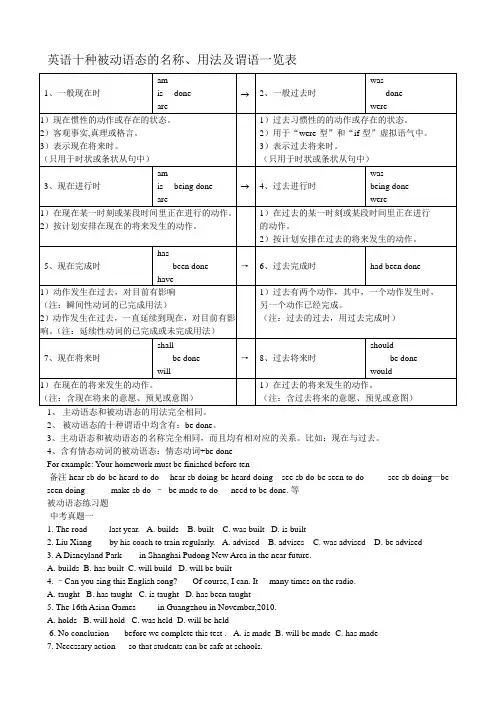
被动语态 一、语态概述 英语中有两种语态:主动语态和被动语态。 主动语态表示主语是动作的执行者。巧记为:主动、主动、主去动。 例如:Many people speak English. 谓语:speak的动作是由主语many people来执行的。 被动语态表示主语是动作的承受者,即行为动作的对象。巧记为:被动、被动、主被动。 例如:English is spoken by many people.主语English是动词speak的承受者。 例如:He opened the door.他开了门。(主动句) The door was opened.门被开了。(被动句) 二、被动语态的构成 被动语态由“助动词be+及物动词的过去分词”构成。人称、数和时态的变化是通过be的变化表现出来的。现以teach为例说明被动语态在各种时态中的构成。 一般现在时:am/is/are+taught 一般过去时:was/were+taught 一般将来时:will/shall be+taught am/ is/ are going to be+taught 现在进行时:am/is/are being+taught 过去进行时:was/ were being+taught 现在完成时:have/has been+taught 歌诀是:被动语态be字变,过去分词跟后面。 三、被动语态的用法 (1)不知道或没有必要说明动作的执行者是谁。 例如:Some new computers were stolen last night. 一些新电脑在昨晚被盗了。(不知道电脑是谁偷的) This book was published in 1981.这本书出版于1981年。 (2)强调动作的承受者,而不强调动作的执行者。 例如:the window was broken by Mike.窗户是迈克打破的。 This book was written by him.这本书是他写的。 Eight hours per day for sleep must be guaranteed.每天8小时睡眠必须得到保证。 歌诀:谁做的动作不知道,说出谁做的没有必要; 动作承受者需强调,被动语态运用到。 四、主动语态变被动语态的方法 (1)把主动语态的宾语变为被动语态的主语。 (2)把谓语变成被动结构(be+过去分词) (根据被动语态句子里的主语的人称和数,以及原来主动语态句子中动词的时态来决定be的形式)。 (3)把主动语态中的主语放在介词by之后作宾语,将主格改为宾格。例如: All the people laughed at him. He was laughed at by all people. They make the bikes in the factory. The bikes are made by them in the factory. 歌诀是:宾变主,主变宾,by短语后面跟。 谓语动词变被动,be后“过分”来使用。 五、含有情态动词的被动语态 由“情态动词+be+过去分词”构成,原来带to的情态动词变成被动语态后“to”仍要保留。 歌诀是:情态动词变动,情态加be加“过分”,原来带to要保留。例如: We can repair this watch in two days. This watch can be repaired in two days. You ought to take it away. It ought to be taken away. They should do it at once. Should it be done at once? 六 含有复合宾语的主动句变为被动句 有些动词后面可以跟“宾语+补足语”结构,这种结构被称作复合宾语。含复合宾语的主动结构变为被动结构时,只将主动结构中的宾语变为被动结构中的主语,宾语补足语保留不动,这时它就成了主语补足语。 ①行为动词 They advised her to take the medicine. (active voice)他们劝她吃这种药。 →She was advised to take the medicine. (passive voice)她被劝告吃这种药。 They named the boy John. (active voice)他们给这男孩取名约翰。 →The boy was named John. (passive voice)这男孩被取名为约翰。 We found him working in the factory. (active voice)我们发现他正在工厂干活。 →He was found working in the factory. (passive voice)他被发现正在工厂干活。 ②感官动词和使役动词跟不定式作宾补时 在主动句中,动词不定式做感官动词(see, watch, hear等)和使役动词(make ,have)的宾语补足语,通常省去动词不定式符号to。但改为被动结构后,要把省略了to再加上。 They made him go there alone. 他们让他自己去那里。 →He was made to go there alone. 他被迫自己去那里。 I saw him cross the road and enter the bank. 我看到他穿过马路到银行去了。 →He was seen to cross the road and enter the bank. 有人看见他穿过马路到银行去了。 注意:动词是let时,其被动结构中不定式仍不带to。 They let John go.他们让约翰走。 →John was let go. 约翰不得不走。 (3)含有双宾语的主动句变为被动句 ①直接宾语是名词、代词时 有些动词(give, tell, buy等)在句中做谓语时可有两个宾语(直接宾语和间接宾语),又称双宾语。含双宾语的主动结构变为被动结构时,可以将其中一个宾语变为主语,另一个保留不动。一般是将主动结构的间接宾语变为被动结构的主语。当直接宾语变为被动结构的主语时,间接宾语前应加介词to(有时可以省去)或for。 She gave me the book.(active voice)她给了我这本书。 →I was given the book.(passive voice)有人送给我一本书 →The book was given to me. (passive voice)。这本书是别人送的。 My mother gave me a pencil.妈妈送给了我一支铅笔。 →I was given a pencil by my mother.我妈妈给了我一支铅笔。 →A pencil was given(to)me by my mother. (介词to可以省略)这支铅笔是妈妈给的。 Father bought me a new coat.爸爸给我买了一件新上衣。 →I was bought a new coat. 有人给我买了一件新上衣。 →A new coat was bought for me. (介词for不可省略)这件新上衣是别人给我买的。 注意:被动句中两个间接宾语对比时,其前的介词to不可省略。 This apple is given to me, not to you. 这个苹果是给我的,不是给你的。 ②直接宾语是从句时 如果直接宾语是从句时,一般只能构成以间接宾语为主语的被动句。 Someone told me where the accident had happened. (passive voice)有人告诉我事故是在何处发生的。 →I was told where the accident had happened. (passive voice)我被告知事故在何处发生。 He asked me whether the meeting was to be put off. 他问我会议是否推迟。 →I was asked whether the meeting was to be put off. 有人问我是否要推迟会议。 (4)带宾语从句的主动句换为被动句 ①带宾语从句的主动句换为被动句时,通常用it作为被动结构的形式主语。 Nobody knew whether there was gold left in the mine.(active voice)无人知道矿中是否还有黄金。 →It was not known whether there was gold left in the mine. ( passive voice)矿中是否还有黄金无人知道。 We believed that he was ill.我们相信他病了。 →It was believed that he was ill. 都相信他病了。 ②带宾语从句的主动句换为被动句时,可以改为不定式结构 He said the play was very interesting. 他说这台戏剧很有趣。 →The play was said to be very interesting. 据说这台戏剧很有趣。 He reported that they had finished the project. 他报道说,他们已经完成了工程。 They were reported to have finished the project. 据报道,他们已经完成了工程。