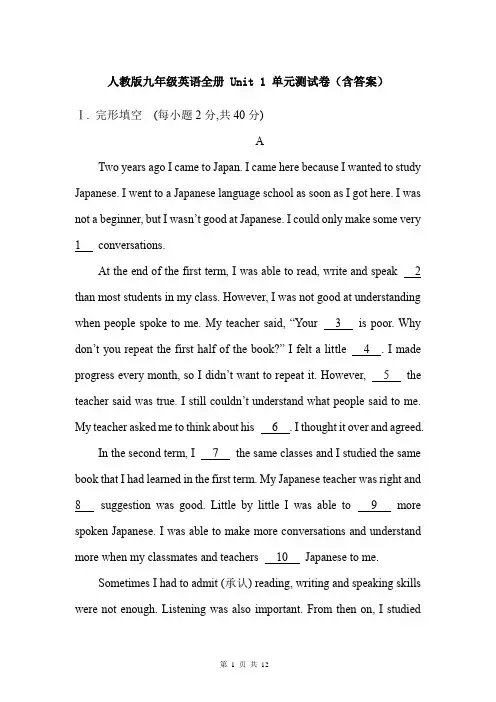
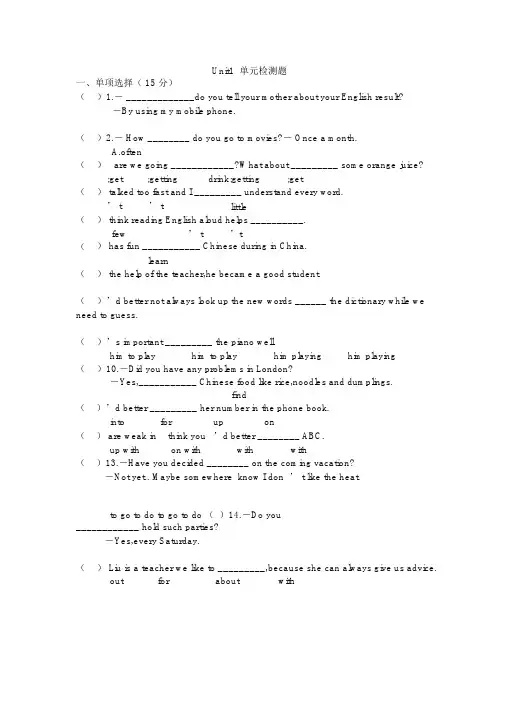
人教版九年级英语全册 Unit 1 单元测试卷(含答案)Ⅰ. 完形填空(每小题2分,共40分)ATwo years ago I came to Japan. I came here because I wanted to study Japanese. I went to a Japanese language school as soon as I got here. I was not a beginner, but I wasn’t good at Japanese. I could only make some very 1 conversations.At the end of the first term, I was able to read, write and speak 2 than most students in my class. However, I was not good at understanding when people spoke to me. My teacher said, “Your 3 is poor. Why don’t you repeat the first half of the book?” I felt a little 4 . I made progress every month, so I didn’t want to repeat it. However, 5 the teacher said was true. I still couldn’t understand what people said to me. My teacher asked me to think about his 6 . I thought it over and agreed.In the second term, I 7 the same classes and I studied the same book that I had learned in the first term. My Japanese teacher was right and 8 suggestion was good. Little by little I was able to 9 more spoken Japanese. I was able to make more conversations and understand more when my classmates and teachers 10 Japanese to me.Sometimes I had to admit (承认) reading, writing and speaking skills were not enough. Listening was also important. From then on, I studiedharder to improve my listening skill.1. A. difficult B. simple C. quick D. slow2. A. worse B. more C. better D. less3. A. reading B. writing C. listening D. speaking4. A. proud B. angry C. relaxed D. moved5. A. when B. how C. which D. what6. A. suggestion B. secret C. activity D. chance7. A. forgot B. repeated C. left D. increased8. A. his B. her C. their D. your9. A. notice B. understand C. add D. teach10. A. joined B. lent C. played D. spokeBAs a university student, I decided to learn German. I really liked the language, but I was not very good at learning it. The grammar 11me a lot and even drove me crazy. My only 12was listening—I always got an “A”. After two yea rs of study, I struggled (挣扎) to communicate in 13German and signed up (报名) to study in Germany to complete my degree. It was the hardest term I would ever have.The moment I 14Germany, I felt like I was starting from the beginning. The German I'd learned in university wasn't 15for everyday conversation. I was often nervous at school and I was 16my teachers. They always asked me some questions that I didn't understand.I only relaxed a little around my eightroommates, who were willing to speak German slowly to me and didn't seem to mind my 17.I chose to study three courses and the history class was the worst among them. The teacher spoke so 18that almost everything he said flew right over my head. I sat in the front, took notes and even recorded every single 19he said in class, but nothing helped.Years have passed, 20I still remember how it felt. That trip was a difficult but valuable lesson. I think my failure that term taught me just as much as my success.11.A.gave B.helped C.troubled D.saved12.A.action B.article C.agreement D.advantage13.A.perfect B.broken C.beautiful D.harmful14.A.arrived in B.handed in C.succeeded in D.took in15.A.peaceful B.painful eful D.careful16.A.pleased with B.angry with C.excited about D.afraid of17.A.purposes B.progress C.mistakes D.achievements18.A.slowly B.quickly C.clearly D.suddenly19.A.word B.book C.passage D.excuse20.A.and B.so C.but D.becauseⅡ.阅读理解(每小题2分,共20分)AChinese is getting more and more popular, so the UK government plans to invest (投资) 10 million pounds to help more kids learn Chinese. Do you think it is necessary for UK pupils to learn Chinese?Seneca (Canada)I studied French for 2 years in high school, and German for 4 years in college and got good marks. I studied Chinese for about 4 months before moving to China. For any language, if you don't use it, it will be easy to lose it. I've forgotten the French I learned except for a few phrases. I speak Chinese every day. My writing, reading and listening are quite good, but far from fluent. I think it's necessary to learn Chinese.Tony (the UK)Learning any language can be valuable, but it is not suitable for everyone. Chinese is a difficult language to learn, and teachers in the UK are not good at teaching foreign languages. However, China is a big and developing market for English business people. For them, Chinese is worth learning.Bill (the US)I don't think Chinese will replace (取代) English. Chinese is difficult to learn. To learn Chinese, you have to learn how to write and read it carefully. In the future Chinese will become more popular, so I think learning Chinese is a good thing.(E9301003)21.Seneca learnt German for .A.2 yearsB.4 monthsC.4 yearsD.6 years22.The underlined word “fluent” means “” in Chinese.A.糟糕的B.流利的C.完美的D.成熟的23.Tony thinks it's to learn Chinese.A.easyB.difficultelessD.interesting24.From the passage we know .A.Bill doesn't think Chinese will replace English in the futureB.Bill thinks it is easy to learn ChineseC.teachers in the UK are very good at teaching ChineseD.Seneca is very good at speaking Chinese25.What's the best title for the passage?A.How to learn Chinese wellB.Chinese is difficult to learnC.Do you like Chinese?D.Is it necessary to learn Chinese?BPerhaps you've seen the English letters “WC” in your city. They show public toilets. But do you know the expression is far from elegant (优雅的) English? In fact, foreigners from English⁃speaking countries rarely use the letters.Workers in our city are changing “WC” signs all over the city. The government is spending much money changing all the bad English on signs and restaurant menus. Many other places in China are following suit(照着做).“WC, or water closet, is old⁃fashioned English. It sounds dirty to me,” says Charlie Shifflet, a young man from the US. The old sign will become “Gents/Men” and “Ladies/Women”.“I see lots of poor English in everyday life, not only on signs,” he says. “I know what they mean. But they are Chinglish (中国式英语), not real English. For example, when someone says to me ‘My hometown is Henan Province.’ I know he should say, ‘My hometown is in Henan Province.’ ‘Hometown’ is a smaller place in a province.” The common mistakes he picked up include “Not Entry”, which should be “No Entry”. “Direction of Airport” should be changed into “To the Airport”. And it is “room rate”, not “room price”. And remember to “Keep off the grass”, rather than “Care of the green”. (E9301003)26.What does the writer think of the use of “WC”?A.He doesn't think it means “water closet”.B.He doesn't think it is old⁃fashioned English.C.He doesn't think it is proper for a sign.D.He thinks it is elegant English.27.The underlined word “rarely” means “”.A.sometimesB.seldomC.oftenD.always28.Charlie Shifflet .A.is a Chinese living in AmericaB.sometimes uses ChinglishC.likes to hear or see ChinglishD.thinks Chinese people sometimes use incorrect English29.The last paragraph is about .A.why there are so many Chinglish signsB.examples of ChinglishC.where Chinglish signs areD.who uses Chinglish signs30.We can read the passage from a magazine called “”.nguage LearningB.American HistoryC.Different CountriesD.Chinese CultureⅢ.语篇填空(每空2分,共20分)从方框中选择适当的词并用其正确形式填空,使短文通顺、意思完整。