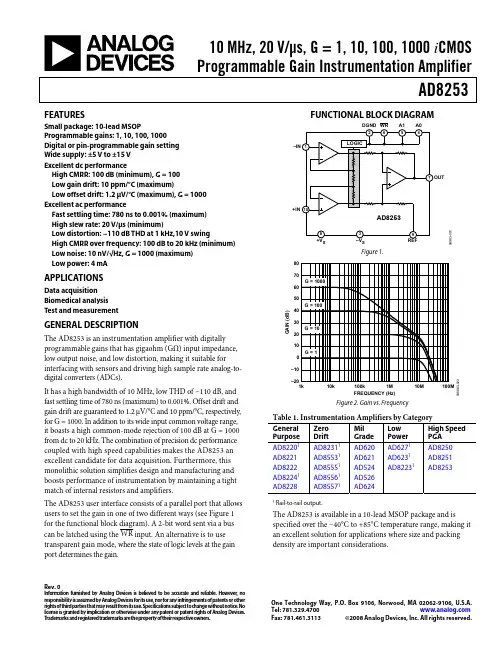
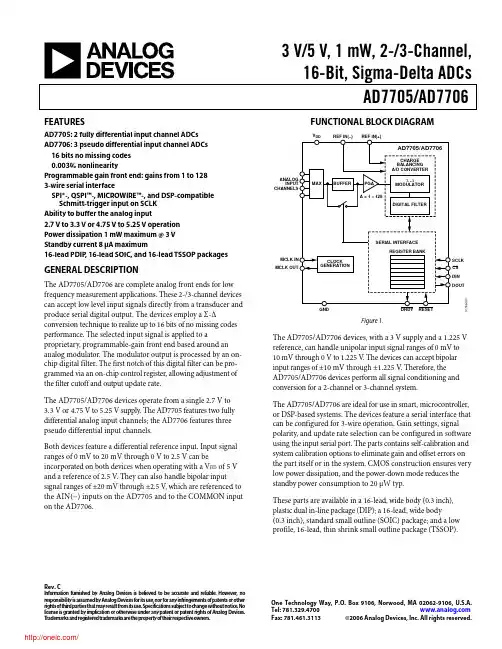
10 MHz, 20 V/μs, G = 1, 10, 100, 1000 i CMOSProgrammable Gain Instrumentation AmplifierAD8253 Rev. 0Information furnished by Analog Devices is believed to be accurate and reliable. However, noresponsibility is assumed by Analog Devices for its use, nor for any infringements of patents or other rights of third parties that may result from its use. Specifications subject to change without notice. No license is granted by implication or otherwise under any patent or patent rights of Analog Devices. T rademarks and registered trademarks are the property of their respective owners. One Technology Way, P.O. Box 9106, Norwood, M A 02062-9106, U.S.A. Tel: 781.329.4700 Fax: 781.461.3113 ©2008 Analog Devices, Inc. All rights reserved.FEATURESSmall package: 10-lead MSOPProgrammable gains: 1, 10, 100, 1000Digital or pin-programmable gain settingWide supply: ±5 V to ±15 VExcellent dc performanceHigh CMRR: 100 dB (minimum), G = 100Low gain drift: 10 ppm/°C (maximum)Low offset drift: 1.2 μV/°C (maximum), G = 1000 Excellent ac performanceFast settling time: 780 ns to 0.001% (maximum)High slew rate: 20 V/μs (minimum)Low distortion: −110 dB THD at 1 kHz,10 V swingHigh CMRR over frequency: 100 dB to 20 kHz (minimum) Low noise: 10 nV/√Hz, G = 1000 (maximum)Low power: 4 mAAPPLICATIONSData acquisitionBiomedical analysisTest and measurementGENERAL DESCRIPTIONThe AD8253 is an instrumentation amplifier with digitally programmable gains that has gigaohm (GΩ) input impedance, low output noise, and low distortion, making it suitable for interfacing with sensors and driving high sample rate analog-to-digital converters (ADCs).It has a high bandwidth of 10 MHz, low THD of −110 dB, and fast settling time of 780 ns (maximum) to 0.001%. Offset drift and gain drift are guaranteed to 1.2 μV/°C and 10 ppm/°C, respectively, for G = 1000. In addition to its wide input common voltage range, it boasts a high common-mode rejection of 100 dB at G = 1000 from dc to 20 kHz. The combination of precision dc performance coupled with high speed capabilities makes the AD8253 an excellent candidate for data acquisition. Furthermore, this monolithic solution simplifies design and manufacturing and boosts performance of instrumentation by maintaining a tight match of internal resistors and amplifiers.The AD8253 user interface consists of a parallel port that allows users to set the gain in one of two different ways (see Figure 1 for the functional block diagram). A 2-bit word sent via a bus can be latched using the WR input. An alternative is to use transparent gain mode, where the state of logic levels at the gain port determines the gain.FUNCTIONAL BLOCK DIAGRAMS S+IN6983-1Figure 1.8070605040302010–10–201k10k100k1M10M100MFREQUENCY (Hz)GAIN(dB)6983-23Figure 2. Gain vs. FrequencyTable 1. Instrumentation Amplifiers by CategoryGeneralPurposeZeroDriftMilGradeLowPowerHigh SpeedPGAAD82201AD82311AD620AD6271AD8250AD8221AD85531AD621AD6231AD8251AD8222AD85551AD524AD82231AD8253AD82241AD85561AD526AD8228AD85571AD6241 Rail-to-rail output.The AD8253 is available in a 10-lead MSOP package and is specified over the −40°C to +85°C temperature range, making it an excellent solution for applications where size and packing density are important considerations.AD8253Rev. 0 | Page 2 of 24TABLE OF CONTENTSFeatures .............................................................................................. 1 Applications ....................................................................................... 1 General Description ......................................................................... 1 Functional Block Diagram .............................................................. 1 Revision History ............................................................................... 2 Specifications ..................................................................................... 3 Timing Diagram ........................................................................... 5 Absolute Maximum Ratings ............................................................ 6 Maximum Power Dissipation ..................................................... 6 ESD Caution .................................................................................. 6 Pin Configuration and Function Descriptions ............................. 7 Typical Performance Characteristics ............................................. 8 Theory of Operation ...................................................................... 16 Gain Selection ............................................................................. 16 Power Supply Regulation and Bypassing ................................ 18 Input Bias Current Return Path ............................................... 18 Input Protection ......................................................................... 18 Reference Terminal .................................................................... 19 Common-Mode Input Voltage Range ..................................... 19 Layout .......................................................................................... 19 RF Interference ........................................................................... 19 Driving an Analog-to-Digital Converter ................................ 20 Applications Information .............................................................. 21 Differential Output .................................................................... 21 Setting Gains with a Microcontroller ...................................... 21 Data Acquisition ......................................................................... 22 Outline Dimensions ....................................................................... 23 Ordering Guide .. (23)REVISION HISTORY7/08—Revision 0: Initial VersionAD8253SPECIFICATIONS+V S = +15 V, −V S = −15 V, V REF = 0 V @ T A = 25°C, G = 1, R L = 2 kΩ, unless otherwise noted.Table 2.Parameter Conditions Min Typ Max Unit COMMON-MODE REJECTION RATIO (CMRR)CMRR to 60 Hz with 1 kΩ Source Imbalance +IN = −IN = −10 V to +10 VG = 1 80 100 dBG = 10 96 120 dBG = 100 100 120 dBG = 1000 100 120 dB CMRR to 20 kHz 1+IN = −IN = −10 V to +10 VG = 1 80 dBG = 10 96 dBG = 100 100 dBG = 1000 100 dB NOISEVoltage Noise, 1 kHz, RTIG = 1 45 nV/√HzG = 10 12 nV/√HzG = 100 11 nV/√HzG = 1000 10 nV/√Hz0.1 Hz to 10 Hz, RTIG = 1 2.5 μV p-pG = 10 1 μV p-pG = 100 0.5 μV p-pG = 1000 0.5 μV p-p Current Noise, 1 kHz 5 pA/√Hz Current Noise, 0.1 Hz to 10 Hz 60 pA p-p VOLTAGE OFFSETOffset RTI V OS G = 1, 10, 100, 1000 ±150 + 900/G μV Over Temperature T = −40°C to +85°C ±210 + 900/G μV Average TC T = −40°C to +85°C ±1.2 + 5/G μV/°C Offset Referred to the Input vs. Supply (PSR) V S = ±5 V to ±15 V ±5 + 25/G μV/V INPUT CURRENTInput Bias Current 5 50 nA Over Temperature2T = −40°C to +85°C 40 60 nA Average TC T = −40°C to +85°C 400 pA/°C Input Offset Current 5 40 nA Over Temperature T = −40°C to +85°C 40 nA Average TC T = −40°C to +85°C 160 pA/°C DYNAMIC RESPONSESmall-Signal −3 dB BandwidthG = 1 10 MHzG = 10 4 MHzG = 100 550 kHzG = 1000 60 kHz Settling Time 0.01% ΔOUT = 10 V stepG = 1 700 nsG = 10 680 nsG = 100 1.5 μsG = 1000 14 μsRev. 0 | Page 3 of 24AD8253Rev. 0 | Page 4 of 24AD8253Rev. 0 | Page 5 of 24Parameter Conditions Min Typ Max UnitPOWER SUPPLY Operating Range±5 ±15 V Quiescent Current, +I S 4.6 5.3 mA Quiescent Current, −I S 4.5 5.3mA Over Temperature T = −40°C to +85°C 6 mA TEMPERATURE RANGE Specified Performance−40 +85 °C1 See Figure 20 for CMRR vs. frequency for more information on typical performance over frequency.2Input bias current over temperature: minimum at hot and maximum at cold. 3See Figure 30 for input voltage limit vs. supply voltage and temperature. 4See Figure 32, Figure 33, and Figure 34 for output voltage swing vs. supply voltage and temperature for various loads. 5Add time for the output to slew and settle to calculate the total time for a gain change.TIMING DIAGRAMA0, A1WR06983-003Figure 3. Timing Diagram for Latched Gain Mode (See the Timing for Latched Gain Mode Section)AD8253Rev. 0 | Page 6 of 24ABSOLUTE MAXIMUM RATINGSTable 3.Parameter RatingSupply Voltage ±17 VPower Dissipation See Figure 4Output Short-Circuit CurrentIndefinite 1 Common-Mode Input Voltage ±V S Differential Input Voltage ±V S Digital Logic Inputs±V SStorage Temperature Range –65°C to +125°C Operating Temperature Range 2–40°C to +85°C Lead Temperature (Soldering 10 sec) 300°C Junction Temperature140°C θJA (4-Layer JEDEC Standard Board) 112°C/W Package Glass Transition Temperature140°C1 Assumes the load is referenced to midsupply.2Temperature for specified performance is −40°C to +85°C. For performance to +125°C, see the Typical Performance Characteristics section.Stresses above those listed under Absolute Maximum Ratings may cause permanent damage to the device. This is a stress rating only; functional operation of the device at these or any other conditions above those indicated in the operationalsection of this specification is not implied. Exposure to absolute maximum rating conditions for extended periods may affect device reliability.MAXIMUM POWER DISSIPATIONThe maximum safe power dissipation in the AD8253 package is limited by the associated rise in junction temperature (T J ) on the die. The plastic encapsulating the die locally reaches the junction temperature. At approximately 140°C, which is the glass transition temperature, the plastic changes its properties. Even temporarily exceeding this temperature limit can change the stresses that the package exerts on the die, permanently shifting the parametric performance of the AD8253. Exceeding a junction temperature of 140°C for an extended period can result in changes in silicon devices, potentially causing failure. The still-air thermal properties of the package and PCB (θJA ), the ambient temperature (T A ), and the total power dissipated in the package (P D ) determine the junction temperature of the die. The junction temperature is calculated as()JA D A J θP T T ×+=The power dissipated in the package (P D ) is the sum of the quiescent power dissipation and the power dissipated in the package due to the load drive for all outputs. The quiescent power is the voltage between the supply pins (V S ) times the quiescent current (I S ). Assuming the load (R L ) is referenced tomidsupply, the total drive power is V S /2 × I OUT , some of which isdissipated in the package and some of which is dissipated in theload (V OUT × I OUT ). The difference between the total drive power and the load power is the drive power dissipated in the package.P D = Quiescent Power + (Total Drive Power − Load Power )()L 2OUT L OUTS S S D R V –R V2V I V P ⎟⎟⎠⎞⎜⎜⎝⎛×+×= In single-supply operation with R L referenced to −V S , the worstcase is V OUT = V S /2.Airflow increases heat dissipation, effectively reducing θJA . In addition, more metal directly in contact with the package leads from metal traces through holes, ground, and power planes reduces the θJA .Figure 4 shows the maximum safe power dissipation in the package vs. the ambient temperature on a 4-layer JEDEC standard board.2.001.751.501.251.000.750.500.250–40–20120100806040200M A X I M U M P O W E R D I S S I P A T I O N (W )AMBIENT TEMPERATURE (°C)06983-004Figure 4. Maximum Power Dissipation vs. Ambient TemperatureESD CAUTIONAD8253Rev. 0 | Page 7 of 24PIN CONFIGURATION AND FUNCTION DESCRIPTIONS–IN DGND –V S A0A1+INREF+V S OUT WRAD8253TOP VIEW(Not to Scale)1234510987606983-005Figure 5. 10-Lead MSOP (RM-10) Pin ConfigurationAD8253Rev. 0 | Page 8 of 24TYPICAL PERFORMANCE CHARACTERISTICST A @ 25°C, +V S = +15 V , −V S = −15 V , R L = 10 kΩ, unless otherwise noted.CMRR (µV/V)21006983-006N U M B E R O F U N I T S180150120906030–60–40–20020INPUT OFFSET CURRENT (nA)240120180601502109030604020006983-009N U M B E R O F U N I T S–60–20–40Figure 6. Typical Distribution of CMRR, G = 1 Figure 9. Typical Distribution of Input Offset CurrentINPUT OFFSET VOLTAGE, V OSI , RTI (µV)180120150200100006983-007N U M B E R O F U N I T S–200–10006983-0101100kFREQUENCY (Hz)N O I S E (n V /√H z )101001k10k8070605040302010Figure 10. Voltage Spectral Density Noise vs. FrequencyFigure 7. Typical Distribution of Offset Voltage, V OSI 06983-011INPUT BIAS CURRENT (nA)30020025015010050906030006983-008N U M B E R O F U N I T S–90–30–60Figure 11. 0.1 Hz to 10 Hz RTI Voltage Noise, G = 1Figure 8. Typical Distribution of Input Bias CurrentAD8253Rev. 0 | Page 9 of 2406983-012Figure 12. 0.1 Hz to 10 Hz RTI Voltage Noise, G = 1000 06983-01318011FREQUENCY (Hz)N O I S E (p A /√H z )00k 101001k 10k 161412108642Figure 13. Current Noise Spectral Density vs. Frequency 06983-014Figure 14. 0.1 Hz to 10 Hz Current Noise 201816141210864200.010.1110WARM-UP TIME (Minutes)C H A N G E I N I N P U T O F F S E T V O L T A G E (µV )06983-015Figure 15. Change in Input Offset Voltage vs. Warm-Up Time, G = 10001401201008040600101M06983-016FREQUENCY (Hz)P S R R (d B )1001k 10k 100k 20Figure 16. Positive PSRR vs. Frequency, RTI1401201008040600101M06983-017FREQUENCY (Hz)P S R R (d B )1001k 10k 100k 20Figure 17. Negative PSRR vs. Frequency, RTIAD8253Rev. 0 | Page 10 of 2420100–10–20–30–40–50–6012.0I B +10.59.07.56.04.53.01.50–15–10–5051015COMMON-MODE VOLTAGE (V)I N P U T B I A S C U R R E N T (n A )I N P U T O F F S E T C U R R E N T (n A )06983-018I B –I OSFigure 18. Input Bias Current and Offset Current vs. Common-Mode Voltage 302520151050–10–5–60–40–20020406080100120140TEMPERATURE (°C)I N P U T B I A S C U R R E N T A N D O F F S E T C U R R E N T (n A )06983-019I B +I B –I OS Figure 19. Input Bias Current and Offset Current vs. Temperature 012010080604020106983-020FREQUENCY (Hz)C M R R (d B )1001k 10k 100k 1MFigure 20. CMRR vs. Frequency120100806040201006983-021FREQUENCY (Hz)C M R R (d B)1001k 10k 100k 1MFigure 21. CMRR vs. Frequency, 1 kΩ Source Imbalance–15–5013006983-022TEMPERATURE (°C)C M R R (µV /V )10155–5–10–30–101030507090110Figure 22. CMRR vs. Temperature, G = 180706050403020100–10–201k10k100k 1M 10M 100MFREQUENCY (Hz)G A I N (d B )006983-023Figure 23. Gain vs. Frequency40302010–10–300–20–40–10–8–6–4–2024681006983-024N O N L I N E A R I T Y (10p p m /D I V )OUTPUT VOLTAGE (V)Figure 24. Gain Nonlinearity, G = 1, R L = 10 kΩ, 2 kΩ, 600 Ω 40302010–10–300–20–40–10–8–6–4–2024681006983-025N O N L I N E A R I T Y (10p p m /D I V )OUTPUT VOLTAGE (V)Figure 25. Gain Nonlinearity, G = 10, R L = 10 kΩ, 2 kΩ, 600 Ω 80604020–20–600–40–80–10–8–6–4–2024681006983-026N O N L I N E A R I T Y (10p p m /D I V )OUTPUT VOLTAGE (V)Figure 26. Gain Nonlinearity, G = 100, R L = 10 kΩ, 2 kΩ, 600 Ω400300200100–100–3000–200–400–10–8–6–4–2024681006983-027N O N L I N E A R I T Y (10 p p m /D I V )OUTPUT VOLTAGE (V)Figure 27. Gain Nonlinearity, G = 1000, R L = 10 kΩ, 2 kΩ, 600 Ω16–1606983-028OUTPUT VOLTAGE (V)I N P U T C O M M O N -M O D E V O L T A G E (V )1284–4–8–12–12–8–44812Figure 28. Input Common-Mode Voltage Range vs. Output Voltage, G = 116–16–161606983-029OUTPUT VOLTAGE (V)I N P U T C O M M O N -M O D E V O L T A G E (V )1284–4–8–12–12–8–44812Figure 29. Input Common-Mode Voltage Range vs. Output Voltage, G = 1000+V S –V S4106983-030SUPPLY VOLTAGE (±V S )I N P U T V O L T A G E (V )R E F E R R E D T O S U P P L Y V O L T A G E S6–1–2+2+168101214Figure 30. Input Voltage Limit vs. Supply Voltage, G = 1, V REF = 0 V, R L = 10 kΩ–1––100m–10–1–100µ–10µ10DIFFERENTIAL INPUT VOLTAGE (V)C U R R E N T (m A )06983-0311001101001Figure 31. Fault Current Draw vs. Input Voltage, G = 1000, R L = 10 kΩ +V S –V S4106983-032SUPPLY VOLTAGE (±V S )OU T P U T V O L T A G E S W I N G (V )R E F E R R E D T O S U P P L Y V O L T A G E S668101214–0.2–0.4–0.6–0.8–1.0–1.2+1.0+1.2+0.8+0.6+0.4+0.2Figure 32. Output Voltage Swing vs. Supply Voltage, G = 1000, R L = 2 kΩ +V S –V S4106983-033SUPPLY VOLTAGE (±V S )O U T P U T V O L T A G E S W I N G (V )R E F E R R E D T O S U P P L Y V O L T A G E S668101214–0.2–0.4–0.6–0.8–1.0+1.0+0.8+0.6+0.4+0.2Figure 33. Output Voltage Swing vs. Supply Voltage, G =1000, R L = 10 kΩ15–1510010k06983-034LOAD RESISTANCE (Ω)1k105–5–10O U T P U T V O L T A G E S W I N G (V )Figure 34. Output Voltage Swing vs. Load Resistance+V S –V S4106983-035OUTPUT CURRENT (mA)668101214–0.4–0.8–1.2–1.6–2.0+2.0+1.6+1.2+0.8+0.4O U T P U T V O L T A G E S W I N G (V )R E F E R R E D T O S U P P L Y V O L T A G E SFigure 35. Output Voltage Swing vs. Output Current06983-036Figure 36. Small-Signal Pulse Response for Various Capacitive Loads, G = 1069TIME (µs)Figure 37. Large-Signal Pulse Response and Settling Time, G = 1, R L= 10 kΩ06983-038TIME (µs)Figure 38. Large-Signal Pulse Response and Settling Time,G = 10, R L= 10 kΩ06983-039TIME (µs)Figure 39. Large-Signal Pulse Response and Settling Time,G = 100, R L= 10 kΩ06983-040TIME (µs)Figure 40. Large-Signal Pulse Response and Settling Time,G = 1000, R L= 10 kΩ06983-041Figure 41. Small-Signal Response,G = 1, R L = 2 kΩ, C L = 10006983-042Figure 42. Small-Signal Response, G = 10, R L = 2 kΩ, C L = 100 pF06983-043Figure 43. Small-Signal Response, G = 100, R L = 2 kΩ, C L = 100 pF06983-044Figure 44. Small-Signal Response, G = 1000, R L = 2 kΩ, C L = 100 pF 06983-045120014000STEP SIZE (V)T I M E (n s )10008006004002004681012141618Figure 45. Settling Time vs. Step Size, G = 1, R L = 10 kΩ06983-04612001400STEP SIZE (V)T I M E (n s )10008006004002004681012141618Figure 46. Settling Time vs. Step Size, G = 10, R L = 10 kΩ06983-04722STEP SIZE (V)T I M E (n s )10008006001800160014004002004681012141618Figure 47. Settling Time vs. Step Size, G = 100, R L = 10 kΩ06983-048STEP SIZE (V)T I M E (µs )1086181614424681012141618Figure 48. Settling Time vs. Step Size, G = 1000, R L = 10 kΩ0–10–20–30–40–50–60–70–80–90–120–110–100101M06983-049FREQUENCY (Hz)T H D + N (d B )1001k 10k 100k Figure 49. Total Harmonic Distortion vs. Frequency,10 Hz to 22 kHz Band-Pass Filter, 2 kΩ Load0–10–20–30–40–50–60–70–80–90–120–110–100101M06983-050FREQUENCY (Hz)T H D + N (d B )1001k 10k 100k Figure 50. Total Harmonic Distortion vs. Frequency, 10 Hz to 500 kHz Band-Pass Filter, 2 kΩ LoadTHEORY OF OPERATIONREFOUTSS 06983-061Figure 51. Simplified SchematicTransparent Gain ModeThe AD8253 is a monolithic instrumentation amplifier based on the classic 3-op-amp topology, as shown in Figure 51. It is fabricated on the Analog Devices, Inc., proprietary i CMOS® process that provides precision linear performance and a robust digital interface. A parallel interface allows users to digitally program gains of 1, 10, 100, and 1000. Gain control is achieved by switching resistors in an internal precision resistor array (as shown in Figure 51).The easiest way to set the gain is to program it directly via a logic high or logic low voltage applied to A0 and A1. Figure 52 shows an example of this gain setting method, referred to through-out the data sheet as transparent gain mode. Tie WR to the negative supply to engage transparent gain mode. In this mode, any change in voltage applied to A0 and A1 from logic low to logic high, or vice versa, immediately results in a gain change. is the truth table for transparent gain mode, and shows the AD8253 configured in transparent gain mode.Table 5Figure 52All internal amplifiers employ distortion cancellation circuitry and achieve high linearity and ultralow THD. Laser-trimmed resistors allow for a maximum gain error of less than 0.03% for G = 1 and a minimum CMRR of 100 dB for G = 1000. A pinout optimized for high CMRR over frequency enables the AD8253 to offer a guaranteed minimum CMRR over frequency of 80 dB at 20 kHz (G = 1). The balanced input reduces the parasitics that in the past had adversely affected CMRR performance.NOTE:1. IN TRANSPARENT GAIN MODE, WR IS TIED TO −V S .THE VOLTAGE LEVELS ON A0 AND A1 DETERMINE THE GAIN. IN THIS EXAMPLE, BOTH A0 AND A1 ARE SET TO LOGIC HIGH, RESULTING IN A GAIN OF 1000.06983-051GAIN SELECTIONThis section describes how to configure the AD8253 for basic operation. Logic low and logic high voltage limits are listed in the Specifications section. Typically, logic low is 0 V and logic high is 5 V; both voltages are measured with respect to DGND. Refer to the specifications table (Table 2) for the permissible voltage range of DGND. The gain of the AD8253 can be set using two methods: transparent gain mode and latched gain mode. Regardless of the mode, pull-up or pull-down resistors should be used to provide a well-defined voltage at the A0 and A1 pins.Figure 52. Transparent Gain Mode, A0 and A1 = High, G = 1000Latched Gain ModeSome applications have multiple programmable devices such as multiplexers or other programmable gain instrumentation amplifiers on the same PCB. In such cases, devices can share a data bus. The gain of the AD8253 can be set using WR as a latch, allowing other devices to share A0 and A1. shows a schematic using this method, known as latched gain mode. The AD8253 is in this mode when Figure 53WR is held at logic high or logic low, typically 5 V and 0 V , respectively. The voltages on A0 and A1 are read on the downward edge of the WR signal as it transitions from logic high to logic low. This latches in the logic levels on A0 and A1, resulting in a gain change. See the truth table listing in for more on these gain changes.Table 6NOTE:FROM LOGIC HIGH TO LOGIC LOW, THE VOLTAGES ON A0AND A1 ARE READ AND LATCHED IN, RESULTING IN AGAIN CHANGE. IN THIS EXAMPLE, THE GAIN SWITCHES TO G = 1000.06983-052Figure 53. Latched Gain Mode, G = 10001X = don’t care.On power-up, the AD8253 defaults to a gain of 1 when inlatched gain mode. In contrast, if the AD8253 is configured in transparent gain mode, it starts at the gain indicated by the voltage levels on A0 and A1 on power-up.Timing for Latched Gain ModeIn latched gain mode, logic levels at A0 and A1 must be held for a minimum setup time, t SU , before the downward edge of WR latches in the gain. Similarly, they must be held for a minimum hold time, t HD , after the downward edge of WR to ensure that the gain is latched in correctly. After t HD , A0 and A1 may change logic levels, but the gain does not change until the next downward edge of WR . The minimum duration that WR can be held high is t -HIGH , and t -LOW is the minimum duration that WR can be held low. Digital timing specifications are listed in The time required for a gain change is dominated by the settling time of the amplifier. A timing diagram is shown in . Table 2.Figure 54When sharing a data bus with other devices, logic levels applied to those devices can potentially feed through to the output of the AD8253. Feedthrough can be minimized by decreasing the edge rate of the logic signals. Furthermore, careful layout of the PCB also reduces coupling between the digital and analog portions of the board.A0, A106983-053Figure 54. Timing Diagram for Latched Gain ModePOWER SUPPLY REGULATION AND BYPASSINGThe AD8253 has high PSRR. However, for optimal performance, a stable dc voltage should be used to power the instrumentation amplifier. Noise on the supply pins can adversely affect per-formance. As in all linear circuits, bypass capacitors must be used to decouple the amplifier.Place a 0.1 μF capacitor close to each supply pin. A 10 μF tantalum capacitor can be used farther away from the part (see Figure 55) and, in most cases, it can be shared by other precision integrated circuits.06983-054Figure 55. Supply Decoupling, REF, and Output Referred to GroundINPUT BIAS CURRENT RETURN PATHThe AD8253 input bias current must have a return path to its local analog ground. When the source, such as a thermocouple, cannot provide a return current path, one should be created (see Figure 56).THERMOCOUPLE+V –V SCAPACITIVELY COUPLED +V SREFCC–V SAD8253TRANSFORMER+V SREF–V SAD8253INCORRECTCAPACITIVELY COUPLEDf HIGH-PASS THERMOCOUPLE+V TRANSFORMER–V SCORRECT06983-055Figure 56. Creating an I BIAS PathINPUT PROTECTIONAll terminals of the AD8253 are protected against ESD. An external resistor should be used in series with each of the inputs to limit current for voltages greater than 0.5 V beyond either supply rail. In such a case, the AD8253 safely handles a continuous 6 mA current at room temperature. For applications where the AD8253 encounters extreme overload voltages, external series resistors and low leakage diode clamps such as BAV199Ls, FJH1100s, or SP720s should be used.REFERENCE TERMINALThe reference terminal, REF, is at one end of a 10 kΩ resistor (see Figure 51). The instrumentation amplifier output is referenced to the voltage on the REF terminal; this is useful when the output signal needs to be offset to voltages other than its local analog ground. For example, a voltage source can be tied to the REF pin to level shift the output so that the AD8253 can interface with a single-supply ADC. The allowable reference voltage range is a function of the gain, common-mode input, and supply voltages. The REF pin should not exceed either +V S or −V S by more than 0.5 V .For best performance, especially in cases where the output is not measured with respect to the REF terminal, source imped-ance to the REF terminal should be kept low because parasiticresistance can adversely affect CMRR and gain accuracy.INCORRECTCORRECT06983-056Figure 57. Driving the Reference PinCOMMON-MODE INPUT VOLTAGE RANGEThe 3-op-amp architecture of the AD8253 applies gain and then removes the common-mode voltage. Therefore, internal nodes in the AD8253 experience a combination of both the gained signal and the common-mode signal. This combined signal can be limited by the voltage supplies even when the individual input and output signals are not. Figure 28 and Figure 29 show the allowable common-mode input voltage ranges for various output voltages, supply voltages, and gains.LAYOUTGroundingIn mixed-signal circuits, low level analog signals need to be isolated from the noisy digital environment. Designing with the AD8253 is no exception. Its supply voltages are referenced to an analog ground. Its digital circuit is referenced to a digital ground. Although it is convenient to tie both grounds to a single ground plane, the current traveling through the ground wires and PC board can cause an error. Therefore, use separate analog and digital ground planes. Only at one point, star ground, should analog and digital ground meet.The output voltage of the AD8253 develops with respect to the potential on the reference terminal. Take care to tie REF to the appropriate local analog ground or to connect it to a voltage that is referenced to the local analog ground.Coupling NoiseTo prevent coupling noise onto the AD8253, follow these guidelines: • Do not run digital lines under the device.• Run the analog ground plane under the AD8253.•Shield fast-switching signals with digital ground to avoid radiating noise to other sections of the board, and never run them near analog signal paths.• Avoid crossover of digital and analog signals.• Connect digital and analog ground at one point only (typically under the ADC).•Power supply lines should use large traces to ensure a low impedance path. Decoupling is necessary; follow the guidelines listed in the Power Supply Regulation and Bypassing section.Common-Mode RejectionThe AD8253 has high CMRR over frequency, giving it greater immunity to disturbances, such as line noise and its associated harmonics, in contrast to typical in amps whose CMRR falls off around 200 Hz. They often need common-mode filters at the inputs to compensate for this shortcoming. The AD8253 is able to reject CMRR over a greater frequency range, reducing the need for input common-mode filtering.Careful board layout maximizes system performance. T o maintain high CMRR over frequency, lay out the input traces symmetrically. Ensure that the traces maintain resistive and capacitive balance; this holds for additional PCB metal layers under the input pins and traces. Source resistance and capacitance should be placed as close to the inputs as possible. Should a trace cross the inputs (from another layer), it should be routed perpendicular to the input traces.RF INTERFERENCERF rectification is often a problem when amplifiers are used in applications where there are strong RF signals. The disturbance can appear as a small dc offset voltage. High frequency signals can be filtered with a low-pass RC network placed at the input of the instrumentation amplifier, as shown in Figure 58. The filter limits the input signal bandwidth according to the following relationship:)C C (R 1FilterFreq C D DIFF +=2π2CCM RC 1FilterFreq π2=where C D ≥ 10 C C .。