Bresenham算法直线光栅化算法
- 格式:doc
- 大小:43.00 KB
- 文档页数:7
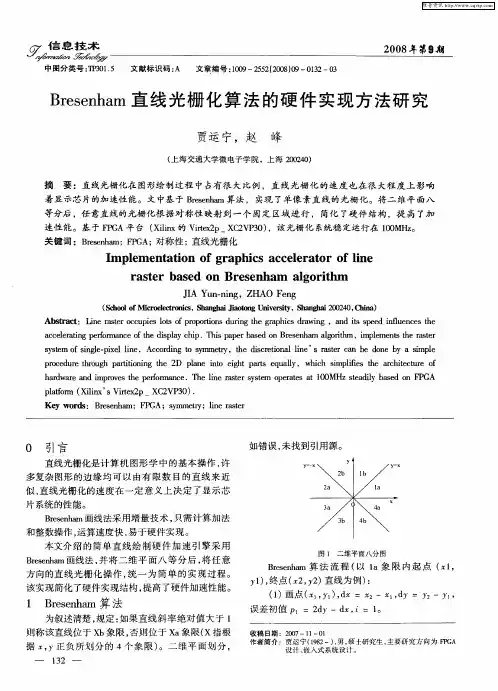
1 / 7 Bresenham算法是计算机图形学典型的直线光栅化算法。
• 从另一个角度看直线光栅化显示算法的原理
o 由直线的斜率确定选择在x方向或y方向上每次递增(减)1个单位,另一变量的递增(减)量为0或1,它取决于实际直线与最近光栅网格点的距离,这个距离的最大误差为0.5。
• 1)Bresenham的基本原理
o 假定直线斜率k在0~1之间。此时,只需考虑x方向每次递增1个单位,决定y方向每次递增0或1。
设
直线当前点为(xi,y)
直线当前光栅点为(xi,yi)
则
下一个直线的点应为(xi+1,y+k)
下一个直线的光栅点
或为右光栅点(xi+1,yi)(y方向递增量0)
或为右上光栅点(xi+1,yi+1)(y方向递增量1)
记直线与它垂直方向最近的下光栅点的误差为d,有:d=(y+k)–yi,且 2 / 7 0≤d≤1
当d<0.5:下一个象素应取右光栅点(xi+1,yi)
当d≥0.5:下一个象素应取右上光栅点(xi+1,yi+1)
如果直线的(起)端点在整数点上,误差项d的初值:d0=0,
x坐标每增加1,d的值相应递增直线的斜率值k,即:d=d + k。
一旦d≥1,就把它减去1,保证d的相对性,且在0-1之间。
令e=d-0.5,关于d的判别式和初值可简化成:
e的初值e0= -0.5,增量亦为k;
e<0时,取当前象素(xi,yi)的右方象素(xi+1,yi);
e>0时,取当前象素(xi,yi)的右上方象素(xi+1,yi+1);
e=0时,可任取上、下光栅点显示。
Bresenham算法的构思巧妙:它引入动态误差e,当x方向每次递增1个单位,可根据e的符号决定y方向每次递增 0 或 1。
e<0,y方向不递增
e>0,y方向递增1
x方向每次递增1个单位,e = e + k
因为e是相对量,所以当e>0时,表明e的计值将进入下一个参考点(上升一个光栅点),此时须:e = e - 1
• 2)Bresenham算法的实施——Rogers 版 3 / 7
o 通过(0,0)的所求直线的斜率大于0.5,它与x=1直线的交点离y=1直线较近,离y=0直线较远,因此取光栅点(1,1)比(1,0)更逼近直线;
如果斜率小于0.5,则反之;
当斜率等于0.5,没有确定的选择标准,但本算法选择(1,1)
(程序)
▪ //Bresenham's line resterization algorithm for the
first octal.
//The line end points are (xs,ys) and (xe,ye) assumed not equal.
// Round is the integer function.
// x,y, ∆x, ∆y are the integer, Error is the real.
//initialize variables
x=xs
y=ys
∆x = xe -xs
∆y = ye -ys
//initialize e to compensate for a nonzero intercept
Error =∆y/∆x-0.5
//begin the main loop
for i=1 to ∆x 4 / 7 WritePixel (x, y, value)
if (Error ≥0) then
y=y+1
Error = Error -1
end if
x=x+1
Error = Error +∆y/∆x
next i
finish
• 3)整数Bresenham算法
o 上述Bresenham算法在计算直线斜率和误差项时要用到浮点运算和除法,采用整数算术运算和避免除法可以加快算法的速度。
由于上述Bresenham算法中只用到误差项(初值Error =∆y/∆x-0.5)的符号
因此只需作如下的简单变换:
NError = 2*Error*∆x
即可得到整数算法,这使本算法便于硬件(固件)实现。
(程序)
▪ //Bresenham's integer line resterization algorithm
for the first octal.
//The line end points are (xs,ys) and (xe,ye) assumed not equal.
All variables are assumed integer.
//initialize variables
x=xs
y=ys
∆x = xe -xs
∆y = ye -ys
//initialize e to compensate for a nonzero intercept
NError =2*∆y-∆x //Error
=∆y/∆x-0.5
//begin the main loop
for i=1 to ∆x 5 / 7 WritePixel (x, y)
if (NError >=0) then
y=y+1
NError = NError –2*∆x //Error = Error -1
end if
x=x+1
NError = NError +2*∆y //Error = Error +∆y/∆x
next i
finish
• 4)一般Bresenham算法
o 要使第一个八卦的Bresenham算法适用于一般直线,只需对以下2点作出改造:
当直线的斜率|k|>1时,改成y的增量总是1,再用Bresenham误差判别式确定x变量是否需要增加1;
x或y的增量可能是“+1”或“-1”,视直线所在的象限决定。
(程序)
▪ //Bresenham's integer line resterization algorithm
for all quadrnts
//The line end points are (xs,ys) and (xe,ye) assumed not equal.
All variables are assumed integer.
//initialize variables
x=xs
y=ys
∆x = abs(xe -xs) //∆x = xe -xs
∆y = abs(ye -ys) //∆y = ye -ys
sx = isign(xe -xs)
sy = isign(ye -ys)
//Swap ∆x and ∆y depending on the slope of the line.
if ∆y>∆x then
Swap(∆x,∆y)
Flag=1
else
Flag=0
end if
//initialize the error term to compensate for a nonezero
intercept
NError =2*∆y-∆x 6 / 7 //begin the main loop
for i=1 to ∆x
WritePixel(x, y , value)
if (Nerror>=0) then
if (Flag) then //∆y>∆x,Y=Y+1
x=x+sx
else
y=y+sy
end if // End of Flag
NError = NError –2*∆x
end if // End of Nerror
if (Flag) then //∆y>∆x,X=X+1
y=y+sy
else
x=x+sx
end if
NError = NError +2*∆y
next i
finish
• 例子
o 7 / 7