
U.S. History.Constitution
- 格式:ppt
- 大小:6.24 MB
- 文档页数:18


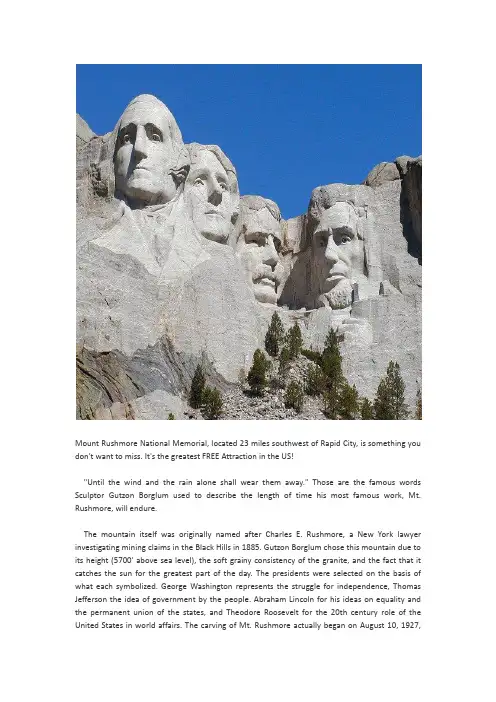
Mount Rushmore National Memorial, located 23 miles southwest of Rapid City, is something you don't want to miss. It's the greatest FREE Attraction in the US!"Until the wind and the rain alone shall wear them away." Those are the famous words Sculptor Gutzon Borglum used to describe the length of time his most famous work, Mt. Rushmore, will endure.The mountain itself was originally named after Charles E. Rushmore, a New York lawyer investigating mining claims in the Black Hills in 1885. Gutzon Borglum chose this mountain due to its height (5700' above sea level), the soft grainy consistency of the granite, and the fact that it catches the sun for the greatest part of the day. The presidents were selected on the basis of what each symbolized. George Washington represents the struggle for independence, Thomas Jefferson the idea of government by the people. Abraham Lincoln for his ideas on equality and the permanent union of the states, and Theodore Roosevelt for the 20th century role of the United States in world affairs. The carving of Mt. Rushmore actually began on August 10, 1927,and spanned a length of 14 years. Only about six and a half years were spent actually carving the mountain, with the rest of the time being spent on weather delays and Borglum's greatest enemy - the lack of funding. The total cost of the project was $900,000. Work continued on the project until the death of Gutzon Borglum in 1941. No carving has been done on the mountain since that time and none is planned in the future.The granite faces of four American presidents' is scaled to men who would stand 465 feet tall! President Calvin Coolidge believed Mount Rushmore was "decidedly American in its conception, magnitude and meaning. It is altogether worthy of our country," Coolidge proclaimed at the dedication of the project in 1927.The most spectacular program at Mount Rushmore is the evening lighting ceremony held in the new amphitheater, 9:00 PM sharp. A must see when you are touring the beautiful Black Hills of South Dakota.A $56 million redevelopment was completed in 1998 with the addition of a new parking structure, amphitheater, museum/theater complex, Visitor Orientation Center, Presidential Trail, gift shop, bookstore, and dining facilities. To complete your Rushmore experience, view the evening lighting ceremony. The National Park Service sponsors a special program Memorial Day through Labor Day. It consists of a 10-minute talk followed by a 20-minute film. The highlight of the evening is the slow exposure of light to the monument until it is fully illuminated. It's a good idea to go early and bring a jacket. Program times are as follows: 9:00-9:30 P.M. lighting ceremony, 9:30-10:30 P.M. illumination. For these traveling in the off season, the faces are illuminated nightly. There are few people who are not subdued by the moments as they gaze upon the beauty of Mt. Rushmore. Just as the monument challenged its creator, so should its splendor challenge its viewer.拉什莫尔山国家纪念公园,也称为美国总统山,位于美国南达科他州。

如何保护文化遗产演讲比赛英语作文全文共5篇示例,供读者参考篇1My Super Important Speech About Protecting Culture TreasuresHi everyone! My name is Jamie and I'm here today to talk about something very important - protecting cultural heritage. Now, you might be wondering "What even is cultural heritage?" Well, it's all the really cool old stuff that teaches us about how people lived a long, long time ago.It includes ancient buildings, historic monuments, artwork, traditions, legends - basically anything made or created by humans in the past that helps us understand history and different cultures. Things like the Egyptian Pyramids, the Colosseum in Rome, the Forbidden City in China, and special holiday celebrations or dances passed down for generations.Why Do We Need to Protect It?Protecting cultural heritage is super duper important for many reasons:It helps us learn about the past. All those old ruins, artifacts, and traditions are like clues that historians and archaeologists use to figure out what life was like way back when. The more we can preserve, the more we can discover!It celebrates diversity. Different cultures all over the world have their own unique customs, arts, languages, and belief systems. Protecting heritage sites and traditions helps us appreciate how amazingly diverse humanity is.It inspires us. Ancient marvels like Machu Picchu, the Taj Mahal, and Stonehenge show the incredible things people created without modern technology. They fire up our imagination and creativity.It's our history. Cultural heritage represents the achievements and stories of our ancestors. It connects us to where we came from as a human family. Protecting it means protecting our own roots.So How Can We Protect It? Here are some ideas:Don't be destructive! This one is obvious but superimportant. Never deface, vandalize or intentionally harm cultural heritage sites and objects. Be very gentle if you visit ruins or historic places.Learn about it. The more you know about cultural heritage, the more you'll appreciate its value. Read books, watch documentaries, and ask questions. Knowledge leads to caring!Share what you know. Teaching others gets them interested too. You could give presentations, make videos, or start a blog or website all about cultural heritage protection.Join heritage clubs or youth groups. There are lots of great organizations focused on cultural preservation. Getting involved lets you take hands-on action.Be an antiquities detective. If you see someone trying to loot, steal, or sell artifacts or antiquities illegally, tell a trusted adult right away so authorities can stop them.Visit museums and historic sites. This supports cultural institutions financially through ticket sales so they can keep up their preservation efforts.Pick careers that protects heritage. You could become an archaeologist, museum curator, preservation architect, conservator, and more when you grow up.Reduce litter and pollution. Things like plastic waste, factory emissions, and oil spills can heavily damage heritage sites over time. Cut down on trash as much as you can!Share traditions. Keep old customs, languages, music, and recipes alive by learning them and passing them along. That's preserving intangible heritage.Speak up! Write letters to government leaders urging stronger laws to protect cultural heritage worldwide. Use your voice for these great causes.Those are just some ideas for how kids like us can look after the amazing diversity of cultural heritage all around the planet. It's a huge responsibility, but also an incredible opportunity to connect with history.If we work together and make an effort, we can save humanity's most precious creations, traditions, and stories for many, many more generations to discover and enjoy. Our ancestors preserved this heritage for us - now it's our turn to be its guardians and protectors. Let's make them proud!I'll leave you with this final thought: cultural heritage isn't just about the past. It's about understanding each other better today while inspiring the world we'll create tomorrow. It deserves to be celebrated, cherished, and shielded with everything we've got.Thank you all for listening! I'll do my part to protect our amazing cultural treasures. Will you?篇2How to Protect Cultural HeritageHi everyone! My name is Emily and I'm in 5th grade. Today I want to talk to you about something really important - protecting our cultural heritage.Cultural heritage is all the really cool old stuff that tells us about how people lived a long time ago. It includes ancient buildings, artworks, traditions, and anything else that shows the culture and history of a group of people. Protecting our cultural heritage is super important because it helps us learn about the past and where we came from.There are so many amazing cultural heritage sites and objects all around the world. Have you ever seen pictures of the ancient Egyptian pyramids? Or the giant moai statues on Easter Island? How about the Colosseum in Rome where gladiators used to fight? Those are all examples of cultural heritage that hundreds and thousands of years old!Closer to home, we have places like Independence Hall in Philadelphia where the Declaration of Independence and U.S.Constitution were signed. And the cliff dwellings at Mesa Verde National Park where the Ancestral Puebloans lived a long, long time ago. Cultural heritage is everywhere if you know where to look.Unfortunately, a lot of cultural heritage is in danger of being destroyed or lost forever. Ancient buildings can fall apart from getting old or damage from the weather. Objects like pottery or tools can easily break. Cultural traditions can be forgotten if they aren't passed down. That's why we have to work hard to protect cultural heritage for future generations.So how can we protect cultural heritage? There are lots of ways! One way is by being really careful around ancient sites and not touching or damaging anything. Sometimes people carve their names into old buildings or take little pieces as souvenirs, but that's not okay because it ruins the cultural heritage for everyone else.Another way to protect cultural heritage is by learning about it and teaching others. The more people know about the cool history behind cultural heritage sites and objects, the more they'll want to protect them. We can learn about cultural heritage in school, go on field trips to museums and historic sites, and read books about different cultures.People called archaeologists also help protect cultural heritage by studying and preserving ancient sites and artifacts. They carefully dig up and document old objects so we can learn from them. Archaeologists have to be really careful not to damage anything.Organizations like UNESCO also work hard to identify important cultural heritage around the world and make sure it is preserved and protected. They make lists of World Heritage sites that are considered super historically important for the whole world. The Pyramids, Easter Island statues, and Mesa Verde cliff dwellings are all UNESCO World Heritage sites.Governments can help too by making laws to protect cultural heritage and providing money to preserve ancient sites and artifacts. They can create museums to house cultural objects and hire people to study cultural traditions so they aren't forgotten.But regular people like you and me can also do our part. We can be respectful visitors at cultural sites by not touching or damaging anything. We can learn about different cultures and share that knowledge with others. We can write letters to government leaders asking them to protect cultural heritage. Every little bit helps!Protecting cultural heritage is so important because it allows us to learn about the people who came before us. Their buildings, objects, and traditions tell the story of where we came from as humans. If we don't protect cultural heritage sites and objects, those stories could be lost forever. That would be such a shame!Our cultural heritage makes the world such an interesting and cool place. Just imagine if there were no pyramids in Egypt, no moai on Easter Island, and no cliff dwellings in the Southwest. We wouldn't be able to see and learn from those amazing remnants of ancient cultures. That's why we all need to do our part to be cultural heritage protectors!So next time you visit a museum, read about an ancient culture, or see remnants of the past in your town, remember how lucky we are to have that cultural heritage. And think about ways you can help protect it, whether by being a respectful visitor, learning more about it, or telling others how important it is. Our cultural heritage is a gift from the past that we need to treasure for the future. Let's work together to protect it!篇3Hi everyone! My name is Emma and I'm 10 years old. Today I want to talk to you about something very important - protectingour cultural heritage. Cultural heritage is all the really cool stuff from the past that helps us understand who we are and where we came from. It includes amazing old buildings, artifacts, traditions, and more!Protecting cultural heritage is super duper important because it keeps history alive. If we don't take care of it, we could lose it forever. Can you imagine a world without the Egyptian Pyramids? Or the Taj Mahal? Or the Forbidden City in China? Those places are incredible treasures from long ago that teach us so much. We have to make sure they stay around for future generations.There are actually lots of threats to cultural heritage that we need to watch out for. One biggie is natural disasters like earthquakes, floods, and fires. These can seriously damage or even destroy historic sites and artifacts. Another threat is war and conflict, which is really sad. Many cultural treasures have been lost or ruined because of fighting over the years. We also have to be careful about pollution, urbanization (that means cities getting bigger), and tourism. Too many visitors can wear down fragile sites over time.So what can we do to protect cultural heritage? Well, there are some amazing organizations out there working really hardon this, like UNESCO World Heritage. They make lists of the most important cultural and natural sites in the world and help countries take care of them.But we can all do our part too! One way is by learning about cultural heritage so we understand why it's valuable. We can also be respectful visitors if we go to museums or historic places. That means not touching anything unless we're allowed, staying quiet, and following the rules. Picking up litter at cultural sites helps too.Another way to protect cultural heritage is by celebrating our own cultures and traditions at home. This keeps them alive and meaningful. Things like festivals, dances, food, songs, art, and stories all connect us to our roots. If we keep doing these things, they won't disappear.If you ever get a chance to be an archaeologist when you grow up, that's another great way to discover and protect cultural heritage! Archaeologists are like detectives of the past - they carefully excavate and study ancient ruins and artifacts to learn about how people lived long ago. Super cool!We can also support laws that protect cultural heritage sites, speak up if we see places being damaged or neglected, and learnabout different cultures to appreciate diversity. Every culture is special and valuable.Protecting cultural heritage might seem like a big job, but we can do it if we all work together. We have to be the guardians and caretakers of these incredible treasures from the past. They teach us who we are, where we came from, and how we've grown as humans over thousands of years. How amazing is that?So let's all make an effort to value cultural heritage - whether it's right in our own hometowns or all the way across the world. It connects us to our shared human story on this planet, and that's a bond that makes the world a little smaller and a little less strange. We're all custodians of the past and it's our duty to protect it for the future. What do you say, who's with me?篇4My name is Jamie and I'm 10 years old. Today I want to talk to you about protecting cultural heritage. Cultural heritage is something very important that we need to take care of.Cultural heritage refers to things from the past that have special value or meaning. It includes stuff like old buildings, monuments, artifacts, traditions, languages, and anything else that is part of a community or country's history and culture.There are many reasons why we should protect cultural heritage. First of all, it helps us understand where we came from and how people lived in the past. Looking at old ruins, reading ancient texts, or seeing artifacts in museums teaches us about our ancestors and how society has changed over time. It's like a window into the lives of people who lived long ago.Cultural heritage is also really important for preserving the unique traditions and identities of different groups of people around the world. Every community, whether it's an indigenous tribe or the people living in a particular country or region, has its own special customs, arts, foods, music, dances, and more. These things make each culture distinct and fascinating! If we don't actively protect them, they could be lost forever as the world becomes more modern and globalized.Another big reason to care about cultural heritage is because many of these historical sites, artifacts, and traditions are extremely old and fragile. Once they are damaged or destroyed, they can never be fully recovered or replaced. It would be such a shame to lose glimpses into humanity's rich history and diverse cultures around the globe.So how can we protect cultural heritage? I have some ideas!One of the most important things is protecting physical sites and objects. We need to make sure ancient ruins, old buildings, artifacts in museums, and other cultural heritage treasures are taken care of properly. This means preserving them from damage caused by factors like weather, pollution, war, vandalism, and neglect.Governments should provide funding to maintain historical sites and have strict rules about construction or development around protected areas. Museums should follow very careful procedures for storing and displaying delicate artifacts so they don't get harmed.The knowledge and techniques for repairing and restoring damaged heritage sites should also be supported.People who visit cultural heritage sites as tourists need to be respectful as well. Don't deface or take souvenirs from ancient ruins or monuments. Don't touch artifacts with dirty hands in museums. Follow all the rules about where you can and cannot go or what you can photograph or video record.In addition to physical objects and places, we also need to protect intangible cultural heritage. These are living traditions like songs, dances, celebrations, arts and crafts, languages, and more that get passed down from generation to generation.Governments and community organizations can support cultural heritage bearers like artists, musicians, storytellers, and elders who keep traditions alive. They can provide funds, training, and spaces for people to learn, practice, and share these customs.Schools can also play a big role by teaching students about their cultural heritage from a young age. Exposing kids to traditional stories, festivals, arts, foods, and languages helps ensure these practices continue in the future.Every person can do their part too. Learn about your family's cultural heritage and participate in celebrating holidays or traditions. Appreciate the beauty and significance of traditional arts, music, clothing styles, folklore, and wisdom passed down over the centuries. Encourage your parents, grandparents, and elders to share skills and stories. If you're from a minority or indigenous group, make an effort to learn your ancestral languages that could be endangered or dying out.Protecting cultural heritage isn't just about preserving old stuff - it's about respecting the diverse people, places, knowledge, and creativity that have shaped humanity throughout history and today. It allows us to better understand each other and our amazingly vibrant world.So be proud of your cultural heritage! Share it, learn about it, appreciate it, and do what you can to make sure it gets passed along to future generations. We're all guardians of these precious treasures from the past. Let's work together to keep our rich cultures and histories alive!篇5My Cultural Heritage EssayHi everyone! My name is Jamie and I'm 10 years old. Today I want to talk to you about something really important - protecting our cultural heritage. But first, what is cultural heritage?Cultural heritage is all the cool stuff that gets passed down from our ancestors. It includes things like historic buildings, ancient ruins, artwork, traditions, and anything else that helps define who we are as a community or nation. Just think about your favorite holiday traditions or historic sites you've visited - that's all part of our cultural heritage!Protecting cultural heritage is super important for lots of reasons. First of all, it helps us learn about history. Can you imagine if the Egyptian pyramids or the Colosseum in Rome just disappeared? We wouldn't be able to study how people livedway back then. Cultural heritage sites are like awesome time capsules!Cultural heritage also makes our world way more interesting and fun. Imagine if every city looked exactly the same with the same buildings and no unique traditions. How boring would that be? The cultural heritage of different places is what gives them personality and makes them special.Unfortunately, lots of cultural heritage is disappearing or getting damaged and destroyed. Sometimes it's from natural causes like earthquakes, floods, or just getting old and run-down over time. But other times it's because of humans doing things like building new construction on historic sites, looting artifacts, or even purposely destroying cultural heritage during wars. That's so sad!So what can we do to protect cultural heritage? I've got some ideas:Learn about cultural heritage! The more you know, the more you'll appreciate it. Read books, visit museums, and ask your teachers to share info about local heritage. Understanding why heritage is important is the first step to caring about protecting it.Be a heritage tourist. If you're traveling somewhere new, pick cultural heritage sites to visit instead of just going to the mall or whatever. When you spend money at heritage sites, it helps provide funds to maintain them.Join clubs or volunteer groups that work on preserving heritage. There are lots of organizations that repair historic buildings, clean up heritage sites, and educate people on cultural preservation.Be an archaeologist for a day! Sometimes museums and historic sites let kids and families help out with digs and cleaning artifacts. It's fun andyou're helping out.Recycle and reduce waste. Protecting the environment is protecting our modern-day heritage. The less pollution and damage to nature, the better chance we have of preserving culturallandscapes.Respectcultural heritage when you see it. Don't deface or destroy anything. Take only photos and memories, not objects or pieces of heritage sites.Write letters! Send messages to your political leaders saying you want them to do more to protect heritage. The more people speak up, the more likely they'll listen.Keep your own heritage alive. Celebrate your family's cultural traditions at home. Teach youngsiblings about your heritage. The more we cherish our own legacies, the more we'll value heritage overall.I know protecting cultural heritage can seem like a huge responsibility, but we can all do our part - even kids! Our heritage helps define who we are, where we came from, and how we understand the world. Without it, we'd lose a piece of what makes us human.Imagine if in hundreds of years, people couldn't learn about our lives today. We'd just be a question mark in history books! That would be such a bummer. By protecting cultural heritage now, we're making sure the awesomeness of human civilization gets passed down forever and ever.What's your favorite cultural heritage site or tradition? I'd love to hear about it! No matter what it is, I'll do my part to make sure it's still around for a super long time. Will you join me? Let's show cultural heritage some love!。

In the United States A Reading Comprehension正文In the United States, a vast and diverse country located in North America, there are numerous aspects to explore and comprehend. From its history and culture to its government and economy, the United States offers a wealth of knowledge and understanding. This article aims to provide a comprehensive and objective overview of the United States, shedding light on some of the key aspects that define the nation.The United States, often referred to as the USA or America, is comprised of 50 states and one federal district. It spans a vast territory, with a population of over 331 million people from various ethnic, cultural, and religious backgrounds. The country's history dates back to the arrival of European settlers in the 16th century, followed by the establishment of the 13 British colonies that eventually declared independence in 1776.The United States operates under a federal system of government, with power divided between the national government and individual state governments. The U.S. Constitution, adopted in 1787, serves as the supreme law of the land,outlining the structure of the government and protecting the rights and freedoms of its citizens. The government is comprised of three branches: the executive branch, headed by the President; the legislative branch, consisting of the Senate and the House of Representatives; and the judicial branch, led by the Supreme Court.The United States is known for its cultural diversity, influenced by various immigrant groups from around the world. It is often referred to as a 'melting pot' due to the blending of different cultures, languages, and traditions. English is the most widely spoken language, although Spanish is also prevalent, particularly in states bordering Mexico.Economically, the United States is one of the largest and most developed countries in the world. It has a highly diversified economy, characterized by sectors such as finance, technology, manufacturing, and services. The country's currency is the United States dollar, and it plays a significant role in global trade and finance.In terms of education, the United States boasts numerous prestigious universities and colleges known for their academic excellence. It attracts students from around the world who seek a high-quality education and research opportunities.The United States also has a rich cultural and entertainment scene. Hollywood, located in Los Angeles, California, is considered the center of the American film industry and has produced countless iconic movies and stars. The country is also renowned for its music industry, with genres such as jazz, blues, rock, and hip-hop originating or flourishing within its borders.In conclusion, the United States is a vast and diverse country with a rich history, diverse culture, and powerful economy. Its government structure, cultural assimilation, economic prowess, and contributions to various fields make it an important and influential nation in the global arena. Understanding the United States requires a comprehensive examination of its history, government, culture, and economy, and this article aims to provide a brief yet insightful overview.。