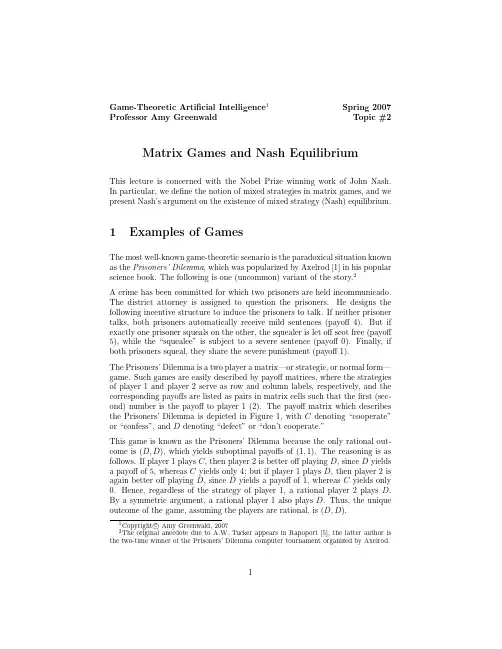
Game-Theoretic Artificial Intelligence1Spring2007 Professor Amy Greenwald Topic#2 Matrix Games and Nash EquilibriumThis lecture is concerned with the Nobel Prize winning work of John Nash. In particular,we define the notion of mixed strategies in matrix games,and we present Nash’s argument on the existence of mixed strategy(Nash)equilibrium. 1Examples of GamesThe most well-known game-theoretic scenario is the paradoxical situation known as the Prisoners’Dilemma,which was popularized by Axelrod[1]in his popular science book.The following is one(uncommon)variant of the story.2A crime has been committed for which two prisoners are held incommunicado. The district attorney is assigned to question the prisoners.He designs the following incentive structure to induce the prisoners to talk.If neither prisoner talks,both prisoners automatically receive mild sentences(payoff4).But if exactly one prisoner squeals on the other,the squealer is let offscot free(payoff5),while the“squealee”is subject to a severe sentence(payoff0).Finally,if both prisoners squeal,they share the severe punishment(payoff1).The Prisoners’Dilemma is a two player a matrix—or strategic,or normal form—game.Such games are easily described by payoffmatrices,where the strategies of player1and player2serve as row and column labels,respectively,and the corresponding payoffs are listed as pairs in matrix cells such that thefirst(sec-ond)number is the payoffto player1(2).The payoffmatrix which describes the Prisoners’Dilemma is depicted in Figure1,with C denoting“cooperate”or“confess”,and D denoting“defect”or“don’t cooperate.”This game is known as the Prisoners’Dilemma because the only rational out-come is(D,D),which yields suboptimal payoffs of(1,1).The reasoning is as follows.If player1plays C,then player2is better offplaying D,since D yields a payoffof5,whereas C yields only4;but if player1plays D,then player2is again better offplaying D,since D yields a payoffof1,whereas C yields only 0.Hence,regardless of the strategy of player1,a rational player2plays D. By a symmetric argument,a rational player1also plays D.Thus,the unique outcome of the game,assuming the players are rational,is(D,D).C D 4,40,51,1 5,0D C12Figure1:The Prisoners’DilemmaAnother popular two-player game is called the Battle of the Sexes.A man and a woman would like to spend an evening out together;however,the man prefers to go to a football game(strategy F),while the woman prefers to go to the ballet(strategy B).Both the man and the woman prefer to be together,even at the event that is not to their liking,rather than go out alone.The payoffs of this coordination game are shown in Figure2;the woman is player1and the man is player2.In this game,there are two coordination equilibria,one which is preferred by the woman,and another which is preferred by the man.12BB2,10,01,20,0FFFigure2:Battle of the SexesThe stag hunt game(see Figure3)is a prototypical social contract.Rousseau tells an early version of the story in A Discourse on Inequality.:If it was a matter of hunting a deer,everyone realized that he mustremain well faithful to his post;but if a hare happened to pass withinreach of one of them,we cannot doubt that he would have gone offin pursuit of it without scruple...This game has two equilibria,one of which Pareto dominates the other:i.e., all players are simultaneously better offat one equilibrium than the other.But action H risk-dominates action D,since action H is safer for each player,given his/her uncertainty about the other player’s action.212DD 2,20,11,0HH 1+ε,1+εFigure 3:Stag HuntOur final example is an ecological game which was studied by Maynard Smith [6]in his analysis of the theory of evolution in terms of games (see Figure 4).The game is played between animals of the same size who live in the wilderness and encounter one another in their search for prey.During an encounter between two animals,each animal has a choice between behaving as a hawk:i.e.,fighting for the prey;or as a dove:i.e.,sharing the prey peacefully.If both animals decide to play like hawks,then each animal has an equal chance of winning the value v of the prey or of losing the fight at cost c ,where 0<v <c ;thus,the expected payoffto both players is (v −c )/2.Alternatively,if both animals act as doves,then the prey is shared with equal payoffs v/2.Finally,if one animal behaves like a hawk and the other behaves like a dove,then the hawk gets a payoffworth the full value of the prey and the other gets nothing.In this game,the animals prefer to choose opposing strategies:if one animal plays hawk,then it is in the best interest of the other to play dove;and inversely,if one animal plays dove,then it is in the best interest of the other to play hawk.D D H12Hv,0(v-c)/2(v-c)/2,0,v v/2,v/2Figure 4:Hawks and Doves32Nash EquilibriumA Nash equilibrium is a strategy profile from which none of the players has any incentive to deviate.In particular,no player can achieve strictly greater payoffs by choosing any strategy other than the one prescribed by the profile,given that all other players choose their prescribed strategies.In this sense,a Nash equilibrium specifies optimal strategic choices for all players.Let us examine the Nash equilibria in the aforementioned examples:•In the Prisoners’Dilemma,(D,D)is a Nash equilibrium:given that player 1plays D,the best response of player2is to play D;given that player2 plays D,the best response of player1is to play D.•The Battle of the Sexes has two pure strategy Nash equilibria,namely (B,B),and(F,F):If the woman plays B,then the best response of the man is B;if the man plays B,then the best response of the woman is B.Analogously,if the woman plays F,the best response of the man is F;if the man plays F,the best response of the woman is F.•The game of Hawks and Doves also has two pure strategy Nash equilibria, only this time,the players seek to miscoordinate their actions,rather than coordinate.If one player plays the hawk,then the other player prefers to play the dove,achieving payoffs of0,rather than(v−c)/2<0.On the other hand,if one player plays the dove,then the other player prefers to play the hawk,achieving payoffs of v,rather than v/2.•Finally,in the Stag Hunt,both(D,D)and(H,H)are Nash equilibria: hunting for deer is Pareto-optimal,but hunting for hare is risk-dominant. Matching Pennies is another well-known example of a two player,zero-sum game.In this game,each of the players,the matcher and the mismatcher,3flips a coin,and the payoffs are determined as follows.If the coins come up matching (i.e.,both heads or both tails),then the matcher wins,so the mismatcher pays the matcher$1.If the coins do not match(i.e.,one head and one tail),then the mismatcher wins,so the matcher pays the mismatcher$1.In Figure5,player 1is the mismatcher and player2is the matcher.This game is called zero-sum because the payoffs in each cell of the matrix sum to zero.In the game of Matching Pennies,there is no pure strategy Nash equilibrium. If player1plays H,then the best response of player2is T;but if player2plays T,the best response of player1is not H,but T.Moreover,if player1plays T, then the best response of player2is H;but if player2plays H,then the best response of player1is not T,but H.This game,however,does have a mixed strategy Nash equilibrium.A mixed strategy is a randomization over a set of12H TH T 1,-1-1,1 -1,11,-1Figure5:Hawks and Dovespure strategies.In particular,the probabilistic strategy profile in which bothplayers choose H with probability12is the unique(mixed strategy)Nash equilibrium in the game of Matching Pennies.A matrix game is a3-tupleΓ=(N,(A i,R i)1≤i≤n),where•N is a set of n players•A i is afinite strategy(or action)set(a i∈A i)•R i:A→R is a payofffunction,where A=A1×...×A nMatrix games are also sometimes called games in strategic,or normal,form.In this formalism,the Prisoners’Dilemma consists of a set of players N={1,2}, with strategy(action)sets A1=A2={C,D},and payoffs as follows:R1(C,C)=R2(C,C)=4R1(C,D)=R2(D,C)=0R1(D,D)=R2(D,D)=1R1(D,C)=R2(C,D)=5A mixed strategy set for player i is the set of probability distributions over the action set A i,which can be described by the simplex operator∆:∆(A i)= q i:A i→[0,1]| a i∈A i q i(a i)=1For convenience,let Q i≡∆(A i).The usual notational conventions extend to mixed strategies: e.g.,Q= i Q i and q=(q i,q−i)∈Q.In the context of mixed strategies,the expected payoffs to player i from strategy profile q are:E a∼q[R i(a)]= a∈A q(a)R i(a)whereq(a)=N j=1q j(a j) 5As usual,the payoffs to player i depend on the mixed strategies of all players. An implication of the assumption of rationality is that a rational player always plays an optimizing strategy,or a best response to the strategies of the other players.A strategy q∗i∈Q i is a best response for player i to opposing strategy q−i∈Q−i iff∀q i∈Q i,E[R i(q∗i,q−i)]≥E[R i(q i,q−i)].The best response set for player i to strategy profile q−i is:br i(q−i)={q∗i∈Q i|∀q i∈Q i,E[R i(q∗i,q−i)]≥E[R i(q i,q−i)]} The set br i(q−i)is often abbreviated br i(q).Let br(q)= i br i(q).A Nash equilibrium is a strategy profile in which all players choose strategies that are best responses to the strategic choices of the other players.Characterized in terms of best response sets,a Nash equilibrium is a strategy profile q∗s.t. q∗∈br(q∗).It is apparent from this definition that a Nash equilibrium is a fixed point of the best response relation.In1951,Nash proved that everyfinite strategic form game has(at least)one mixed strategy Nash equilibrium[4].The existence proof relies on a fundamental result in topology,namely Kakutani’s fixed point theorem,a generalization of Brouwer’sfixed point theorem[2].2.1Digression:Fixed Point TheoremsA closed set X contains all its limit points:i.e.,for all sequences{x n}in X,if x n→x,then x∈X.A set is open if its complement is closed.For example, the interval[0,1]is a closed subset of R and the interval(0,1)is an open subset of R;but the intervals(0,1]and[0,1)are neither open nor closed subsets of R.A subsequence of the sequence{x n}is a restriction of the mapping from N to X to a mapping from N′⊆N to X.A subsequence is a sequence in its own right.A set X is called compact iffevery sequence in X has a convergent subsequence that converges to a point in X.Note that every compact set is closed.Heine-Borel Theorem A set X⊆R n is compact iffit is closed and bounded. Weierstrass’Theorem A real-valued continuous function on a compact set attains a maximum and a minimum.A correspondence f:X⇒Y is a mapping from X to subsets of Y:i.e., f(x)⊆Y.A function is a special case of a correspondence in which f(x) is a singleton for all x∈X.Just as functions can be associated with their graphs,correspondences can be associated with their graphs.The graph of the correspondence f is the set of pairs{(x,y)|x∈X,y∈f(x)}.A set X is called convex iff∀λ∈[0,1],∀x,y∈X,λx+(1−λ)y∈X.The correspondence f is nonempty and convex-valued ifff(x)is nonempty and convex for all x∈X. Kakutani’s Fixed Point Theorem.Let X⊂R n be nonempty,compact, and convex.If f:X⇒X is a nonempty,convex-valued correspondence with a closed graph,then f has afixed point:i.e.,there exists x∗∈X s.t.x∗∈f(x∗).6Brouwer’s Fixed Point Theorem.Let X⊂R n be nonempty,compact, and convex.If f:X→X is a continuous function,then f has afixed point:i.e.,there exists x∗∈X s.t.x∗=f(x∗).2.2Proof of ExistenceThe proof of existence of Nash equilibrium is a direct application of Kakutani’s fixed point theorem.It suffices to show that the set of mixed strategies Q is nonempty,compact,and convex,and that the best-response correspondence (i.e.,br:Q⇒Q)is nonempty and convex-valued,with a closed graph.Lemma The set of mixed strategies Q is nonempty,compact,and convex. Proof Recall that Q= i Q i,where Q i is the set of probability over distri-butions player i’s the action set A i.The set Q is nonempty(assuming A i is nonempty,for all players i).Given a sequence{(q m1,...,q m n)}of mixed strategies.that converges to(q∗1,...,q∗n). This limit point is indeed a mixed strategy:i.e.,q∗i≥0and i q∗i=1.The former claim follows from the fact that the limit of a sequence of non-negative points is itself non-negative.The latter claim follows from the fact that the sumof the limits equals the limit of the sum.Thus,Q is closed.Moreover,Q is bounded in each component by0and1.Therefore,Q is compact.The set of mixed strategies Q i for each player i is convex:i.e.,for all q i,p i∈Q i, for allλ∈[0,1],the convex combinationλq i+(1−λ)p i∈Q i.thus,given two elements(q1,...,q n),(p1,...,p n)∈Q,the convex combinationλ(q1,...,q n)+ (1−λ)(p1,...,p n)=(λq1+(1−λ)p1,...,λq n+(1−λ)p n)∈Q,for allλ∈[0,1]. Thus,the set of mixed strategies Q is nonempty,compact,and convex.Lemma The best-response correspondence is nonempty.Proof By Weierstrass’theorem,any real-valued continuous function on a compact set attains a maximum.Recall that the set Q i is compact.Since R i isa linear function of Q i,R i is continuous.Thus,br i:Q→Q i is nonempty,for all players i,from which it follows that br is nonempty.Lemma The best-response correspondence is convex-valued.Proof If q∗i,p∗i∈br i(q−i)are best replies of player i to q−i,then R i(q∗i,q−i)=R i(p∗i,q−i)=λR i(q∗i,q∗−i)+(1−λ)R i(p∗i,q∗−i).Now,by the linearity of R i,λR i(q∗i,q∗−i)+(1−λ)R i(p∗i,q∗−i)=R i(λq∗i+(1−λ)p∗i,q∗−i).Thus,the convex combinationλq∗i+(1−λ)p∗i∈br i(q−i).Since q−i was arbitrary,br i is convex-valued.Since i was arbitrary,br is convex-valued.Lemma The graph of the best-response correspondence is closed.7Proof Must show p ∈br (q ),given the sequences q m ,p m ∈Q s.t.q m →q and p m →p ,with p m ∈br (q m )for all m .Suppose not:i.e.,suppose there exists player i s.t.p i ∈br i (q −i ).It follows that there exists q i ∈Q i s.t.R i (q i ,q −i )>R i (p i ,q −i ).Now let δ≡R i (q i ,q −i )−R i (p i ,q −i )>0.Since R i is linear,and therefore continuous,for all ǫ>0,there exists M ǫ∈N s.t.for all m ≥M ǫ,|R i (p m i ,q m −i )−R i (p i ,q −i )|<ǫand |R i (q i ,q m −i )−R i (q i ,q −i )|<ǫ.NowR i (q i ,q m −i )>R i (q i ,q −i )−ǫ=R i (p i ,q −i )+R i (q i ,q −i )−R i (p i ,q −i )−ǫ=R i (p i ,q −i )+δ−ǫ>R i (p m i ,q m −i )+δ−2ǫIf ǫ=δ/2,then R i (q i ,q m −i )>R i (p m i ,q m −i ),for all m ≥M δ/2.But then p m i ∈br i (q m −i )for all m .Contradiction.Therefore,the graph of br is closed.Exercise Compute the best-response correspondences for the game depicted in Figure 6,a version of Hawks and Doves.Plot these correspondences,and compute all Nash equilibria.12H H 1,1D D2,00,2−1,−1Figure 6:Hawks and Doves3SummaryIn this lecture,we defined Nash equilibrium and reproved Nash’s theorem guar-anteeing its existence in all (finite)matrix games.Although Nash equilibrium is the generally accepted solution concept in the deductive analysis of matrix games,the Nash equilibria in our examples are somewhat peculiar.In the Prisoners’Dilemma,the Nash equilibrium payoffs are sub-optimal.In the game of Matching Pennies,there is no pure strategy Nash equilibrium;the unique Nash equilibrium is probabilistic.Finally,in the coordination and miscoordination games,the Nash equilibrium is not unique.In future lectures,alternative notions of equilibria are discussed.8References[1]R.Axelrod.The Evolution of Cooperation.Basic Books,New York,1984.[2]L.Brouwer.Uber abbildungen von mannigfaltigkeiten.Mathematische An-nalen,38(71):97–115,1912.[3]S.Kakutani.A generalization of brouwer’sfixed point theorem.Duke Math-ematical Journal,8:457–458,1941.[4]J.Nash.Non-cooperative games.Annals of Mathematics,54:286–295,1951.[5]A.Rapoport.Two-Person Game Theory.University of Michigan Press,AnnArbor,1966.[6]J.M.Smith.Evolution and the Theory of Games.Cambridge UniversityPress,New York,1982.9。