
初中全英课程学习 Area
- 格式:ppt
- 大小:244.50 KB
- 文档页数:17

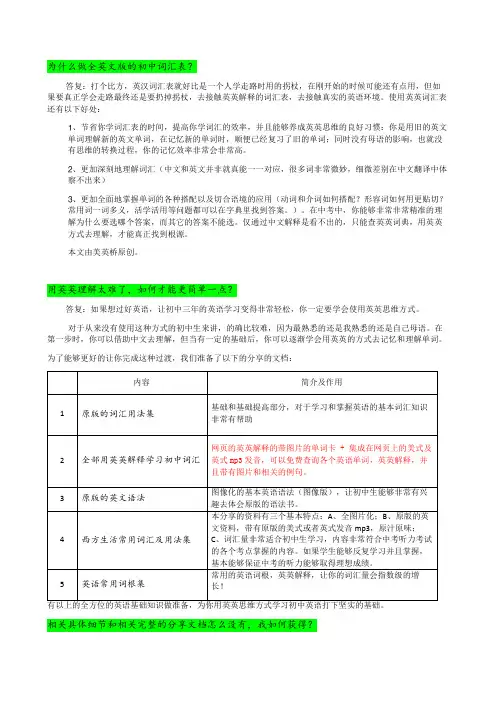
为什么做全英文版的初中词汇表?答复:打个比方,英汉词汇表就好比是一个人学走路时用的拐杖,在刚开始的时候可能还有点用,但如果要真正学会走路最终还是要扔掉拐杖,去接触英英解释的词汇表,去接触真实的英语环境。
使用英英词汇表还有以下好处:、节省你学词汇表的时间,提高你学词汇的效率,并且能够养成英英思维的良好习惯:你是用旧的英文单词理解新的英文单词,在记忆新的单词时,顺便已经复习了旧的单词;同时没有母语的影响,也就没有思维的转换过程,你的记忆效率非常会非常高。
、更加深刻地理解词汇(中文和英文并非就真能一一对应,很多词非常微妙,细微差别在中文翻译中体察不出来)、更加全面地掌握单词的各种搭配以及切合语境的应用(动词和介词如何搭配?形容词如何用更贴切?常用词一词多义,活学活用等问题都可以在字典里找到答案。
)。
在中考中,你能够非常非常精准的理解为什么要选哪个答案,而其它的答案不能选。
仅通过中文解释是看不出的,只能查英英词典,用英英方式去理解,才能真正找到根源。
本文由美英桥原创。
用英英理解太难了,如何才能更简单一点?答复:如果想过好英语,让初中三年的英语学习变得非常轻松,你一定要学会使用英英思维方式。
对于从来没有使用这种方式的初中生来讲,的确比较难,因为最熟悉的还是我熟悉的还是自己母语。
在第一步时,你可以借助中文去理解,但当有一定的基础后,你可以逐渐学会用英英的方式去记忆和理解单词。
为了能够更好的让你完成这种过渡,我们准备了以下的分享的文档:相关具体细节和相关完整的分享文档怎么没有,我如何获得?相关的文档由于篇幅或者上传限制的原因可能不完整,请发邮件至2487452826@索取(请注意要索取的文档内容)。
词汇表特别说明:由于篇幅所限,没有相关例句,如需要,请发邮件索取Excel有例句的文档。

Fro m Module2 Uni t4Co m m unicat ion WorkshopI. Teaching a imsAt the end of th i s l e sson,s tuden t s wi l l1. be ve ry in te res ted in wr i t ing an a r t i c l e to in t roduce a p lace.2. be ab le to use su i t ab le pe rson,t ense,l ayou t,sent ence s t ruc tures and l ink ing wordsto in t roduce a p l ace.3. be p roud o f our cap i ta l Be i j ing and our hometown J iaozuo and l ove them.II. Teaching key po ints and d i f f i cu l t po ints1. Teacher l eads s tuden ts to under s tand and mas ter the l ayou t,sen t ence s t ruc tu res a nd l ink ing words e f fec t ive ly.2. Teacher l eads s tuden ts to mas t er the way to use advanced and var ious sen tences t ruc tu res.III. Teaching and learning methodsProcess-focused wri t ing approach, Group work, Coopera t ive l ea rn i ng.IV. Teaching procedure1.Teacher arouses students’ interests by showing some photos of some famous citiesin the world, and singing the song, “Welcome to Beijing”.2. Teacher shows the sample a r t i c le o f Be i j ing to s tuden ts. Th is a r t i c le se rves asl anguage inpu t before wr i t ing.3. Teacher asks s tuden ts ques t ions to l ead them t o unders tand and mas te r the l ayout, sen tence s t ruc tur es and l ink ing words e f fec t ive ly.e.g.“Ho w many paragraph s are there in the article?”Answer:(1.In t r oduc t ion. 2. Th i ngs to see. 3. Things to do. 4. Ending words.)“What fac tors a r e in cluded in the first paragraph?”Answer:(Genera l desc r ip t ion, Loca t ion, Area, Popula t ion, His to r y, Cl imate andTe mpera ture.).“Can you find and circle the beautiful and advanced sentences in the article?”Answer:(Loca t ion:1.…i s loca ted i n…2.…l i e s in….Area:1.…covers an a rea o f…2....i s the second/th i rd/...l a r ges t c i ty in the world as regards a rea.e tc.)5.Teacher introduces the writing task “write an article to introduce Jiaozuo.6. Teacher d iv ides s tuden t s in to groups o f s ix and a rouses them t o express the photos of J i aozuo in best poss ib le ways accord ing to the s en tence s t ruc tures in the a r t i c le o f Bei j ing. Meanwhi le,t eacher encourages s tuden ts t o jo in s imple s en tences toge ther with l ink ing words,r e la t ive p ronouns,p resen t pa r t i c ip les,e tc.to f orm more advanced and more va r ious sen tence s t ruc t ures.7. S tuden ts wr i t e t he f i r s t d ra f t s by themse lves.8. Teacher s t imul a tes s tuden t s to check and cor rect the i r own dra f t s; meanwhi le,t eacher p rov ides t he s t andards o f check ing and cor rec t ing. For exam ple,the con tent, the l ayout,the l a nguage,the l ink i ng words,the handwr i t ing,the te nse and person,t he gram mar and the spe l l ing.9. Teacher d iv ides s tuden t s in to groups o f s ix and a rouses them t o check and cor r ec t the i r pa r tne r s’ art i c l es. Teacher prov ides the s tandards o f check ing and cor rec t ing aga in.10. Teacher chooses two typ ica l ar t i c les to examine before c lass;s tuden ts l ea rn howto check fu l ly and e f fec t ive ly.10. Teacher he lp t he s tuden t s to s u m mar ize some typ ica l and comm on mis takes among s tuden ts’ ar t i c les,and cor r ec t and ana lyze t hem.12. Ho me work.Pol i sh the f i r s t dra f t and rewr i te i t.V.After-c lass ref lec t ion(教后反思)1. By s ing ing a s ong to l ead in,s t uden ts a re deep l y a roused to read the sample a r t i c le of Be i j ing, bu t m y s ing ing i s not p ro fess iona l and per fec t.2. The a r t i c le i s wel l des igned with many good sentence s t ruc tu res and l ink ing words, s tuden ts can unders tand them by answer ing the ques t ions in tended fo r them, bu t t he time spared for them is too limited, and they can’t fully master a nd p rac t i ce them.3. The t ime g iven s tuden t s to wr i t e i s 10 minu tes,which p roves re l a t ive ly shor t and l imi ted.I shou ld have g iven them more t ime to wri te the a r t i c l e be t te r.4. The t ime for s tuden t s to check i s on ly 3 minu tes, which p roves t o be too shor t. The check ing procedure i s ve ry impor t an t in wr i t ing prac t ice,so t eachers shou ld p lacem ore emphas i s on i t.Fro m Module2 Uni t4Co m m unicat ion WorkshopI. Teaching a imsAt the end of th i s l e sson,s tuden t s wi l l1. be ve ry in te res ted in wr i t ing an a r t i c l e to in t roduce a p lace.2. be ab le to use su i t ab le pe rson,t ense,l ayou t,sent ence s t ruc tures and l ink ing wordsto in t roduce a p l ace.3. be p roud o f our cap i ta l Be i j ing and our hometown J iaozuo and l ove them.II. Teaching key po ints and d i f f i cu l t po ints1. Teacher l eads s tuden ts to under s tand and mas ter the l ayout,sen t ence s t ruc tu res a nd l ink ing words e f fec t ive ly.2. Teacher l eads s tuden ts to mas t er the way to use advanced and var ious sen tences t ruc tu res.III. Teaching and learning methodsProcess-focused wri t ing approach, Group work, Coopera t ive l ea rn i ng.IV. Teaching procedure1.Teacher arouses students’ interests by showing some photos of some famous citiesin the world, and singing the song, “Welcome to Beijing”.2. Teacher shows the sample a r t i c le o f Be i j ing to s tuden ts. Th is a r t i c le se rves asl anguage inpu t before wr i t ing.3. Teacher asks s tuden ts ques t ions to l ead them t o unders tand and mas te r the l ayout, sen tence s t ruc tur es and l ink ing words e f fec t ive ly.e.g.“Ho w many paragraph s are there in the article?”Answer:(1.In t r oduc t ion. 2. Th i ngs to see. 3. Things to do. 4. Ending words.)“What fac tors a r e in cluded in the first paragraph?”Answer:(Genera l desc r ip t ion, Loca t ion, Area, Popula t ion, His to r y, Cl imate andTe mpera ture.).“Can you find and circle the beautiful and advanced sentences in the article?”Answer:(Loca t ion:1.…i s loca ted i n…2.…l i e s in….Area:1.…covers an a rea o f…2....i s the second/th i rd/...l a r ges t c i ty in the world as regards a rea.e tc.)5.Teacher introduces the writing task “write an article to introduce Jiaozuo.6. Teacher d iv ides s tuden t s in to groups o f s ix and a rouses them t o express the photos of J i aozuo in best poss ib le ways accord ing to the s en tence s t ruc tures in the a r t i c le o f Bei j ing. Meanwhi le,t eacher encourages s tuden ts t o jo in s imple s en tences toge ther with l ink ing words,r e la t ive p ronouns,p resen t pa r t i c ip les,e tc.to f orm more advanced and more va r ious sen tence s t ruc t ures.7. S tuden ts wr i t e t he f i r s t d ra f t s by themse lves.8. Teacher s t imul a tes s tuden t s to check and cor rect the i r own dra f t s; meanwhi le,t eacher p rov ides t he s t andards o f check ing and cor rec t ing. For exam ple,the con tent, the l ayout,the l a nguage,the l ink i ng words,the handwri t ing,the t e nse and person,t he gram mar and the spe l l ing.9. Teacher d iv ides s tuden t s in to groups o f s ix and a rouses them t o check and cor r ec t the i r pa r tne r s’ art i c l es. Teacher prov ides the s tandards o f check ing and cor rec t ing aga in.10. Teacher chooses two typ ica l ar t i c les to examine before c lass;s tuden ts l ea rn howto check fu l ly and e f fec t ive ly.10. Teacher he lp t he s tuden t s to s u m mar ize some typ ica l and comm on mis takes among s tuden ts’ ar t i c les,and cor r ec t and ana lyze t hem.12. Ho me work.Pol i sh the f i r s t dra f t and rewr i te i t.V.After-c lass ref lec t ion(教后反思)1. By s ing ing a s ong to l ead in,s t uden ts a re deep l y a roused to read the sample a r t i c le of Be i j ing, bu t m y s ing ing i s not p ro fess iona l and per fec t.2. The a r t i c le i s wel l des igned with many good sentence s t ruc tu res and l ink ing words, s tuden ts can unders tand them by answer ing the ques t ions in tended fo r them, bu t t he time spared for them is too limited, and they can’t fully master a nd p rac t i ce them.3. The t ime g iven s tuden t s to wr i t e i s 10 minu tes,which proves re l a t ive ly shor t and l imi ted.I shou ld have g iven them more t ime to wri te the a r t i c l e be t te r.4. The t ime for s tuden t s to check i s on ly 3 minu tes, which p roves t o be too shor t. The check ing procedure i s ve ry impor t an t in wr i t ing prac t i ce,so t eachers should p lacem ore emphas i s on i t.。


《旅游接待业Introduction to Hospitality》课程教学大纲一、课程基本信息课程代码:20080092课程名称:旅游接待业(全英)英文名称:Introduction to Hospitality课程类别:专业课学时:32学分:2适用对象:旅游管理(中外人才培养实验班)考核方式:考试先修课程:无二、课程简介This course provides an understanding of Tourism, Hospitality and Events as separate fields of study and the interrelationship between them all. It looks at the role of THE in society, its involvement with industry and government and its impact on the environment. Tourism, hospitality and events are often viewed as almost separate industries/activities and university degree programs. However, this course is designed to study the inter-relationships that exist between these industries and to demonstrate how they fit into the wider industrial and social landscapes.Given the increasing trend towards globalization, both socially and economically, the course will take a global perspective of these industries/activities to exemplify how they are related to, and influence the nature of, one another.As a result of this course, students should recognize that although they may be focusing their studies on one particular industry/activity they need to take into account all the others in order to fully understand their chosen area of expertise.三、课程性质与教学目的This course aims for students to develop their knowledge and understanding of the industries/activities of tourism, hospitality and events. In particular students should have aclear understanding of the sectors of these industries/activities and the inter-relationships that exist between them.After successfully completing this course you should be able to:1.clearly define tourism, hospitality and event management;prehend and report on the inter-related nature of tourism, hospitality and events;3.understand and explain the concepts, evolution and impacts of tourism, hospitality andevents globally;4.work with peers to synthesise and communicate information on a particular topic fromthe body of knowledge on tourism, hospitality, and events;5.demonstrate academic literacy and ethical scholarship, and appreciate how this appliesto future studies;pare tourism and hospitality industries in China and globally, especially theroles of different actors and management/government principles in different countrie s.四、教学内容及要求Chapter 1 Introducing Hospitality1.Learning Objectives1.1Discuss the history of hospitality through the ages.1.2Describe the characteristics of the hospitality industry.1.3Explain corporate philosophy and total Quality Management.1.4Discuss the many facets of service and why it has become such an important part ofthe hospitality industry.1.5Suggest ways to improve service.1.6Discuss current trends in the hospitality industry.2.Contents2.1Hospitality through the ages.2.2The interrelated nature of hospitality and tourism.2.3Characteristics of the hospitality industry.2.4Sustainable hospitality.2.5Trends in hospitality and tourism.3.Review and Discussion3.1Compare and contrast the characteristics of the hospitality industry in relation to thetourism industry.3.2Identify the corporate philosophy of the global hospitality industry.3.3Assess the importance of Total Quality Management in the global hotel industry.3.4What is the difference between Total Quality Management and quality control?3.5Describe the history of the global hospitality industry.3.6Apart from sustainability and green travel, discuss two key trends in hospitality andtourism.4.Teaching MethodsLecture, Online resources application.Chapter 2 The Hotel Business1.Learning Objectives1.1Describe hotel ownership and development via hotel franchising and managementcontracts.1.2Explain the diamond rating classification of hotels.1.3Classify hotels by rating system type, location, and price.1.4Discuss the concept and growth of vacation ownership.1.5Discuss sustainable/green lodging.1.6Identify trends influencing the hotel business.2.Contents2.1Hotel development and ownership2.2Classification of hotels and lodging properties2.3International perspectives2.4Sustainable or green lodging2.5Trends in hotel development and management3.Review and Discussion3.1Why do you think an entrepreneur would choose to purchase a hotel instead ofacquiring a franchise?3.2Evaluate the importance of various hotel rating systems.3.3Critically assess the trends that you feel will have the biggest impact on the futureof the global hospitality industry.4.Teaching MethodsLecture, Online resources application.Chapter 3 Rooms Division1.Learning Objectives1.1Outline the duties and responsibilities of key executives and department heads.1.2Draw an organizational chart of the rooms division of a hotel and identify theexecutive committee members.1.3Describe the main functions of the rooms division departments.1.4Describe property management systems and discuss yield management.1.5Calculate occupancy percentages, average daily rates, and actual percentage ofpotential rooms revenue.1.6Outline the importance of the reservations and guest services functions.1.7List the complexities and challenges of the concierge, housekeeping, andsecurity/loss prevention departments.2.Contents2.1 The functions and departments of a hotel2.2Management structure and roles of departments2.3 Security/loss prevention2.4 Trends in hotel development and management3.Review and Discussion3.1Briefly define the purpose of a hotel. Why is it important to empathize with theculture of guests?3.2List the main responsibilities of the front- office manager.3.3What are the benefits of using a central reservation system?3.4Why is the concierge an essential part of the personality of a hotel?3.5Explain the importance of accident and loss prevention. What security measures aretaken to protect guests and their property?4.Teaching MethodsLecture, Online resources application.Chapter 4 Food and Beverage1.Learning Objectives1.1Describe the duties and responsibilities of a food and beverage director and otherkey department heads.1.2Describe a typical food and beverage director’s day.1.3State the functions and responsibilities of the food and beverage departments.1.4Perform computations using key food and beverage operating ratios.2.Contents2.1 Food and beverage management2.2 Kitchen2.3 Stewarding department2.4 Catering department2.5 Sustainable wine production2.6 Sustainable brewing2.7 Trends in the beverage industry3.Review and Discussion3.1Briefly describe the challenges a food and beverage director faces on a daily basis.3.2List the measures used to determine the food and beverage department’s profit andloss.3.3Explain the problems a hotel faces in making the following departments profitable:restaurants, bars, and room service.3.4Explain the importance of the catering department for a hotel and list theresponsibilities of a catering sales manager (CSM).4.Teaching MethodsLecture, Online resources application.Chapter 5 The Restaurant Business and Management1.Learning Objectives1.1Describe a restaurant’s front of the house.1.2Explain how restaurants forecast their business.1.3Describe restaurant service.1.4Describe front- and back-of-the-house systems.1.5Outline back-of-the-house operations.1.6Summarize restaurant management financials.2.Contents2.1 The restaurant business2.2 Franchises2.3 Sustainable restaurant operations2.4 Back-of-the-house operation2.5 Restaurant management financials2.6 Trends in the restaurant industry3.Review and Discussion3.1Most restaurants forecast a budget on a weekly and monthly basis, one that projectssales and costs for a year in consideration of guest counts and the average guest check.3.2To operate a restaurant, products need to be purchased, received, and properlystored.3.3Food production is determined by the expected business for the next few days. Thekitchen layout is designed according to the sales forecasted.3.4Good service is very important. In addition to taking orders, servers act assalespersons for the restaurant.3.5The front of the house deals with the part of the restaurant having direct contactwith guests, in other words, what the guests see—grounds maintenance, hosts/ hostesses, dining and bar areas, bartenders, bussers, and so on.3.6The back of the house is generally run by the food service/kitchen manager, andrefers to those functional areas and tasks with which guests usually do not come in contact. This includes purchasing, receiving, storing/issuing, food production, stewarding, budgeting, accounting, and control.4.Teaching MethodsLecture, Online resources application.Chapter 6 Tourism and managed services1.Learning Objectives1.1Summarize the historical impact of transportation on tourism.1.2Define tourism and describe the important international tourism organizations.1.3Describe the benefits and prospects of tourism.1.4Describe the economic impact of tourism.1.5Identify the promoters of tourism.1.6Summarize the sociocultural impact of tourism.1.7Describe ecotourism.2.Contents2.1 The historical impact of transportation on tourism2.2 What is tourism in the 21st century?2.3 The economic, social and cultural impact of tourism2.4 Ecotourism2.5 Sustainable tourism2.6Cultural, heritage, nature, and volunteer tourism2.7Trends in tourism and travel3.Review and Discussion3.1Give a broad definition of tourism and explain why people are motivated to travel.3.2explain the objectives of the UNWTO. What are the characteristics of the travel andtourism industry according to the UNWTO and the WTTC?3.3Choose a career in the tourism business and give a brief overview of what yourresponsibilities would be.3.4Discuss the positive and negative impacts that tourism can have on a country inrelation to tourism pollution and ecotourism.4.Teaching MethodsLecture, Online resources application.Chapter 7 Recreation, Attractions, and Clubs1.Learning Objectives1.1Discuss the relationship of recreation and leisure to wellness.1.2Explain the origins and extent of government-sponsored recreation.1.3Distinguish between commercial and noncommercial recreation.1.4Identify different types of major attractions in China and globally.2.Contents2.1 Recreation, leisure and wellness2.2 Government-sponsored recreation3.2Commercial recreation attractions3.3Managing attractions3.4Noncommercial recreation2.6 Trends in recreation and leisure3.Review and Discussion3.1Define recreation and its importance to human wellness. What factors affect anindividual’s decision to participate in recreational activities?3.2Describe three recreation activities that are sponsored by the Chinesegovernment and identify the superiority of the socialist system.3.3Briefly describe the difference between commercial and noncommercial recreation.4.Teaching MethodsLecture, Online resources applicationChapter 8 Gaming Entertainment1.Learning Objectives1.1Outline the history of modern casinos.1.2Describe the various components of modern casino hotels.1.3Explain how casinos have been integrated into larger hospitality operations.1.4Understand the basic principles of casino operations.1.5Discuss the different positions within the gaming industry.2.Contents2.1 Historical review of gaming entertainment2.2Case of Macau2.3Working in a casino resort2.4Sustainability in gaming entertainment2.5Trends in the gaming entertainment industry3.Review and Discussion3.1What defines a gaming entertainment business?3.2Explain the attraction of gaming entertainment as a tourist.3.3Why is it necessary for strict regulations to be in force on the casino floor?3.4How are hotel operations in a gaming entertainment business different from hoteloperations in a nongaming environment?4.Teaching MethodsLecture, Online resources applicationChapter 9 Meetings, Conventions and Expositions1.Learning Objectives1.1List the major players in the convention industry.1.2Describe destination management companies.1.3Describe the different aspects of being a meeting planner.1.4Explain the different types of meetings, conventions, and expositions.1.5List the various venues for meetings, conventions, and expositions.2.Contents2.1 Development of the meetings, conventions, and expositions industry2.2 Key players in the industry2.3 Types of meetings, conventions, and expositions2.4 Historical associations2.5 venues for meetings, conventions, and expositions1.6Sustainable meetings, conventions, and expositions2.6 Trends in meetings, conventions, and expositions3.Review and Discussion3.1Which new technologies are being used in meetings and conventions?3.2Why are cruise ships being increasingly used as venues for meetings?3.3Discuss the role and functions of a DMC.3.4Outline the format of a typical convention program.4.Teaching MethodsLecture, Online resources applicationChapter 10 Special Events1.Learning Objectives1.1Define a special event.1.2Describe what event planners do.1.3Classify special events.1.4Outline the skills and abilities required for event management.1.5Identify the main professional organizations and associations involved with thespecial events industry.2.Contents2.1 Classifications of special events2.2What event planners do2.3Required skills and abilities for event management2.4Special event organizations2.5Sustainability in special events2.6 Trends in the special events industry3.Review and Discussion3.1What are the responsibilities of an event planner?3.2What are the challenges for event planners and managers?3.3Describe three of the classifications of special events.3.4Describe what organizers should do for crisis management.4.Teaching MethodsLecture, Online resources applicationChapter 11 Leadership and Management1.Learning Objectives1.1Identify the characteristics and practices of leaders.1.2Define leadership.1.3Identify the characteristics and practices of management.1.4Define management.1.5Differentiate between leadership and management.1.6Discuss ethics in hospitality.2.Contents2.1 Leadership in hospitality management2.2Sustainable leadership2.3 Ethical dilemmas in hospitality2.4 Trends in leadership and management3.Review and Discussion3.1Give examples of the management functions as they apply to the hospitalityindustry.3.2Discuss the changing role of managers.3.3Define leadership and name the essential qualities of a good leader.4.Teaching MethodsLecture, Online resources application六、课程考核(一)考核方式考试(二)成绩构成平时成绩占比:40% 期末考试占比:60%(三)成绩考核标准1. Assessment:Presentation: Content (40%) + Structure (30%) + Oral Presentation (15%) + Aesthetics (15%)Reading Report: Content (40%) +Structure (30%) + Grammar (20%) + Aesthetics (10%)2. Class Attendance3. Finals七、推荐教材和教学参考资源1.Walker, J. R. (2017). Introduction to Hospitality (7th ed.). Prentice Hall.2.Ford, R.C., Sturman, M.C. & Heaton, C.P. (2012). Managing Quality Service inHospitality: How Organizations Achieve Excellence in the Guest Experience. Pages 14-17.3.Weaver, D. & Lawton, L. (2014). Tourism Management, 5th Ed. Pages 50-60.4.Walker, J.R. (2013). Introduction to Hospitality, 6th Ed. Pages 354-356.5.UNWTO. (2019). Tourism Highlights. https:///10.18111/97892844211526.Weaver, D. & Lawton, L. (2014). Tourism Management, 5th Ed. Pages 286-295.7.Ford, R.C., Sturman, M.C. & Heaton, C.P. (2012). Managing Quality Service inHospitality: How Organizations Achieve Excellence in the Guest Experience.lard, N. (2006). Learning from the ‘wow’ factor- how to engage customers throughthe design of effective affective customer experiences. BT Technology, 24(1), 11-16.9.Calahan, M. (2014). What do the words hospitality and customer service mean to you?10.Coussement, M.A., Tanyatanaboon, M., Li, Z., Shportko, A. & Miao, L. (2014). Astrategy of duality: New choreography for the Marriott/Ritz-Carlton dance. Journal of Hospitality & Tourism Cases.。