
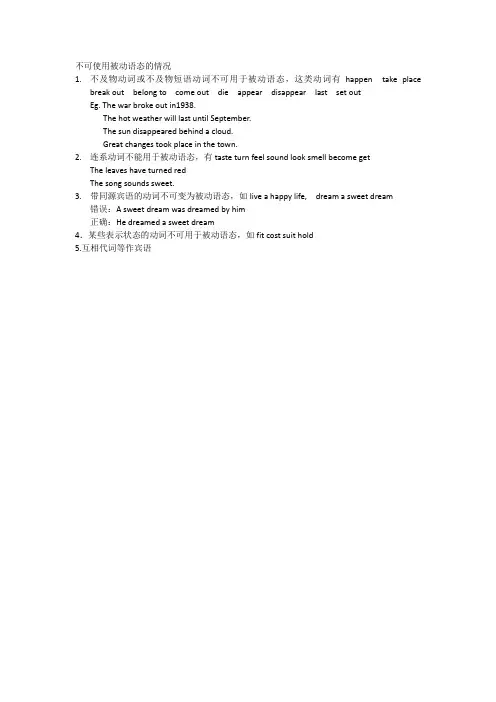
不可使用被动语态的情况
- 格式:docx
- 大小:11.94 KB
- 文档页数:1
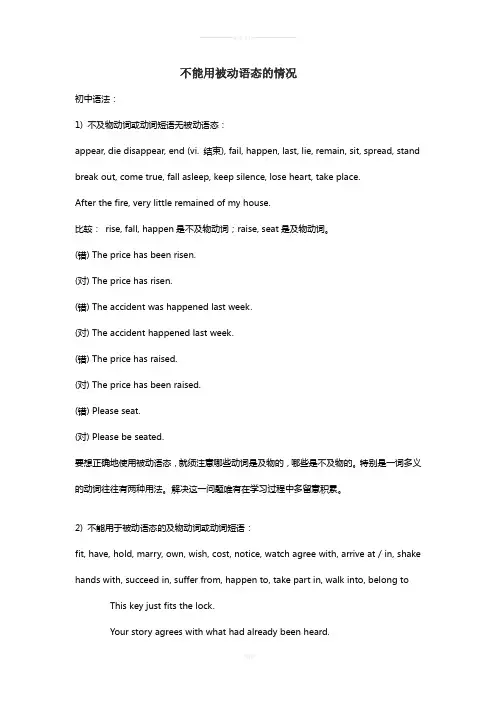
不能用被动语态的情况初中语法:1) 不及物动词或动词短语无被动语态:appear, die disappear, end (vi. 结束), fail, happen, last, lie, remain, sit, spread, stand break out, come true, fall asleep, keep silence, lose heart, take place.After the fire, very little remained of my house.比较:rise, fall, happen是不及物动词;raise, seat是及物动词。
(错) The price has been risen.(对) The price has risen.(错) The accident was happened last week.(对) The accident happened last week.(错) The price has raised.(对) The price has been raised.(错) Please seat.(对) Please be seated.要想正确地使用被动语态,就须注意哪些动词是及物的,哪些是不及物的。
特别是一词多义的动词往往有两种用法。
解决这一问题唯有在学习过程中多留意积累。
2) 不能用于被动语态的及物动词或动词短语:fit, have, hold, marry, own, wish, cost, notice, watch agree with, arrive at / in, shake hands with, succeed in, suffer from, happen to, take part in, walk into, belong to This key just fits the lock.Your story agrees with what had already been heard.3) 系动词无被动语态:appear, be become, fall, feel, get, grow, keep, look, remain, seem, smell, sound, stay, taste, turnIt sounds good.4) 带同源宾语的及物动词,反身代词,相互代词,不能用于被动语态:die, death, dream, live, lifeShe dreamed a bad dream last night.5) 当宾语是不定式时,很少用于被动语态。

不用被动语态的N种情况1.不及物动词不能用于被动语态。
例如:太阳冉冉升起。
当这件事情发生?2.表示状态特征的系动词,如look、sound、feel、smell、taste、appear、seem、go、prove、turn、e、fall、get、grow、keep等的主动形式表示被动意义。
例如:听起来很好。
3.表示开始、结束、运动的动词不用于被动语态。
这类动词有begin、start、finish、open、close。
end、shut、run、XXX等。
例如:课程在8点开始。
4.read、write、wash、sell、wear、lock等动词和well、easily、XXX等连用时,主动形式表示被动意义。
例如:这支笔书写流畅。
这件外套容易洗涤。
5.一部分动词用进行时表示被动意义。
这类动词有print、cook、fry、hang、build、make等。
例如:这本小说正在印刷。
晚餐正在烹饪中。
6.need、want、require、deserve等动词以物做主语时,后接动名词的主动形式表示被动意义。
我的手表需要修理。
谁说那男孩应该受到惩罚。
7.宾语是反身代词、相互代词、同源宾语时,不用被动语态。
例如:我自学英语。
我们互相帮助。
他们过着幸福的生活。
8.一部分及物动词不用于被动语态。
常见的有:fit、have、wish、cost、leave、enter、reach、suit、benefit(受益)、lack、own等。
例如:他走进房间并拿起了他的书。
我有一本书。
Some phrasal verbs cannot be used in passive voice。
such as breakout。
take place。
lose heart。
come true。
belong to。
consist of。
add up to。
agree with。
arrive at/in。
shake hands with。

Period Five Grammar & Writing一、转述结构1.常见的转述结构(1)动词+that从句that引导的从句为间接引语。
常用动词有add,admit,agree,announce,believe,boast,claim,complain,deny,declare,explain,insist,remind,suggest,warn等。
They announced that she would give one extra song.他们宣布她将再唱一首歌。
He explained that he had been cheated.他解释说他受骗了。
(2)动词+sb.+that从句常用动词有warn,remind,tell等。
He warned me that I couldn't go out alone at night.他警告我晚上不能单独出去。
She told me that she would be back in an hour.她告诉我她一个小时后就会回来。
(3)动词+sb.+to do sth.常用动词有advise,beg,order,promise等。
He begged his father not to give the puppy away.他恳求父亲不要把小狗送走。
I promised my mother to get up early in the morning.我向妈妈承诺早上早起。
(4)动词+to do sth.常用动词有agree,offer,refuse,threaten等。
He offered to lend me some books.他主动提出要借给我一些书。
He threatened to call the police.他威胁说要叫警察。
(5)动词+v.-ing常用动词有admit,deny,suggest等。
I admitted breaking the window.我承认打破了窗户。
不用被动语态的几种情况1.不及物动词不能用于被动语态。
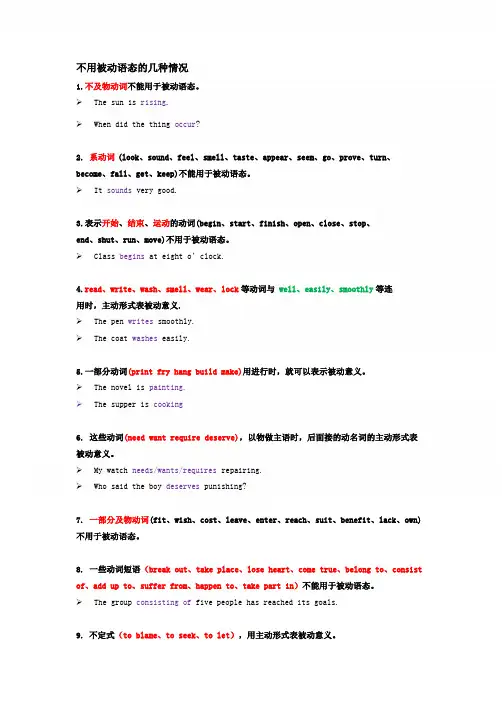
➢The sun is rising.➢When did the thing occur?2.系动词(look、sound、feel、smell、taste、appear、seem、go、prove、turn、become、fall、get、keep)不能用于被动语态。
➢It sounds very good.3.表示开始、结束、运动的动词(begin、start、finish、open、close、stop、end、shut、run、move)不用于被动语态。
➢Class begins at eight o’clock.4.read、write、wash、smell、wear、lock等动词与well、easily、smoothly等连用时,主动形式表被动意义.➢The pen writes smoothly.➢The coat washes easily.5.一部分动词(print fry hang build make)用进行时,就可以表示被动意义。
➢The novel is painting.➢The supper is cooking6.这些动词(need want require deserve),以物做主语时,后面接的动名词的主动形式表被动意义。
➢My watch needs/wants/requires repairing.➢Who said the boy deserves punishing?7.一部分及物动词(fit、wish、cost、leave、enter、reach、suit、benefit、lack、own)不用于被动语态。
8.一些动词短语(break out、take place、lose heart、come true、belong to、consist of、add up to、suffer from、happen to、take part in)不能用于被动语态。