(完整版)仁爱英语七年级下Unit_6单元知识归纳
- 格式:doc
- 大小:25.51 KB
- 文档页数:4
1 U6T 1
Section A
一. 重点词语
1. on the first /second floor在第一/二层
2. next to my bedroom在我卧室旁
二. 重要句型
There be 句型:
1. There is a study next to my bedroom. 我卧室的旁边有一间书房在。
2. There is a sofa, a desk, some books and so on. 有一张沙发,一张桌子和几本书等等。
三、语法内容
1.涵义:表示"某地有某物"。
如:There is a boat in the river.河里有一条船。
2.句型
1.肯定式:There is/are+物体+方位介词+地点。
2.否定式:There is/are+ not+物体+方位介词+地点。
3.疑问式:--Is/Are there+物体+方位介词+地点。?
--Yes, there is/are. --No, there isn't/aren't
3.较近原则
如:There some milk in the bottle. There a hat on the desk.
如:There some flowers in the basket.
如: There a mouse and two pens on the desk.
如:There two pens and a mouse on the desk.
Section B
一. 重点词语
in your study 在你的书房里 on your desk在你的桌子上
next to my family photo在我家庭照旁边 near the desk在桌底旁
on the shelf在书架上(shelves 复数) under the chair在椅子下
二. 重要句型
1. Are there any English books in your study? 你的书房里有一英语些书吗?
Yes, there are.有。
2. Is there a computer in your study? 你的书房里有一台电脑吗?
Yes, there is. 是的,有。
3. What’s in front of the classroom? 班级前面有什么?
4. Are there two students in the front of the classroom?
班级的前面有两个学生吗?
in front of 在……的前面(在范围之外的前面)
in the front of在……的前面(在范围内的前面)
如:There is a tree in front of the classroom.(树在教室外的前面)
The teacher’s desk is in the front of the classroom. (讲台在教室里的前面)
Section C
一. 重点词语
1. in the center of 在…的中央 at the back of 在…的后面
2. in the tree(非树本身的东西)在树上 on the tree(树本身的东西)
3. on the left/right of在…的左/右边 2 二. 重要句型
1. What’s on the desk? 什么在桌子上?
There are some model planes on it. 有一些飞机模型在上面。
2. How many model planes are there? 有多少飞机模型?
There are three. 有三架。
3. How much water is there? 有多少水?
Only a little. 只有一点点。
三、语法内容
划线提问
1.对主语提问一律用"What's+方位介词+某地?"结构,
如:There are some pictures on the wall.---What's on the wall?
2.对地点提问要用"Where is/are+物体?"
如:There is a black car under the tree.--Where is a black car?
3.对主语的数量提问要用"How many+主语(复数)+are there…?
How much+主语(不可数)+is there…?"
Section D
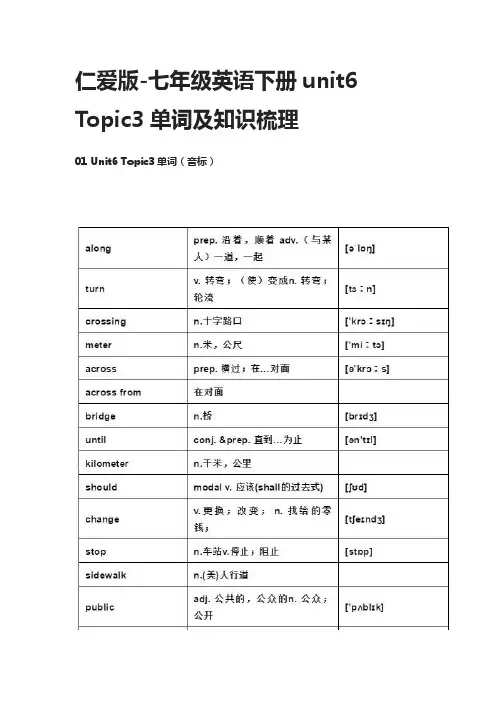
Topic 2 My home is in an apartment building.
Section A
一. 重点词语
1. live in居住在 live with与…一起住 look for寻找
二. 重要句型
1. It’s a townhouse with two floors.它是两层楼的城镇住宅。
2. They live in a big farmhouse in the country. 他们住在乡下的大农房里。
3. Michael is looking for an apartment near our school. Michael正在寻找离我们学校附近的单元房。
Section B
一. 重点词语
1. 地点名词
post office 邮局 bookstore书店 library图书馆 parking lot停车场 supermarket超市
hospital医院 bank银行 railway station火车站
2. at the end of 在…的尽头 between …and…在…和..之间 next to 在…近邻
二. 重要句型 (略)
Section C
一. 重点词语
a lot of=lots of 许多 close to 靠近 far from 远离
二. 重要句型
1. There are many old people living here.有很多的老人居住在这里。
句型:There be + sb + Ving +… 有某人在某地做某事
如:There are many children playing in the park.公园里有很多小孩子在玩。
Section D
一. 重点词语
from…to… 从…到… cost of living 生活费用 生活费用高用high
二. 重要句型
1. Cities are large and interesting but they are noisy. 城市又大有好玩,但是却很吵。 3 2. The traffic is heavy and the cost of living is high. 交通是繁忙的并且生活费用是高的。
3. The air is fresh and the life is quiet. 空气是新鲜的并且生活是安逸的。
句型:主语+be/系动词+adj(当表语)+…(adj用来描述主语的特征等)
Topic 3 Which is the way to the hospital?
Section A
一. 重点词语
1. go along…沿着…走 go across…穿过
turn left/right向左/右转
2. on the first/second/third crossing在第一/二/三个路口
on the corner of在… 的角落 on the left/ right /在左/右边
across from在…对面 between …and…在…和..之间
二. 重要句型
问路语
① Excuse me, is there a bank near here? 请问,这附近有银行吗?
② Excuse me, how can I get to the library? 请问,我怎么可以到达图书馆?
③ Excuse me, which is the way to the hospital? 请问,去医院是哪一条路?
问路句型:1. Excuse me, where is ……?
2. Excuse me, is there a……near here?
3. Excuse me, which is the way to ……?
4. Excuse me, how can I get to……?
5.Excuse me, could you tell me the way to……?
Section B
一. 重点词语
walk on直走 take Bus No…坐…路公交 change to变成
二. 重要句型
问路语
1. Excuse me, could you tell me the way to Dinghao Building? 请问,你可以告诉我去Dinghao楼的路吗?
2. Excuse me, where is Beitai Road? 请问,Beitai路在哪里?
Section C
一. 重点词语
get hurt受伤 lose one’s life失去某人的生命 keep safe保持安全
obey the traffic rules遵守交通规则 cross the street过街
二. 重要句型
1. It’s god to help children and old people cross the street.帮小孩和老人过马路是好样的。
句型: It’s adj( for sb) to do sth: 做某事对某人来说是…
如: It’s good for us to get up early.
三、语法学习
祈使句:表示请求、命令、禁止、劝告或建议的句子,特点是省略了主语。
祈使句无主语
动词原形当谓语或者don't+动词原形;
●肯定结构:
1. Do型
如:Have a seat here. 这边坐。