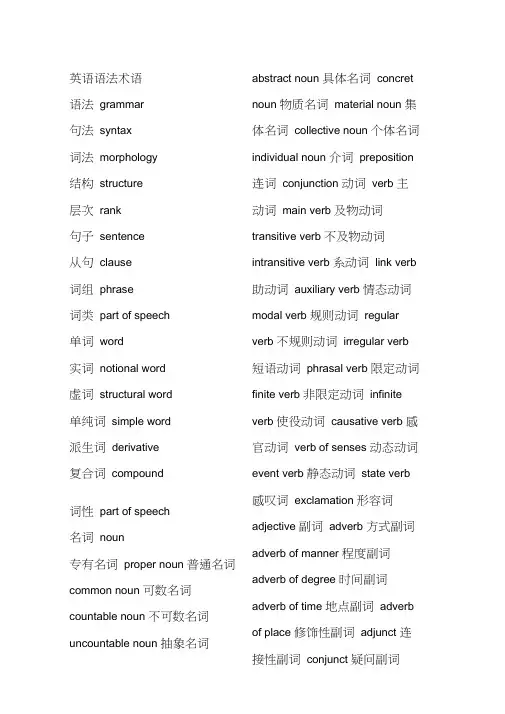
汇编英语语法教育教案主要章节语法术语
- 格式:doc
- 大小:769.73 KB
- 文档页数:12
,. 《新编英语语法教程》主要章节语法术语 Introduction: Grammatical Hierarchy (导论—语法层次)
2. Parts of speech (word class)
3. Phrases 词组
4. Clause 分句
5. Sentence 句子
1. Morpheme 词素
Free morpheme 自由词素
Bound morpheme 粘附词素 Allomorph 词素变体
Words 词
Simple words 简单词 Derivatives 派生词 Compounds 复合词 *(1) Classification in terms of word formation
Open-class words (content words) 开放词类(实义词)
Closed-class words (function words) 封闭词类(功能词)
Intermediate class (中间词类) * (2) Classification in terms of grammatical function
Noun Verb Adjective Adverb
Preposition Pronoun Determiner Conjunction Auxiliary
Numerals Interjection
Noun phrase Verb phrase Adjective phrase Adverb phrase Preposition phrase Conjunction (1) Independent clause & Subordinate clause 独立分句和从属分句 (2) Simple clause & Complex clause (*complex sentence) 简单分句和复杂分句(*复杂句) (3) Main clause & Subordinate clause 主句和从句 (4) Finite clause,non-finite clause and Verbless clause 限定分句、非限定分句、无动词分句 (1) Full sentence &Minor sentence 完全句和不完全句 (2) Simple sentence, Compound sentence, Complex sentence & Compound complex sentence 简单句、并列句、复杂句、并列复杂句 (3) Declarative sentence, imperative sentence, interrogative sentence, exclamatory sentence ,. Lecture 1 Sentence Structure(L1) Sentence elements: S (subject) 主语 V (predicate verb) 谓语动词 O (object) 宾语 C (complement) 补足语 A (Adverbial) 状语
1. Two ways of sentence analysis 1) SVO
Sentence Clause NP VP NP Subject Predicate verb Object All the man have done their best. Sentence = Subject + Predicate (Predicate Verb + Object, Complement, Adverbial, etc.) 句子由主语和谓语构成,进一步把谓语剖析为谓语动词、宾语、补语、状语等。 2) Subject + Predicate (= operator + predication)
Sentence Clause Subject Predicate Operator Predication All the man have done their best. 句子由主语和谓语构成,进一步把谓语剖析为操作词(operator)和述谓成分(predication)。 2. Basic clause types SVC, SV, SVA, SVO, SVOA, SVOC, SVoO
Lecture 2 Subject-Verb Concord (L2-3)
Guiding principles: Grammatical Concord Notional Concord Principle of Proximity 语法一致原则 意义一致原则 就近原则
Nominal clause Non-finite clause Relative clause Cleft sentence Existential clause 名词性分句 非限定分句 关系分句 分裂句 存在句
Lecture 3 Noun and Noun Phrase(L4-5) 1. Classification of nouns ,. Partitive (Unit Noun) 单位词 2. Cases of Nouns Nominative case / Subjective case(主格) Accusative case / Objective case(宾格 ) Genitive case(属格 )/ Possessive case(所有格) Dative case (受事格/与格)
Genitive case Genitive cases specifying the reference of the noun phrase. Specific reference (特指) Generic reference(类指) Indefinite genitive phrase(非确定特指)
Lecture 4 Determiner(L6-7) 1. Definition Determiners are function words which are used to determine or fix the reference of a noun.
2. Classification
Independent Genitive Double Genitive ,. 3. Articles Article is a major group of determiners used to delimit the scope of reference of nouns (主要用来限定名词的指称范围).
*p.74, 7.1.3, 冠词的确定特指(definite specific reference)分为前照应特指(cataphoric specific reference)、后照应特指(anaphoric specific reference)和语境特指(situational reference),这与后面的代词照应(pronoun reference p.104, 9.3)在术语上略有不同。
Lecture 5 Pronoun(L8-9) 1. Classification ,. Antecedent 先行词 2. The use of reflexive pronoun (-self)
3. Pronoun reference (代词照应) 前照应(Cataphoric reference)、后照应(Anaphoric reference)、语境照应(Situational reference)、人称照应(Personal reference)、指示照应(Demonstrative reference) ,. Lecture 6 Verb and Verb Phrase(L10-22) 1. Classification of verbs
动词分类的标准有很多种,如上图所示,记住基本的术语和其用法就是。比如及物动词、不及物动词、联系动词、助动词、动态动词、静态动词、词组动词、限定动词、非限定动词、不定式,不带to不定式(bare infinitive)等等,还有副词/介词小品词(adverb particle & proposition particle)。
➢ Transitive Verbs:followed by objects. ➢ Intransitive verbs:do not require an object. ➢ Linking verbs:followed by subject compliments. • SVO主—动—宾 (Transitive verb) • SVoO主—动—宾—宾 (Ditransitive verb)【双宾语动词】 • SVOC主—动—宾—补 (Monotransitive verb)【单宾语动词】 • SV主—动 (Intransitive verb) • SVC主—动—补 (Linking verb) • This aspect is of essential importance because the verb type here determines the basic sentence structure of your sentence and how you can expand your sentence. 2. Five forms of Verbs(动词的五种基本形式) 原形(base form)、第三人称单数(third person singular)、过去式(past tense)、 过去分词(past tense)、现在分词(present participle) 3. Tense and aspects Tense Aspect Simple present Simple past Simple future Past future
progressive 现在进行体 过去进行体 将来进行体 过去将来进行体
perfective 现在完成体 过去完成体 将来完成体 过去将来完成体
Perfective progressive 现在完成进行体 过去完成进行体 将来完成进行体 过去将来完成进行体