新概念英语第一册语法点梳理上课讲义
- 格式:doc
- 大小:100.01 KB
- 文档页数:15
新概念一共144课,其中单课为课文,双课为语法和练习。
整本书是以单数课为正课,并附带有插图而双数课则是针对单数课所讲的内容有针对性地进行练习,从此出展现出整个新概念一教材区别于其他教材的独特之处。
以下是对新概念一整本教材的理解和剖析,以供各位对整个课本的理解和把握上参考和借鉴。
首先根据课本中出现的时态来分析:本册书的语法出现层次性和规律性是很强的,首先我们先来整本书中都出了哪些时态,这些时态的具体分布和讲解时我们大家需要注意的递进性。
Lesson 31—34 现在进行时Lesson 37—40 第一次出现be going to 的将来时Lesson 51—56 一般现在时Lesson 67—76 为一般过去式Lesson 83—90 为现在完成时Lesson 91—96 为一般将来时(will)Lesson 117—118 过去进行时Lesson 119—120 过去完成时除去前面所有时态和句型所占据的76课我们一起来看一下以下的68课,每一课小的语言点,语法点都是在什么地方,应该用什么样的方式来讲解。
新概念一的每一个单课的重点都是出现双课的标题和课后的练习题里面。
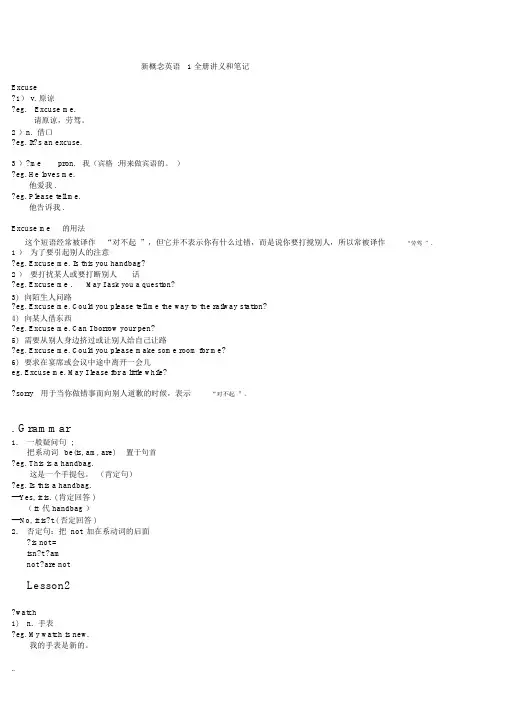
Lesson1—2语言点:与陌生人说话或引起别人的注意。
Excuse me. Yes? Pardon? Thank you very much.语法点:主系表结构this为主语,名词做表语1的一般疑问句以及它的肯定回答。
Is this your handbag? Yes, it is.Lesson 5—6语言点:如何介绍别人。
This is Miss Sophie Dupont. Nice to meet you.语法点:主语为第三人称单数的主系表结构。
She is French. He is German. It’s a Volvo.(L6) a/an 的使用。
Lesson 7—8语言点:如何自我介绍和相互认识。
语法点:主语为第二人称的主系表结构。
Are you French?What nationality are you? What’s your job? 特殊疑问句。
Lesson 9—10语言点:朋友或熟识的人之间如何相互问候。
How are you?语法点:主系表结构形容词做表语。
介词短语表位置near the window, on the television, on the wallLesson 29—30语言点:如何发号命令。
语法点:祈使句(肯定); 动词与宾语的固定搭配。
Lesson 37—38语言点:如何表达将要做的事情。
语法点:现在进行时态be going to do结构表达将要发生的事情。
There be 句型的一般疑问句形式。
Lesson 41-42语法点:如何表示不可数名词的量。
Lesson 63-64语言点:建议忠告。
语法点:don’t do…. You mustn’t do…Lesson 65-66语法点:具体时间表示法(半点和刻钟)。
反身代词。
具体日期表达方式。
Lesson 73-74语言点:问路。
语法点:不规则动词的过去式。
形容词转变成副词。
Lesson 77-78语言点:看病。
语法点:综合时间表达方式。
Lesson 105-106语言点:办公室用语。
语法点:want sb to do…./ tell sb to do…以及其否定形式。
Lesson 103-104语言点:考试。
语法点:宾语从句。
(从句部分为非现在时态); 程度副词too, very ,enough Lesson 125-126语言点:/ 语法点:have to do…/ don’t need to do…Lesson 127-128语言点:娱乐界。
语法点:must/can’t 对现在事情的肯定/否定猜测。
Lesson 129-130语言点:交通状况。
语法点:must/ can’t have been….对过去事情的肯定/否定猜测。
Lesson 131-132语言点:度假。
语法点:may 对现在/过去事情的肯定或否定猜测。
以下学的知识慢慢与新概念二接轨:现在完成时:Lesson 83—90 直接引语变成间接引语:Lesson 99—102形容词的比较级和最高级:Lesson107—112 neither ,so 的用法:Lesson 113—114不定代词的用法:Lesson 115—116 过去进行和过去完成时:Lesson 117—120定语从句:Lesson 121—124 情态动词的综合用法:Lesson 125—132直接引语变间接引语:Lesson 133—136(着重讲时态的倒推)if 的用法:Lesson 137—140 被动语态:Lesson 141—1441)代词及be动词主格I we you you she/he/it they宾格me us you you her/him/it them代词所有格my our your your her/his/its their名词性代词mine ours yours yours hers/his/its theirsbe动词现在时Am are are are is arebe动词过去时was were were were was were2)名词的复数规则变化的名词复数形式规则1一般情况+s e.g. shell→shells toy→toys规则2以s, x, ch, sh结尾+es e.g. fox→foxes church→churches规则3以o结尾+s或+es e.g. radio→radios potato→potatoes规则4以f, fe结尾的,变f, fe为ves e.g. life→lives half→halves规则5以辅音字母+y结尾,变y为i+es e.g. sky→skies study→studies3)动词的第三人称单数形式规则1一般情况+s e.g. like-likes, look-looks规则2以s, x, ch, sh和o结尾+es e.g. do-does, catch-catches规则3以辅音字母+y结尾,变y为i+es e.g. carry-carries, fly-flies4)动词现在分词规则1一般动词加-ing e.g. look-looking, read-reading, play-playing规则2以不发音的字母结尾的单词去e加-ing e.g. make-making, take-taking, arrive-arriving 规则3重读闭音节词结尾,即单词中只有一个元音字母,其后紧跟一个辅音字母的词,双写辅音字母再加-ing e. g. run-running, sit-sitting, get-getting, swim-swimming, stop-stopping5)动词过去式规则动词变化规则1 一般动词加-ed e.g. look-looked, watch-watched, play-played规则2 以e结尾的加-d e.g. make-maked, arrive-arrived规则3 以辅音字母y结尾的变y为i加-ed e.g. cry-cried, carry-carried规则4 重读闭音节词结尾,即单词中只有一个元音字母,其后紧跟一个辅音字母的词,双写辅音字母再加-ed e.g. stop-stopped过去式的读音在清辅音后面(除外)读/t/ e.g. walked, jumped 在浊辅音和元音后读/d/ e.g. washed, watched 在/t/,/d/后读/id/ e.g. waited, hated6)形容词和副词的比较级和最高级比较级规则1 一般加-er e.g. high-higher规则2 以e结尾加-r nice-nicer规则3 以辅音字母加y结尾,变y为i再加-er busy-busier规则4 重读闭音节结尾,双写辅音字母再加-er fat-fatter最高级规则1 一般加-est e.g. high-highest规则2 以e结尾加-st nice-nicest规则3 以辅音字母加y结尾,变y为i再加-est busy-busiest规则4 重读闭音节结尾,双写辅音字母再加—est fat-fattest7)常见缩写:is='s I am=I'm are='re is not=isn't /iznt/ are not=aren't /a:nt/ do not=don'tdoes not=doesn't was='s did not=didn't can not=can't will='ll has='shave='ve have not=haven't has not=hasn't will not=won't shall not=shan't不定代词及不定副词some, any, no, every-thing: something, anything, nothing, everything-one: someone, anyone, anything, everyone-where: somewhere, anywhere, anywhere, everywhere-body: somebody, anybody, nobody, everybody例子:1)I looked for my book everywhere, but I can’t find it anywhere.2)If you want to go somewhere, if you want to be someone, you must wake up.3)Help! Somebody? Anybody?4)You are really something. 你真了不起!(口语中常用"something"来表示“真像回事儿”,“真行”)5)Since everybody is here, let’s begin our class.6)Where did you go? I went nowhere.7)Nobody is at home.副词可以修饰形容词,动词,副词或整个句子。
如:The book is very good. He runs fast.She came here quite early. Certainly I will go with you.副词变化形式:• 直接在形容词后加-ly:careful- carefully, slow-slowly• 以辅音字母加y结尾的形容词,把y变i, 加-ly:happy- happily, lucky-luckily• 有些词形容词和副词的形式相同,不需要做任何变化:fast, hard, late• 有些词加上-ly后意思与原词相差很远:neary-nearly, high-highly, late-lately分为可数名词和不可数名词:1)不可数名词无法分开的东西:water, tea, bread, milk, rice抽象的东西:love, beauty, coldness不可数名词有以下特点:不能用a, an修饰;不能加s;和单数be动词或动词搭配。