
on, over, above修改稿(6)
- 格式:pptx
- 大小:2.23 MB
- 文档页数:21

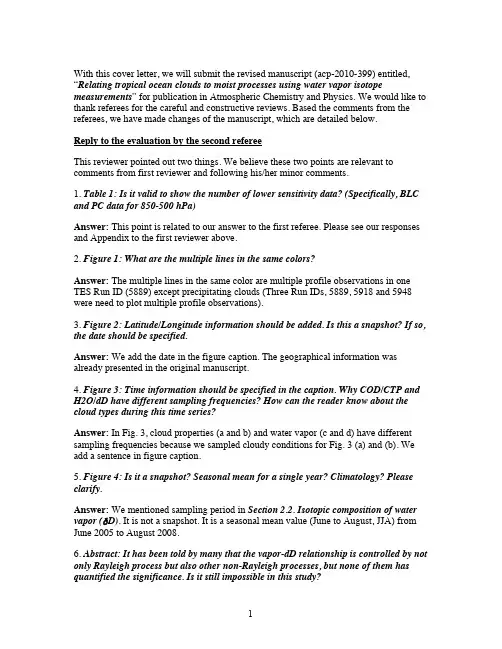
1 With this cover letter, we will submit the revised manuscript (acp-2010-399) entitled, “Relating tropical ocean clouds to moist processes using water vapor isotope measurements” for publication in Atmospheric Chemistry and Physics. We would like to thank referees for the careful and constructive reviews. Based the comments from the referees, we have made changes of the manuscript, which are detailed below. Reply to the evaluation by the second referee This reviewer pointed out two things. We believe these two points are relevant to comments from first reviewer and following his/her minor comments. 1. Table 1: Is it valid to show the number of lower sensitivity data? (Specifically, BLC and PC data for 850-500 hPa) Answer: This point is related to our answer to the first referee. Please see our responses and Appendix to the first reviewer above. 2. Figure 1: What are the multiple lines in the same colors? Answer: The multiple lines in the same color are multiple profile observations in one TES Run ID (5889) except precipitating clouds (Three Run IDs, 5889, 5918 and 5948 were need to plot multiple profile observations). 3. Figure 2: Latitude/Longitude information should be added. Is this a snapshot? If so, the date should be specified. Answer: We add the date in the figure caption. The geographical information was already presented in the original manuscript. 4. Figure 3: Time information should be specified in the caption. Why COD/CTP and H2O/dD have different sampling frequencies? How can the reader know about the cloud types during this time series? Answer: In Fig. 3, cloud properties (a and b) and water vapor (c and d) have different sampling frequencies because we sampled cloudy conditions for Fig. 3 (a) and (b). We add a sentence in figure caption. 5. Figure 4: Is it a snapshot? Seasonal mean for a single year? Climatology? Please clarify. Answer: We mentioned sampling period in Section 2.2. Isotopic composition of water vapor (δD). It is not a snapshot. It is a seasonal mean value (June to August, JJA) from June 2005 to August 2008. 6. Abstract: It has been told by many that the vapor-dD relationship is controlled by not only Rayleigh process but also other non-Rayleigh processes, but none of them has quantified the significance. Is it still impossible in this study? 2 Answer: It is a good point. One of the simplest models for atmospheric water vapor isotope is based on the Rayleigh distillation equation. Several processes could potentially change the isotopic composition of water vapor, such as mixing, subsidence and re-evaporation (non-Rayleigh processes) as we described in our manuscript. Quantifying the significance is beyond our scope of the study. However, some studies using remotely sensed data and/or in-situ measurements have been used to constrain humidity dynamics of lower troposphere. For example, Worden et al. (2007) quantitatively showed the contribution of rainfall evaporation to lower tropospheric humidity. Galewsky et al. (2007) reproduced the clear-sky free troposphere relative humidity and D/H ratios using a model that accounts for large-scale condensation, fractionation, mixing and transport of water vapor, which Rayleigh distillation model underpredicted. Galewsky, J., Strong, M., and Sharp, Z. D.: Measurements of water vapor D/H ratios from Mauna Kea, Hawaii, and implications for subtropical humidity dynamics, Geophys. Res. Lett., 34, L22808, doi:10.1029/2007GL031330, 2007. 7. P17412 top: What is the unit of COD? Answer: Cloud Optical Depth is unit-less. 8. P17414 bottom: Why do the ranges of the lines in Fig 1e-h link to the sensitivity? What is the each single line in the figure 1e-h? What is difference between error and sensitivity in this context? Answer: If there is little sensitivity, there would be no difference between TES a priori constraint and an estimate. Each line represents a single observation measured by TES in Fig. 1e-h. 9. P17415 middle: What is “step-and-stare”? Describe. Answer: “Step-and Stare” is a TES observation mode in which 60 measurements are made spaced about 35km apart. “Stare” means point at a specific latitude and longitude for up to 210 seconds. “Transect” means a set of exactly contiguous latitudes and longitudes in a line up to 885 km long. We added the definition of “step and stare” in the manuscript. Now it becomes “A TES “step-and-stare”, which is a set of nadir footprint spaced about 35 km apart, was conducted during this same time and the approximate orbit location of this set of observations is shown as a vertical red line over the MODIS imagery.”. 10. P17416 middle: “less than 0.1” -> No COD data is less than 0.1 in Figure 3. Answer: Fixed. Now the sentence is “Near –3°, the air is relatively dry, approximately 1 g/kg but also very isotopically depleted underneath high cirrus (cloud-top pressure near 200 hPa, but cloud optical depth less than 1.0).”. 11. P17419 bottom: “The first distribution is for comparison against...” -> I don’t see any clear sky and non-precipitation cloud distributions in the figure 6.
英语翻译评语
【篇一:英文论文审稿意见汇总】
英文论文审稿意见汇总
以下12点无轻重主次之分。每一点内容由总结性标题和代表性审稿人意见构成。
1、目标和结果不清晰。
it is noted that your manuscript needs careful editing by
someone with expertise in technical english editing paying
particular attention to english grammar, spelling, and sentence
structure so that the goals and results of the study are clear to
the reader.
2、未解释研究方法或解释不充分。
◆ in general, there is a lack of explanation of replicates and
statistical me
thods used in the study.
◆ furthermore, an explanation of why the authors did these
various experiments should be provided.
3、对于研究设计的rationale:
also, there are few explanations of the rationale for the study
design.
4、夸张地陈述结论/夸大成果/不严谨:
the conclusions are overstated. for example, the study did not
show
if the side effects from initial copper burst can be avoid with
人教版必修第二册全册单词短语句型汇总
Unit 1 Cultural Heritage ................................................................................................. 1
Unit 2 Wildlife Protection ............................................................................................... 6
Unit 3 The Internet ....................................................................................................... 12
Unit 4 History And Traditions ....................................................................................... 19
Unit 5 Music ................................................................................................................. 24
Unit 1 Cultural Heritage
Ⅰ.重点单词
1.former adj.以前的;(两者中)前者的
2.preserve vt.保存;保护;维持 n.保护区
preservable adj.可保存的
preservation n.保存
preserver n.保护者;保存者
3.promote vt.促进;提升;推销;晋级
范文二:如何回复英文论文编辑部的修改意见
望对大家有帮助
1.
Dear Prof. XXXX,
Thank you very much for your letter and the comments from the referees about our paper submitted to XXXX (MS
Number XXXX).
We have checked the manuscript and revised it according to the comments. We submit here the revised manuscript
as well as a list of changes.
If you have any question about this paper, please don’t hesitate to let me know.
Sincerely yours,
Dr. XXXX
Response to Reviewer 1:
Thanks for your comments on our paper. We have revised our paper according to your comments: 1. XXXXXXX
2. XXXXXXX
2.
Dear Professor ***,
Re: An *** Rotating Rigid-flexible Coupled System (No.: JSV-D-06-***)
by ***
Many thanks for your email of 24 Jun 2006, regarding the revision and advice of the above paper in JSV. Overall
the comments have been fair, encouraging and constructive. We have learned much from it.