
林肯英语简介
- 格式:ppt
- 大小:380.50 KB
- 文档页数:5
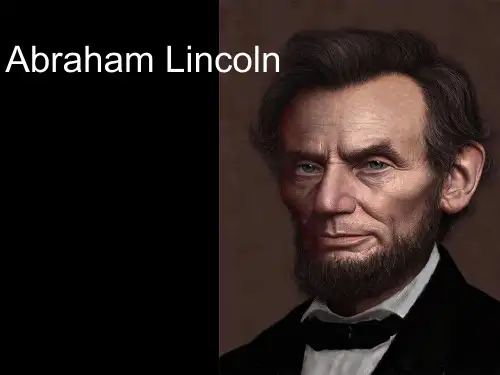

英语作文我的偶像林肯My Idol: Abraham Lincoln.In the annals of history, few figures stand as tall as Abraham Lincoln. A man of humble beginnings, Lincoln rose to become the 16th President of the United States, leading the nation through one of its most tumultuous periods, the Civil War. His legacy is not just in the preservation of the Union but also in the ideals he championed: democracy, equality, and freedom.Born in a log cabin in Kentucky, Lincoln's early life was marked by poverty and hardship. His family moved several times, seeking better opportunities, and Lincoln received only limited formal education. However, he was a voracious reader and a self-taught man of immense intellectual curiosity. This thirst for knowledge and understanding formed the foundation of his later political and philosophical ideas.Lincoln's political journey began in Illinois, where he served as a state legislator and then as a one-term congressman. It was during these years that he honed his skills as a politician and orator, delivering impassioned speeches that resonated with his audience. His rise to the presidency, however, was not a smooth one. He faced numerous challenges, including defeat in his first bid for the presidency and the loss of his wife and young son to illness.As president, Lincoln faced the greatest crisis in American history: the Civil War. He led the nation with resolve and courage, refusing to compromise on the issue of slavery, which was the root cause of the conflict. His Emancipation Proclamation, issued in 1863, declared an end to slavery in the Confederate states, a momentous step towards justice and equality.Lincoln's presidency was also marked by his statesmanship and diplomatic skills. He worked tirelessly to preserve the Union and reunite the nation after the war, recognizing the need for reconciliation and healing. Hisleadership in the post-war period helped lay the groundwork for the economic and social progress that followed.What makes Lincoln an enduring icon is not just his accomplishments but also his character. He was a man of principle and integrity, who believed strongly in the rule of law and the protection of individual rights. Hishumility and compassion towards others, despite his own personal tragedies, is a testament to his humanity and leadership.Lincoln's legacy lives on in the institutions he created and the values he championed. The National Park Service, established during his presidency, preserves and protects America's natural and cultural heritage. The Gettysburg Address, his famous speech delivered at the dedication of a cemetery for Civil War soldiers, is a concise and powerful expression of his vision for a nation "conceived in liberty and dedicated to the proposition that all men are created equal."In conclusion, Abraham Lincoln stands as a beacon ofhope and inspiration. His life and times are a reminder of the power of perseverance, the importance of principles, and the value of leadership. As we look towards the future, Lincoln's example serves as a guidepost for leaders and citizens alike, reminder us of the enduring value of freedom, equality, and justice.。

林肯的名词解释
林肯,全名亚伯拉罕·林肯(Abraham Lincoln),是美国历史上著名的政治家和第16任美国总统。
他生于1809年,逝世于1865年。
林肯被广泛认为是美国最伟大的总统之一,他在美国内战期间的领导和废除奴隶制的决心使他在历史上留下了深远的影响。
林肯的名词解释不仅包括他的个人生平,也涉及他对美国政治和社会的重要贡献。
首先,林肯是美国历史上第一位来自西部的总统。
他的竞选活动和政策聚焦于西部各州,这些州在工业化和移民潮中扮演了重要角色。
林肯通过其竞选活动和政策,实现了西部地区的联邦扩张,并为后来的发展奠定了基础。
其次,林肯是奴隶制废除运动的重要人物。
在他的领导下,美国发生了南北战争,这场战争最终导致了奴隶制的废除。
林肯签署了《解放黑奴宣言》,宣布南方所有奴隶自由,并最终推动通过了第13修正案,废除了美国宪法上的奴隶制度。
这一举措标志着美国历史上一个重要的转折点,消除了奴隶制对国家的影响,为今后的民权运动奠定了基础。
此外,林肯还以其富有感染力的演讲和政治领导力而闻名。
他的名言和演讲如《莱科尔纳特演说》和《葛底斯堡演说》等至今仍被广泛引用。
林肯的领导力和坚定的信仰使他能够在关键时刻保持国家的团结,并为美国民主政治奠定了基础。
总的来说,林肯作为美国历史上最重要的政治家和总统之一,他的名词解释涵盖
了他的个人生平、对西部地区的发展、奴隶制废除运动以及其非凡的领导力。
林肯的贡献和影响远远超出了他的时代,他的价值观和理念激励和引导着今天的美国社会。

林肯英语作文翻译Abraham Lincoln, the 16th President of the United States, is a figure whose legacy continues to inspire and educate generations. His leadership during one of the most tumultuous periods in American history, the Civil War, and his role in the abolition of slavery through the Emancipation Proclamation, have cemented his place as a pivotal figure in the nation's history.Born in 1809 in a log cabin in Kentucky, Lincoln's rise to the presidency was a testament to the American dream. He began his political career as a member of the Whig Party, eventually becoming a Republican. His famous debates with Stephen A. Douglas in 1858, known as the Lincoln-Douglas Debates, brought national attention to the issue of slavery and further established Lincoln's reputation as an orator and a statesman.Lincoln's election in 1860 as the first Republican President was met with secession by several Southern states, leading to the formation of the Confederate States of America. His presidency was immediately challenged by the outbreak of the Civil War. Despite the initial setbacks for the Union, Lincoln's resolve and leadership saw the North through to victory.Perhaps his most significant contribution to American history was the issuance of the Emancipation Proclamation in 1862,which declared that all slaves in the Confederate states "shall be then, thenceforward, and forever free." This was a strategic move during the war, but it also marked a moral stance against the institution of slavery.Lincoln's Gettysburg Address in 1863, delivered during the Civil War, is considered one of the greatest speeches in American history. It redefined the purpose of the war, emphasizing the principles of human equality and liberty enshrined in the Declaration of Independence.Tragically, Lincoln's life was cut short by an assassin's bullet on April 14, 1865, just days after the war's end. His death was a profound loss for a nation that had come to rely on his steady hand and visionary leadership.In conclusion, Abraham Lincoln's presidency was marked by extraordinary challenges and significant achievements. His steadfast commitment to the Union and his role in ending slavery have left an indelible mark on the United States. Lincoln's life and work continue to serve as a reminder of the power of conviction and the importance of moral courage in leadership.。

林肯英语范文高中Abraham Lincoln, the 16th President of the United States, is widely regarded as one of the greatest leaders in American history. His eloquence and mastery of the English language have long been admired, and his writings have served as models for aspiring writers and orators. In this essay, we will explore the elements of Lincoln's English composition that made him a revered figure in the realm of rhetoric and literature.Lincoln's early life was marked by a deep appreciation for the power of words. Born in a one-room log cabin in Kentucky, he had limited formal education, but he possessed an innate talent for self-expression. As a young man, he would read extensively, studying the works of great writers and thinkers, and honing his own writing skills through practice and dedication.One of the hallmarks of Lincoln's writing style was his ability to convey complex ideas in a clear and concise manner. He had a remarkable talent for distilling complex issues into their essential components, and then presenting them in a way that was accessibleto a wide audience. This skill was particularly evident in his famous speeches, such as the Gettysburg Address and the Second Inaugural Address, which have become enduring examples of American oratory.At the heart of Lincoln's writing was a deep understanding of the human condition. He had a keen sense of empathy and a profound respect for the dignity of all people, and this was reflected in the way he crafted his words. His language was often poetic and evocative, capable of evoking powerful emotions and inspiring his listeners to action.One of the most striking features of Lincoln's English composition was his use of rhetorical devices. He was a master of metaphor, simile, and alliteration, using these techniques to enhance the impact of his words and to convey his message with greater clarity and force. For example, in the Gettysburg Address, he famously referred to the "last full measure of devotion," a metaphor that has become an enduring part of the American lexicon.Another key aspect of Lincoln's writing was his ability to adapt his style to the needs of his audience. Whether he was addressing a group of farmers, a room full of politicians, or a nation in crisis, he was able to tailor his language to the specific needs of his listeners. This flexibility allowed him to connect with a wide range of people, and to inspire them to action in ways that were both compelling andmeaningful.Throughout his life, Lincoln remained committed to the power of language to shape the course of history. He understood that the written and spoken word had the power to inspire, to persuade, and to transform, and he dedicated himself to honing his craft as a writer and orator. His legacy as one of the greatest communicators in American history is a testament to the enduring power of the English language, and to the transformative potential of words when wielded with skill and purpose.In conclusion, Abraham Lincoln's English composition serves as a model for aspiring writers and orators, demonstrating the power of clear, concise, and evocative language to inspire and persuade. Through his mastery of rhetorical devices, his deep understanding of the human condition, and his ability to adapt his style to the needs of his audience, Lincoln has left an indelible mark on the literary and political landscape of the United States. His writings continue to be studied and admired by scholars and students alike, and serve as a testament to the enduring power of the written word.。