
1新综合英语V
- 格式:ppt
- 大小:2.75 MB
- 文档页数:35

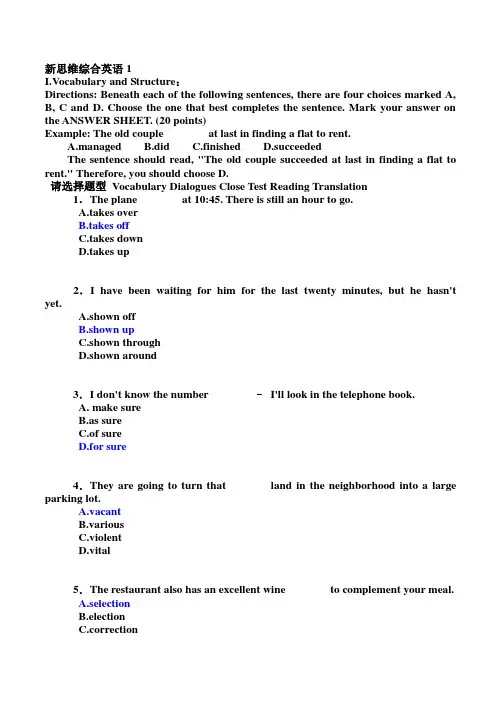
新思维综合英语1I.Vocabulary and Structure:Directions: Beneath each of the following sentences, there are four choices marked A, B, C and D. Choose the one that best completes the sentence. Mark your answer on the ANSWER SHEET. (20 points)Example: The old couple at last in finding a flat to rent.A.managedB.didC.finishedD.succeededThe sentence should read, "The old couple succeeded at last in finding a flat to rent." Therefore, you should choose D.请选择题型Vocabulary Dialogues Close Test Reading Translation1.The plane at 10:45. There is still an hour to go.A.takes overB.takes offC.takes downD.takes up2.I have been waiting for him for the last twenty minutes, but he hasn't yet.A.shown offB.shown upC.shown throughD.shown around3.I don't know the number–I'll look in the telephone book.A. make sureB.as sureC.of sureD.for sure4.They are going to turn that land in the neighborhood into a large parking lot.A.vacantB.variousC.violentD.vital5.The restaurant also has an excellent wine to complement your meal.A.selectionB.electionC.correctionD.reflection6.Could you tell me the tissues are, please?A.whatB.whereC.whichD.when7.How long?A. have you got marriedB.you got marriedC.have you been marriedD.did you marry8.You will find rice at every meal in the South of China.A.servedB.servingC.be servedD.serves9.She opened the door the fresh air to come in.A.ofB.forC.intoD.let10.All is a continuous supply of the basic necessities of life.A.that is neededB.what is neededC.the thing neededD.our needsII.Situational Dialogues:Directions: Choose A, B or C to complete each conversation, using the sentences below. Mark your answer on the ANSWER SHEET. (20 points)Example:- Oh, look. Joni Mitchell is in town.- .- What? She's one of the greatest folk singers in the world!Who's that? I've never heard of her.Sure, I'm in town.Yes, I'm glad she's coming.Answer A is correct because the conversation should read,"- Oh, look. Joni Mitchell is in town.- Who's that? I've never heard of her.- What? She's one of the greatest folk singers in the world!"请选择题型Vocabulary Dialogues Close Test Reading Translation11.–Thanks very much. You've been very helpful.–.A.No, thanks.B.You are right. You can say it again.C.Don't mention it. Any time.12.–How about joining us? It is really a wonderful feeling.–.A.Well, I was planning to work on Saturday. But I change my mind now.B.Great! It doesn't sound like that great when I was there last time.C.Really? I thought the steak was terrible.13.–Hello, Chris? This is Lee..–Oh, that's O.K. I was just setting the table.A.What are we going to have for dinner?B.I hope I'm not calling at dinner time.C.Jane invites us over for dinner tonight.14.–Do you know where Liberty Street is? –It's off Oak Street, near the park.–.–I don't know exactly. Perhaps every five minutes or so.A.The park? Which one do you mean?B.Do you have any idea where Pine Street is?C.By the way, do you know how often the Number 5 bus runs normally?15.–Could you tell me which bus goes to the Fine Arts Museum?—.A.Sorry, I've never been there.B.You can always take a taxi.C.I think No. 16 is OK.16.–Do you have any plans for the weekend?–.A.It will be fine on the weekend.B.It depends on the weather.C.I went to the cinema last weekend.17.–Do you know what you're going to order?–.A.It smells awful.B.It tastes delicious.C.I can't make up my mind.18.–If the weather is good, I might play tennis. What about you?–.A.What would you like order?B.I went to the cinema yesterday.C.I'm not sure. I may just stay home.19.–Do you ever go back to Cambridge?–.–I don't know exactly. Perhaps every five minutes or so.A.Not very often.B.Let's keep in touch.C.Not again.20.–How about working fifteen more minutes? Then we can order out for pizza.—.A.Sounds great. I am so hungry I could eat a horse.B.Good idea. I need to leave immediately.C.Let's move to other topics.III.Close Test:Directions: For each numbered blank in the following passage, there are four choices marked A, B, C and D. Choose the best one and mark your answer on the ANSWER SHEET. (20 points) 请选择题型Vocabulary Dialogues Close Test Reading TranslationHenry's job was to examine cars whichcrossed the frontier to make21that they werenot smuggling (走私) anything into the country.Every evening, except at weekends, he 22see a factory worker coming up the hill towardsthe frontier, pushing a bicycle with a big load ofold straw on it. When the bicycle reached thefrontier, Henry 23to stop the man and makehim take the straw off and untie it. Then he wouldexamine the 24very carefully to see if hecould find anything, after which he would look inall the man's pockets 25he let him tie thestraw again. The man would then put it on hisbicycle and go off down the hill with it. AlthoughHenry was always 26to find gold or jewelry orother valuable things hidden in the straw, henever found any.Then one evening, after he had looked27the straw as usual, he said to him,"Listen. I know that you are smuggling thingsacross this frontier. Won't you tell me what it isthat you are bringing into the country so 28?I'm an oldman, and today's my last day on thejob. Tomorrow I'm going to 29. I promisethat I shall not tell anyone if you tell me whatyou've been smuggling." The factory workerdid not sayanything for 30. Then he smiled,turned to Henry and said quietly, "Bicycles."21. A.known B.clearC.obviousD.sure--------------------------------------------------------------------------------22. A.would B.mustC.mightD.should--------------------------------------------------------------------------------23. A.had edC.wantedD.sure--------------------------------------------------------------------------------24. A.bicycle B.hillC.strawD.worker--------------------------------------------------------------------------------25. A.when B.beforeC.whileD.as--------------------------------------------------------------------------------26. A.thinking B.suspectingC.expectingD.insisting--------------------------------------------------------------------------------27. A.thoroughly B.throughC.downD.up--------------------------------------------------------------------------------28. A.carefully B.successfullyC.obviouslyD.silently--------------------------------------------------------------------------------29. A.return B.retreatC.retireD.rest--------------------------------------------------------------------------------30. A.short while B.a periodC.few minutesD.some timeIV. Reading ComprehensionDirections: Each of the passages below is followed by some questions. For each question there are four answers marked A, B, C and D. Read the passages carefully and choose the best answer to each of the questions. Mark your answer on the ANSWER SHEET. (20 points)请选择题型Vocabulary Dialogues Close Test Reading TranslationQuestions 31~35 are based on the Passage 1.Passage 1Learning the language of a country isn't enough. If you know the manners of your foreign friends, you will probably be surprised just how different they can be from your own.A visitor to India should remember it is impolite there to use the left hand for passing food at the table. The left hand is for washing yourself. Also in India, you might see a man shaking his head at another to show that he is disagreeing. But inmany parts of India a side-to-side movement of the head is to show agreement. In Bulgaria you shake your head to show "yes"—a nod shows "no".In Europe it is quite usual to cross your legs while sitting and talking to someone, even at an important meeting. But doing this could cause offence to a Thailander. Touching the head of a grown-up is also not done in Thailand.Knowing about manners is useful when you are traveling, and you also need to know the language used to express the customs.31. If you are staying in India, you'd better.A. not use your left hand to pass food at the tablee your left hand to pass food at the tableC.not use your left hand to wash yourselfe your left hand at all times32. To shake your head means "Yes.A.in IndiaB.in EuropeC.in BulgariaD.in Thailand33. You can easily make a Thailander angry by.A.touching his headB.crossing your legs while talking to himC.shaking your headD.nodding your head34. The writer thinks that to know about a country well one must.A. know the language of the countryB.know the manners of the countryC.know the manners better than the languageD.know both the language and the manners35.We can learn from the passage that.A.different countries have different mannersB.the manners in Thailand are the same as those in IndiaC.one should be careful not to cross legs in EuropeD.one should not touch a grown-up's head in IndiaIV. Reading Comprehension请选择题型Vocabulary Dialogues Close Test Reading TranslationQuestions 36~40 are based on the Passage 2.Passage 2Last night after dinner I told my family the bad news. I had this class assignment to monitor (监控)our use of energy at home for a week. Our family got an F.Tuesday night my brother watched the same two hour movie on his TV set that we were watching in the living room. Thursday Mom ran an entire dishwashing cycle for 3 cups, 2 plates, a knife and 3 little spoons. That's a lot of electricity and hot water down the drain(下水道).Dad drives 28 miles back and forth to work alone. Two men he works with live right nearby, and they could carpool (合伙使用汽车) and save about a thousand gallons of gas a year. And me, I'm guilty too. I went out and left the radio blaring(喇叭大声地响)in my room all Saturday morning.So last night at the dinner table we all agreed to do everything we could to conserve(节约)energy. Faster showers. Lower thermostats (温度调节器). Fuller care. It is a fact that this country's using up energy faster than we produce it. I read that we may run out of oil-forever-in thirty years. So terrible!Unless every person in every house on every block does his part, the future looks pretty dim.I'm getting more and more concerned about the future. Because that's where I'm going to be.36. The people in this family.A. wasted energy unconsciouslyB.had the radio on when they went outC.watched TV programs separatelyD.liked to use hot water while washing dishes37. It is a fact that.A.oil is getting less and lessB.the future is terrible with such a serious problemC.the government tries to solve the problem within several yearsD.the county will soon use up energy if we keep wasting like this38. If every person in every house.A.rides a bike instead of a car, everything will be OKB.stops using hot water washing dishes, we'll waste less energyC.makes efforts to save energy, the future will be brightD.has company while watching TV, nothing will go wrong39. What's the main idea that the author want to convey in this passage?A.There is a waste at home.B.To waste is a serious problem.C.Families will run out of energy.D.We should conserve energy.40. The suitable title for this passage is.A.What an Assignment!B.What a Waste!C.How to Save Energy?D.The Future is Dim.V. TranslationDirections: Put each of the following sentences into English or Chinese, using the word(s) given in the bracket if any. Write your answer on the ANSWER SHEET. (20 points)请选择题型Vocabulary Dialogues Close Test Reading Translation41. The attention to details assures you that the setting and service are as perfect as your meal, whether it's a quiet dinner for two, or a business lunch.参考答案:无论静谧的二人晚餐还是商务午餐,细致入微的服务都会保证这里的环境和服务与您所点的食物一样品质优良。
《新标准大学英语综合教程》(1)第一单元课文(Active Reading 1)疑难详解武汉科技大学双文庭1. After a long drive from home, we arrive at my hall of residence…从家里出发后,我们开车开了很长一段时间才到达我们要住的宿舍楼。
这是本文的第一句话,有两点需要注意。
首先是时态的用法。
这里叙述的显然是过去的事情,但从开头到全文的结尾,主要的时态都是用的现在一般时(the simple present),这种用法叫做历史现在时(historical present,也有学者称historic present)。
这种用法是为了使描写更加生动、形象,犹如眼前发生的一般。
这种时态多出现在叙事文中。
这一用法在具体使用的时候,可以是现在时态为主,偶尔插入其他时态(如过去时等);也可以是过去时态为主,偶尔插入现在时,本文属于前一种情况。
后一种情况如:I was sitting here talking to Mark when Dick walked in. He looked furious ... then suddenly, up he comes shouting at me, picks up my drink and throws it all over me. I had no idea what was going on.其次,要注意的另外一点是英语介词的用法。
对阅读而言,中国学生的英语介词一般不成问题,因为介词数量少,意义也不复杂。
但值得注意的是,介词(当然还有名词)是英语的优势词类,也就是,正常情况下,它们的使用频次要高于其他词类。
比较而言,汉语的优势词类则为动词。
翻译中经常要将汉语的动词表达为英语的介词,反义亦然。
本文第一句话中译至少用了三个动词:出发、开(车)、到达;但英文中却只有一个动词arrive,名词drive和介词from都译成了汉语中的动词。

全新版大学英语综合教程1课文翻译(Unit1-Unit8)Unit 1 Growing Up为自己而写拉塞尔·贝壳从孩提时代,我还住在贝尔维尔时,我的脑子里就断断续续地转着当作家的念头,但直等到我高中三年级,这—想法才有了实现的可能。
在这之前,我对所有跟英文课沾边的事都感到腻味。
我觉得英文语法枯燥难懂。
我痛恨那些长而乏味的段落写作,老师读着受累,我写着痛苦。
弗利格尔先生接我们的高三英文课时,我就准备着在这门最最单调乏味的课上再熬上沉闷的一年。
弗利格尔先生在学生中以其说话干巴和激励学生无术而出名。
据说他拘谨刻板,完全落后于时代。
我看他有六七十岁了,古板之极。
他戴着古板的毫无装饰的眼镜,微微卷曲的头发剪得笔齐,梳得纹丝不乱。
他身穿古板的套装,白衬衣领扣外的领带打得——丝不苟。
他救着古板的尖下巴,古板的直鼻梁,说起话来—本正经,字斟句酌,彬彬有礼,活脱脱一个橱稽的老古董。
我作好准备,打算在弗利格尔先生的班上一无所获地混上—年,不少日子过去了,还真不出所料。
后半学期我们学写随笔小品文。
弗利格尔先生发下一张家庭作业纸,出了不少题供我们选择。
像“暑假二三事”那样傻乎乎的题目倒是一个也没有,但绝大多数—样乏味。
我把作文题带回家,—直没写,直到要交作业的前一天晚上。
我躺在沙发上,最终不得不面对这一讨厌的功课,便从笔记本里抽出作文题目单粗粗—看。
我的目光落在“吃意大利细面条的艺术”这个题目上。
这个题目在我脑海里唤起了一连串不同寻常的图像。
贝尔维尔之夜的清晰的回忆如潮水一般涌来,当时,我们大家—起围坐在晚餐桌旁——艾伦舅舅、我母亲、查理舅舅、多丽丝、哈尔舅舅——帕特舅妈晚饭做的是意大利细面条。
那时意大利细面条还是很少听说的异国食品。
多丽丝和我都还从来没吃过,在座的大人也是经验不足,没有—个吃起来得心应手的。
艾伦舅舅家诙谐有趣的场景全都重现在我的脑海中,我回想起来,当晚我们笑作—团,争论着该如何地把面条从盘子上送到嘴里才算合乎礼仪。