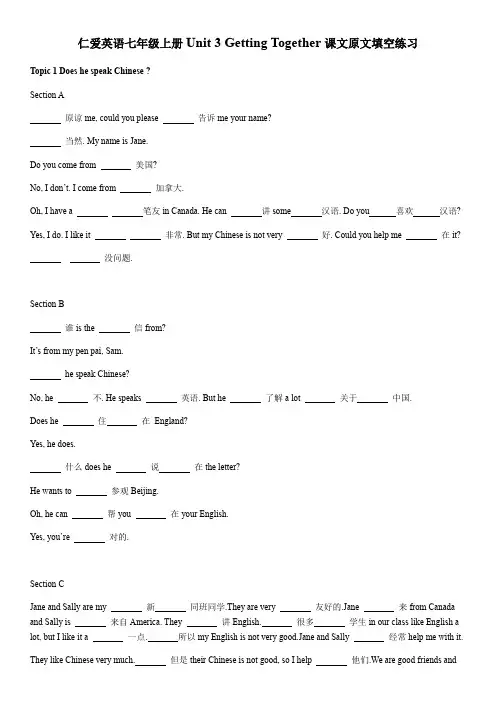
仁爱英语七年级上册Unit 3 Getting Together课文原文填空练习Topic 1 Does he speak Chinese ?Section A原谅me, could you please 告诉me your name?当然. My name is Jane.Do you come from 美国?No, I don’t. I come from 加拿大.Oh, I have a 笔友in Canada. He can 讲some汉语. Do you喜欢汉语?Yes, I do. I like it 非常. But my Chinese is not very 好. Could you help me 在it?没问题.Section B谁is the 信from?It’s from my pen pai, Sam.he speak Chinese?No, he 不. He speaks 英语. But he 了解a lot 关于中国.Does he 住在England?Yes, he does.什么does he 说在the letter?He wants to 参观Beijing.Oh, he can 帮you 在your English.Yes, you’re 对的.Section CJane and Sally are my 新同班同学.They are very 友好的.Jane 来from Canada and Sally is 来自America. They 讲English. 很多学生in our class like English a lot, but I like it a 一点.所以my English is not very good.Jane and Sally经常help me with it.They like Chinese very much. 但是their Chinese is not good, so I help 他们.We are good friends and we 互相帮助.TOPIC 2 What does your mother do?Section A1Mom. I’m 家. These are my 同班同学.Hi, 孩子们! 高兴的to meet you.欢迎to my home.Glad to meet you, too.Thank you.2.Kangkang, what does your 妈妈做?She is a 老师.And your 爸爸?He is a 医生. Michelle, what do your 父母do? They are 办公室职员.Section B1aMaria, what your mother do?She is a 护士.哪里does she 工作?She 工作in a 医院.And 什么(工作)does your father do?He is a 厨师.哪里does he work?He works in a 餐馆.Section C1Look! This is a 我的全家福照片.Who’s the 年轻的woman in 黄色的?She’s my 姑姑.2.Is the young woman in 红色的your mother?对.That’s my mother.3.Is the young man in a 绿色的T-shirt your 叔叔?Yes, he’s my 叔叔, my father’s 兄弟.4.谁are they on the sofa?My 爷爷奶奶, my 堂妹and I.You have a big 家庭.Section DMy name is Peter.I come from America.I am twelve years old.I’m a student in Grade Seven.I have a happy family.We 住in Beijing 现在.My father is doctor.He works 在a hospital.My mother is a teacher.She 教in a 高中.My grandparents live 跟us.My 小的sister, Rose, is four years old.She likes to 玩with Kitty.It is a 可爱的cat.它的颜色is black and white.I love my family!TOPIC 3 What would you like to 喝?Section A随便吃!Thank you. I would like an 蛋and some 鱼.要you like some eggs, Maria?No, thanks. I’d like some 鸡肉.怎么样you, Jane?米饭and chicken, please.好的. What would you like to drink?苹果汁, please. I like it very much.牛奶for me, please.Me, 也.Section BWhat do you 通常have for 早餐, Micheal?I usually 吃/喝milk and 面包for breakfast.What about you ?I usually have chicken with 蔬菜and some rice.And 晚餐?Jiaozi. It’s my 最喜欢的food. I like 中国的food very much.Section C1Would you like to 吃晚餐with me?Yes, I’d like to.2.May I help you, 先生?Yes.What would you like to eat ?让me 看看.3.为何不have some fish and eggs?好主意!4.Help 你自己to some fish. 给你.Thanks.5.Would you like 东西to drink? No,thanks.仁爱英语七年级上册Unit 3 Getting Together课文原文Topic 1 Does he speak Chinese ?Section AExcuse me, could you please tell me your name?Sure. My name is Jane.Do you come from America?No, I don’t. I come from Canada.Oh, I have a pen pal in Canada. He can speak some Chinese. Do you like Chinese?Yes, I do. I like it very much. But my Chinese is not very good. Could you help me with it?No problem.Section BWho is the letter from?It’s from my pen pai, Sam.Does he speak Chinese?No, he doesn’t. He speaks English. But he knows a lot about China.Does he live in England?Yes, he does.What does he say in the letter?He wants to visit Beijing.Oh, he can help you with your English.Yes, you’re right.Section CJane and Sally are my new classmates.They are very nice.Jane comes from Canada and Sally is from America.They speak English.Many students in our class like English a lot, but I like it a little. So my Englsih is not very good.Jane and Sally often help me with it.They like Chinese very much.But their Chinese is not good, so I help them.We are good friends and we help each other.TOPIC 2 What does your mother do?Section A1Mom. I’m home. These are my classmates.Hi, kids! Glad to meet you.Welcome to my home.Glad to meet you, too.Thank you.2.Kangkang, what does your mother do?She is a teacher.And your father?He is a doctor. Michelle, what does your parents do?They are office workers.Section B1aMaria, what does your mother do?She is a nurse.Where does she work?She works in a hospital.And what does your father do?He is a cook.Where does he work?He works in a restaurant.Section C1Look! This is a photo of my family.Who’s the young woman in yellow?She’s my aunt.2.Is the young woman in red your mother?Right.That’s my mother.3.Is the young man in a green T-shirt your uncle?Yes, he’s my uncle, my father’s brother.4.Who are they on the sofa?My grandparents, my cousin and I.You have a big family.Section DMy name is Peter.I come from America.I am twelve years old.I’m a student in Grade Seven.I have a happy family.We live in Beijing now.My father is doctor.He works in a hospital.My mother is a teacher.She teaches in a high school.My grandparents live with us.My little sister, Rose, is four years old.She likes to play with Kitty.It is a cute cat.Its color is black and white.I love my family!TOPIC 3 What would you like to drink?Section AHelp yourselves!Thank you. I would like an egg and some fish.Would you like some eggs, Maria?No, thanks. I’d like some chicken.What about you, Jane?Rice and chicken, please.All right. What would you like to drink?Apple juice, please. I like it very much.Milk for me, please.Me, too.Section BWhat do you usually have for breakfast, Micheal?I usually have milk and bread for breakfast.What about you ?I usually have chicken with vegetables and some rice.And dinner?Jiaozi. It’s my favorite food. I like Chinese food very much.Section C1Would you like to have dinner with me?Yes, I’d like to.2.May I help you, Sir?Yes.What would you like to eat ? Let me see.3.Why not have some fish and eggs? Good idea!4.Help yourself to some fish.Here you are.Thanks.5.Would you like something to drink? No,thanks.。