高职国际英语1-unit-1
- 格式:docx
- 大小:18.83 KB
- 文档页数:10
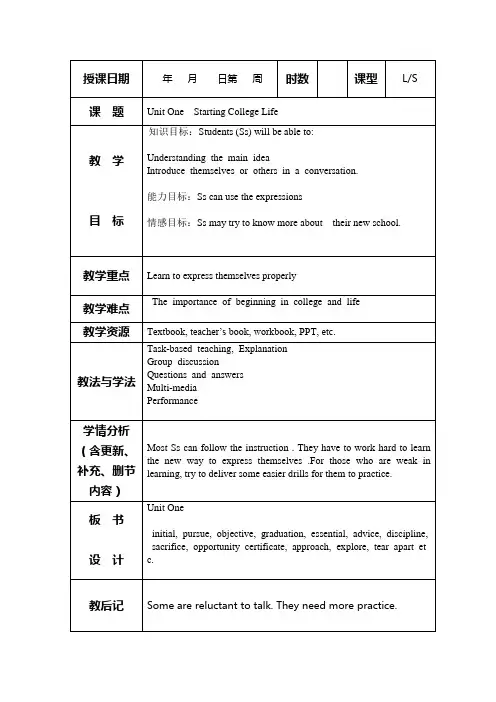
Unit 1 People1.Warming up:Using the phrases “How do you do? My name is .... Nice to meet you.” written on the board.2.Focus:The students are shown pictures of people meeting for the first time. They are also supplied with a dialogue which they can copy to say what they do when they meet somebody for the first time.They join their hands at palms and smile.They shake hands and smile.They bow from the waist and lower their eyes.Ask students to:1)Match nationalities with the pictures: which picture shows an Indianwoman? Which pictures shows two Japanese women? Which picture shows two Americans? Which pictures shows two Chinese men?2)Act out one of these greetings in class. The other students must guess howthey are greeting each other. Are you bowing from the waist and lowering your eyes? Are you shaking hands and smiling?3)Tell how they greet each other? How they greet older people? How theygreet their teachers? How they greet their parents and other relatives? And acting out these different ways for greeting people.3.Text A: greeting and introducing people1)New words reading2)Ask students what they can see in the pictures, how old they think thepeople are, what kind of occasion it could be and if they have a barbecue at home and what they barbecue.3)Ask students to read out the text loud paragraph by paragraph. Collect anywords which students have difficulty pronouncing. Writing these words on the board. Make a list on the board. Then repeat the words.4)Ask students the following questions:How to greet an older person when you meet him for the first time?Do you shake hands with an older person?Do you smile at an older person?How do you introduce yourself to an older person?What do you say to a younger person?How do you introduce somebody else to a younger person?What do you say to somebody you already know?How do you answer a younger person you know who greets you first?5)Pair work as Kate Miller and Sung Ling starting from line 17.6)Page 5-1: read out the sentences and then pair them.7)Page 5-2: check the meaning of the words before doing.4.Background information:1)student exchange: increase student’s understanding and tolerance of other cultures, as well as improving their language skills and broaden their social horizon.2)Barbecue: an outdoor meal, usually a form of social gathering at which meats, fish, or fowl, along with vegetables, are roasted over a wood or charcoal fire.5.words and expressions:1)exchange partner2)BowThey bowed low to the chairman.He turned and bowed to his boss.Bow and arrowsHe took bow on stage to audience.3)Next-door neighbor4)LimpLimp handshakeShe let her whole body go limp.Mary had twisted her ankle and was limping. 一瘸一拐5)Friend--friendly unfriend--unfriendly--unfriendliness6)Informal--informally--informality7)Short period8)Formal--formally--formality9)Had better do10)Informal formal natural personal professional additional educational musical actual official regional industrial international medical traditional cultural practicalSpeaking:Page7 listening 1:Before playing the recording get students to read the sentences 1 to 6, first quietly to themselves, then aloud. Make sure that everybody has understood the sentences.Now play the recording and get students to do the exercise. Be prepared to play the recording as often as the students need it.Patrick: good morning. Excuse me, but are you Ms Susan Garner from Chicago, please?Susan: that’s right.Patrick: how do you do, Ms Garner? I’m Patrich Choy. It’s nice to meet you. I’ve come to take you to your hotel.Susan: how do you do, Mr Choy. It’s nice to meet you, too. Look, may i introduce you to one of my colleagues? This is tony Hunter. Tony, this is Patrick Choy. He’s come to take us to our hotel.Tony: Fine. How do you do, Mr Choy? It’s a pleasure to meet you.Patrick: How do you do, Mr Hunter. Welcome to Hongkong.Tony: Thank you. I’ve heard so many good things about Hongkong that it’s wonderful to be here.Patrick: that’s nice to hear. Now, could you come this way, please? The car’s just outside the building. It’s not far.Ask students to read out the sentences and say whether they are true or false. Grammar check: nounsText B: Blind Date1.Background information:1)Blind date: it usually occurs when the two people previously not knowingeach other are going out on a date set up by another person who knows both people. Today, most blind dates are n’t totally blind per se, thanks to online social sites such as Facebook and MySpace, where many people have photographs of themselves that are easily accessible by others.2)Geocaching地理寻宝游戏: is a high tech version of hide and seek and anoutdoor recreational activity, in which the participants explore the outdoors in search of hidden “treasure” and adventure by using a GPS receiver or mobile device and other navigational techniques.2.Words and expressions:1)Internet dating site2)I could not believe my eyes.3)She began modelling in Paris aged 15.4)Glamour--glamorous5)Suit--suitable6)All the girls fancied him.Linda took quite a fancy to him.What do you fancy doing?I just fancied a drink.7)tongue-tied8) A generous glass of wine一大杯酒; generosity 大量充足9)Tip the waiter a dollar10)Striped tie条纹领带11)Tie up your shoelaceI tied a knot in the rope.12)i can’t stand.13)Ignore--ignorant--ignorance14)Be in no mood for.../to do...没心情做某事Be in the mood for../to do...有心情做某事Be in a mood情绪不好15)misery--miserable--miserably16)Regret--regrettable--regrettably17)Straight away 马上18)Hopefully 但愿19)Strike up a conversation with sb.搭讪攀谈strick--struck20)Be in conversation with sb. 正在谈话21)Make conversation 搭话找话说说应酬话3.Text outline:。