金融风险管理第8章 操作风险管理
- 格式:ppt
- 大小:122.00 KB
- 文档页数:33

Chapter 8: How Traders Manage Their Risks8.1交易组合价值减少10500美元。
8.2 当波动率变化2%时,交易组合价格增长200×2=400美元。
8.3 两种情形均为0.5*30*4=60美元8.4 1000 份期权短头寸的Delta 等于-700,可以通过买入700 份股票的形式使交易组合达到Delta 中性。
8.5 Theta为-100的含义是指在股价与波动率没有变化的情况下,期权价格每天下降100美元。
假如交易员认为股价及隐含波动率在将来不会改变,交易员可以卖出期权,并且Theta值越高越好。
8.6当一个期权承约人的Gamma绝对值较大,Gamma本身为负,并且Delta等于0,在市场变化率较大的情况下,期权承约人会有较大损失。
8.8看涨及看跌期权的多头头寸都具备正的Gamma,由图6.9可以看出,当Gamma为正时,对冲人在股票价格变化较大时会有收益,而在股票价格变化较小时会有损失,因此对冲人在(b)情形收益更好,当交易组合包含期权的空头头寸时,对冲人在(a)情形收益会更好。
8.9 Delta的数值说明当欧元汇率增长0.01时,银行交易价格会增加0.01*30000=300美元,Gamma的数值说明,当欧元价格增长0.01时,银行交易组合的Delta会下降0.01*80000=800美元;为了做到Delta中性,我们应该卖出30000欧元;当汇率增长到0.93时,我们期望交易组合的Delta下降为(0.93-0.9)*80000=24000,组合价值变为27600。
为了维持Delta中性,银行应该对2400数量欧元空头头寸进行平仓,这样可以保证欧元净空头头寸为27600。
当一个交易组合的Delta为中性,同时Gamma为负时资产价格有一个较大变动时会引起损失。
因此银行可能会蒙受损失。
8.15.The gamma and vega of a delta-neutral portfolio are 50 per $ per $ and 25 per %, respectively. Estimate what happens to the value of the portfolio when there is a shock to the market causing the underlying asset price to decrease by $3 and its volatility to increase by 4%.With the notation of the text, the increase in the value of the portfolio isSgamma2)(σ⨯vega5.0∆⨯⨯+∆This is0.5 × 50 × 32 + 25 × 4 = 325The result should be an increase in the value of the portfolio of $325.8.16.Consider a one-year European call option on a stock when the stock price is $30, the strike price is $30, the risk-free rate is 5%, and the volatility is 25% per annum. Use the DerivaGem software to calculate the price, delta, gamma, vega, theta, and rho of the option. Verify that delta is correct by changing the stock price to $30.1 and recomputing the option price. Verify that gamma is correct by recomputing the delta for the situation where the stock price is $30.1. Carryout similar calculations to verify that vega, theta, and rho are correct.The price, delta, gamma, vega, theta, and rho of the option are 3.7008, 0.6274, 0.050, 0.1135, −0.00596, and 0.1512. When the stock price increases to 30.1, the option price increases to 3.7638. The change in the option price is 3.7638 − 3.7008 = 0.0630. Delta predicts a change in the option price of 0.6274 × 0.1 = 0.0627 which is very close. When the stock price increases to 30.1, delta increases to 0.6324. The size of the increase in delta is 0.6324 − 0.6274 = 0.005. Gamma predicts an increase of 0.050 × 0.1 = 0.005 which is (to three decimal places) the same. When the volatility increases from 25% to 26%, the option price increases by 0.1136 from 3.7008 to3.8144. This is consistent with the vega value of 0.1135. When the time to maturity is changed from 1 to 1−1/365 the option price reduces by 0.006 from 3.7008 to 3.6948. This is consistent with a theta of −0.00596. Finally, when the interest rate increases from 5% to 6%, the value of the option increases by 0.1527 from 3.7008 to 3.8535. This is consistent with a rho of 0.1512.8.17.A financial institution has the following portfolio of over-the-counter optionson sterling:A traded option is available with a delta of 0.6, a gamma of 1.5, and a vegaof 0.8.(a) What position in the traded option and in sterling would make the portfolioboth gamma neutral and delta neutral?(b) What position in the traded option and in sterling would make the portfolioboth vega neutral and delta neutral?The delta of the portfolio is−1, 000 × 0.50 − 500 × 0.80 − 2,000 × (−0.40) − 500 × 0.70 = −450The gamma of the portfolio is−1, 000 × 2.2 − 500 × 0.6 − 2,000 × 1.3 − 500 × 1.8 = −6,000The vega of the portfolio is−1, 000 × 1.8 − 500 × 0.2 − 2,000 × 0.7 − 500 × 1.4 = −4,000(a) A long position in 4,000 traded options will give a gamma-neutral portfolio since the long position has a gamma of 4, 000 × 1.5 = +6,000. The delta of the whole portfolio (including traded options) is then:4, 000 × 0.6 − 450 = 1, 950Hence, in addition to the 4,000 traded options, a short position in £1,950 is necessary so that the portfolio is both gamma and delta neutral.(b) A long position in 5,000 traded options will give a vega-neutral portfolio since the long position has a vega of 5, 000 × 0.8 = +4,000. The delta of the whole portfolio (including traded options) is then5, 000 × 0.6 − 450 = 2, 550Hence, in addition to the 5,000 traded options, a short position in £2,550 is necessary so that the portfolio is both vega and delta neutral.8.18.Consider again the situation in Problem 8.17. Suppose that a second traded option with a delta of 0.1, a gamma of 0.5, and a vega of 0.6 is available. How could the portfolio be made delta, gamma, and vega neutral?Let w1 be the position in the first traded option and w2 be the position in the second traded option. We require:6, 000 = 1.5w1 + 0.5w24, 000 = 0.8w1 + 0.6w2The solution to these equations can easily be seen to be w1 = 3,200, w2 = 2,400. The whole portfolio then has a delta of−450 + 3,200 × 0.6 + 2,400 × 0.1 = 1,710Therefore the portfolio can be made delta, gamma and vega neutral by taking a long position in 3,200 of the first traded option, a long position in 2,400 of the second traded option and a short position in £1,710.8.19. (Spreadsheet Provided)Reproduce Table 8.2. (In Table 8.2, the stock position is rounded to the nearest 100 shares.) Calculate the gamma and theta of the position each week. Using the DerivaGem Applications Builders to calculate the change in the value of theportfolio each week (before the rebalancing at the end of the week) and check whether equation (8.2) is approximately satisfied. (Note: DerivaGem produces a value of theta “per calendar day.” The theta in equation 8.2 is “per year.”) Consider the first week. The portfolio consists of a short position in 100,000 options and a long position in 52,200 shares. The value of the option changes from $240,053 at the beginning of the week to $188,760 at the end of the week for a gain of $51,293. The value of the shares change from 52,200 × 49 = $2,557, 800 to 52,200 × 48.12 = $2,511,864 for a loss of $45,936. The net gain is 51,293 − 45,936 = $5,357. The gamma and theta (per year) of the portfolio are −6,554.4 and 430,533 so that equation (8.2) predicts the gain as430,533 ×1/52 + 0.5 × 6,554.4 × (48.12 − 49)2 = 5,742The results for all 20 weeks are shown in the following table.。

金融机构操作风险识别与管理在当今复杂多变的金融市场环境中,金融机构面临着各种各样的风险,其中操作风险是一种不容忽视的重要风险类型。
操作风险可能导致金融机构遭受重大的经济损失,影响其声誉和稳定性,甚至危及整个金融体系的安全。
因此,有效地识别和管理操作风险对于金融机构的可持续发展至关重要。
一、金融机构操作风险的定义与特点操作风险是指由于不完善或有问题的内部程序、人员、系统以及外部事件所造成的损失风险。
与信用风险和市场风险不同,操作风险具有内生性、多样性、隐蔽性和难以量化等特点。
内生性是指操作风险主要源于金融机构内部的业务操作和管理流程。
人员的疏忽、违规操作、内部欺诈等都可能引发操作风险。
多样性则体现在操作风险的来源广泛,涵盖了金融机构的各个业务领域和管理环节。
隐蔽性使得操作风险难以被及时发现和察觉,往往在造成严重损失后才被暴露出来。
难以量化则增加了对操作风险进行准确评估和管理的难度。
二、金融机构操作风险的主要类型1、内部欺诈风险内部人员故意欺诈、挪用资金、违规操作等行为给金融机构带来损失。
例如,员工利用职务之便进行虚假交易、窃取客户资金等。
2、外部欺诈风险外部人员通过欺诈手段获取金融机构的资金或信息,如网络诈骗、信用卡盗刷等。
3、客户、产品与业务操作风险由于对客户需求了解不足、产品设计缺陷或业务操作流程不当导致的风险。
比如,金融产品在销售过程中未充分揭示风险,引发客户投诉和法律纠纷。
4、执行、交割和流程管理风险在业务执行、交易交割和流程管理过程中出现的失误,如交易处理错误、文件缺失等。
5、系统故障风险信息技术系统故障、网络攻击、数据丢失等造成的风险。
6、人员与劳动力风险员工离职、劳动力短缺、员工能力不足等导致的业务中断或效率低下。
7、法律与合规风险违反法律法规或监管要求,面临罚款、诉讼等风险。
三、金融机构操作风险的识别方法1、流程分析法对金融机构的各项业务流程进行详细梳理,分析每个环节可能存在的操作风险。
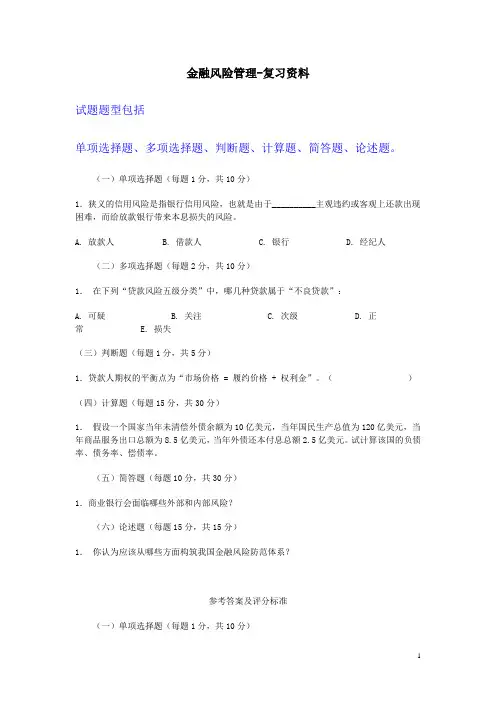
金融风险管理-复习资料试题题型包括单项选择题、多项选择题、判断题、计算题、简答题、论述题。
(一)单项选择题(每题1分,共10分)1.狭义的信用风险是指银行信用风险,也就是由于__________主观违约或客观上还款出现困难,而给放款银行带来本息损失的风险。
A. 放款人B. 借款人C. 银行D. 经纪人(二)多项选择题(每题2分,共10分)1.在下列“贷款风险五级分类”中,哪几种贷款属于“不良贷款”:A. 可疑B. 关注C. 次级D. 正常 E. 损失(三)判断题(每题1分,共5分)1.贷款人期权的平衡点为“市场价格 = 履约价格 + 权利金”。
()(四)计算题(每题15分,共30分)1.假设一个国家当年未清偿外债余额为10亿美元,当年国民生产总值为120亿美元,当年商品服务出口总额为8.5亿美元,当年外债还本付息总额2.5亿美元。
试计算该国的负债率、债务率、偿债率。
(五)简答题(每题10分,共30分)1.商业银行会面临哪些外部和内部风险?(六)论述题(每题15分,共15分)1.你认为应该从哪些方面构筑我国金融风险防范体系?参考答案及评分标准(一)单项选择题(每题1分,共10分)1.借款人(二)多项选择题(每题2分,共10分)1.A,C,E(三)判断题(每题1分,共5分)1.×(四)计算题(每题15分,共30分)1.负债率=(当年未清偿外债余额/当年国民生产总值)×100%= 10/120 = 8.33% (5分)债务率=(当年未清偿外债余额/当年商品服务出口总额)×100%= 10/8.5 = 117.65% (5分)偿债率=(当年外债还本付息总额/当年商品服务出口总额)×100%= 2.5/8.5 = 29.41% (5分)(五)简答题(每题10分,共30分)1. (1)商业银行面临的外部风险包括:①信用风险。
是指合同的一方不履行义务的可能性。
②市场风险。