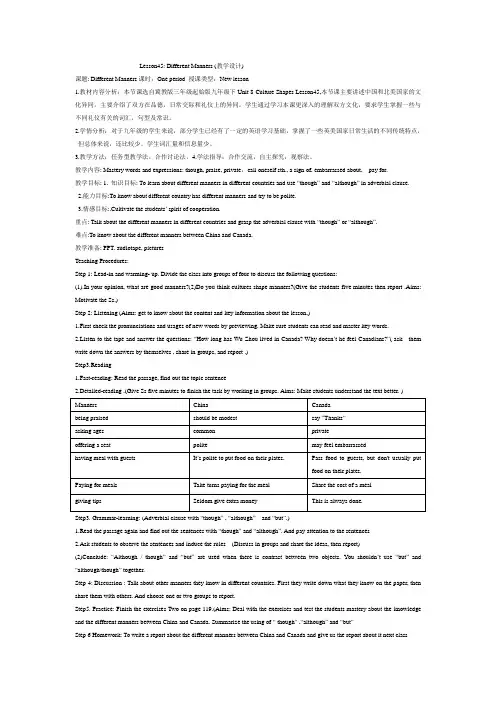
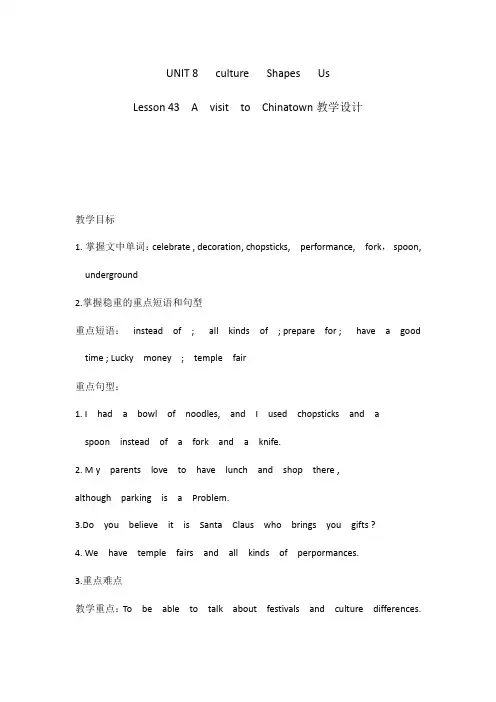
初中英语九年级下册冀教版Unit 8 Culture Shapes Us Lesson 45 Differert Manners 课后作业
- 格式:doc
- 大小:25.59 KB
- 文档页数:6
第1页 共6页 Lesson 45 Different Manners
一、单项选择
1. —What a nice model plane!
—Thanks. I made it with the 3D printer by________.
A. me B. him C. itself D. myself
2. Lucy likes staying at home. She ________ goes traveling during
holidays.
A. usually B. seldom C. always D. often
3. ________ vegetable juice is a good habit, which helps you eat a
balanced diet.
A. Drink B. Drank C. Drunk D. Drinking
4. —You should ________ your son. He works harder than before.
—Thanks, I will.
A. praise B. punish C. prove D. provide
5. Please take turns ________ food in the restaurant.
A. buy B. buying C. buys D. bought
6. —How's Bob now?
—I hear the company ________him a very good job, but he turned it
down.
A. donated B. served
C. offered D. introduced
第2页 共6页 7. Before stamps, people didn't ________ for the letters they sent, but for
the letters they received.
A. pay B. cost C. spend D. take
8. The Reader has been a popular programme since 2016, ________ there
is still something not satisfying.
A. though B. until C. if D. unless
9. ________ my sister ________ I do well in our lessons. My mother is
very proud of us.
A. Not; but B. Neither; nor
C. Either; or D. Both; and
10. —Does Jimmy still work as a driver?
—No. He has ________ for two years.
A. left the company B. gone to Shanghai
C. studied in college D. lost his job
二、用所给单词的适当形式填空
11. ________(be) proud is bad in our country.
12. There are________(child) playing on the square.
13. It is interesting__________(watch) the program—Running Man.
14. (易错题)There are no______________(different) between the two
words.
15. Jenny is a________(Canada) girl. She loves her country.
第3页 共6页 三、连词成句
16. different, our, from, culture, hers, is
_______________________________________________________.
17. the, of, meal, we, a, share, cost
_______________________________________________________.
18. not, age, to, it's, her, polite, ask
_______________________________________________________.
19. does, embarrassed, she, why, feel
_______________________________________________________?
20. extra, you, to, give, waiters, money, did
_______________________________________________________?
四、完形填空 (词数:约160;建议用时:5分钟)
How much do you know about manners? Different countries have
________21 manners. In some Asian countries, it is good manners to take
off your shoes before you go into a house. ________22 in European
countries, even if they sometimes become very dirty, this kind of
behavior is not done. If you are a ________23 in a Chinese house, when
you have a meal, you usually do not ________24 the food. You often
leave a little to show that you have had enough. But in England, a visitor
always finishes food to show that he has ________25 it. We must know
the customs of other ________26 so that they will not think us badmannered. People all over the world ________27 that a wellmannered
第4页 共6页 person should be kind and ________28 to others. If you remember this,at least you will not go very far wrong. ________29 likes a person with
good manners, but no one likes a person ________30 bad manners. Keep
your manners.
21. A. same B. different C. some D. interesting
22. A. And B. So C. But D. Or
23. A. stranger B. traveler C. visitor D. foreigner
24. A. need B. finish C. choose D. have
25. A. finished B. enjoyed C. taken D. drunk
26. A. countries B. villages C. cities D. places
27. A. find B. know C. guess D. agree
28. A. careful B. helpful C. hardworking D. healthy
29. A. Somebody B. Anybody C. Nobody D. Everybody
30. A. with B. had C. knows D. is
答案
一、1. D 2. B 3. D 4. A 5. B 6. C 7. A 8. A 9. D
10. C 点拨:本题运用语法判定法。由于句中“for two years”是指一段时间,动词要用延续性动词。选项中的leave,go和lose都是非延续性动词,只有study是延续性动词。故选C。
二、11. Being 12. children 13. to watch
14. differences 15. Canadian
三、16.Our culture is different from hers
第5页 共6页 17. We share the cost of a meal
18. It's not polite to ask her age
19. Why does she feel embarrassed
20. Did you give extra money to waiters
四、21. B
22. C 点拨:本题运用逻辑推理法。结合上句“进门前脱鞋在一些亚洲国家是好的礼仪”,本句是在说在欧洲国家是不这样做的,前后为转折关系,故选C。
23. C 点拨:stranger陌生人;traveler旅行者;visitor 游客,访问者;foreigner外国人。提到的是在中国一个人家中用餐,可知是指假如是一位客人,故选C。
24. B 点拨:根据后边句子“You often leave a little to show…”可知该句:你通常不要吃完食物。也可以通过文章后面的句子a
visitor always finishes food to show that…,可知选B。
【温馨提示】做完形填空题时,如果遇到没有思路的题目,我们可以暂且把它放过,有时候可以在下文中找到结构类似的句子,那么答案可能就在那里。
25. B 26. A
27. D 点拨:find发现,找到;know知道,认识;guess猜;agree同意。句意:全世界的人________有礼貌的人应该是友好的……。结合句意可知选D。
28. B 点拨:本题运用排除法。careful小心的;helpful乐于助人的;