
两类SBR改性剂调合生产塔河A级沥青的性能比较
- 格式:pdf
- 大小:254.97 KB
- 文档页数:3

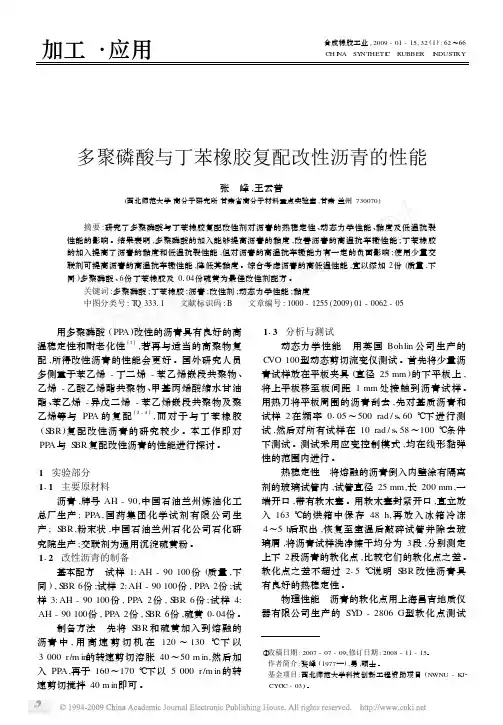
加工・应用 合成橡胶工业,2009-01-15,32(1):62~66CH I N A SY NTHETI C RUBBER I N DUST RY多聚磷酸与丁苯橡胶复配改性沥青的性能张 峰,王云普(西北师范大学高分子研究所甘肃省高分子材料重点实验室,甘肃兰州730070) 摘要:研究了多聚磷酸与丁苯橡胶复配改性剂对沥青的热稳定性、动态力学性能、黏度及低温抗裂性能的影响。
结果表明,多聚磷酸的加入能够提高沥青的黏度,改善沥青的高温抗车辙性能;丁苯橡胶的加入提高了沥青的黏度和低温抗裂性能,但对沥青的高温抗车辙能力有一定的负面影响;使用少量交联剂可提高沥青的高温抗车辙性能,降低其黏度。
综合考虑沥青的高低温性能,宜以添加2份(质量,下同)多聚磷酸、6份丁苯橡胶及0104份硫黄为最佳改性剂配方。
关键词:多聚磷酸;丁苯橡胶;沥青;改性剂;动态力学性能;黏度 中图分类号:T Q33311 文献标识码:B 文章编号:1000-1255(2009)01-0062-05 用多聚磷酸(PP A)改性的沥青具有良好的高温稳定性和耐老化性[1],若再与适当的高聚物复配,所得改性沥青的性能会更好。
国外研究人员多侧重于苯乙烯-丁二烯-苯乙烯嵌段共聚物、乙烯-乙酸乙烯酯共聚物、甲基丙烯酸缩水甘油酯、苯乙烯-异戊二烯-苯乙烯嵌段共聚物及聚乙烯等与PP A的复配[2-4],而对于与丁苯橡胶(S BR)复配改性沥青的研究较少。
本工作即对PP A与S BR复配改性沥青的性能进行探讨。
1 实验部分111 主要原材料沥青,牌号AH-90,中国石油兰州炼油化工总厂生产;PP A,国药集团化学试剂有限公司生产;S BR,粉末状,中国石油兰州石化公司石化研究院生产;交联剂为通用沉淀硫黄粉。
112 改性沥青的制备基本配方 试样1:AH-90100份(质量,下同),S BR6份;试样2:AH-90100份,PP A2份;试样3:AH-90100份,PP A2份,S BR6份;试样4: AH-90100份,PP A2份,S BR6份,硫黄0104份。

SBS-SBR胶乳复合改性乳化沥青流变性能畅润田【摘要】将改性剂SBS与SBR胶乳同时用于乳化沥青改性,充分发挥SBR胶乳与乳化沥青较好的相溶性和其对沥青低温、抗水损性能具有良好的改性效果,有效解决SBS改性沥青黏度较大乳化困难和低掺量时路用性能不佳的问题.首先从改性乳化沥青储存稳定性和蒸发残留物常规指标出发,得出不同掺量改性剂对乳化沥青的复合改性效果变化规律,之后通过样品在流变性能随温度和频率的变化趋势对其效果进行验证,并得到改性效果较好的改性方案.试验结果显示,在SBS掺量2%的基础上,添加3%的SBR胶乳可以大幅改善乳化沥青蒸馏残留物的弹性性能和高低温性能.【期刊名称】《山西交通科技》【年(卷),期】2017(000)006【总页数】4页(P44-47)【关键词】乳化沥青;SBS;SBR;复合改性;流变行为【作者】畅润田【作者单位】山西省交通科学研究院,山西太原 030006【正文语种】中文【中图分类】U414.750 引言随着我国早期建设道路陆续进行维修养护阶段,具有可以常温施工、节约能源、减少环境污染等优点的乳化沥青逐渐成为道路材料和技术应用、研究与发展的主流方向[1-2]。
但是沥青本身的技术指标无法满足路面使用性能要求,聚合物苯乙烯-丁二烯-苯乙烯嵌段共聚物(SBS)能够显著提高沥青的高温抗车辙、低温抗开裂性、抗老化以及改善沥青路面的耐疲劳性能,是目前筑路使用最广泛的聚合物改性剂[3-4]。
SBS聚合物可以在沥青内部发生交联,使体系的黏弹特征发生明显变化[5-6],对乳化设备、乳化条件和储存条件都要求较高,若掺量太低,则不能满足沥青路面的性能要求。
SBR胶乳与乳化沥青相溶性较好,操作便捷,且SBR胶乳生产工艺简单,但其改性效果略差。
在此,将改性剂SBS与SBR胶乳同时用于乳化沥青改性,充分发挥SBR胶乳与乳化沥青较好的相溶性和其对沥青低温、抗水损性能良好的改性效果[7],因而将两者同时用于乳化沥青改性,不仅有效解决SBS改性沥青乳化困难的问题,SBS和SBR胶乳对乳化沥青改性效果具有协同增效作用,使乳化沥青各方面性能均有较为显著的提升。

SBR 与SBS 复合改性沥青制备及其混合料路用性能研究摘要:本文研究了SBR(丁苯橡胶)与SBS(苯乙烯-丁二烯-苯乙烯)复合改性沥青制备方法和其混合料的路用性能。
以SBR 与SBS 的质量比为1:1,通过熔融混合法制备了SBR/SBS 复合改性沥青,研究了SBS 添加量对复合沥青性质的影响。
在此基础上,制备了不同添加量SBR/SBS 复合改性沥青的混合料,并测试了其抗拉强度、剪切应力、渗水性等路用性能。
通过实验研究发现,随着SBS 添加量的增加,复合沥青的黏度、软化点和负荷剪切模量均有所增加;而渗透性和弹性恢复率则有所降低。
在添加20% SBS 的情况下,SBR/SBS 复合沥青的各项性能最优,混合料也具有较好的路用性能,其抗拉强度、剪切应力和渗水性均有所提高。
本研究结果表明,采用SBR 与SBS 相结合的复合改性方法是可行的,可以显著提高沥青的性能和混合料的路用性能。
因此,SBR/SBS 复合沥青有望作为一种新型材料在路面建设中得到广泛应用。
关键词:SBR/SBS 复合改性沥青;路用性能;混合料IntroductionAsphalt is widely used in road construction due to its excellent performance in providing a smooth and durable road surface. However, traditional asphalt has some shortcomings such as low elasticity, low temperature cracking resistance, and poor waterproofing property. Therefore, improving the performance of asphalt has become a research hotspot in the field of road construction.Many studies have shown that the addition of polymers can improve the performance of asphalt effectively. Among them, styrene- butadiene rubber (SBR) and styrene-butadiene-styrene copolymer (SBS) are two commonly used polymers in asphalt modification. SBR can improve the elasticity and low-temperature resistance of asphalt, whileSBS can enhance the high-temperature stability and waterproofing property of asphalt. Therefore, combining SBR and SBS to modify asphalt is expected to achieve a comprehensive improvement in its performance.In this study, SBR/SBS composite modified asphalt was prepared by melt blending method, and the effect of SBS content on the properties of composite asphalt was investigated. Furthermore, the performance of different SBR/SBS composite modified asphalt mixtures was tested to evaluate their road usage efficiency.ExperimentalMaterials:Asphalt: A pen grade 60/70 asphalt was used as the base material.SBR: A commercial grade SBR with a styrene content of 23% was used.SBS: A commercial grade SBS with a styrene content of 30% was used.Preparation of SBR/SBS composite modified asphalt:SBR and SBS were characterized by their respective melting points to ensure that they were fully melted before being added to the asphalt. Then, SBR and SBS were added to the asphalt at a SBR/SBS mass ratio of 1:1. The mixture was stirred at 170°C for 3 hours until a uniform composite modified asphalt was obtained. The SBS content was adjusted to 10%, 15%, and 20% of the total amount of SBR/SBS to prepare three different composite modified asphalt samples.Performance testing of SBR/SBS composite modified asphalt mixture:The SBR/SBS composite modified asphalt mixture was prepared according to the Marshall method. The mixture was compacted and molded into cylindrical samples with a diameter of 63.5mm and a height of 63.5mm. The samples were then tested for their tensile strength, shear stress, and water permeability according to the relevant standards.Results and discussionEffect of SBS content on composite modified asphalt:The rheological properties of SBR/SBS composite modified asphalt with different SBS contents were analyzed through dynamic shearrheometer tests. The results showed that the addition of SBS could increase the viscosity, softening point, and negative load shear modulus of the composite modified asphalt. With the increase of SBS content, the improvement of these properties becomes more pronounced. Based on this, the optimal SBS content was determined to be 20%.Effect of SBS content on composite modified asphalt mixture:The mechanical properties of the SBR/SBS composite modified asphalt mixture were tested for different SBS contents. The results showed that increasing the SBS content could increase the tensile strength and shear stress of the mixture. However, the water permeability and elastic recovery rate of the mixture decreased with the increase of SBS content. When the SBS content was 20%, the composite modified asphalt mixture had the best road usage performance.ConclusionThe SBR/SBS composite modified asphalt prepared by melt blending method has the potential to significantly improve the performance of asphalt. The addition of SBS can increase the viscosity, softening point, and negative load shear modulus of the composite modified asphalt, while reducing its permeability and elastic recovery rate. With the optimal SBS content of 20%, the SBR/SBS composite modified asphalt mixture obtained exhibited good mechanical properties including improved tensile strength, shear stress, and water permeability.The use of SBR/SBS composite modified asphalt has great potential in road construction, and further research should be conducted to explore its application prospects in this field.。