
ECMT 5001 Year 2008 Semester 2_ECMT 5001 Lecture 5
- 格式:ppt
- 大小:510.50 KB
- 文档页数:79


LIHONG LIlihong@/˜lihongRutgers University,Piscataway,NJ08854E DUCATION•2005-present,PhD,Department of Computer Science,Rutgers University,USA•2002-2004,M.Sc.,Department of Computing Science,University of Alberta,Canada•1998-2002,B.Eng.,Department of Computer Science and Technology,Tsinghua University,ChinaW ORKING AND T EACHING E XPERIENCEMay2007-Aug2007research intern at Yahoo!Research NYCMay2006-Aug2006engineer intern at Google NYCJan2005-present graduate research assistant at the Rutgers UniversitySep2002-Jul2004teaching/research assistant at the University of AlbertaMay2002-May2002programming language tutor at a professional training centerJun2000-Sep2001part-time software programmerJan1999-Feb1999home tutor of college mathS ELECTED G RADUATE C OURSES•AI/ML:Machine Learning(Greiner),Reinforcement Learning(Sutton),Learning and Sequential Decision Mak-ing(Littman),Introduction to Control System Theory(Sontag),Pattern Recognition(Kulikowski),Foundation of Knowledge Representation(McCarty),Abstraction and Hierarchies for Learning and Planning(Littman),Natural Language Processing(Kondrak),Bounded Rationality and Non-conventional Computing(Bulitko),Principles of Artificial Intelligence(Shan),Agent Communication and Architecture(Elio)•Optimization:Nonlinear Programming(Shanno),Discrete Optimization(Boros),Network and Combinatorial Optimization(Zhou)•Algorithm/Theory:Design and Analysis of Algorithms(Fredman),Foundations of Computer Science(Kilian), Complexity of Computation(Bogdanov),Hard Problems and Phase Transitions(Culberson),Automated Reasoning •Misc:Numerical Analysis(Pai)P ROFESSIONAL S KILLS•Programming:Primarily C/C++and Java,some experience in other popular languages•Systems&Software:MS Windows/Office,Linux/Unix,MS VC++with MFC,Matlab,L A T E X•AI/ML Expertise:–Familiar with many popular AI/ML theories and techniques,including reinforcement learning,(partially ob-servable)Markov decision processes,(hidden)Markov chains,decision-theoretic planning,statistical learn-ing theory,PAC theory,SVMs,neural networks,decision trees,nearest neighbor learning,ensemble learning, Bayesian inference,EM,heuristic search,and online learning–General knowledge in data mining,graphical models,feature selection,dimensionality reduction,unsuper-vised learning,semi-supervised learning,game theory,and information theoryLihong Li December22,2007P ROFESSIONAL A CTIVITIES•Reviewer for the Journal of Machine Learning Research,AAAI’06,IJCAI’07,AAAI’08,and some workshops •Oral or poster presentations at IJCAI’03,NIPS’03(workshop),ECML’04,AAAI’05,ICML’06,and AI&Math’08 S ELECTED P UBLICATIONSJournal and Conference Papers•L.Li and M.L.Littman:Efficient value-function approximation via online linear regression.In the Tenth Interna-tional Symposium on Artificial Intelligence and Mathematics(AI&Math),2008.•J.Wortman,Y.V orobeychik,L.Li,and ngford:Maintaining equilibria during exploration in sponsored search auctions.In the Third International Workshop on Internet and Network Economics(WINE),LNCS4858,2007.•L.Li,V.Bulitko,and R.Greiner:Focus of attention in reinforcement learning.In Journal of Universal Computer Science,13(9):1246–1269,2007.•T.J.Walsh,A.Nouri,L.Li,and M.L.Littman:Planning and learning in environments with delayed feedback.In the Eighteenth European Conference on Machine Learning(ECML),LNCS4701,2007.•R.Parr,C.Painter-Wakefield,L.Li,and M.L.Littman:Analyzing feature generation for value-function approxima-tion.In the Twenty-Fourth International Conference on Machine Learning(ICML),2007.•A.L.Strehl,L.Li,E.Wiewiora,ngford,and M.L.Littman:PAC model-free reinforcement learning.In the Twenty-Third International Conference on Machine Learning(ICML),2006.•A.L.Strehl,L.Li,and M.L.Littman:Incremental model-based learners with formal learning-time guarantees.In the Twenty-Second Conference on Uncertainty in Artificial Intelligence(UAI),2006.•A.L.Strehl,L.Li,and M.L.Littman:PAC reinforcement learning bounds for RTDP and Rand-RTDP.In AAAI’06 Workshop on Learning for Search(AAAI technical report WS-06-11),2006.•L.Li,T.J.Walsh,and M.L.Littman:Towards a unified theory of state abstraction for MDPs.In the Ninth Interna-tional Symposium on Artificial Intelligence and Mathematics(AI&Math),2006.•L.Li,M.L.Littman:Lazy approximation for solving continuousfinite-horizon MDPs.In the Twentieth National Conference on Artificial Intelligence(AAAI),2005.•L.Li,V.Bulitko,and R.Greiner:Batch reinforcement learning with state importance(extended abstract).In the Fifteenth European Conference on Machine Learning(ECML),LNCS3201,2004.•V.Bulitko,L.Li,R.Greiner,and I.Levner:Lookahead pathologies for single agent search(poster paper).In the Eighteenth International Joint Conference on Artificial Intelligence(IJCAI),2003.•I.Levner,V.Bulitko,L.Li,G.Lee,and R.Greiner:Towards automated creation of image interpretation systems.In the Sixteenth Australian Joint Conference on Artificial Intelligence,LNCS2903,2003.•L.Li,V.Bulitko,R.Greiner,and I.Levner:Improving an adaptive image interpretation system by leveraging.In the Eighth Australian and New Zealand Intelligent Information System Conference(ANZIIS),2003.•L.Li,M.Shao,Z.Zheng,C.He,and Z.-H.Du:Typical XML document transformation methods and an application system(in Chinese).Computer Science,30(2):40–44,February,2003.Book•Min Shao,Lihong Li,Zhenkun Zheng,and Chuan He:Practical Programming in XML.Tsinghua University Press, Beijing,China,December,2002.ISBN7-900643-85-0.Theses•Lihong Li:Focus of Attention in Reinforcement Learning.MSc thesis,Department of Computing Science,Univer-sity of Alberta,Edmonton,Alberta,Canada,July,2004.•Lihong Li:Design and implementation of an agent communication module based on KQML.Bachelor degree thesis,Department of Computer Science and Technology,Tsinghua University,Beijing,China,June,2002.R EFERENCESAvailable upon request.。
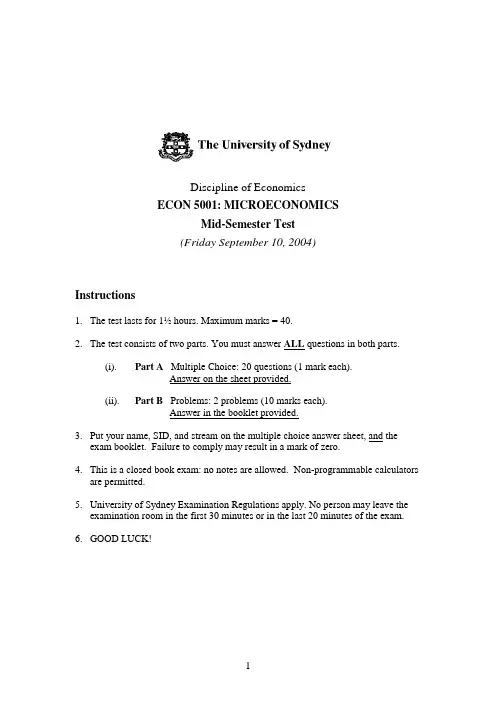
Discipline of EconomicsECON 5001: MICROECONOMICSMid-Semester Test(Friday September 10, 2004)Instructions1.The test lasts for 1½ hours. Maximum marks = 40.2.The test consists of two parts. You must answer ALL questions in both parts.(i).Part A Multiple Choice: 20 questions (1 mark each).Answer on the sheet provided.(ii).Part B Problems: 2 problems (10 marks each).Answer in the booklet provided.3.Put your name, SID, and stream on the multiple choice answer sheet, and theexam booklet. Failure to comply may result in a mark of zero.4.This is a closed book exam: no notes are allowed. Non-programmable calculatorsare permitted.5.University of Sydney Examination Regulations apply. No person may leave theexamination room in the first 30 minutes or in the last 20 minutes of the exam. 6.GOOD LUCK!Part A: Multiple Choice (20 marks)1. The slope of an indifference curve reveals:a.that preferences are complete.b.the marginal rate of substitution of one good for another good.c.the ratio of market prices.d.that preferences are transitive.e.none of the above.2. Jane is trying to decide which courses to take next semester. She has narroweddown her choice to two courses Econ 1 and Econ 2. Now she is having trouble.She just cannot decide whi ch of the two courses to take. It’s not that she isindifferent between the two courses, she just cannot decide. An economistwould say that this is an example of preferences that:a.are not transitive.b.are incomplete.c.violate the assumption that more is preferred to less.d.all of the above.3. If a consumer must spend her entire income on some combination of twocommodities and chooses to spend it all on just one of the commodities then:a.the other commodity is an economic bad.b.the other commodity must have zero marginal utility.c.the other commodity generates less utility per dollar spent on the good.d.the two commodities must be perfect substitutes.4. The change in the price of one good has no effect on the quantity demanded ofanother good. These goods are:plements.b.substitutes.c.both inferior.d.both Giffen goods.e.none of the above.5. The income-consumption curve for Dana between Q A and Q B is given by theequation Q A = Q B. His budget constraint is given as:120 = Q A + 4Q BHow much Q A will Dana consume to maximize utility?a.0.b.24.c.30.d.60.e.More information is needed to answer this question.6. Assume that beer is a normal good. If the price of beer rises, then thesubstitution effect results in the person buying ______ of the good and theincome effect results in the person buying ______ of the good.a.more, more.b.more, less.c.less, more.d.less, less.7. Which of the following will cause the price of beer to rise?a. A shift to the right in the demand curve for beer.b. A shift to the left in the supply curve of beer.c.both (a) and (b).d.none of the above.8. Blanca would prefer a certain income of $20,000 to a gamble with a 0.5probability of $10,000 and a 0.5 probability of $30,000. Based on thisinformation:a.we can infer that Blanca neutral.b.we can infer that Blanca is risk averse.c.we can infer that Blanca is risk loving.d.we cannot infer Blanca's risk preferences.Wanting to invest in the computer games industry, you select Whizbo, Yowzo and Zowiebo as the three best firms. Over the past 10 years, the three firms have had good years and bad years. The following table shows their performance:9. Refer to the table above. Where is the highest expected revenue, based on the10 years' past performance?a.Whizbo.b.Yowzo.c.Zowiebo.d.Whizbo and Yowzo.e.Yowzo and Zowiebo.10. The price of good A goes up. As a result the demand for good B shifts to theleft. From this we can infer that:a.good A is used to produce good B.b.good B is used to produce good A.c.goods A and B are substitutes.d.goods A and B are complements.e.none of the above.11. A firm uses two factors of production. Irrespective of how much of each factoris used, both factors always have positive marginal products which imply thata. isoquants are relevant only in the long run.b. isoquants have negative slope.c. isoquants are convex.d. isoquants can become vertical or horizontal.e. none of the above.12. A firm's marginal product of labor is 4 and its marginal product of capital is 5.If the firm adds one unit of labor, but does not want its output quantity tochange, the firm shoulda. use five fewer units of capital.b. use 0.8 fewer units of capital.c. use 1.25 fewer units of capital.d. add 1.25 units of capital.13. If input prices are constant, a firm with increasing returns to scale can expecta. costs to double as output doubles.b. costs to more than double as output doubles.c. costs to go up less than double as output doubles.d. to hire more and more labor for a given amount of capital, since marginalproduct increases.e. to never reach the point where the marginal product of labor is equal tothe wage.14. Which of the following is not an expression for the cost minimizing combinationof inputs?a. MRTS = MP L / MP K.b. MP L / w = MP K / r.c. MRTS = w / r.d. MP L / MP K = w / r.e. None of these.15. A firm wants to minimize the total cost of producing 100 tons of dynamite. Thefirm uses two factors of production, chemicals and labor. The combination of chemicals and labor that minimizes production costs will be found wherea.the marginal products of chemicals and labor are equal.b.the ratio of the amount of chemicals used to the amount of labor usedequals the ratio of the marginal product of chemicals to the marginalproduct of labor.c.the ratio of the amount of chemicals used to the amount of labor usedequals the ratio of the price of chemicals to the wage rate.d.the production of an additional unit of dynamite costs the same regardlessof whether chemicals or labor are used.e.none of the above.16. A firm employs 100 workers at a wage rate of $10 per hour, and 50 units ofcapital at a rate of $21 per hour. The marginal product of labor is 3, and themarginal product of capital is 5. The firma. is producing its current output level at the minimum cost.b. could reduce the cost of producing its current output level by employingmore capital and less labor.c. could reduce the cost of producing its current output level by employingmore labor and less capital.d. could increase its output at no extra cost by employing more capital andless labor.e. both (b) and (d) are true.17. When an isocost line is just tangent to an isoquant, we know thata.output is being produced at minimum cost.b.output is not being produced at minimum cost.c.the two products are being produced at the least input cost to the firm.d.the two products are being produced at the highest input cost to the firm.18. If current output is less than the profit-maximizing output, then the next unitproduceda.will decrease profit.b.will increase cost more than it increases revenue.c.will increase revenue more than it increases cost.d.will increase revenue without increasing cost.e.may or may not increase profit.19. If a graph of a perfectly competitive firm shows that the MR = MC point occurswhere MR is above AVC but below ATC,a.the firm is earning negative profit, and will shut down rather thanproduce that level of output.b.the firm is earning negative profit, but will continue to produce whereMR = MC in the short run.c.the firm is still earning positive profit, as long as variable costs arecovered.d.the firm is covering explicit, but not implicit, costs.e.the firm can cover all of fixed costs but only a portion of variable costs.20.When the price faced by a competitive firm was $5, the firm produced nothingin the short run. However, when the price rose to $10, the firm produced 100 tons of output. From this we can infer thata.the firm's marginal cost curve must be flat.b.the firm's marginal costs of production never fall below $5.c.the firm's average cost of production was less than $10.d.the firm's total cost of producing 100 tons is less than $1000.e.the minimum value of the firm's average variable cost lies between $5and $10.Part B: Problems (20 marks - Answer BOTH questions)1. (10 marks)Mark derives utility from attending rock concerts (R) and fromcolas (C) as follows:U(C,R) = C 0.9R 0.1.The marginal utility of cola (MU C) and the marginal utility of rock concerts(MU R) are given as follows:MU C = 0.9C −0.1R 0.1 ,MU R = 0.1C 0.9R−0.9 ,withMRS = MU C/ MU R = 9R / C.a.If the price of cola (P C) is $1 and the price of concert tickets (P R)is $30 and Natasha's income is $300, how many colas and ticketsshould Natasha buy to maximize utility? (4 marks)b.Suppose that the promoters of rock concerts require each fan tobuy 4 tickets or none at all. Under this constraint and given theprices and income in (a), how many colas and tickets shouldNatasha buy to maximize utility? (4 marks)c.Is Natasha better off under the conditions in (a) or (b)? Explainyour answer. (2 marks)2.(10 marks)Consider a competitive market made up of a large number ofidentical firms. The market demand curve for the product is:Q = 1,000 – 50P,where P is price and Q is quantity. The market supply is expressed as:Q = 200P– 1,000.A typical firm in the industry has a marginal cost function as follows:MC = 5 + 0.5Q.a.Determine the market equilibrium price and quantity for theindustry. (2 marks)b.Determine each firm’s ou tput level and the number of firms in theindustry. (2 marks)c.Suppose that the government imposes a tax of $1 per unit ofoutput produced by firms. Compute the new equilibrium price inthe market after the tax is imposed. (3 marks)d.Suppose that the price in (a) represented a long-run equilibrium inthe market. Does the new equilibrium (c) represent a long-runequilibrium? What adjustments, if any, will occur in the industry?Explain. (3 marks)***** END OF TEST ******。

Course outlineCode: SCS295Title: Gender and CultureFaculty of Arts and BusinessSchool of Social SciencesTeaching Session: Semester 2Year: 2015Course Coordinator: Sonia TasconEmail: ***************.auTel: (07) 5456 52881. What is this course about?1.1 Course descriptionHow do we learn to become ‘proper’ women and ‘proper’ men? How does our understanding of sex, gender and sexuality impact on how we experience ourselves as men or women? This course introduces you to a sociological understanding of gender, by exploring the connections between gender, personal experience and social structures, and the changing social position of women and men in contemporary Australia. You are encouraged to examine issues related to gender such as stereotypes, media images of female and male bodies, health, sport and sexual ‘identity’ and sexual politics.1.2 Course content∙Defining gender and gender studies. Key terms and debates.∙Socio-historical context. History of gender issues. History of feminism.∙Understanding and theorising gender. Engaging with sociological perspectives and theories on gender. Engaging with multiple sociological perspectives.∙Exploring current global gender statistics and Australian based data.∙Gender across various life experiences, social arenas, and organisations (such as corporations and community organisations, states).∙Interaction of gender with other power hierarchies such as age and ethnicity.2. Unit value12 units4. Am I eligible to enrol in this course?Refer to the Coursework Programs and Awards - Academic Policy for definitions of “pre-requisites, co-requisites and anti-requisites”4.1 Enrolment restrictionsNil4.2 Pre-requisitesAny 2 courses or enrolled in AR505, AR605 or AR7074.3 Co-requisitesNil4.4 Anti-requisitesNil4.5 Specific assumed prior knowledge and skillsN/A5. How am I going to be assessed?5.1 Grading scaleStandard – High Distinction (HD), Distinction (DN), Credit (CR), Pass (PS), Fail (FL)Assessment Task 1: Take-home assignmentAssessment Task 2: In-class-group presentation analysing the impact of gender on men or women’s experiences in contemporary Australia and facilitated discussionAssessment Task 3: Major essay5.3 Additional assessment requirementsSafeAssignIn order to minimise incidents of plagiarism and collusion, this course may require that some of its assessment tasks are submitted electronically via SafeAssign. This software allows for text comparisons to be made between your submitted assessment item and all other work that SafeAssign has access to. If required, details of how to submit via SafeAssign will be provided on the Blackboard site of the course. Eligibility for Supplementary AssessmentYour eligibility for supplementary assessment in a course is dependent of the following conditions applying:a) The final mark is in the percentage range 47% to 49.4%b) The course is graded using the Standard Grading scalec) You have not failed an assessment task in the course due to academic misconduct5.4 Submission penaltiesLate submission of assessment tasks will be penalised at the following maximum rate: ∙5% (of the assessment task’s identified value) per day for the first two days from the date ident ified as the due date for the assessment task.∙10% (of the assessment task’s identified value) for the third day∙20% (of the assessment task’s identified value) for the fourth day and subsequent days up to and including seven days from the date identified as the due date for the assessment task.∙ A result of zero is awarded for an assessment task submitted after seven days from the date identified as the due date for the assessment task.Weekdays and weekends are included in the calculation of days late. To request an extension you must contact your course coordinator to negotiate an outcome.6. How is the course offered?6.1 Directed study hoursOn campus Lecture: 2 hours per weekOn campus Tutorial: 1 hour per week6.2 Teaching semester/session(s) offeredSemester 26.3 Course activities7. What resources do I need to undertake this course?7.1 Prescribed text(s)Building, Ground Floor, E Street.7.2 Required and recommended readingsLists of required and recommended readings may be found for this course on its Blackboard site. These materials/readings will assist you in preparing for tutorials and assignments, and will provide further information regarding particular aspects of your course.7.3 Specific requirementsN/A7.4 Risk managementThere is minimal health and safety risk in this course. It is your responsibility to familiarise yourself with the Health and Safety policies and procedures applicable within campus areas.8. How can I obtain help with my studies?In the first instance you should contact your tutor, then the Course Coordinator. Student Life and Learning provides additional assistance to all students through Peer Advisors and Academic Skills Advisors. You can drop in or book an appointment. To book: Tel: +61 7 5430 1226 or Email:******************************.au9. Links to relevant University policies and proceduresFor more information on Academic Learning & Teaching categories including:∙Assessment: Courses and Coursework Programs∙Review of Assessment and Final Grades∙Supplementary Assessment∙Administration of Central Examinations∙Deferred Examinations∙Student Academic Misconduct∙Students with a Disability.au/university/governance-and-executive/policies-and-procedures#academic-learning-and-teaching10. Faculty specific informationLocating Journal ArticlesIf you have been notified that the journal articles in this course are available on e-reserve, use the on-line library catalogue to find them. For journal articles not on e-reserve, click on the "Journals and Newspapers" link on the Library Homepage. Enter the journal title e.g. History Australia, then search for the volume and issue or keyword as needed.Assignment Cover SheetsThe Faculty of Arts and Business assignment cover sheet can be found on Blackboard or on the USC Portal at: Faculty of Arts and Business (Students) > Forms. It must be completed in full identifying student name, assignment topic, tutor and tutorial time. This must be attached securely to the front of each assessment item prior to submission. Claims of loss of assignments will not be considered unless supported by a receipt.Help: If you are experiencing problems with your studies or academic work, consult your tutor in the first instance or the Course Coordinator as quickly as possible.Difficulties: If you are experiencing difficulties relating to teaching and assessment you should approach your tutor in the first instance. If not satisfied after that you should approach in order your Course Coordinator, Program Coordinator then Head of School.General enquiries and student supportFaculty Student CentreTel: +61 7 5430 1259Fax: +61 7 5430 2859Email: ***************.au。