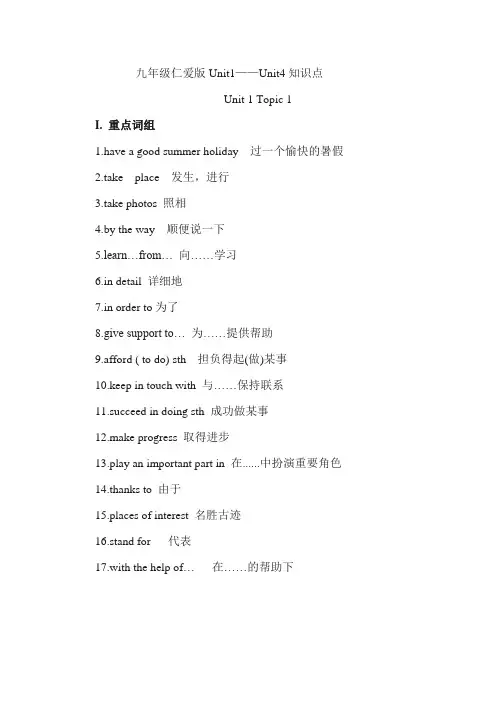
仁爱英语九年级上册(各单元知识点归纳汇总)
- 格式:doc
- 大小:70.50 KB
- 文档页数:36
欢迎阅读Unit 1 Topic 1I. 重点词组1.take photos 照相2.learn…from…向……学习3.in detail 详细地3. Where have you been, Jane? 你去过哪里,简?4. She has gone to Cuba to be a volunteer.她去古巴当志愿者了。
5. There goes the bell. 铃响了。
6. Though I had no time to travel, I still felt very happy.虽然我没有时间去旅行,但是我仍然感到很开心。
7. Now our country has developed rapidly.现在我们国家发展迅速。
III.语法1. 现在完成时态的构成:助动词have/has+动词的过去分词e.g. You have just come back from your hometown.2. 现在完成时态的句式:’t.2. each other 彼此3.at least 至少4take place发生5because of 因为6.be strict with sb. 对某人严格要求7.carry out 实行8.be short of 缺乏9.take measures to do sth.采取措施做某事10.be known as…作为……而着名11.work well in doing…在……方面起作用我也如此。
但是但是faster. ——So it is.而且,发展中国家的人口在更快地发展。
的确如此。
8. Our government has taken many measures to control the population.我们的政府已采取了许多控制人口的措施。
III.语法:常用于现在完成时的时间状语:already, just , yet, ever, never, recently.e.g. 1. I have just called you.2. ——Have you ever been to France? ——No, I’ve never been to any European countries.3. ——Have you seen him yet? ——Yes, I have seen him already.12.at home and abroad 在国内外13.pay for 付款14.thousands of 成千上万的II. 重点句型1You must come for a visit. 请你一定来参观。
2Well, once they find people in deed, they decide on suitable ways to help them.他们一旦发现有人需要帮助, 就选定适当的方式来帮助他们。
3I think it is important for these people to feel good about themselves.我认为对于这些人来说,自我感觉良好是重要的。
Unit 2 Topic 1I. 重点词组1. chemical factory 化工厂2. pour… into…把……排放到……3. in a bad mood 处在不好的情绪中4. manage to do sth. 设法去做某事看, 有几家化工厂正往河里排放废水.2. Everything has changed.一切已发生了变化.3. How long have you been like this? 你像这样多长时间了?4. I’m always in a bad mood because I can’t stand the environment here.我的情绪总是很差因为我受不了这里的环境.5. However, not all people know that noise is also a kind of pollution and is harmful to humans’ health.Topic 2I. 重点词组1. as a result 结果2. here and there 到处3. in the beginning 一开始4. in danger 处于危险中5. cut down 砍倒1. As we know, none of us likes pollution.众所周知,没有人喜欢污染。
2. Humans have come to realize the important of protecting animals.人类逐渐意识到保护动物的重要性。
3. Trees can also stop the wind blowing the earth away.树木也能防风固土。
4. Cutting down trees is harmful to human beings, animals and plants.砍伐树木对人类、动植物都有害。
5. Some things we’ve done are very good for earth while some are notgood.天一2. 用法: 在句中可作主语、宾语、表语、定语等。
something , somebody, anything, anybody等作主语时,通常视为单数。
当形容词修饰它们时,要放在其后。
e.g. But the government has done something useful to protect the environment.Topic 3I. 重点词组1. not only…but also…不仅……而且……2. be supposed to 应该II. 重点句型1. For example, we should use both sides of paper and reuse plastic bags. 例如,我们应该用纸的两面,并且重新使用塑料袋。
2. Everyone is supposed to do that.每个人都有义务那样做.3. First, you ought to turn off the lights when you leave a room.首先, 你离开房间时应该随手关灯。
4. Easier said than done. 说起来容易做起来难。
5. Well, actions speak louder than words.嗯, 百说不如一做。
Unit 3 Topic1一.重点词语1.be able to=can 能够,会2.can’t wait to do sth.迫不急待地做某事3.have a (good) chance to do sth.有(好)机会做某事4.practice doing sth.练习做某事地制造13.mother tongue 母语14.take the leading position处于领先地位15.encourage sb. to do sth.鼓励某人做某事16.call for号召二.重点句型1.Disneyland is enjoyed by millions of people from all over the world.世界上数以百万的人们都喜欢迪斯尼乐园。
并且世界上三分之二的科学家用英语阅读。
三.语法学习一般现在时的被动语态英语语态有主动语态和被动语态两种。
主语是动作的执行者,叫主动语态。
如:We clean the classroom.我们打扫教室。
主语是动作的承受者,叫被动语态。
如:The classroom is cleaned (by us).教室被(我们)打扫。
be作为2. 被动语态的用法:(1)在没有指明动作的执行者或者不知道动作执行者的情况下可用被动语态。
如:This coat is made of cotton.这件大衣是棉制的。
(2)要强调动作的承受者而不是执行者时,用被动语态。
如:Her bike is stolen.她的自行车被偷了。
3. 主、被动语态的转换:主动语态:主语+及物动词谓语动词+宾语(+其它)被动语态:主语+be+及物动词的过去分词+by+宾语(+其它)注意:(1)主动、被动互转时,时态不变。
(2)主动句的主语是代词的主格形式,四一. 重点词语1.by the way 顺便说一下2.depend on取决于……;依靠……3.be different from与……不同4.succeed in成功,达成5.make yourself understood表达你自己的意思6.on one’s way to 在某人去……的路上7.see sb. Off给……送行16.be forced to do sth.被迫做……/force sb.to do强迫某人做某事17.even worse 更糟的是二.重点句型Is Australia English the same as British English? 澳式英语和英式英语一样吗?2.English is spoken differently in different English-speaking countries.不同的国家使用不同的英语。
用现在进行时表示将来现在进行时表示将来时,常有“意图”、“安排”(但不是固定不变的)或“打算”含义。
它表示最近或较近的将来,所用的动词多是位移动词。
如:come, go, arrive, leave, fly, start, begin, return, open, die例:I’m going.我要走了。
When are you starting?你什么时候动身?Don’t worry. The train is arriving here soon.别着急,火车马上就到了。
表示将来的现在进行时除了用于位移动词外,亦可用于某些非位移动词。
四knowin pronunciation and spelling.Topic 3一、重点词语1.in public在公共场所2.at times=sometimes有时3.feel like doing=would like to do想要做……4..give up sth./doing sth.放弃5..turn to sb. for help求助于某人6..give sb. some advice on/about…给某人一些有关……的建议4.Try to guess the meanings of the new words, and get the main idea of the article.尽量猜测生词的意思,理解文章的大意。