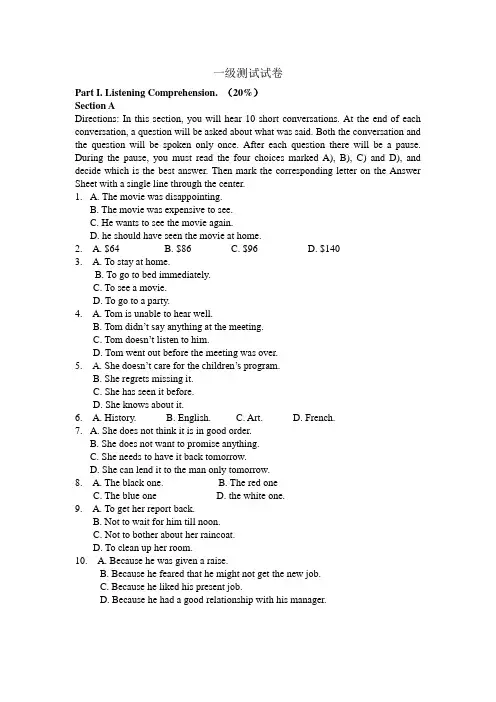
一级测试试卷Part I. Listening Comprehension. (20%)Section ADirections: In this section, you will hear 10 short conversations. At the end of each conversation, a question will be asked about what was said. Both the conversation and the question will be spoken only once. After each question there will be a pause. During the pause, you must read the four choices marked A), B), C) and D), and decide which is the best answer. Then mark the corresponding letter on the Answer Sheet with a single line through the center.1. A. The movie was disappointing.B. The movie was expensive to see.C. He wants to see the movie again.D. he should have seen the movie at home.2. A. $64 B. $86 C. $96 D. $1403. A. To stay at home.B. To go to bed immediately.C. To see a movie.D. To go to a party.4. A. Tom is unable to hear well.B. Tom didn’t say anything at the meeting.C. Tom doesn’t listen to him.D. Tom went out before the meeting was over.5. A. She doesn’t care for the children’s program.B. She regrets missing it.C. She has seen it before.D. She knows about it.6. A. History. B. English. C. Art. D. French.7. A. She does not think it is in good order.B. She does not want to promise anything.C. She needs to have it back tomorrow.D. She can lend it to the man only tomorrow.8. A. The black one. B. The red oneC. The blue oneD. the white one.9. A. To get her report back.B. Not to wait for him till noon.C. Not to bother about her raincoat.D. To clean up her room.10. A. Because he was given a raise.B. Because he feared that he might not get the new job.C. Because he liked his present job.D. Because he had a good relationship with his manager.Section BDirections: In this part you will hear three passages. Each passage will be read only once. At the end of each passage you will hear some questions. After you hear a question, you should decide which of the four choices is the best answer to the question you heard.Passage 111. A. The changing role of women in US.B. The changing role of men in USC. The traditional role of men.D. The traditional role of women.12. A. They worked together with men.B. They stayed at home doing housework.C. They went to school and then joined the work force.D. They played an important role in society.13. A. Because they often work in schools and governments.B. Because they now work in all walks of life.C. Because they are especially interested in society.D. Because they earn their own money and feel confident.Passage 2.14. A. Americans. B. People on American TVC. People in the East.D. Friends of the two speakers.15. A. Rather kind. B. Rather violent.C. Rather interestingD. Rather exciting.16. A. Boring B. StupidC. UntrueD. Terrifying.17. A. Because people are naturally violent inside.B. Because life is violent.C. Because journalists like violent programs.D. Because violent programs attract people.Passage 318. A. Making choices B. Choices in schoolsC. Good choices and bad choices.D. Hopes and dreams19. A. Some people always regret their choices.B. We can avoid making decisions to avoid regrets.C. Choices should be make after consulting others.D. Choices made may bring satisfaction or sorrow.20. A. Life is full of opportunities.B. People look forward to good choices.C. No one wishes to make bad choices.D. One can choose to live with hopes or with regrets.Part II. Vocabulary and Structure. (15%)21. When I saw my little boy crying bitterly over the death of his pet dog, I couldhardly ______ my tears.A. hold; upB. hold, onC. hold, backD. hold, off22. I should think they’ve done it _______, to avoid paying you the money.A. unconsciouslyB. voluntarilyC. on purposeD. in purpose23. Good habits of living have proved to be of much ______ to our health.A. barrierB. benefitC. immunityD. commitment24. I paid for the piano and asked the store to ______ it to my address in the afternoon.A. deliverB. identifyC. unloadD. delay25. Being a sailor (水手) _______ long periods away from home.A. expectsB. affectsC. involvesD. provides26.The trade unions urged employers _______ more money in staff training.A. in investingB. to investC. will investingD. by investing27. It’s too late to go to the movies so we _______ watch TV.A. might asB. might as wellC. might as ifD. might as to28. It is not surprising that in modern times the _______ in this month may be out of date in next.A. fashionB. anchorC. sectionD. brow29. When she was told that her cat was killed by the neighbor’s dog, the old lady ______ tears.A. reached forB. bolted outC. burst intoD. turn on30. I applied for a job as a secretary, but I was rejected.A. resentedB. refusedC. resistedD. retired31. My camera can be ______ to take pictures in cloudy or sunny conditions.A. adaptedB. adjustedC. adoptedD. remedied32. After they got married, they ______ in New York.A. movedB. wentC. settledD. left33. What’s your ______, English or Business?A. majorB. subjectC. professionD. object34. I’ll just go and ______ what’s going on outside.A. findB. foundC. find outD. find to35. The two companies are in _______ with each other.A. competitionB. contemptC. responsibilityD. neighborhood36. Professor Taylor’s talk has indicated that science has a very strong ______ on the everyday life of the human society.A. motivationB. perspectiveC. impressionD. impact37. When business is in ______ , there is usually an obvious increase in unemployment.A. convictionB. relaxationC. depressionD. competition38. Do you ______ your children to cross the street by themselves?A. allowB. agreeC. agree withD. agree to39. The ______ of the plane could be clearly seen on the hillside.A. spotB. wreckC. sacrificeD. stuff40. The new director or the TV station is likely to make major changes in ______.A. inventivenessB. sequenceC. correspondenceD. personnel41.Because his condition’s not serious they’ve _______ his name ______ on the hospital waiting list.A. put, downB. put, awayC. put, offD. put, in42. We offered them our congratulations _____ winning the match.A. inB. aboutC. onD. for43. I’m tired ____ you telling me what to do all the time.A. ofB. withC. inD. out44.From the way he looked at me, I ____________ that he did not like me.A. includedB. concludedC. consideredD. suggested45. The teacher described the day's events ____________ detail.A. withB. onC. atD. in46. I hope that we’ll _______ with our neighbors after we move away.A. keep in touchB. keep touchC. kept in touchD. kept touch47. Bill’s lecture aroused our interest ____ IT, i.e. information technology.A. onB. toC. inD. with48. It’s important to check that your car is __________ before you start.A. not in good shapeB. in good shapeC. not under good shapeD. under good shape49. The footballer made a(n) _____ gesture, which made the audienc e’s blood boil.A. matureB. offeringC. offensiveD. hesitative50. More and more people began to ______ the relationship between man andnature, especially after the event.A. get rid ofB. go too farC. be concerned aboutD. burst intoPart III. Reading Comprehension. (40%)Directions:There are 4reading passages in this part.Each passage is followed by some questions.For each question there are four suggested answers marked A),B),C) and D).You should choose the ONE best answer.Questions 51-55 are based on the following passage:It was Monday, and Mrs. Smith’s dog was hungry, but there was not any meat in the house.Considering that there was no better way, Mrs. Smith took a piece of paper, and wrote: “Give my dog half a pound of meat.” Then she gave the paper to her dog and said ge ntly, “Take this to the butcher, and he’s going to give you your lunch today.”Holding the piece of paper in its mouth, the dog ran to the butcher’s. It gave the paper to the butcher. The butcher read it carefully, recognized it was really the lady’s handwriting and did as he was asked. The dogs was very happy, and ate the meat up immediately.At midday, the dog returned to the shop. It gave the butcher a piece of paper again. After reading it, he gave it half a pound of meat once more.The next day, the dog came again exactly at midday. And as usual, it brought apiece of paper in its mouth. This time, the butcher did not look at the paper, and gave the dog its meat, for he had regarded the dog as one of his customers.But, the dog came again at fo ur o’clock. And the same thing happened again. To the butcher’s further surprise, it came for the third time at six o’clock, and brought with it a third piece of paper. The butcher felt a bit puzzled. He said to himself, “This is a small dog. Why does Mrs. Smith giveIt so much meat to eat today?”Looking at the piece of paper, he found that there were not any words on it!51.When Mrs. Smith found there was no meat in the house, she_________.A.went to the butcher’sB.wrote a noteC.shouted at her dogD.sold her dog52.The butcher gave the dog some meat the next day, because he _______.A.read the paperB.saw the paperC.felt sorry for the dogD.wanted the dog to go away53.The writer of this passage suggests that the butcher was fooled because_____.A.he could not readB.the dog could writeC.he was a creature of habitD.the dog looked hungry54.In total, how much meat did the dog get from the butcher?A.Half a poundB. A poundC.One and a half poundsD.Two pounds55.It can be learned from the passage that the dog was _____.A.lovelyB.smartC.naughtyD.troublesomeQuestions 56 to 60 are based on the following passage:People over the age of 65 in the United States are called senior citizens. Most senior citizens retire of no longer work full time. Also it is unusual for people of this age to live with their children and grandchildren. For many senior citizens, the years after age 65 are not enjoyable. They feel unproductive when they no longer work. Their lives lose meaning. In addition, they may feel lonely being away from their families. Moreover, they became more concerned about their health as they grow older. If they live in big cities, they often worry about their safety.Other senior citizens enjoy their lives. They fell free to do things they were not able to do when they were working and raising families. They now have time to enjoy hobbies and sports and travel. They associate with their fellow senior citizens whohave common interests and equal free time. Many senior citizens move to retirement communities located in warm climate. Some senior citizens continue to work beyond retirement age. Many find new careers and professional opportunities after they retire.The number of the senior citizens in the United States is increasing rapidly because people are living longer than before. The average life span for Americans is now more than 74 years. Because of their larger numbers and more active life styles, senior citizens are gaining social influence in the country both politically and economically. Their concerns are receiving a wider audience than ever before. The time may come when all Americans will look forward to becoming senior citizens.56.Many senior citizens are not happy due to the following reasons EXCEPT______A.lonelinessB.less moneyC.poor healthD.meaningless life57.It’s implied in the first paragraph that _______.A.living in the country is safer for elder people than living in big cities.B.People become senior citizens in the U.S. at 65C.Most senior citizens live with their childrenD.People retire at 65 in the U.S.58.From Para.2 we learn that______.A.senior citizens’ life can be enjoyable.B.Senior citizens enjoy their livesC.Senior citizens enjoy living in retirement communitiesD.Senior citizens enjoy working after retirement.59.It can be learned from the passage that senior citizens must___ to be happy.A.have free timeB.find fun in lifeC.continue to workD.live with their children60.According to the writer, in the future, senior citizens will be ____.A.enjoying a longer life spanB. a burden to the societyC.highly respectedD.fewer in numberQuestions 61—65are based on the following passage:In the summer of 1885, nine-year-old Joseph Meister was a very ill little boy. He had been attacked by a sick dog that had rabies, a very dangerous disease. His doctor tried to help him, but there was no cure for rab ies at that time. The doctor told Joseph’ s parents that perhaps there was one man who could save Joseph’s life. His name was Louis Pasteur.When Pasteur was a young boy in France, he was very curious. Louis was especially interested in medicine, so he spent many hours every day with the chemistwho lived in his small town. The chemist sold pills, cough syrups, and other types of medicine, just as modern pharmacists, or druggists, do today. At that time, the chemist had to make all the medicines himself. Young Louis enjoyed watching the chemist as he worked and listening to him help the customers who came to him each day. Pasteur decided that one day he wanted to help people, too.As a schoolboy, Pasteur worked slowly and carefully. At first, his teachers thought that young Louis might be a slow learner. Through elementary school, high school, and college, Pasteur worked the same thoughtful way. In fact, he was not a slow learner, but a very intelligent young man. He became a college professor and a scientist and he continued to work very carefully.Because of Pasteur’s patient methods, he was able to make many observations about germs. For example, germs cause meat and milk to spoil. They also cause many serious diseases. Pasteur was studying about the germs that cause rabies when Joseph Meister became ill. In fact, Pasteur believed he had a cure for rabies, but he had never given it to a person before. At first, Pasteur was afraid to treat Joseph, but his doctor said the child was dying. Pasteur gave Joseph an inoculation, or shot, everyday for ten days. Slowly, the child became better. Pasteur’s vaccination cured him.During his lifetime, Pasteur studied germs and learned how they cause diseases in animals and people. He developed vaccinations that prevent many of these illnesses. He also invented the process of pasteurizations which stops foods such as milk from spoiling. Louis Pasteur died on September28, 1895, at the age of 72. Modern medicine continues to benefit from the work of this great scientist.61. We learn from the passage that __________.A)Joseph finally died of rabiesB)Joseph fell ill with a very dangerous diseaseC)Joseph’s doctor knew that Joseph’s disease could not be curedD)Joseph’s doctor turned to another doctor for help62. As a young boy, Pasteur __________.A)lived with a French chemistB)observed a chemist making medicineC)helped a chemist cure sick peopleD)served customers in a chemist’s shop63. Louis Pasteur’s teacher first thought that young Pasteur _______.A)worked slowly and with great careB)was always observing thingsC)was a slow learnerD)was a very thoughtful person.64. Pasteur was afraid to treat Joseph at first because ________.A)he thought Joseph’s disease was caused by an unknown germB)he had never tried his way of treatment on anyone else beforeC)he saw that Joseph was dyingD)his medicine took effect very slowly65. During his lifetime, Pasteur ________.A)worked as a doctor and cured many peopleB)made major discoveries in the field of medicineC)mainly studied how diseases could be preventedD)studied the process of the spoiling of foodQuestions 66-70 are based on the following passage:Johnny was three when he ran away form home for the first time. Somebody left the garden gate open. Johnny wandered out, crossed some fields, and two hours later, arrived in the next village. He was just able to give his mane and address.By the time he was seven, Johnny used to vanish from home two to three times a year. Sometimes he covered quite long distances on foot. On other occasions he got on a bus or even a train, and simply sat there until someone asked for his ticket. Generally the police brought him home. “Why do you do it?” they used to ask. “You aren’t unhappy at home, are you? ” “ Of course not,” Johnny replied. “Then why?” “ I just like seeing places,” Johnny told them.Johnny continued to “see places” although everyone tried to stop him. His parents used to watch him closely, and so did his teachers; but sooner or later Johnny managed to slip away. As he grew older, his favorite trick was to hide on a ling distance truck. Sometimes he used to travel hundreds of miles before anyone discovered him.It is hardly surprising that eventually Johnny managed to get on board a plane. He was twelve at the time. It was a cargo plane and , a few hours late, Johnny found himself in Cairo. How did he get on board? No one knows! According to Johnny himself, it was easy: he just went into the airport, walked along some corridors and got on board the nearest plane.In spite of all this, Johnny did well at school. He enjoyed maths and languages and, perhaps not surprisingly, he was especially good at geography. “What do you want to be when you grow up?” his teachers asked him. Johnny did not take long to answer that question. “An explorer!” He answered. “But it’s difficult to become an explorer in this modern age.” they tried to tell him, “unless you go into space!” but it was no use; Johnny know what he wanted!Just before he left school, Johnny saw a notice in one of the daily papers. An expedition was about to go to Brazil to travel up the Amazon River. There were vacancies for three young people “willing to work hard and with a sense of adventure”. Johnny applied, and two months later, he was on his way to Brazil.66. The first time Johnny ran away form home, _________.A)he was only 7 years oldB)he reached a town far away from homeC)he walked for two hours before he reached another villageD)he went into the fields after managing to open the garden gate67. Johnny frequently left home because _________A)he was unhappy thereB)he loved walking long distancesC)he liked taking risksD)he liked seeing new places68. In school, Johnny ________.A)was only good at geographyB)did well in all subjectsC)was always thinking of exploringD)was interested in learning about space69. People around Johnny __.A)tried to stop Johnny from going away from homeB)watched Johnny day and night in turnC)talked him our of slipping away from homeD)kept following him to get him back70. We learn from the passage that Johnny _________.A)went to Brazil two months after he finished schoolB)answered an ad in the newspaper and found a jobC)went exploring along the Amazon RiverD)left home for an expedition to AfricaPart IV. Cloze (10%)Directions: There are 20 blanks in the following passage. For each blank there are four choices marked A), B), C) and D). You should choose the ONE answer that best fitsinto the passage. Then mark the corresponding letter on the Answer Sheet with asingle line through the center.In Japan, most people still feel that a woman’s place is in the home; and most women willingly accept their 71 role as wife, leaving the business of making a living 72 their husbands. For those who do want a 73 of their own, opportunities are limited, and working women usually have to 74 for lower wages, fewer promotions, less responsible 75 .In America, on the other hand, most women, 76 wives and mothers, work most of their lives. But 77 , few have had real careers. As in Japan most fields are 78 by men and opportunities for women have been 79 , salaries low, chances for advancement 80 . American women work mainly because they 81 ; in these days of inflation and luxury living, 82 in come per family is simply not enough to 83 . So American women actually have two jobs: one nine-to-five position outside the home, and 84 round-the-clock in-the-home job 85 housemaid, cook, and nurse.One of the main goals of the modern women’s liberation movement, which started 86 , was to eliminate sex discrimination in the work force, and to 87 careers for women that were previously 88 for men. And though there is still a long way to 89 , a lot of progress has been 90 .71. A. conservative B. usual C. traditional D. unhappy72. A. for B. on C. up to D. away with73. A. job B. career C. profession D. post74. A. settle B. request C. ask D. search75. A. titles B. status C. assignments D. positions76. A. concerning B. including C. containing D. involving77. A. at present B. until recently C. recently D. not until recently78. A. owned B. kept C. led D. dominated79.. A. restricted B. bounded C. reduced D. prohibited80. A. small B. inadequate C. rare D. scarce81. A. should B. ought C. like D. have to82. A. one B. single C. only D. the one83. A. live B. live on C. feed on D. support84. A. another B. one C. other D. the other85. A. such as B. like C. as D. acting86. A. in the early 1960s B. in early the 1960sC. early in the 1960sD. in the early 196087. A. lead to B. open up C. offer D. set up88. A. preserved B. observed C. concerned D. reserved89. A. go B. travel C. strive D. pull though90. A. made B. taken C. covered D. completed Part V. Writing (15%)Directions: For this part, you are allowed 30 minutes to write a composition titled “How Internet Change our Life”. You should write at least 120 words according to the outline given below in Chinese.1.Internet 给我们的生活带来了便利2.Internet 也在一定程度上对我们的生活有负面影响3.你对Internet的看法答案Part I。