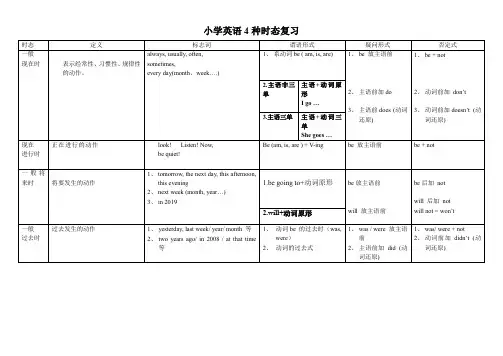
英语时态总结表格
- 格式:docx
- 大小:21.58 KB
- 文档页数:12
英语时态总结表格
表示过去习惯性动作。特别是由would/ used to do表达的句型,本身表示的就是过去时。以下内容是小编为您精心整理的英语时态总结表格,欢迎参考!
英语时态总结表格篇一 Ⅰ. 初中英语八种时态归纳复习
时态是英语学习中一个至关重要的内容,广大初中学生在实际运用时,往往对时态总是倍感棘手,下面我们就归纳复习一下这几种时态。
一、一般现在时:
概念:经常、反复发生的动作或行为及现在的某种状况。
时间状语:
always, usually, often, sometimes, every week (day,
year, month…), once a week, on Sundays, etc.
基本结构:①be动词;②行为动词
否定形式:①am/is/are+not;②此时态的谓语动词若为行为动词,则在其前加dont,如主语为第三人称单数,则用doesnt,同时还原行为动词。
一般疑问句:①把be动词放于句首;②用助动词do提问,如主语为第三人称单数,则用does,同时,还原行为动词。 二、一般过去时:
概念:过去某个时间里发生的动作或状态;过去习惯性、经常性的动作、行为。
时间状语:ago, yesterday, the day before yesterday,
last week(year, night, month), in 1989, just now, at
the age of 5, one day, long long ago, once upon a time,
etc.
基本结构:①be动词;②行为动词
否定形式:①was/were+not;②在行为动词前加didnt,同时还原行为动词。
一般疑问句:①was或were放于句首;②用助动词do的过去式did 提问,同时还原行为动词。
三、现在进行时:
概念:表示现阶段或说话时正在进行的动作及行为。
时间状语:now, at this time, these days, etc.
基本结构:am/is/are+doing
否定形式:am/is/are+not+doing.
一般疑问句:把be动词放于句首。
四、过去进行时:
概念:表示过去某段时间或某一时刻正在发生或进行的行为或动作。
时间状语:at this time yesterday, at that time或以when引导的谓语动词是一般过去时的时间状语等。
基本结构:was/were+doing
否定形式:was/were + not + doing.
一般疑问句:把was或were放于句首。
五、现在完成时:
概念:过去发生或已经完成的动作对现在造成的影响或结果,或从过去已经开始,持续到现在的动作或状态。
时间状语:recently, lately, sincefor,in the past
few years, etc.
基本结构:have/has + done
否定形式:have/has + not +d one.
一般疑问句:have或has。
六、过去完成时:
概念:以过去某个时间为标准,在此以前发生的动作或行为,或在过去某动作之前完成的行为,即“过去的过去”。
时间状语:before, by the end of last year(term,
month),etc.
基本结构:had + done.
否定形式:had + not + done.
一般疑问句:had放于句首。
七、一般将来时:
概念:表示将要发生的动作或存在的状态及打算、计划或准备做某事。
时间状语:tomorrow, next day(week, month,
year),soon, in a few minutes, by,the day after tomorrow,
etc.
基本结构:①am/is/are/going to + do;②will/shall
+ do.
否定形式:①was/were + not; ②在行为动词前加didnt,同时还原行为动词。
一般疑问句:①be放于句首;②will/shall提到句首。
八、过去将来时:
概念:立足于过去某一时刻,从过去看将来,常用于宾语从句中。
时间状语:the next day(morning, year),the
following month(week),etc.
基本结构:①was/were/going to + do;②would/should
+ do.
否定形式:①was/were/not + going to + do;②would/should + not + do.
一般疑问句:①was或were放于句首;②would/should
提到句首。
Ⅱ. 几种常见时态的相互转换
英语中的几种时态在一定情况下可以互相转换,以下是几种常见的转换形式:
一、一般过去时与现在完成时的转换
在现在完成时中,延续性动词能与表示一段时间的状语连用,瞬间动词却不能。但是,可用别的表达方式:①瞬间动词用于“一段时间 + ago”的一般过去时的句型中;②瞬间动词可改成与之相对应的延续性动词及短语,与一段时间连用;③瞬间动词用于“It is + 一段时间 + since + 一般过去时”的句型中,表示“自从以来有时间”的意思,主句一般用it is来代替It has been;④瞬间动词用于“Some
time has passed since + 一般过去时”的句型中。请看:
A. He joined the League two years ago.
B. He has been in the League for two years.
C. It is two years since he joined the League.
D. Two years has passed since he joined the League.
二、一般现在时与现在进行时的转换
在一般现在时中,at加上名词表示“处于某种状态”,如at work, at school等。此短语可与进行时态转换。请看:
Peter is at work, but Mike is at play.
Peter is working, but Mike is playing.
三、现在进行时与一般将来时的转换
在现在进行时态中go, come, leave, start, arrive等动词常与表示将来的时间状语连用表示将要发生的动作。如:I am coming, Mum! 意为“我就来,妈妈!”请看:
The train is leaving soon.
The train will leave soon.四、“be going to+动词原形”与“will(shall)+动词原形”结构的转换
“be going to+动词原形”、表示打算、计划要做的事;将来时“will(shall)+动词原形”结构在书面语中,当主语为第一人称时,常用助动词shall。在口语中,所有人称都可以用will。请看:
We are going to visit the Great Wall next Sunday.
We shall visit the Great Wall next Sunday .
1.in English 用英语 2.how many 多少3.a piece of
bread 一片而包 4.four cups of tea 四杯茶5.a pair of
shoes 一双鞋 6.play chess 下棋 7.run after 追逐
8.play football 踢足球9.be good at 擅长 10.on the
basketabll team 在篮球队 11.scoot at the basket 投篮
12.the first us 第一班车 13.at eight 在八点
14.hurry up 快点 15.a quarter past ten 十点一刻
16.five to eleven 差五分十
一点 17.the next train 下一趟火车 18.on Monday
在周一 19.a ticket for Shanghai 一张飞往上海的机票 20.at home 在家 21.a good idea 好主意 22.go skating
去滑冰 23.in the afternoon 在下午
24.in winter 在冬季 25.make a snowman 堆雪人 26.
put on 穿上,戴上 第二册词组(共84个)
1.in Class One,Grade One 在一年级一班 2.play ball
games 进行球类活动
英语时态总结表格篇二 英语共有十六种时态,其表现形式如下(以study为例)
一般时 进行时 完成时完成进行时
现在 study be studyinghave studied have been
studying
过去 studied be studyinghad studied had been
studying
将来 will study will be studying will have studied
will have been studying
过去将来would study would be studying would have
studied would have been studying
时态是表示行为、动作和状态在各种时间条件下的动词形式。因此,当我们说时态结构的时候,指的是相应时态下的动词形式。
1. 一般现在时
英语时态分为16种:一般现在、一般过去、一般将来、