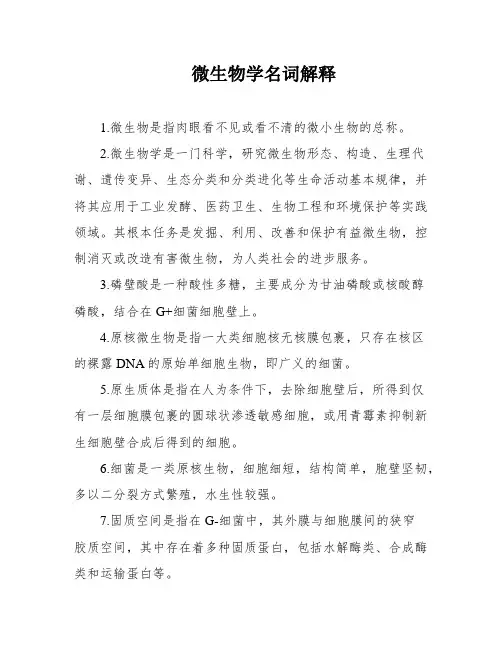
微生物名词解释
- 格式:doc
- 大小:75.00 KB
- 文档页数:7
Glossary Actinomycetes(放线菌,放线菌属) A group of filamentous, funguslike bacteria. active transport (主动运输) Nutrient transport method that requires carrier proteins in the membranes of the living cells and the expenditure of energy. adenovirus Noenveloped DNA virus; means of transmission is human-to-human via respiratory and ocular secretions. aerobe (需氧微生物)A microorganism that lives and grows in the presence of free gaseous oxygen (O2). aerobic respiration (需氧呼吸)Respiration in which the final electron acceptor in the electron transport chain is oxygen (O2). agar (琼脂)A polysaccharide found in seaweed and commonly used to prepare solid culture media. AIDS(艾滋病) Acquired immunodeficiency syndrome. The complex of signs and symptoms characteristic of the late phase of human immunodeficiency virus (HIV) infection. algae(藻类) Photosynthetic, plant-like organisms which generally lack the complex structure of plants; they may be single-celled or multicellular, and inhabit diverse habitats such as marine and freshwater environments, glaciers, and hot springs. Ames test(艾姆斯氏试验)A method for detecting mutagenic and potentially carcinogenic agents based upon the genetic alteration of nutritionally defective bacteria. ammonification(氨化作用) Phase of the nitrogen cycle in which ammonia is released from decomposing organic material. anaerobe(厌氧性微生物,厌氧菌) A microorganism that grows best, or exclusively, in the absence of oxygen. anaerobic respiration(无氧呼吸) Respiration in which the final electron acceptor in the electron transport chain is an inorganic molecule containing sulfate, nitrate, nitrite, carbonate, etc. antagonism(拮抗作用) Relationship in which microorganisms compete for survival in a common environment by taking actions that inhibit or destroy another organism. antibiotic(抗生素)A chemical substance from one microorganism that can inhibit or kill another microbe even in minute amounts. archaea(古生菌) Prokaryotic single-celled organisms of primitive origin that have unusual anatomy, physiology and genetics, and live in harsh habitats; when capitalized (Archaea) the term refers to one of the three domains of living organisms as proposed by Woese. arthrospore (分节孢子)A fungal spore formed by the septation and fragmentation of hyphae. ascospore (囊孢子,子囊孢子)A spore formed within a saclike cell (ascus) of Ascomycota following nuclear fusion and meiosis. ascus(子囊) Special fungal sac in which haploid spores are created. autoclave(高压锅) A sterilization chamber which allows the use of steam under pressure to sterilize materials. The most common temperature/pressure combination for an autoclave is 121℃and 15 psi. autotroph(自养生物) A microorganism that requires only inorganic nutrients and whose sole source of carbon is carbon dioxide. Bacillus(芽孢杆菌) Bacterial cell shape that is cylindrical (longer than it is wide). back-mutation(回复突变) A mutation which counteracts an earlier mutation, resulting in the restoration of the original DNA sequence. bacteria (细菌)Category of prokaryotes with peptidoglycan in their cell wails and a single, circular chromosome. This group of small cells is widely distributed in the earth’s habitats. Bacteria (plural of bacterium) When capitalized can refer to one of the three domains of living organisms proposed by Woese, containing all non- archaea prokaryotes. bacterial chromosome 细菌染色体A circular body in bacteria that contains the primary genetic material. Also called nucleoid. Bacteriophage噬菌体A virus that specifically infects bacteria. bacterium 杆菌属A tiny unicellular prokaryotic organism that usually reproduces by binary fission and usually has a peptidoglycan cell wall, has various shapes, and can be found in virtually any environment. basidiospore(芽孢) A sexual spore that arises from a basidium. Found in basidiomycota fungi. Bdellovibrio(蛭弧菌属) A bacterium that preys on certain other bacteria. It bores a hole into a specific host and inserts itself between the protoplast and the cell wall. There it elongates before subdividing into several cells and devouring the host cell. capsule蒴果 In bacteria, the loose, gel-like covering or slime made chiefly of simple polysaccharides. This layer is protective and can be associated with virulence. Chemoautotroph 华能自养生物An organism that relies upon inorganic chemicals for its energy and carbon dioxide for its carbon. Also called a chemolithotroph. chemoheterotroph 华能异养生物Microorganisms that derive their nutritional needs from organic compounds. chemotaxis趋化性 The tendency of organisms to move in response to a chemical gradient (toward an attractant or to avoid adverse stimuli). chitin 几丁质A polysaccharide similar to cellulose in chemical structure. This polymer makes up the horny substance of the exoskeletons of arthropods and certain fungi. chromosome 染色体The tightly coiled bodies in cells that are the primary sites of genes. Clone无性繁殖 A colony of cells (or group of organisms) derived from a single cell (or single organism) by asexual reproduction. All units share identical characteristics. Also used as a verb to refer to the process of producing a genetically identical population of cells or genes. colony 菌落A macroscopic cluster of cells appearing on a solid medium, each arising from the multiplication of a single cell. commensalism 共栖An unequal relationship in which one species derives benefit