
RHETORICAL DEVICES
- 格式:ppt
- 大小:605.00 KB
- 文档页数:53


Lesson PlanTeaching Material: Advanced EnglishTeaching Content: Unit 7 Everyday UseTime: 20 minutesAnalysis of the students:Students have some basic knowledge of rhetorical devices but they still have some difficulty in comparing and mastering the major rhetorical devices.Teaching Objectives:At the end of this class,Ss are able to recognize different kinds of rhetorical devices;Ss are able to compare the differences between some rhetorical devices, like simile & metaphor;Ss are able to appreciate the beauty of language by using rhetorical devices;Ss are able to create their own sentences by using some rhetorical devices.Key Points & Difficult Points:Form a sharp feeling to rhetorical devices that used in the passage;Lead students put rhetorical devices into their writing.Teaching Procedure:Step 1: Lead in (2minutes)1. Greet the students2. Compare a short paragraph with two versions—one with rhetorical devices another one without rhetorical devices.(In this part, we will rise students’ interest by feeling the magic of rhetorical devices with an example, and then lead to today’s topic.)Step 2: Presentation (7minutes)Give the definition of each rhetorical devices with proper examples.1. Present the definition of simile2. Compare simile with metaphor3. Present the definition of sarcasm and irony and comparison of them4. Complement of other rhetorical devices such as rhetorical question, alliteration, metonymy and repetition.Step 3: Practice and consolidation(7minutes)1. Lead students to appreciate the use of rhetorical devices such as simile, metaphor, irony and some other rhetorical devices.Step 4: Summary (3minutes)Review the key rhetorical devices and sum up the function of rhetorical devices.Step 5: Homework (1minute)1. Ask students to write a short passage of what is love by using rhetorical devices.2. Ask students to find out all the rhetorical devices in unit7.。
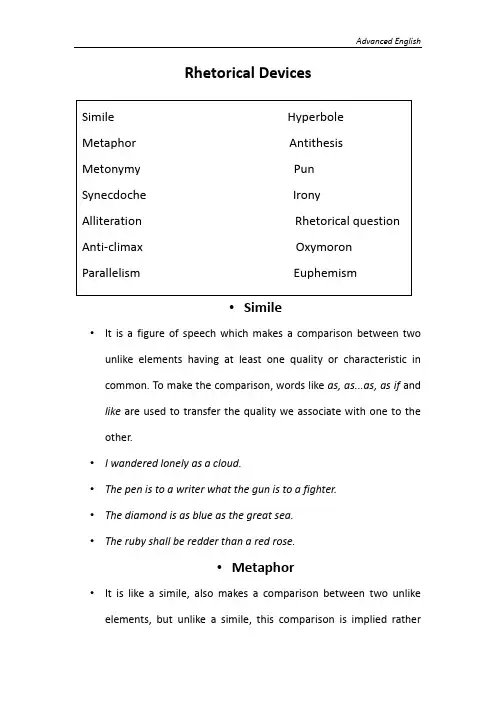
Rhetorical Devices•Simile•It is a figure of speech which makes a comparison between two unlike elements having at least one quality or characteristic in common. To make the comparison, words like as, as...as, as if and like are used to transfer the quality we associate with one to the other.•I wandered lonely as a cloud.•The pen is to a writer what the gun is to a fighter.•The diamond is as blue as the great sea.•The ruby shall be redder than a red rose.•Metaphor•It is like a simile, also makes a comparison between two unlike elements, but unlike a simile, this comparison is implied ratherthan stated.•The world is a stage.•Beauty without virtue is a rose without fragrance.•Some books are to be tasted, others swallowed, and some few to be chewed and digested.•Snow clothes the ground.•The lecturer looked down at the sea of faces beneath him.•Metonymy•The substitution of the name of one thing for that of another with which it is closely associated.•Gray hairs should be respected.•I have never read Li Bai.•He is too fond of bottle.•I was not one to let my heart rule my head.•借喻不直接说出所要说的事物,而使用另一个与之相关的事物名称。

Rhetorical Devices1.Simile 明喻A figure of speech in which two essentially unlike things are compared, often in a phraseintroduced by like or asEg. How like the winter hath my absence been.So are you to my thoughts as food to life. (Shakespeare)2.Metaphor 暗喻A figure of speech in which a word or phrase that ordinarily designates one thing is usedto designate another, thus making an implicit comparisonEg.The world is a stage.3.Personification 拟人A figure of speech in which inanimate objects or abstractions are endowed with humanqualities or are represented as possessing human formEg. Hunger sat shivering on the road.4.Antithesis 对照,对立,对比A figure of speech in which sharply contrasting ideas are juxtaposed in a balanced orparallel phrase or grammatical structureEg.That’s one small step for man; one giant leap for mankind. (Neil Armstrong, Apollo11 Moon Landing Speech)5.Pun 双关A play on words, sometimes on different senses of the same word and sometimes on thesimilar sense or sound of different wordsEg. Being in politics is just like playing golf: you are trapped in one bad lie after another.(lie:①a deliberate untruth ②the position in which something rests)6.Ridicule 奚落Words intended to evoke contemptuous laughter at or feelings toward a person or thing Eg.Sure my worthy opponent claims that we should lower tuition, but that is just laughable.7.Irony 反语,讽刺The use of words to express something different from and often opposite to their literal meaningAn expression or utterance marked by a deliberate contrast between apparent and intended meaningEg. It must be delightful to find oneself in a foreign country without a penny in one's pocket.8.Sarcasm 讥讽A combine of irony and ridicule, using witty language to convey insults or scornEg. It is possible for your mind to be so open that your brain falls out.9.Hyperbole 夸张A figure of speech in which exaggeration is used for emphasis or effectEg. This book weighs a ton.10.Euphemism 委婉The act or an example of substituting a mild, indirect, or vague term for one considered harsh, blunt, or offensiveEg. sleep with — have sexual intercourse with;departed — dead;relieve oneself — urinate11.Epigram警句, 隽语, 讽刺短诗A concise, clever, often paradoxical statementOr: A short, witty poem expressing a single thought or observationEg. "I am not young enough to know everything." (Oscar Wilde)12.Allusion 隐喻, 典故A figure of speech that makes a reference to, or representation of, a place, event, literarywork, myth, or work of art, either directly or by implicationEg. A son of the morning is a traveler; an allusion to the practice in the Middle East to rise before dawn so one wouldn't have to travel in the heat of day.13.Litotes 间接肯定A figure of speech consisting of an understatement in which an affirmative is expressedby negating its oppositeEg. This is no small problem. (Instead of “this is a big problem”)14.Oxymoron 矛盾形容法,逆喻A rhetorical figure in which incongruous or contradictory terms are combinedEg. A mournful optimist15.Paradox似非而是的隽语A seemingly contradictory statement that may nonetheless be trueEg. "I know that I know nothing."(Knowing "know nothing" is knowing something, thus cannot be "know nothing". This logic is self-contradictory, but one can know that they know nothing.)16.Transferred epithet 移就A figure of speech in which the adjective or adverb is transferred from the noun itlogically belongs with, to another one which fits it grammatically but not logicallyEg. A sleepless night (night cannot be sleepless; people can)17.Metonymy转喻A figure of speech in which one word or phrase (usually an attribute or feature) issubstituted for another with which it is closely associatedEg. They counted heads. (heads stands for people)the White House for the US president18.Synecdoche提喻A figure of speech in which a part is used for the whole (as hand for sailor), the wholefor a part (as the law for police officer), the specific for the general (as cutthroat for assassin), the general for the specific (as thief for pickpocket), or the material for the thing made from it (as steel for sword)19.Climax层进法A figure of speech in which words, phrases, or clauses are arranged in order ofincreasing importance. It is sometimes used with anadiplosis, which uses the repetition of a word or phrase in successive clauses.Eg.There are three things that will endure: faith, hope, and love. But the greatest of these is love.20.Anticlimax突降法An abrupt declension (either deliberate or unintended) on the part of a speaker or writer from the dignity of idea which he appeared to be aiming atEg. Die and endow a college or a cat.21.Alliteration头韵The repetition of the same sounds or of the same kinds of sounds at the beginning of words or in stressed syllablesEg. A r ound the r ock the r agged r ascal r an.22.Syllepsis一语双叙法, 兼用法, 轭语法A construction in which a word governs two or more other words but agrees in number,gender, or case with only one, or has a different meaning when applied to each of the wordsEg. He lost his coat and his temper.23.Zeugma轭式修饰法(一形容词或动词勉强修饰或支配两个名词)A construction in which one word or phrase is understood to be related to two or moreother words or phrases, while being grammatically consistent with only one of them Eg. To wage war and peace (war can be waged, but peace cannot)24.Anadiplosis联珠法, 顶真法Rhetorical repetition at the beginning of a phrase of the word or words with which the previous phrase endedEg. He is a man of loyalty. Loyalty always firm.25.Apostrophe呼语The direct address of an absent or imaginary person or of a personified abstraction, especially as a digression in the course of a speech or compositionEg. "O Romeo, Romeo! Wherefore art thou Romeo?" (Shakespeare, Romeo and Juliet)26.Consonance辅音韵The repetition of consonants or of a consonant pattern, especially at the ends of words Eg. bla nk and thi nkstro ng and stri ng27.Onomatopoeia拟声The formation of words whose sound is imitative of the sound of the noise or action designatedEg.hiss, buzz, bang …28.Zoosemy 拟物法A metaphor for the way names of animals are used to denote and characterise humanqualities and traits of the characterEg. A lucky dog you are!Cow (a fat, or disagreeable woman)Pig (an ugly, dirty or gluttonous person)29.Palindrome 回文A word, phrase, verse, or sentence that reads the same backward or forwardEg. A man, a plan, a canal, Panama!30.Synesthesia 通感The description of one kind of sense impression by using words that normally describe anotherEg. Now is the Winter of our discontent.31.Antonomasia 换称the use of a proper name to designate a member of a classEg.Solomon for a wise rulerAlso: the use of an epithet or title in place of a proper nameEg. the Bard for Shakespeare32.Rhetorical question (不必回答,只为加强语气及效果的)反问A question to which no answer is expected, often used for rhetorical effectEg. Who knows?If Winter comes, can Spring be far behind?。