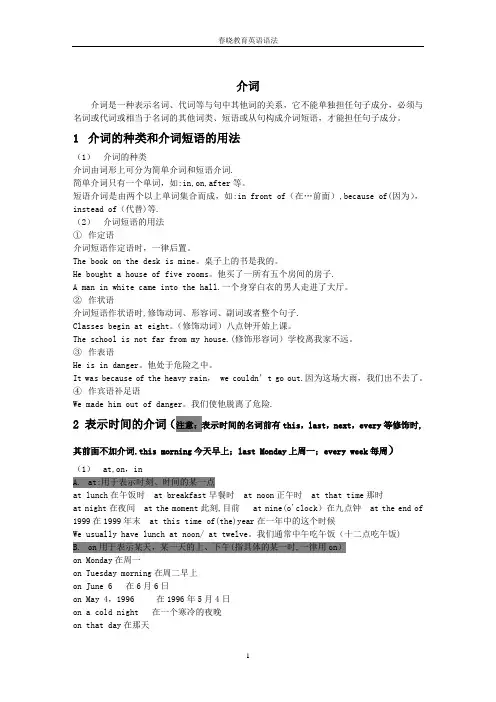
初中英语语法介词讲解
- 格式:doc
- 大小:25.51 KB
- 文档页数:4
初中英语语法介词讲解
Prepositions" with more than 1000 words, written in English without
any additional title or punctuation.
English grammar can be a complex and nuanced subject with many
intricate rules and exceptions to master. One of the fundamental
grammatical concepts that students often struggle with is the proper
use of prepositions. Prepositions are small yet essential words that
indicate the relationship between a noun or pronoun and other
elements in a sentence. They play a crucial role in conveying
meaning and ensuring clear communication. In this essay, we will
delve into the world of English prepositions, exploring their types,
usage, and common challenges faced by learners.
Prepositions are typically short words that precede a noun or
pronoun, establishing a spatial, temporal, or logical connection
between that word and other parts of the sentence. They can
indicate direction, location, time, manner, and a host of other
relationships. Some common prepositions include "in," "on," "at,"
"to," "from," "with," "without," "during," and "after," among many
others. Mastering the appropriate use of prepositions is crucial for
accurate and idiomatic English expression.
One of the primary challenges in using prepositions correctly is the
fact that they often do not have a direct one-to-one translation from
one language to another. What may be expressed using a particular
preposition in English may require a different preposition or even a
completely different grammatical structure in another language. This
can lead to common mistakes made by non-native English speakers,
such as using the wrong preposition or omitting a preposition
entirely.
For example, in English, we say "I am going to the park," using the
preposition "to" to indicate the destination. However, in Spanish, the
equivalent phrase would be "Voy al parque," using the preposition
"a" instead. Similarly, in English, we say "I am interested in learning
Spanish," but in French, the equivalent would be "Je suis intéressé
par l'apprentissage de l'espagnol," using the preposition "par"
instead of "in."
Another complexity in the use of prepositions arises from the fact
that they can have multiple meanings and usages, depending on the
context. The preposition "in," for instance, can be used to indicate
location ("I am in the house"), time ("I will arrive in the afternoon"),
or a state of being ("I am in a good mood"). Learners must be able to
discern the appropriate meaning and application of a preposition
based on the specific context of the sentence.
Furthermore, prepositions can sometimes be used idiomatically,
where their meaning cannot be directly derived from the individual
words. Expressions like "look forward to," "take care of," and "in the
long run" are examples of idiomatic prepositional phrases that must
be learned and understood as a whole, rather than by analyzing the
individual components.
To help students overcome the challenges of preposition usage, it is
essential to provide them with ample practice and exposure to a
wide range of prepositional patterns and contexts. This can be
achieved through various teaching methods, such as grammar
exercises, sentence completion activities, and exposure to authentic
English texts and conversations.
One effective approach is to group prepositions into categories
based on their common functions, such as prepositions of location,
time, direction, and manner. By understanding the broader
conceptual categories that prepositions belong to, students can
more easily remember and apply the appropriate prepositions in
different contexts.
Additionally, it is crucial to encourage students to pay close attention
to preposition usage in the input they receive, whether it's through
reading, listening, or observing native speakers. By actively noticing and analyzing how prepositions are used in real-world
communication, students can develop a more intuitive
understanding of their proper application.
Another valuable strategy is to encourage students to consult
reference materials, such as grammar books or online resources,
whenever they are unsure about the correct preposition to use. By
developing the habit of checking and verifying their understanding,
students can gradually build a more robust knowledge of preposition
usage.
In conclusion, prepositions are a fundamental aspect of English
grammar that deserve careful attention and practice. By
understanding the various types of prepositions, their multiple
meanings and idiomatic usages, and engaging in targeted exercises
and exposure to authentic language, students can overcome the