
PLC水塔水位控制系统设计与仿真_张少强
- 格式:pdf
- 大小:993.11 KB
- 文档页数:3

任务书开题报告书(表1)基于PLC控制系统控制的水塔水位[摘要]随着科技的发展,无论在日常生活中,还是在工农业发展中,PLC具有广泛的应用。
PLC的一般特点:抗干扰能力强,可靠性极高、编程简单方便、使用方便、维护方便、设计、施工、调试周期短、易于实现机电一体化。
PLC总的发展趋势是:高功能、高速度、高集成度、大容量、小体积、低成本、通信组网能力强。
本水塔水位控制系统采用PLC为控制核心,具备开启和全部停止功能,这是一种PLC控制的自动调节控制系统。
应用此控制系统能显著提高劳动效率,减少劳动强度。
[关键词] 高集成度通信组网水塔水位 PLCBased on PLC control system control towers water levelAbstract:With technological development, both in daily life, or the industrial and agricultural development, plc have wide application. PLC general features: strong anti-jamming capability, high reliability, programming is simple and convenient, easy operation and maintenance convenience, design, construction, commissioning period is short, easy to realize the electromechanical integration. PLC general development trend is: high function, high speed, high level of integration, large capacity, small volume, low cost, communication networking capability is strong. This water tower water level control system adopts PLC as control core, with open and full stop functions,this is a kind of PLC automatic adjustment of the control system. Application of this control system can significantly improve the work efficiency and reduces labor intensity.Key words:The high level of Integration communication networking towers Water level PLC目录第1章绪论......................................................................................................... - 1 -1.1 可编程控制器........................................................................................... - 1 -1.2 可编程控制器使用前景........................................................................... - 2 -1.3 PLC的发展 .............................................................................................. - 3 -1.4 PLC的基本结构 ...................................................................................... - 4 -1.5 PLC的控制原理 ...................................................................................... - 9 -1.6 PLC的特点 ............................................................................................ - 10 - 第2章水塔水位控制系统PLC硬件设计 ....................................................... - 13 -2.1 水塔水位控制系统设计要求................................................................. - 13 -2.2 水塔水位控制系统主电路..................................................................... - 13 -2.3 I/O接口分配 ........................................................................................ - 14 -2.3.1 列出水塔水位控制系统PLC的输入/输出接口分配表。

基于PLC水箱液位控制系统毕业设计水箱液位控制系统是一种常见的自动化控制系统,通过控制水位的高低来实现水箱中水的供应与排放。
该系统常用于水处理、供水系统、工业生产等领域。
本篇毕业设计将基于可编程逻辑控制器(PLC)来设计一个水箱液位控制系统。
PLC作为控制器,能够实现对水位的监测、控制和保护。
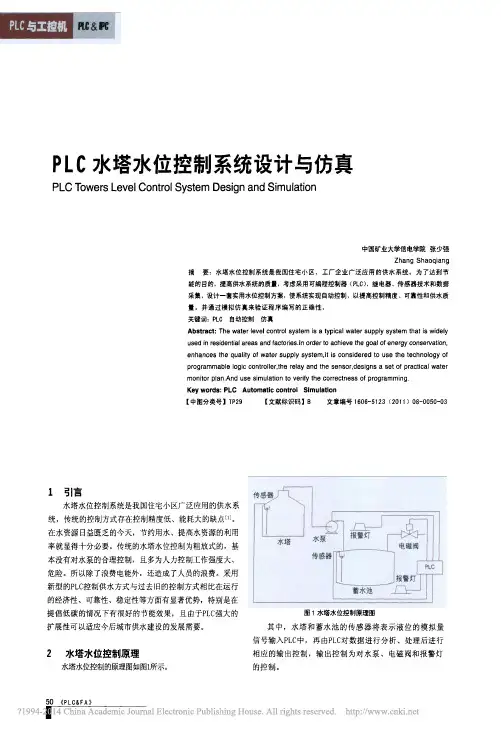
首先,本设计将使用传感器来监测水箱的液位。
液位传感器将放置在水箱内部,在不同的液位位置测量水的高度。
传感器将通过模拟信号将液位信息传输给PLC。
PLC将读取并处理传感器的信号,得到水箱的液位信息。
其次,PLC将根据液位信息来控制水泵的运行。
当水箱的液位低于一定的阈值时,PLC将启动水泵,从水源处将水注入到水箱中。
当液位达到一定的高度时,PLC将关闭水泵,停止水的注入。
通过控制水泵的启动和停止,系统可以实现自动补水,从而保持水箱的水位在一个恰当的范围内。
此外,本系统还将具备一定的保护功能。
当水箱液位过高或过低时,PLC将触发报警装置,以便及时采取措施解决问题。
同时,系统将设置相应的安全控制,以防止水泵出现过载或短路等故障。
为了实现PLC控制系统的功能,本设计将使用PLC编程软件进行程序的编写和调试。
程序将根据液位传感器的输入信号,进行逻辑判断和控制指令的输出。
同时,本设计将与水泵、报警装置等硬件进行连接,以实现实际的控制功能。
最后,本设计将进行系统的仿真和调试。
通过模拟真实的液位变化情况,测试系统的控制性能和稳定性。
在确保系统正常运行的前提下,对系统进行各项性能指标的测试和评估。
通过该毕业设计的实施,我将能够掌握PLC水箱液位控制系统的原理和设计方法,提升自己在自动化控制领域的实践能力和工程应用能力。
同时,通过该设计的完成,也能为工业生产中的水箱液位控制问题提供一种可行的解决方案。

水塔水位PID控制系统设计摘要供水是一个关系国计民生的重要产业。
随着社会的发展和人民生活水平的提高,对城市供水提出了更高的要求,有一个水箱需要维持一定的水位,该水塔里的水以变化的速度流出。
这就需要有一个输入控制液体阀以不同的速度给水塔供水,以维持水位的变化,这样才能使水塔不断水。
研究设计的基于PLC控制的水塔水位PID供水系统,以西门子公司的S7-200系列中PLC-CPU226为基础,结合模拟量模块EM235、液位传感器、输入控制液压阀、输出控制液压阀等,组成一个基于S7-200系列中PLC-CPU226的水塔水位控制系统,能完成逻辑控制、水位调节和数据采样等功能,实现对水塔的水位进行控制及检测。
在设计中大量运用PLC中PID来实现水塔水位的控制,为了精确地实现对水位的控制,建立成闭环控制系统,实现了水塔中的进、出水的水位自动控制。
关键词:可编程控制器PLC,水塔水位,PID控制WATER TOWERS PID CONTROL SYSTEM DESIGNABSTRACTWater supply is an important industry of the people's livelihood. With the social development and people's living standards, urban water supply to a higher demand, there is a need to maintain a certain water tank water level, the water towers in order to change the speed of the outflow. This requires a liquid input control valve to the different speeds of water towers in order to maintain the water level changes, so that continuous water towers.PLC-based research and design of the towers level PID control the water supply system to Siemens S7-200 series PLC-CPU226-based light simulation module EM235, liquid level sensors, type of hydraulic control valve, hydraulic valve control output and so on, based on the formation of a S7-200 series of the PCL-CPU226 towers water level control system, to complete logic control, water regulation and function of data sampling, etc., to achieve the level of the water tower for control and detection. In the design of PID make extensive use of PLC to achieve the level of control towers, in order to achieve precise level of control, into a closed-loop control system, the water tower in progress, the water level of automation.KEY WORDS: Programmable Logic Controller PLC, Water Towers, PID Control目录前言 (1)第1章水塔水位自动控制系统的概述 (2)1.1 水位控制系统现状与发展 (2)1.2 水塔水位自动控制系统的组成 (2)1.3 水位控制系统效率及运行模式分析 (3)第2章PLC结构和工作原理 (4)2.1 PLC组成与基本结构 (4)2.1.1 PLC的系统结构 (4)2.1.2 PLC的基本工作原理 (5)2.2 PLC的主要应用 (6)2.3 S7-200 系列可编程控制器 (6)2.3.1 S7-200 PLC系统组成 (7)2.3.2 S7-200系列PLC元件功能 (7)2.4 PID控制器简介 (9)2.4.1 PID控制器的结构及原理 (9)2.4.2 数字式PID控制 (10)2.4.3 数字式PID控制的实现 (12)第3章水塔水位控制系统方案设计 (14)3.1 系统的工作原理 (14)3.1.1 设计分析 (14)3.1.2 可行性试验 (15)3.1.3 可行性分析 (16)3.2 水位闭环控制系统 (16)3.2.1 PLC的选择 (17)3.2.2 供水的控制方法 (18)第4章PLC中PID控制器的实现 (20)4.1 PID算法 (20)4.2 PID应用 (21)4.3 PLC实现PID控制的方式 (21)4.4 PLC中PID控制器的实现 (22)4.5 PID指令及回路表 (24)第5章系统硬件开发设计 (26)5.1 硬件系统的结构 (26)5.2 可编程控制器的选型 (26)5.3 EM235模拟量模块 (28)5.3.1 EM235的安装使用 (29)5.3.2 EM235的工作程序编制 (29)5.4 系统硬件连接图 (30)5.5 控制系统I/O地址分配 (30)第6章系统软件控制设计 (31)6.1 水位PID控制的逻辑设计 (31)6.2 梯形图编程 (34)6.3 控制程序 (37)6.4 联机 (38)结论 (39)谢辞 (40)参考文献 (41)附录 (41)外文资料翻译 (44)前言在工业生产中,电流、电压、温度、压力、液位、流量等都是常用的主要被控参数。
