
《介词》课件讲解 PPT
- 格式:pptx
- 大小:306.39 KB
- 文档页数:19

介词及介词短语讲解
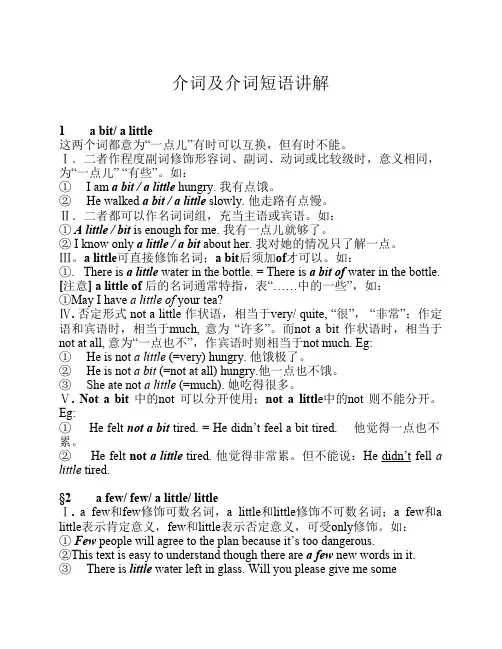
1 a bit/ a little
这两个词都意为“一点儿”有时可以互换,但有时不能。
Ⅰ.二者作程度副词修饰形容词、副词、动词或比较级时,意义相同,
为“一点儿” “有些”。如:
① I am a bit / a little hungry. 我有点饿。
② He walked a bit / a little slowly. 他走路有点慢。
Ⅱ.二者都可以作名词词组,充当主语或宾语。如:
① A little / bit is enough for me. 我有一点儿就够了。
② I know only a little / a bit about her. 我对她的情况只了解一点。
Ⅲ。a little可直接修饰名词;a bit后须加of才可以。如:
①. There is a little water in the bottle. = There is a bit of water in the bottle.
[注意] a little of 后的名词通常特指,表“……中的一些”,如:
①May I have a little of your tea?
Ⅳ. 否定形式 not a little 作状语,相当于very/ quite, “很”, “非常”;作定
语和宾语时,相当于much, 意为 “许多”。而not a bit 作状语时,相当于
not at all, 意为“一点也不”,作宾语时则相当于not much. Eg:
① He is not a little (=very) hungry. 他饿极了。
② He is not a bit (=not at all) hungry.他一点也不饿。
③ She ate not a little (=much). 她吃得很多。
Ⅴ. Not a bit 中的not 可以分开使用;not a little中的not 则不能分开。
Eg:
① He felt not a bit tired. = He didn’t feel a bit tired. 他觉得一点也不
介词讲解 节婧
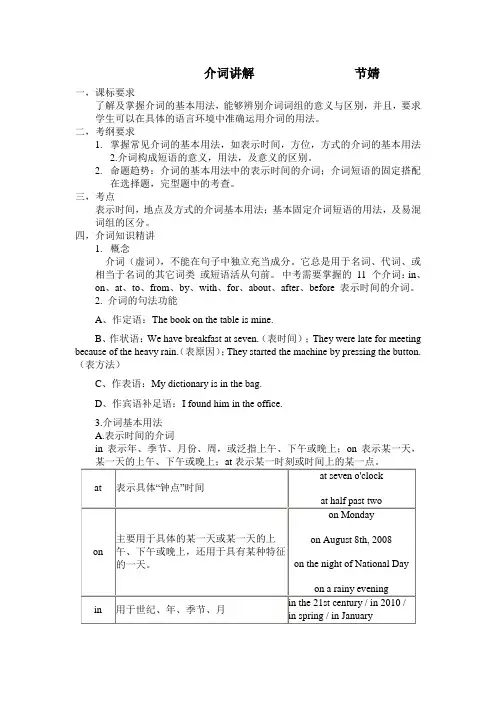
一,课标要求
了解及掌握介词的基本用法,能够辨别介词词组的意义与区别,并且,要求学生可以在具体的语言环境中准确运用介词的用法。
二,考纲要求
1. 掌握常见介词的基本用法,如表示时间,方位,方式的介词的基本用法
2.介词构成短语的意义,用法,及意义的区别。
2. 命题趋势:介词的基本用法中的表示时间的介词;介词短语的固定搭配在选择题,完型题中的考查。
三,考点
表示时间,地点及方式的介词基本用法;基本固定介词短语的用法,及易混词组的区分。
四,介词知识精讲
1. 概念
介词(虚词),不能在句子中独立充当成分。它总是用于名词、代词、或相当于名词的其它词类 或短语活从句前。 中考需要掌握的 11 个介词:in、on、at、to、from、by、with、for、about、after、before 表示时间的介词。
2. 介词的句法功能
A、作定语:The book on the table is mine.
B、作状语:We have breakfast at seven.(表时间);They were late for meeting
because of the heavy rain.(表原因);They started the machine by pressing the button.(表方法)
C、作表语:My dictionary is in the bag.
D、作宾语补足语:I found him in the office.
3.介词基本用法
A.表示时间的介词
in表示年、季节、月份、周,或泛指上午、下午或晚上;on表示某一天,某一天的上午、下午或晚上;at表示某一时刻或时间上的某一点。
at 表示具体“钟点”时间 at seven o'clock
at half past two
on 主要用于具体的某一天或某一天的上午、下午或晚上,还用于具有某种特征的一天。 on Monday
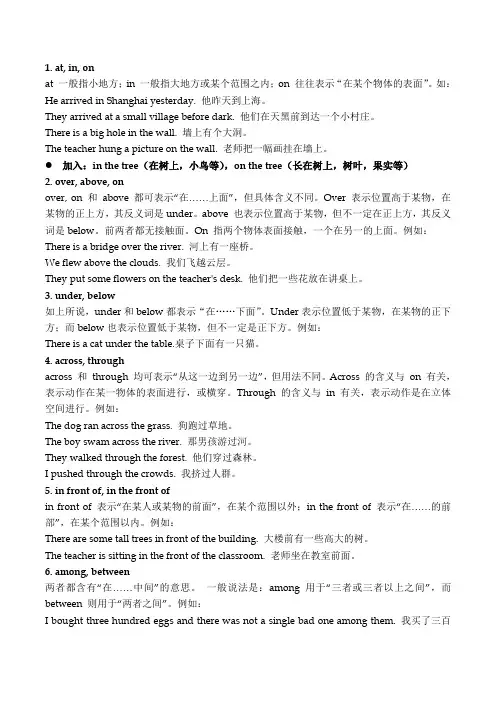
1. at, in, on
at 一般指小地方;in 一般指大地方或某个范围之内;on 往往表示“在某个物体的表面”。如:
He arrived in Shanghai yesterday. 他昨天到上海。
They arrived at a small village before dark. 他们在天黑前到达一个小村庄。
There is a big hole in the wall. 墙上有个大洞。
The teacher hung a picture on the wall. 老师把一幅画挂在墙上。
加入:in the tree(在树上,小鸟等),on the tree(长在树上,树叶,果实等)
2. over, above, on
over, on 和 above 都可表示“在……上面”,但具体含义不同。Over 表示位置高于某物,在某物的正上方,其反义词是under。above 也表示位置高于某物,但不一定在正上方,其反义词是below。前两者都无接触面。On 指两个物体表面接触,一个在另一的上面。例如:
There is a bridge over the river. 河上有一座桥。
We flew above the clouds. 我们飞越云层。
They put some flowers on the teacher's desk. 他们把一些花放在讲桌上。
3. under, below
如上所说,under和below都表示“在„„下面”。Under表示位置低于某物,在某物的正下方;而below也表示位置低于某物,但不一定是正下方。例如:
There is a cat under the table.桌子下面有一只猫。
4. across, through
across 和 through 均可表示“从这一边到另一边”,但用法不同。Across 的含义与 on 有关,表示动作在某一物体的表面进行,或横穿。Through 的含义与 in 有关,表示动作是在立体空间进行。例如:
介词 知识讲解 in on at的用法
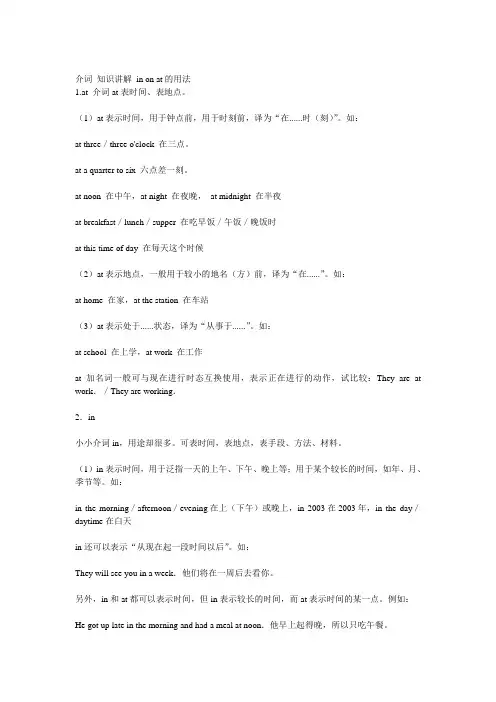
1.at 介词at表时间、表地点。
(1)at表示时间,用于钟点前,用于时刻前,译为“在......时(刻)”。如:
at three/three o'clock 在三点。
at a quarter to six 六点差一刻。
at noon 在中午,at night 在夜晚, at midnight 在半夜
at breakfast/lunch/supper 在吃早饭/午饭/晚饭时
at this time of day 在每天这个时候
(2)at表示地点,一般用于较小的地名(方)前,译为“在......”。如:
at home 在家,at the station 在车站
(3)at表示处于......状态,译为“从事于......”。如:
at school 在上学,at work 在工作
at加名词一般可与现在进行时态互换使用,表示正在进行的动作,试比较:They are at
work./They are working.
2.in
小小介词in,用途却很多。可表时间,表地点,表手段、方法、材料。
(1)in表示时间,用于泛指一天的上午、下午、晚上等;用于某个较长的时间,如年、月、季节等。如:
in the morning/afternoon/evening在上(下午)或晚上,in 2003在2003年,in the day/daytime在白天
in还可以表示“从现在起一段时间以后”。如:
They will see you in a week.他们将在一周后去看你。
另外,in和at都可以表示时间,但in表示较长的时间,而at表示时间的某一点。例如:
He got up late in the morning and had a meal at noon.他早上起得晚,所以只吃午餐。
(2)in表示地点、场所,译为“在......里”、“在......中”。如:in the factory 在工厂,in the room