2019-2020年中考英语语法复习资料 第一部分:词法 中考考点九:被动语态
- 格式:doc
- 大小:57.00 KB
- 文档页数:6
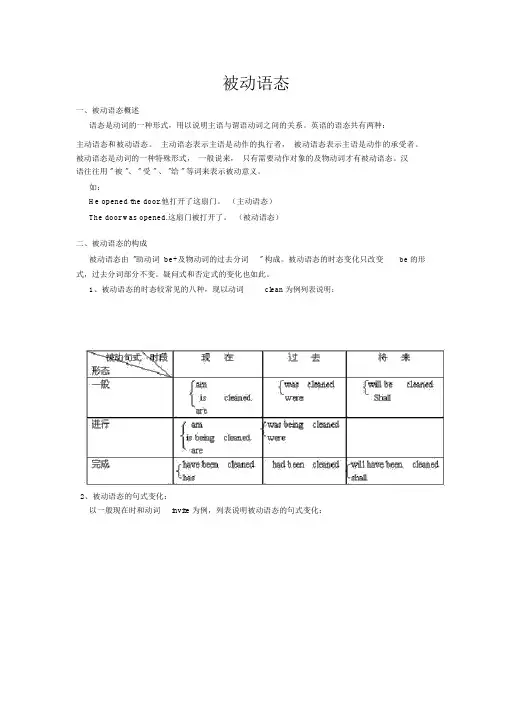
2019-2020年中考英语语法复习资料第一部分:词法中考考点九:被动语态一.被动语态的时态:1.一般现在时的被动语态:am /is/ are +动词的过去分词2.一般过去时的被动语态:was /were +动词的过去分词3.一般将来时的被动语态:will be +动词的过去分词4.现在进行时的被动语态:am /is /are +being +动词的过去分词5.现在完成时的被动语态:have /has +been +动词的过去分词6.情态动词的被动语态:情态动词 + be +动词的过去分词二.主动语态变被动语态的变法:口诀:宾变主,主变宾,谓变be done ,时不变,数格必须随被变。
注:1.主动、被动的时态要一致。
2.主动、被动的句式要一致。
3.变成的被动语态的主语与谓语在单复数上保持一致。
三.特殊情况的被动语态:1.带双宾语的被动语态:动词+ sb(间宾) +sth(直宾)口诀:如遇双宾语,一般变间宾,若把直宾变,to /for 间宾连。
1).give/pass /show 与介词to 搭配。
give sb sth —— sb +be given sth 或 sth +be given +to sb .2).buy/make/cook 与介词for 搭配。
buy sb sth —— sb +be bought + sth 或 sth +be bought +for sbHe gave me a bookI ______ ______ a book by him. A book ____ ____ _____ me by him.My mother made me a cake.I ____ _____ a cake by my mother A cake ____ ____ ____ me by my mother.2.带省to 的不定式作宾补的被动语态:动词+ sb + do sth .口诀:感使动词真叫怪,to来to去记心怀,主动语态to离去,被动语态to回来。
动词:make / let /have /see /hear /feel /watchmake sb do sth ----sb + be +made +to do sthThe boss made the workers work all dayThe workers ____ ____ ____ work all day by the boss.3.在see /hear /notice /keep +sb +doing sth 句型中变被动语态时,doing 不变。
I heard Tom singing just nowTom _____ _____ _____ by me just now .4.以动词短语作谓语的主动语态变被动语态时,不可丢掉后面的介词或副词。
We should take care of the old .The old should ______ _____ _____ _____ .四.注意事项:1.有些及物动词或动词短语不能用于被动语态: last ,have ,own ….. belong to, suit…fine ,2.不及物动词是没有被动语态: happen ,take place ,appear , hold (容纳)3.系动词是没有被动语态: Look, feel, sound, smell, taste ….The dish tastes good.4.有些词组没有被动语态:sell well , write well ,ride well ,drive wellThis kind of skirt sells well.5.need表示需要时,后面常接doing 形式表示被动意义,相当于to be done .All the computers need repairing. =All the computers need _____ _____ _____ . 6.在too…to…及enough to …结构中有时表示被动意义。
The problem is too difficult to solve.2019-2020年中考英语语法复习资料第一部分:词法中考考点二:冠词的用法考查重点冠词的考查重点包括不定冠词a和an的用法,定冠词the的用法和零冠词的用法等。
一.a和an的区别不定冠词有a和an两种形式,a用于辅音(不是辅音字母)开头的词前,an用于元音(不是元音字母)开头的词前。
例如:a boy, a university, a European country; an hour, an honor, an island, an elephant, an umbrella, an honest man ,a useful book不看字母看读音,不见原因(元音)别施恩(n)1.泛指某一类人、事或物;相当于any,这是不定冠词a/an的基本用法。
A horst is an animal2.泛指某人或某物,但不具体说明何人或何物。
A girl is waiting for you.3.表示数量,有“一”的意思,但数的概念没有one强烈。
I have a computer.4.表示“每一”,相当于every. I go to school five days a week.我一周上五天课。
5.用在序数词前,表示“又一”,“再一”。
I have three books. I want to buy a fourth one.6.用在某些固定词组中:a lot(of), after a while ,a few ,a little ,at a time ,have a swim ,have a cold ,in a hurry ,for a long time,have a good time ,have a look三.定冠词的用法1.特指某(些)人或某(些)物,这是定冠词的基本用法。
The book on the desk is mine2.指谈话双方都知道的人或事物。
Open the window, please.3.指上文已经提到的人或事物。
I have a car. The car is red.4.指世界上独一无二的事物。
Which is bigger, the sun or the earth?5.用在序数词,形容词最高级前。
The first lesson is the easiest one in this book.6.用在由普通名词构成的专有名词前。
the Great Wall 长城,the United States 美国7.用在某些形容词前,表示某一类人。
the poor穷人, the blind盲人8用在姓氏复数形式前,表示“全家人”或“夫妻俩”。
the Greens 格林一家或格林夫妻俩9.用在方位词前。
on the left在左边,in the middle of在中间10.用在乐器名称前。
She plays the piano every day.11.用在表示海洋,河流,山脉,群岛及国家和党派等名词前。
the Black Sea黑海,the Yangzi River长江12.用在某些固定词组中:all the same仍然;all the time一直;at the moment此刻;at the same time同时;by the way顺便说;do the shopping/washing买东西/洗衣服;in the morning/afternoon/evening 在上午/下午/晚上;in the open air 在户外,在野外1.棋类,球类,一日三餐名词前不用任何冠词Play chess play football have supper特例:当football,basketball指具体的某个球时,其前可以用冠词:I can see a football.我可以看到一只足球。
Where’s the football?那只足球在哪儿?(指足球,并非“球类运动”)2.季节,月份,星期,节假日名词前不用任何冠词.In July in summer on Monday on Teache rs’ Day3.人名,地名,国家名前不加冠词. Beijing is the capital of China.4.学科,语言,称呼,语职务名词前不用冠词Math is hard to learn.5.复数名词表示类别时不加冠词They are workers I like eating apples.6.名词前已有物主代词(my,your,his,her等)、指示代词(this/these,that/those)、不定代词(some,any等)及所有格限制时,不用冠词my book(正);my the book(误)7.在表特定的公园,街道,车站,桥,学校等之前。
No.25 Middle School五.用与不用冠词的差异in hospital住院 /in the hospital在医院里in front of在…(外部的)前面 /in the front of在…(内部的)前面at table进餐 /at the table在桌子旁by sea乘船 /by the sea在海边go to school(church…)上学(做礼拜…) /go to the school(church…)到学校(教堂…)去two of us我们当中的两人/the two of us我们两人(共计两人)next year明年 /the next year 第二年a teacher and writer一位教师兼作家(一个人)a teacher and a writer一位教师和一位作家(两个人)练习题1.More college graduates would like to work in west part of our country______ next year.A. the, theB./,/C./,the D2.He hit his sister inA. theB. herC. ×3.-Have you seen -Is it Chinese bookA. a, theB. the, theC. the, a D4.There's “u” and “s” in word “use”.A. an, a, theB. a, an,×C. a, a, a D5.-Did you see my grandmother?-Oh, I saw old woman sitting on a chair by the lake. Maybe she is.A. aB. anC. the6.-Do you see man with dog? -Oh, Yes,A. the, a, TheB. a, a, theC. a, a, A7. next morning, she went to school without breakfast.A. The, the, theB. The,/,/C./,/,the8.-How do you like -It'sA. the, aB. a, the C9.---What’s the matter with you? ---I caught ________ bad cold and had to stay in ________bed.A. a;/B. a; theC. a; aD. the; the10. ---Have you seen _______ pen? I left it here this morning.---Is it ________ black one? I think I saw it somewhere.A. a; theB. the; theC. the; aD. a; a11. I’m going to see my mother. She is ill ____.A. in hospitalB. in the hospitalC. in a hospitalD. at a hospital12. We have three meals ___day. We have _______breakfast at 6:30 in ___morningevery day.A. the,the,theB. the,/,theC. a,/,the D .a,the,the13.——Tina,could you please play____piano for me while I’m singing?——With pleasure.A .a B. an C. the D. /14. -- What is ______ most useful invention in the 20th century? -- ______ computer,I think.A. the; AB. a; AC. the; TheD. /; the15. Can you see ______ one-eyed cow in ______ field?A. an; theB. a; theC. /; theD. a; a16. My friend Bob likes to play ______ basketball before ______ supper.A. the; theB. /; theC. the; /D. /; /17. ____ Guangzhou today is more beautiful now. Mr. Jackson said he would visit it ____ third time.A. The; aB. The; theC. /; aD. /; the18. I think this is ______ useful dictionary.A. very aB. very anC. quite aD. quite an19. -- Did you have ______ good time yesterday afternoon?-- Yes. It is ______ pleasure to fly kites on sunny spring days.A. a; aB. a; theC. the; aD. a; /20. -- How far is it from our school to ______ seaside? -- It is ______ eight-kilometer walk from here.A. the; anB. /; anC. the; aD. /; a。