
人教版高中英语Book2 Unit2 Reading An Interview教学课件 (共18张P
- 格式:ppt
- 大小:796.50 KB
- 文档页数:18
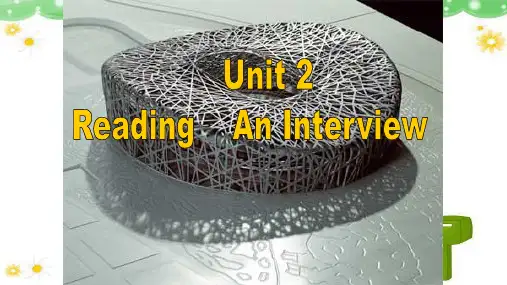


A Teaching Plan for Module2 Unit2 Olympic GamesReading An InterviewTeaching Aimsa. To know some basic information about the ancient and modern Olympicsb. To catch the key words or phrases in the readingc. To enhance the skills fast-reading and careful-readingTeaching Keys Pointsa.To bear some new and important words and phrases in minds, such as ancient,take part in, stand for, Greece, magical, volunteer, athlete, slave, host, olive wreath.b.To improve the reading and speaking skillsTeaching Difficult Pointsa.To summarize the similarities and difference between the earlier and latestOlympics through the long dialogues.b.To arouse the students’ interests of English-speaking.Teaching AidsBlackboard, Multi-media, and other normal teaching tools.Teaching MethodsStudents-centered approach and Task-based teaching and learing.Teaching periodsPeriod 1 Warming up(3’)1. Enjoy a video which is to celebrate that Beijing win the right to host the 2008 Olympic Games to lead in the topic: the Olympic Games.2. Guessing game: Which ring is concerned with the Olympic Games?five rings flagfive continentsThe five interlocking rings stand for friendship of five continents.Blue =Europe Black =Africa Red =America Yellow =Asia Green =Oceania3. Show the pictures to Students about the Olympic motto: Swifter, Higher, Stronger 4.Introduce three medals to students; gold, silver, bronze.Period 2 ReadingStep1 Pre-reading(6’)A. Let us have a competition to check who know the most knowledge about the Olympic Games1.When and where did the ancient Olympic Games start?A. 776BC; in GreeceB. 776 AD.; in Greece2. Who was China’s first gold medal winner and for what event?A.Xu Haifeng; shootingB. Xie Jun running3. Who got the golden medal in 110-metre hurdle in 2004 Olympic Games?A Liu Xiang B. Li Xiaopeng C. Fu Mingxia4. Which one is the mascot of Beijing Olympics?A B C D5 What is the motto of Beijing Olympic Games?A Welcome to Beijing B. One world one dream C New Beijing New OlympicsB. Before reading, teacher teaches students to read the new words.ancient, take part in, stand for, Greece, magical, volunteer, athlete, slave, host, olive wreath.Step2 While-reading(19’)1. Fast reading : True or False.( )1. Women and slaves were allowed to take part in the ancient Olympic Games.( )2. The 2012 Olympic Games will be held in China.( )3. In the modern Olympics, the winner will be given olive wreath.( )4. A special village is built for competitors to live in.( )5. The modern Olympics are held every four years.2. Careful readingTell the difference between ancient and modern Olympics according to the reading passage. What do they mainly talk about?A. History about the Olympic GamesB. The differences and similarities between the ancient and modern Olympic GamesC. 2008 Olympic GamesName The ancient Olympics The modern OlympicsTime every four yearsPlace in GreecePeople men and womenStep3: Post-readingDiscussion(8’)Imagine if the Olympic Games will be held in Hainan, what can we do for it? (Teacher will give some hints to Ss , such as behavior, language, environment, culture.)1.Encourage the public to plant more trees and grass.2.Have good manners in public so as to leave a good impression on foreigners.3.Have a good knowledge of English and encourage the public speak English widely.4.Be Volunteers to be guides for foreigners5.Learn the spirit of the Olympic Games and regard its motto as life and study motto.6.Spread our local culture to other people,especially foreigners.Period3 Revision (3’)1.What words have we learnt?athlete运动员take part in 参与stand for代表…2.What useful structures have we learnt?Passive voice(被动语态):sth be done/ sth will be done…3.What information do we get from thetext?The similarities and difference betweenthe ancient and modern Olympics.Period4 Homework (1’)1.Surf the Internet to learn more information about Olympic Games2.Find out and underline the important language points in this unit.3.Prepare for the next period.。
