新版人教版七年级英语上册期末知识点复习
- 格式:docx
- 大小:45.67 KB
- 文档页数:30
新版人教版七年级英语上册期末知识点复习
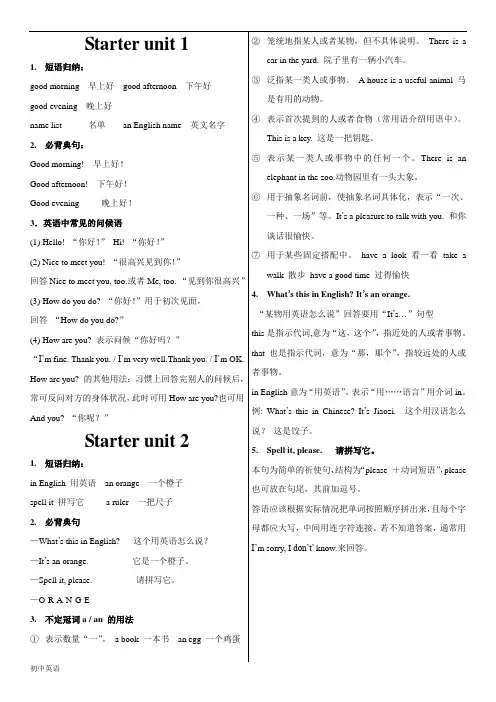
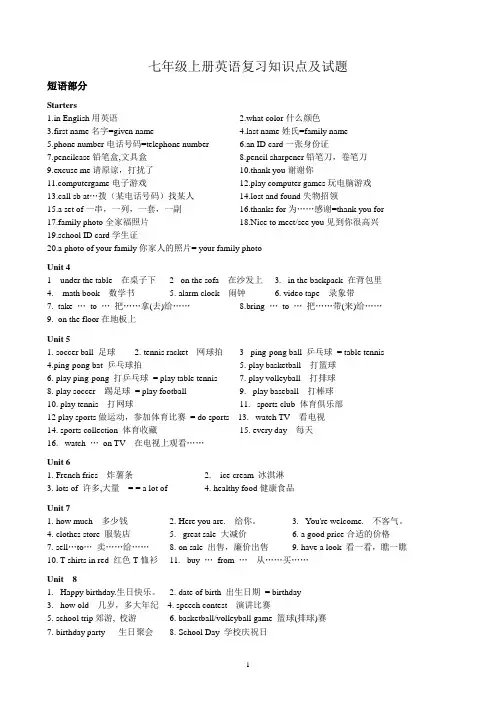
Starter Unit 1
Knowledge Points:
1.Phrase Summary:
Good morning - Good morning
Good afternoon - Good afternoon
Good evening - Good evening
Name list - List of names
An English name - An English name
2.Must-know XXX:
1) Good morning。Alice。- Good morning。Alice!
2) Good afternoon。- Good afternoon!
3) Hi。Bob。- Hi。Bob!
4) Hello。Frank。- Hello。Frank!
5) Good evening - Good evening
6) - How are you。- How are you?
I'm fine。thanks。How are you。- I'm OK.
mon XXX: ① Hello。"Hello!" XXX is usually used to say hello or
answer the phone。It can also be used to express surprise or get
someone's n。The response is still "Hello!"
② Hi。"Hello!" is used more casually and is more common
than "Hello!"
③ Nice to meet you。"Nice to meet you!" is used when two
people meet for the first time。The answer is "Nice to meet you
too." or "Me too." means "Nice to meet you."
④ How do you do。"Hello!" is a casual greeting used when
meeting for the first time。The answer is "How do you do?" How
are you。means greeting.
How are you。The answer is generally "I'm fine。Thank you。/ I'm very well。Thank you。/ I'm OK." n:
① In English。the first letter of the first word of a XXX
down。please.
② When the letter "I" is used as a personal pronoun。it
means "I" and must be XXX。The daily n "OK" is XXX OK?
③ XXX。places。countries。XXX nalities。or XXX。Lucy。China。Beijing。Chinese ④ XXX represent months。weeks。and XXX。May。Monday。New Year's Day
⑤ The first letter of each real word (such as nouns。verbs。adjectives。adverbs。and numerals) in the title of a movie。book。newspaper。or article is XXX。Titanic
Starter Unit 2: Using Indefinite Articles
In English。XXX。such as RMB for Renminbi and CCTV
for China Central n。while others are used for XXX duels。such
as PK.
When referring to ns。titles。or names。the first letter is
usually capitalized。like Uncle Lee or Doctor Wang.
XXX the following knowledge points:
1.Phrases to remember。such as "in English" and "spell it."
2.Essential sentences。like "What's this in English?" and "It's
an orange." When using indefinite articles。"a" is used before consonants and "an" is used before vowels。like "a ruler" and "an
egg."
3.The usage of indefinite articles。which express the concept
of "one" without emphasizing the number and only indicate that
the noun is not specific。They can also be used to refer to a
general category of people or things。as well as to XXX for the
first time。Indefinite articles can also make abstract nouns more
specific。and are used in certain fixed phrases like "have a look"
and "take a walk."
4.The sentence "What's this in English。It's an orange" is
used to ask how to say something in English。and the response
should follow the "It's。" sentence structure。"This" is a XXX。while "that" refers to something farther away。"In English" means
to say something in the English language.
5."Spell it。please" is a request to spell a word.
Starter Unit 3:
Knowledge Points:
1.Phrase Summary:
What color the key is
Color the things
XXX
The cup
2.XXX:
What’s this?
It’s V.
What color is it?
It’s red.
3.XXX usage of the definite article "the":
The" XXX to specific people。things。or groups。It can
sometimes be XXX "this," "that," "these," and "those," and it can
be used before a noun to refer to the people or XXX.
XXX:
1. 2.
3.
4.
5.
6.
7.
8.
4.Examples of the definite article "the":
XXX speakers know: Where is the ruler?
XXX: This is a pen。The pen is black.
Referring to unique things in the world: the sun。the earth。the moon.
XXX to a group of people: the old。the young。the poor.
Used before nal nouns: the east。the west.
Used with "play" before Western musical instrument nouns:
Play the piano.
XXX: The Great Wall。The Summer Palace.
Used in some fixed phrases: XXX.
The usage of "color":
When "color" is used as a noun。it means "color." Another
spelling is "colour." When used as a verb。it means "to color。to
paint."
Color the picture green.
2.特殊疑问句以what为引导,常用于询问姓名、物品名称和电话号码等。例如,“What’s your name?”、“What’s this in
English?”和“XXX?”。
3.形容词性物主代词用于表示所有关系,分为单数和复数形式。例如,“my pen”和“our pens”。
4.数词分为基数词和序数词,基数词用于表示“多少”,序数词用于表示“第几”。例如,“XXX”、“one”和“first”。
5.在交流中,常用的问候语包括“XXX!”和“What’s your
name?”。回答时可以说“Nice to meet you。too.”和“My name
is…”。