数字bpsk调制流程
- 格式:doc
- 大小:16.31 KB
- 文档页数:7
数字bpsk调制流程
## BPSK Modulation: A Comprehensive Guide.
BPSK (Binary Phase Shift Keying) modulation is a
digital modulation technique used to transmit binary data
over a communication channel. It is a simple and effective
modulation scheme that is widely used in various
applications, including data communication,
telecommunication, and wireless communication systems.
In BPSK modulation, the binary data is represented by
two distinct phases of the carrier signal. The following
steps describe the process of BPSK modulation:
1. Input Binary Data: The input to the BPSK modulator
is a stream of binary data, represented by a sequence of
'0's and '1's.
2. Carrier Signal Generation: The carrier signal is a
sinusoidal waveform with a specific frequency and amplitude. It serves as the base signal for modulation.
3. Phase Shift Encoding: The binary data is encoded
onto the carrier signal by shifting its phase. A '0' bit is
represented by a phase shift of 0 degrees, while a '1' bit
is represented by a phase shift of 180 degrees.
4. Modulated Signal: The phase-encoded carrier signal
is the modulated signal. It contains the binary data
embedded in the phase variations of the carrier signal.
5. Transmission: The modulated signal is transmitted
over the communication channel, such as a cable or wireless
link.
At the receiver, the demodulation process is performed
to extract the original binary data from the modulated
signal. The following steps outline the BPSK demodulation
process:
1. Signal Reception: The transmitted modulated signal
is received at the receiver.
2. Phase Detection: The phase of the received signal is
detected and compared to a reference phase.
3. Data Decoding: The phase difference between the
received signal and the reference phase determines the
original binary data. A phase difference of 0 degrees
corresponds to a '0' bit, while a phase difference of 180
degrees corresponds to a '1' bit.
4. Output Binary Data: The decoded binary data is the
output of the BPSK demodulator.
Advantages of BPSK Modulation:
Simple and easy to implement.
Robust against noise and interference.
Efficient use of bandwidth.
Suitable for both wired and wireless communication systems.
Disadvantages of BPSK Modulation:
Limited data rate compared to other modulation schemes.
Susceptible to phase errors due to signal impairments.
Applications of BPSK Modulation:
Data communication over telephone lines.
Wireless communication in Bluetooth and Wi-Fi systems.
Satellite communication.
Radar systems.
Navigation systems.
## BPSK调制流程。
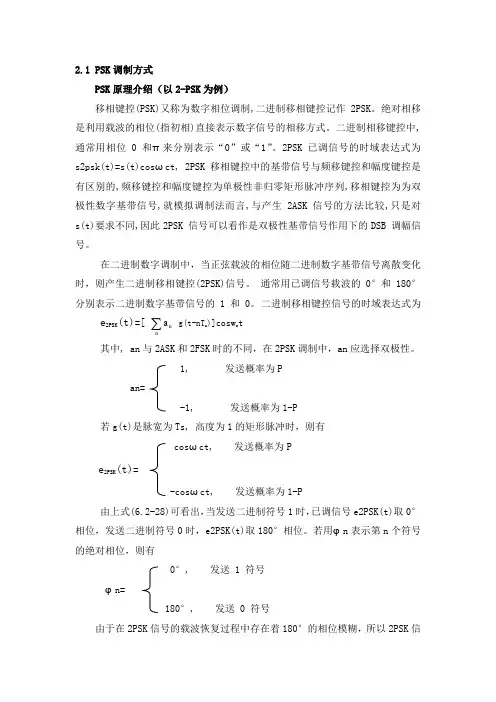
BPSK(二进制相移键控)调制是一种用于通过通信信道传输二进制数据的数字调制技术。它是一种简单有效的调制方案,广泛应用于各种应用中,包括数据通信、电信和无线通信系统。
在BPSK调制中,二进制数据由载波信号的两个不同相位表示。以下步骤描述了BPSK调制的过程:
1.输入二进制数据,BPSK调制器的输入是二进制数据流,以0和1的序列表示。
2.载波信号生成,载波信号是具有特定频率和幅度的正弦波形。它作为调制的基本信号。
3.相移编码,通过改变其相位将二进制数据编码到载波信号上。'0'比特以0度相移表示,而'1'比特以180度相移表示。
4.调制信号,相位编码的载波信号是调制信号。它包含嵌入在载波信号相位变化中的二进制数据。
5.传输,调制信号通过通信信道(例如电缆或无线链路)传输。
在接收器处,执行解调过程以从调制信号中提取原始二进制数据。以下步骤概述了BPSK解调过程:
1.信号接收,接收器接收传输的调制信号。
2.相位检测,检测接收信号的相位并将其与参考相位进行比较。
3.数据解码,接收信号与参考相位之间的相位差决定原始二进制数据。0度相位差对应'0'比特,而180度相位差对应'1'比特。
4.输出二进制数据,译码的二进制数据是BPSK解调器的输出。
BPSK调制的优点:
简单易于实现。
鲁棒性强,抗噪声和干扰。
有效利用带宽。
适用于有线和无线通信系统。
BPSK调制的缺点:
与其他调制方案相比,数据速率有限。
由于信号损伤,容易出现相位误差。
BPSK调制的应用:
电话线路上的数据通信。
蓝牙和Wi-Fi系统中的无线通信。
卫星通信。
雷达系统。
导航系统。