新被动语态讲解与练习
- 格式:doc
- 大小:161.00 KB
- 文档页数:23
被动语态讲解与练习一、语态分类语态是动词的一种形式,用以说明主语与谓语动词之间的关系。
英语的语态共有两种:主动语态和被动语态。
主动语态表示主语是动作的执行者,被动语态表示主语是动作的承受者。
被动语态是动词的一种特殊形式,一般说来,只有需要动作对象的及物动词才有被动语态。
汉语往往用“被”、“受”、“给”等词来表示被动意义。
如:They didn’t offer Ann the job. (主动语态)Ann wasn’t offered the job. (被动语态)安没得到这份工作。
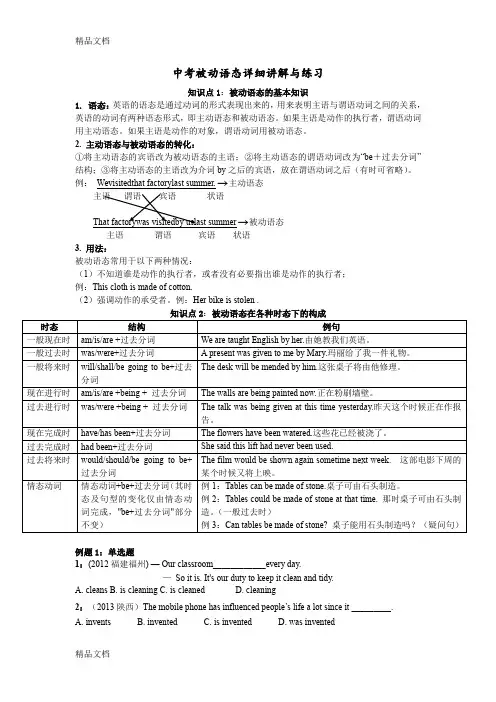
二、被动语态的构成由于不及物动词不能带宾语,故无被动语态,只有及物动词或相当于及物动词的动词短语才有被动语态,其基本构成方式是“助动词be+过去分词”。
被动语态的时态变化只改变be的形式,过去分词部分不变。
疑问式和否定式的变化也如此。
主语+be+过去分词(+by+动作的发出者)① 一般现在时:am/is/are+过去分词如:Trees are planted every year.② 现在进行时 am/is/are+ being +过去分词如:The road is being repaired.③ 现在完成时 have/has + been +过去分词如:The work has been finished.④ 一般过去时 was/were + 过去分词如:The story was told by him.Many birds were killed last year.⑤过去进行时 was/were+ being + 过去分词如:The new house was being painted when I got home.⑥过去完成时 had +been+ 过去分词如:He told me that the work had been finished.⑦一般将来时 will +be + 过去分词如:The problem will be discussed tomorrow.⑧ 过去将来时 would/should +be +过去分词如:He said that the Christmas tree would be put up soon.⑨情态动词的被动语态情态动词+ be +过去分词如:The problem must be solved soon.Children should be taught to love animals.注意:“be+过去分词”结构不一定都是被动语态,有些动词(如 be,feel,look,seem 等)后面的过去分词已转化为形容词,用作表语表示状态。
如:My bike is broken.(我的自行车坏了。
)The door is open.(门开了。
)三、被动语态的用法:1、不知道或没有必要指出谁是动作的执行者。
The old bridge was built many years ago. 这座古桥是许多年前建造的。
He was elected chairman.他被选为主席。
2、强调动作的承受者。
动作的执行者由by引导置于谓语动词之后,也可省略。
Your plan is considered to be the best. 你的计划被认为是最好的。
3、动作的执行者是无生命的事物。
The window was blown by wind.窗户被风吹开了。
The whole village has been washed away by the flood.整个村庄都被洪水冲走了。
4. 避免更换主语,如:Once a promise is made, it shouldn’t be broken. 诺言一旦许下,就不能违背。
Mothers love their children and children are sure to love their mothers.母亲爱孩子,孩子当然也爱母亲了。
5. 使句子保持平衡,如:The lecture will be made by Joe Smith, who is a young artist from the States.乔·史密斯将来做报告,他是一位年轻的美国艺术家。
(Joe Smith有一个非限定性定语从句,所以后置)四.主动语态改被动语态的方法1)将主动语态改为被动语态应注意以下三个方面:①将主动语态的宾语改为被动语态的主语;②将主动语态的谓语动词改为“be+过去分词”结构;③将主动语态的主语改为介词by之后的宾语,放在谓语动词之后(有时可省略)。
2)含直接宾语和间接宾语的主动语态改为被动语态时有两种情况:①把间接宾语改为被动语态的主语,直接宾语仍保留原位;②把直接宾语改为主动语态的主语,此时,间接宾语前要加介词to或 for。
如:He gave the boy an apple.→The boy was given an apple.(或An apple was given to the boy.)Her father bought her a present.→She was bought a present by her father.(或A present was bought for her by her father.)3)不带to的动词不定式作宾语补足语的主动语态,改为被动语态时不定式前要加to。
如:They watched the children sing that morning.→The children were watched to sing that morning.4)带复合宾语的动词在改为被动语态时,一般把主动语态的宾语改为主语,宾语补足语在被动语态中作主语补足语。
如:We call him Xiao Wang.→He is called Xiao Wang.He cut his hair short.→His hair was cut short.They told him to help me.→He was told to help me.5)短语动词是不可分割的整体,改为被动语态时要保持其完整性,介词或副词不可遗漏。
如:We must take good care of the young trees.→The young trees must be taken good care of.6)含有宾语从句的主动结构变为被动结构时,通常用it作为被动结构的先行主语,从句放在句子后面;也可采用另一种形式。
可以这样转换为被动结构的动词有know,say,believe,find,think,report等。
如:People believe that he is ill.→It is believed that he is ill.(或:He is believed to be ill.)五.被动语态改为主动语态的方法:被动语态中介词by后的宾语改为主动语态中的主语(或按题意要求确定主语),按照这个主语的人称和数以及原来的时态把谓语动词形式由被动语态改为主动语态。
注意在主动语态中有的动词要求不带to的动词不定式作宾语补足语,此时要把被动语态中的to去掉。
被动语态的主语用来作主动语态的宾语。
如:History is made by the people.The people make history.六.不能用于被动语态的情况1)某些表示“静态”的及物动词(表示状态而不是动作,而且常常是不可用于进行时态的动词)如have,fit,suit,hold(容纳),cost, suffer,last(持续)等不能用于被动语态。
如:They have a nice car.他们有一辆漂亮的汽车。
My shoes don't fit me.我的鞋不合适。
My brain can't hold so much information at one time.我的脑子一下子记不住这么多资料。
How much /What does it cost?这值多少钱?Our holiday lasts 10days.我们的假期有十天。
This food will last(them)(for)3 days.这食物足够(他们)(吃)三天。
2)不是所有带介词的动词都能用于被动结构。
若是构成成语动词通常有被动态,若不构成成语动词则无被动态。
试比较:They arrived at a decision. A decision was arrived at.他们作出了决定。
They arrived at the station.他们到达车站。
(不说:The station was arrived at.)He looked into the question. The question was looked into.他调查了这个问题。
3)动词leave(离开),enter(进入),join(参加)不可用于被动语态。
如:The car left the road and hit a tree.车子离开了道路,撞上了树。
4)某些及物动词可作不及物动词用,特别是后加副词(如well, easily等)时。
主动语态有被动含义,这类动词常见的有sell,write, wear,wash,cook,open,close,lock,read,record等。
如:His new novel is selling well.他的新小说很畅销。
The cloth washes well.这布很耐洗。
This material won't wear.这种材料不耐穿。
His play won't act.他的戏剧不会上演。
The window won't shut.这窗关不上。
The door won't open.这门打不开。
The door won't lock.这门锁不上。
This poem reads well.这首诗读来很好。
5)feel,look,appear,sound,taste,smell等由实意动词演变而来的系动词,后接形容词作表语,不可用于被动语态。
如:Tell me if you feel cold.你要是感到冷就告诉我。
You're looking very unhappy—what's the matter?你看来很不高兴——怎么回事儿?The soup tastes wonderful.这汤味道好极了。
Those roses smell beautiful.那些玫瑰好闻极了。