
化学专业英语:无机物命名
- 格式:ppt
- 大小:140.00 KB
- 文档页数:25

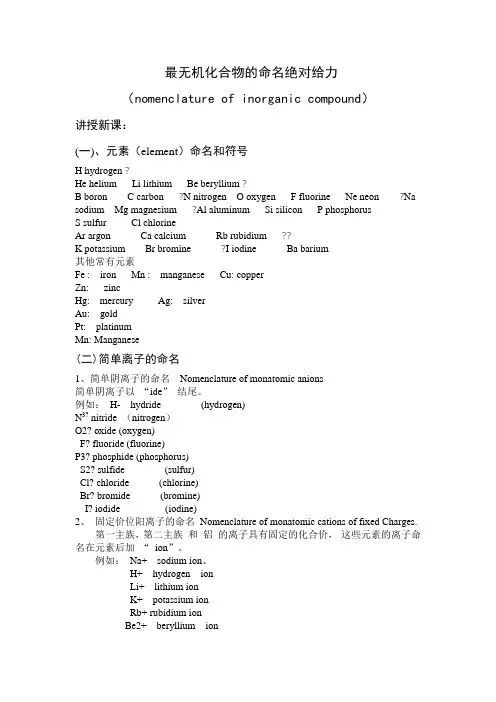
最无机化合物的命名绝对给力(nomenclature of inorganic compound)讲授新课:(一)、元素(element)命名和符号H hydrogen ?He helium Li lithium Be beryllium ?B boronC carbon ?N nitrogen O oxygen F fluorine Ne neon ?Na sodium Mg magnesium ?Al aluminum Si silicon P phosphorusS sulfur Cl chlorineAr argon Ca calcium Rb rubidium ??K potassium Br bromine ?I iodine Ba barium其他常有元素Fe : iron Mn : manganese Cu: copperZn: zincHg: mercury Ag: silverAu: goldPt: platinumMn: Manganese(二)简单离子的命名1、简单阴离子的命名Nomenclature of monatomic anions简单阴离子以“ide”结尾。
例如:H- hydride (hydrogen)N3? nitride (nitrogen)O2? oxide (oxygen)F? fluoride (fluorine)P3? phosphide (phosphorus)S2? sulfide (sulfur)Cl? chloride (chlorine)Br? bromide (bromine)I? iodide (iodine)2、固定价位阳离子的命名Nomenclature of monatomic cations of fixed Charges.第一主族,第二主族和铝的离子具有固定的化合价,这些元素的离子命名在元素后加“ion”。
例如:Na+ sodium ion、H+ hydrogen ionLi+ lithium ionK+ potassium ionRb+ rubidium ionBe2+ beryllium ionMg2+ magnesium ionCa2+ calcium ionBa2+ barium ionAl3+ aluminum ion3、多价位阳离子命名cations of variable charges.有些阳离子有多种化合价,stock name . 元素后(化合价罗马数字)+ ion表示common name: 高价态的一“ic”结尾,低价态的以:“ous”结尾。
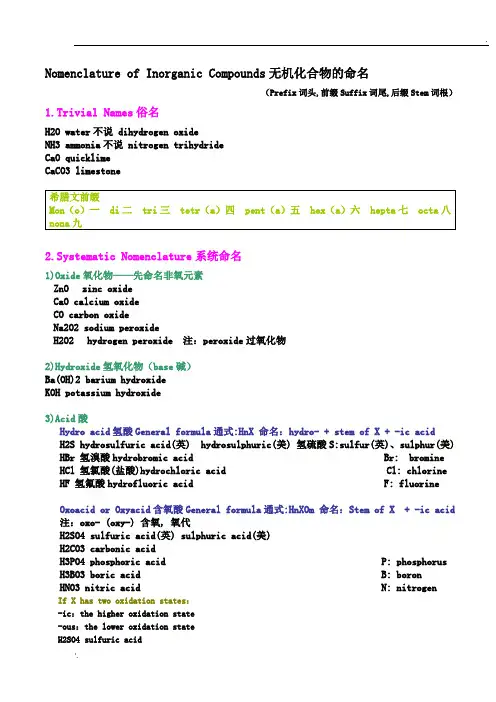
Nomenclature of Inorganic Compounds无机化合物的命名(Prefix词头,前缀Suffix词尾,后缀Stem词根)1.Trivial Names俗名H2O water不说 dihydrogen oxideNH3 ammonia不说 nitrogen trihydrideCaO quicklimeCaCO3 limestone2.Systematic Nomenclature系统命名1)Oxide氧化物——先命名非氧元素ZnO zinc oxideCaO calcium oxideCO carbon oxideNa2O2 sodium peroxideH2O2hydrogen peroxide 注:peroxide过氧化物2)Hydroxide氢氧化物(base碱)Ba(OH)2 barium hydroxideKOH potassium hydroxide3)Acid酸Hydro acid氢酸General formula通式:HnX 命名:hydro- + stem of X + -ic acid H2S hydrosulfuric acid(英) hydrosulphuric(美) 氢硫酸S:sulfur(英)、sulphur(美) HBr 氢溴酸hydrobromic acid Br: bromine HCl 氢氯酸(盐酸)hydrochloric acid Cl: chlorine HF 氢氟酸hydrofluoric acid F: fluorineOxoacid or Oxyacid含氧酸General formula通式:HnXOm 命名:Stem of X + -ic acid 注:oxo- (oxy-) 含氧, 氧代H2SO4 sulfuric acid(英) sulphuric acid(美)H2CO3 carbonic acidH3PO4 phosphoric acid P: phosphorus H3BO3 boric acid B: boronHNO3 nitric acid N: nitrogen If X has two oxidation states:-ic:the higher oxidation state-ous:the lower oxidation stateH2SO4 sulfuric acidH2SO3 sulfurous acidHNO3 nitric acidHNO2 nitrous acidIf X (such as halogens) has more than two oxidation states:halogen卤素per- (过,高) + -ic:the still higher oxidation statehypo- (次,在…下) + -ous:the still lower oxidation stateHClO3 chloric acidHClO2 chlorous acidHClO4 perchloric acidHClO hypochlorous acidHIO hypoiodous acid4)Salt盐General formula通式:MnXm 命名:Name of M stem of X + -ide(-ide…化物)Oxide、chloride、nitride、hydrideKI potassium iodideAl2S3 aluminum sulfideLiH lithium hydrideOxysalt含氧酸盐 Name the metal ion first and then the anionNaming anions:-ate anions derived from the -ic acid(the higher oxidation state of X)-ite anions derived from the -ous acid (the lower oxidation state of X)HNO3 nitric acidNaNO3 sodium nitrateHNO2 nitrous acidNaNO2 sodium nitriteSO42- sulfateSO32- sulfiteAgClO4 silver perchlorateNaIO3 sodium iodateKClO2 potassium chloriteKBrO potassium hypobromiteMnO42- manganateMnO4- permanganateAcid salt 酸式盐 Using “hydrogen” to specify “H”NaHSO4 sodium hydrogen sulfateNaH2PO4 sodium dihydrogen phosphateNa2HPO4 disodium hydrogen phosphate P: phosphorus phosphate磷酸盐(根) Using prefix bi- + name of anion if only one acid salt existsNaHSO4 sodium bisulfateNaHSO3 sodium bisulfiteKHCO3 potassium bicarbonate5)Metals(M)with more than one oxidation stateTwo methods:①后缀法: 早期使用stem of M + -ic the higher oxidation state of Mstem of M + -ous the lower oxidation state of MHgI2 mercuric iodideHg2I2 mercurous iodide Hg:mercury Cr2+ chromousCr3+ chromic Cr: chromium注:In most cases, Latin stem is used if the metal has symbol derived from its Latin name.(mercury is an exception)Cu:cupr um (拉丁),copper (英)Cu+ cuprousCu2+ cupricCuI cuprous iodideCuS cupric sulfideSn:stann um (拉丁), tin (英)SnCl2 stannous chlorideSnO2 stannic oxideFe:ferr um (拉丁), iron (英)Fe(OH)2 ferrous hydroxideFeBr3 ferric bromide②IUPAC Rule 1957年开始使用English name of metal(Roman numeral)CuBr copper(I) bromideCuF2 copper(II) fluorideSnO tin(II) oxideSnS2 tin(IV) sulfideFe(NO3)2 iron(II) nitrateFe2(SO4)3 iron(III) sulfateUse Greek prefixes希腊文前缀Mon(o)一 di二 tri三 tetr(a)四 pent(a)五 hex(a)六 hepta七 octa八nona九1.to specify the number of each atom in the chemical formula.NO2 nitrogen dioxidePCl5 phosphorus pentachlorideCO2 carbon dioxide2.to specify the number of identical central atoms in condensed acids and their corresponding anions.condensed acid缩酸H3PO4 (mono)phosphoric acidH4P2O7 diphosphoric acidH2SO4 sulfuric acidH2S3O10 trisulfuric acidCrO42- 铬酸盐(根) chromateCr2O72- 重铬酸盐(根)dichromate3. to indicate extent of substitutionPO43- phosphatePS2O23- dithiophosphate thio-硫代…,硫的,含硫的注:The prefixes ortho- and meta- have been used to distinguish acids differingin the “content of water.”ortho- [希腊词头] 正、原(无机酸用)邻(位)(有机化合物命名)meta- [希腊词头] 偏(无机酸用)间(位)(有机化合物命名)ortho-acid 原酸;meta-acid 偏酸H3BO3 orthoboric acid(or boric acid)(原)硼酸(HBO3)n metaboric acid偏硼酸H4SiO4 orthosilicic acid(or silicic acid)原硅酸H2SiO3 metasilicic acid 硅酸(习惯上不叫偏硅酸)H3PO4 orthophosphoric acid (or phosphoric acid)(正)磷酸(HPO3)n metaphosphoric acid 偏磷酸。
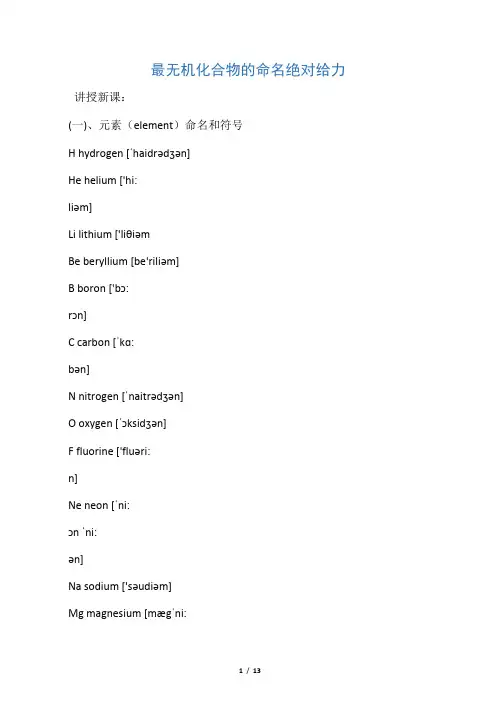
最无机化合物的命名绝对给力讲授新课:(一)、元素(element)命名和符号H hydrogen [ˈhaidrədʒən]He helium ['hi:liəm]Li lithium ['liθiəmBe beryllium [be'riliəm]B boron ['bɔ:rɔn]C carbon [ˈkɑ:bən]N nitrogen [ˈnaitrədʒən]O oxygen [ˈɔksidʒən]F fluorine ['fluəri:n]Ne neon [ˈni:ɔn ˈni:ən]Na sodium ['səudiəm]Mg magnesium [mægˈni:ziəm]Al aluminum [ˈæljuˈminiəm,ˈæləˈminiəm] Si silicon [ˈsilikən]P phosphorus ['fɔsfərəs]S sulfur [ ['sʌlfə]Cl chlorine ['klɔ:ri:n]Ar argon ['ɑ:gɔn]Ca calcium [ˈkælsiəm]Rb rubidium [ru:'bidiəm]K potassium [pə'tæsiəm]Br bromine ['brəumi:n]I iodine [ˈaiədi:n]Ba barium ['bɛəriəm其他常有元素Fe :iron ['aiən]Mn :manganese [ˈmæŋgə'ni:z]Cu:copper [ˈkɔpə]拉丁语:CuprumZn:zinc [ziŋk]Hg:mercury [ˈmə:kjuri]来源于古希腊人对它的称呼hydor argyros (水银)Ag:silver [ˈsilvə]拉丁名Argentum 即来自希腊文argyros (明亮) ,元素符号Ag ,与英文名silver 毫不相干;Au:gold [gəuld]金的拉丁名Aurum 来自希腊文aurora (灿烂) ,元素符号Au ,与英文名gold 也无关系。
