
2015年12月英语六级真题及答案第二套
- 格式:docx
- 大小:4.01 MB
- 文档页数:17
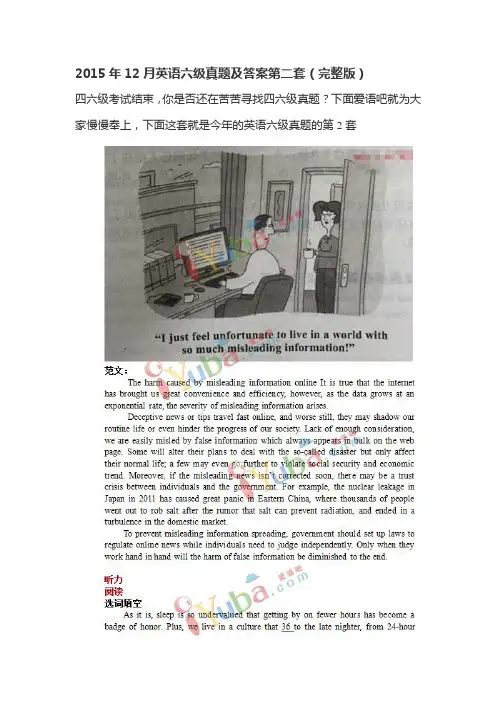
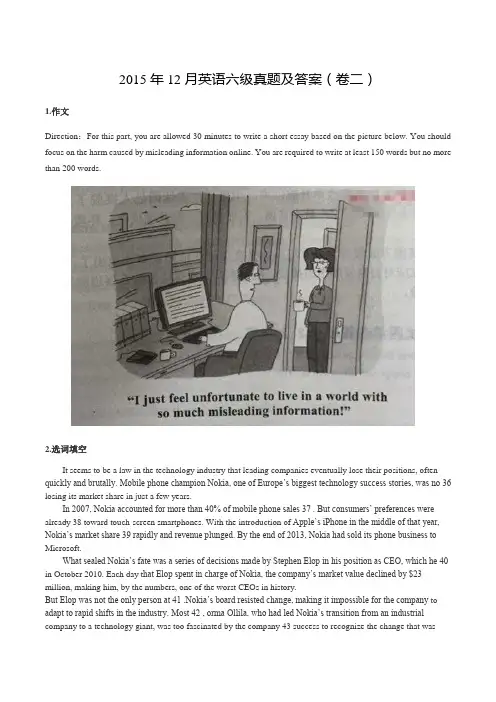
2015年12月英语六级真题及答案(卷二)1.作文Direction:For this part, you are allowed 30 minutes to write a short essay based on the picture below. You should focus on the harm caused by misleading information online. You are required to write at least 150 words but no more than 200 words.2.选词填空It seems to be a law in the technology industry that leading companies eventually lose their positions, often quickly and brutally. Mobile phone champion Nokia, one of Europe’s biggest technology success stories, was no 36 losing its market share in just a few years.In 2007, Nokia accounted for more than 40% of mobile phone sales 37 . But consumers’ preferences were already 38 toward touch-screen smartphones. With the introduction ofApple’s iPhone in the middle of that year,N okia’s market share 39 rapidly and revenue plunged. By the end of 2013, Nokia had sold its phone business to Microsoft.What sealed Nokia’s fate was a series of decisions made by Stephen Elop in his position as CEO, which he 40 in October 2010. Each day th at Elop spent in charge of Nokia, the company’s market value declined by $23 million, making him, by the numbers, one of the worst CEOs in history.But Elop was not the only person at 41 .Nokia’s board resisted change, making it impossible for the company to adapt to rapid shifts in the industry. Most 42 , orma Ollila, who had led Nokia’s transition from an industrial company to a technology giant, was too fascinated by the company 43 success to recognize the change that wasneeded to sustain its competitiveness. The company also embarked on a 44 cost cutting program, which included the elimination of thousands of jobs. This contributed to the 45 of th e company’s once-spirited culture, which had motivated employees to take risks and make miracles. Good leaders left the company, taking Nokia’s sense of vision and direction with them. Not surprisingly, much of Nokia's most valuable design and programming talent left as well.A) assumedI) previousB) biasJ) relayedC) desperateK) shiftingD) deteriorationL) shrankE) exceptionM) subtleF) faultN) transmittingG) incidentallyO) worldwideH) notably3.长篇阅读First-Generation College-Goers: Unprepared and BehindKids who are the first in their families to brave the world of higher education come on campus with little academic know-how and are much more likely than their peers to drop out before graduation.A) When Nijay Williams entered college last fall as a first-generation student and Jamaican immigrant, he was academically unprepared for the rigors of higher education. Like many first-generation students, he enrolled in a medium-sized state university many of his high school peers were also attending, received a Pell Grant, and took out some small federal loans to cover other costs. Given the high price of room and board and the closeness of the school to his family, he chose to live at home and worked between 30 and 40 hours a week while taking a full class schedule.B) What Nijay didn’t realize about his school—Tennessee State University一was its frighteningly low graduation rate: a mere 29 percent for its first-generation students. At the end of his first year, Nijay lost his Pell Grant of over $5,000 after narrowly missing the 2.0 GPA cut-off, making it impossible for him to continue paying for school. C) Nijay represents a large and growing group of Americans: first-generation college students who enter school unprepared or behind. To make matters worse, these schools are ill-equipped to graduate these students—young adults who face specific challenges and obstacles. They typically carry financial burdens that outweigh those of their peers, are more likely to work while attending school, and often require significant academic remediation (补习).D) Matt Rubinoff directs I’m First, a nonprofit organization launched last October to reach out to this specific population of students. He hopes to distribute this information and help prospective college-goers find the best post-secondary fit. And while Rubinoff believes there are a good number of four-year schools that truly care about these students and set aside significant resources and programs for them, he says that number isn’t high enough. E) “It’s n ot only the selective and elite institutions that provide those opportunities for a small subset of this population,” Rubinoff said, adding that a majority of first-generation under-graduates tend toward options such as online programs, two-year colleges, and commuter state schools. “Unfortunately, there tends to be a lack ofinformation and support to help students think bigger and broader.”F) Despite this problem, many students are still drawn to these institutions—and two-year schools in particular As a former high school teacher, I saw students choose familiar, cheaper options year after year. Instead of skipping out on higher education altogether, they chose community colleges or state schools with low bars for admittance.G) “They underestimate themselves when selecting a university,” said Dave Jarrat, a marketing executive for Inside Track, a for-profit organization that specializes in coaching low-income students and supporting colleges in order to help students thrive. “The reality of it is that a l ot of low-income kids could be going to elite universities on a full ride scholarship and don’t even realize it.”H) “Many students are coming from a situation where no one around them has the experience of successfully completing higher education, so they are coming in questioning themselves and their college worthiness,” Jarrat continued That helps explain why, as I’m First’s Rubinoff indicated, the schools to which these students end up resorting can end up being some of the poorest matches for them. The University of Tennessee in Knoxville offers one example of this dilemma. A flagship university in the South, the school graduates just 16 percent of its first-generation students, despite its overall graduation rate of 71 percent. Located only a few hours apart, The University of Tennessee and Tennessee State are worth comparing. Tennessee State’s overall graduation rate is a tiny 39 percent, but at least it has a smaller gap between the out-comes for first-generation students and those of their peers.I) Still, the University of Tennessee deserves credit for being transparent. Many large institutions keep this kind of data secret—or at least make it incredibly difficult to find The University of North Carolina at Chapel Hill, for instance, admits only that the graduation rate for its first-generation pupils is “much lower” than the percentage of all students who graduate within four years (81 percent).J) It is actually quite difficult to find reliable statistics on the issue for many schools. Higher education institutions are, under federal law, required to report graduation rates, but these re- ports typically only include Pell recipient numbers~not necessarily rates specific to first-gen-eration students. Other initiatives fail to break down the data, too. Imagine how intimidating it can be for prospective students unfamiliar with the complexities of higher education to navigate this kind ofinformation and then identify which schools are the best fit.K) It was this lack of information that prompted the launch of I’m First in 2013, originally as an arm of its umbrella organization, the Center For Student Opportunity. “If we can help to direct students to more of these types of campuses and help students to understand them to be realistic and accessible places, have them apply to these schools at greater frequency and ultimately get in and enroll, we are going to raise the success rate,” Rubinoff said, citing a variety of colleges ranging from large state institutions to smaller private schools.L) Chelsea Jones, who now directs student programming at I’m First, was a first-generation college student at Howard. Like other students new to the intimidating higher-education world, she often struggled on her path to college. “There wasn’t really a college-bound culture at my high school.” she said “I wanted to go to college but I didn’t really know the process.” Jones became involved with a college-access program through Princeton University in high school. Now, she attributes much of her understanding of college to that:“But once I got to campus, it was a completely different ball game that no one really prepared me for.”M) She was fortunate, though. Howard, a well-regarded historically black college, had an array of resources for its first-generation students, including matching kids with counselors, connecting first-generation students to one another, and TRIO, a national program that supported 200 students on Howard’s campus. Still, Jones represents a small percentage of first-generation students who are able to gain entry into more elite universities, which are often known for robust financial aid packages and remarkably high graduation rates for first-generation students. (Harvard, for example, boasts a six-year graduation rate for underrepresented minority groups of 98 percent.)N) Christian Vazquez, a first-generation Yale graduate, is another exception, his success story setting him far apartfrom students such as Nijay. “There is a lot of support at Yale, to an extent, after a while, there is too much support,” he said, half-joking about the countless resources available at the school. Students are placed in small groups with counselors (trained seniors on campus); they have access to cultural and ethnic affinity (联系) groups, tutoring centers and also have a summer orientation specifically for first-generation students (the latter being one of the most common programs for students).O) “Our support structure was more like: ‘You are going to get through Yale; you are going to do well,’”he said, hinting at mentors (导师), staff, and professors who all provided significant support for students who lacked confidence about “belonging”at such a top institution.46. Many first-generation college-goers have doubts about their abilities to get a college degree. 47. First-generation college students tend to have much heavier financial burdens than their peers.48. The graduation rate of first-generation students at Nijay’s university was incredibly low.49. Some top institutions like Yale seem to provide first-generation students with more support than they actually need.50. On entering college, Nijay Williams had no idea how challenging college education was.51. Many universities simply refuse to release their exact graduation rates for first-generation students.52. According to a marketing executive, many students from low-income families don’t know they could have a chance of going to an elite university.53. Some elite universities attach great importance to building up the first-generation students’self-confidence.54. I’m First distributes information to help first-generation college-goers find schools that are most suitable for them.55. Elite universities tend to graduate first-generation students at a higher rate.4.仔细阅读Passage OneSaying they can no longer ignore the rising prices of health care, some of the most influential medical groups in the nation are recommending that doctors weigh the costs, not just the effectiveness of treatments, as they make decisions about patient care.The shift, little noticed outside the medical establishment but already controversial inside it, suggests that doctors are starting to redefine their roles, from being concerned exclusively about individual patients to exerting influence on how healthcare dollars are spent.In practical terms, the new guidelines being developed could result in doctors choosing one drug over another for cost reasons or even deciding that a particular treatment — at the end of life, for example — is too expensive. In the extreme, some critics have said that making treatment decisions based on cost is a form of rationing.Traditionally, guidelines have heavily influenced the practice of medicine, and the latest ones are expected to make doctors more conscious of the economic consequences of their decis ions, even though there’s no obligation to follow them. Medical society guidelines are also used by insurance companies to help determine reimbursement (报销) policies.Some doctors see a potential conflict in trying to be both providers of patient care and financial overseers.“There should be forces in society who should be concerned about the budget, but they shouldn’t be functioning simultaneously as doctors,” said Dr. Martin Samuels at a Boston hospital. He said doctors risked losing the trust of patient s if they told patients, “I’m not going to do what I think is best for you because I think it’s bad for the healthcare budget in Massachusetts.”Doctors can face some grim trade-offs. Studies have shown, for example, that two drugs are about equallyeffective in treating macular degeneration, an eye disease. But one costs $50 a dose and the other close to $2,000. Medicare could save hundreds of millions of dollars a year if every-one used the cheaper drug, Avastin, instead of the costlier one, Lucentis.But the Food and Drug Administration has not approved Avastin for use in the eye, and using it rather than the alternative, Lucentis, might carry an additional, although slight, safety risk. Should doctors consider Medicare’s budget in deciding what to use?“I think ethically (在道德层面上) we are just worried about the patient in front of us and not trying to save money for the insurance industry or society as a whole,”said Dr. Donald Jensen.Still, some analysts say that there’s a role for doctors to play in cost analysis because not many others are doing so, “In some ways,” said Dr. Daniel Sulmasy, “it represents a failure of wider society to take up the issue.”56. What do some most influential medical groups recommend doctors do?A) Reflect on the responsibilities they are supposed to take.B) Pay more attention to the effectiveness of their treatments.C) Take costs into account when making treatment decisions.D) Readjust their practice in view of the cuts in health care.57. What were doctors mainly concerned about in the past?A) Specific medicines to be used. C) Professional advancement.B) Effects of medical treatment. D) Patients5 trust.58. What may the new guidelines being developed lead to?A) The redefining of doctors’ roles. C) Conflicts between doctors and patients.B) Overuse of less effective medicines. D) The prolonging of patients’ suffering.59. What risk do doctors see in their dual role as patient care providers and financial overseers?A) They may be involved in a conflict of interest.B) They may be forced to divide their attention.C) They may have to use less effective drugs.D) They may lose the respect of patients.60. What do some experts say about doctors' involvement in medical cost analysis?A) It may add to doctors’ alrea dy heavy workloads.B) It will help to save money for society as a whole.C) It results from society’s failure to tackle the problem.D) It raises doctors’ awareness of their social responsibilitiesPassage TwoEconomic inequality is the “defining challenge of our time, ” President Barack Obama declared in a speech last month to the Center for American Progress. Inequality is dangerous, he argued, not merely because it doesn’t look good to have a large gap between the rich and the poor, but because inequality itself destroys upward mobility, making it harder for the poor to escape from poverty. “Increased inequality and decreasing mobility pose a fundamental threat to the American Dream,” he said.Obama is only the most prominent public figure to declare inequality. Public Enemy No. 1 and the greatest threat to reducing poverty in America. A number of prominent economists have also argued that it’s harder for the poor to climb the economic ladder today because the rungs (横档) in that ladder have grown farther apart.For all the new attention devoted to the 1 percent, a new dataset from the Equality of Opportunity Project at Harvard and Berkeley suggests that, if we care about upward mobility overall, we’re vastly exaggerating the dangers of the rich-poor gap. Inequality itself is not a particularly strong predictor of economic mobility, associologist Scott Winship noted in a recent article based on his analysis of this data.So what factors, at the community level, do predict if poor children will move up the economic ladder as adults? What explains, for instance, why the Salt Lake City metro area is one of the 100 largest metropolitan areas most likely to lift the fortunes of the poor and the Atlanta metro area is one of the least likely?Harvard economist Raj Chetty has pointed to economic and racial segregation, community density, the size of a community’s middle class, the quality of schools, community religiosity, and familystructure, which he calls the “single strongest correlate of upward mobility.” Chetty finds that communities like Salt Lake City, with high levels of two-parent families and religiosity, are much more likely to see poor children get ahead than communities like Atlanta, with high levels of racial and economic segregation.Chetty has not yet issued a comprehensive analysis of the relative predictive power of each of these factors. Based on my analyses of the data, of the factors that Chetty has highlighted, the following three seem to be most predictive of upward mobility in a given community:1. (人均) income growth2. Prevalence of single mothers (where correlation is strong, but negative)3. Per-capita local government spendingIn other words, communities with high levels of per-capita income growth, high percentages of two-parent families, and high local government spending~which may stand for good schools一are the most likely to help poor children relive Horatio Alger’s rags-to-riches story.61. How does Obama view economic inequality?A) It is the biggest obstacle to social mobility.B) It is the greatest threat to social stability.C) It is the No. 1 enemy of income growth.D) It is the most malicious social evil of our time.62. What do we learn about the inequality gap from Scott Winship’s data analysis?A) It is fast widening across most parts of America.B) It is not a reliable indicator of economic mobility.C) It is not correctly interpreted.D) It is overwhelmingly ignored.63. Compared with Atlanta, metropolitan Salt Lake City is said to______________.A) have placed religious beliefs above party politicsB) have bridged the gap between the rich and the poorC) offer poor children more chances to climb the social ladderD) suffer from higher levels of racial and economic segregation64. What is strongly correlated with social mobility according to economist Raj Chetty?A) Family structure. C) School education.B) Racial equality. D) Community density.65. What does the author seem to suggest?A) It is important to increase the size of the middle class.B) It is highly important to expand the metropolitan areas.C) It is most imperative to focus our efforts on the elimination of income inequality.D) It is better to start from the community to help poor children move up the social ladder.5 翻译最近,中国政府决定将其工业升级。
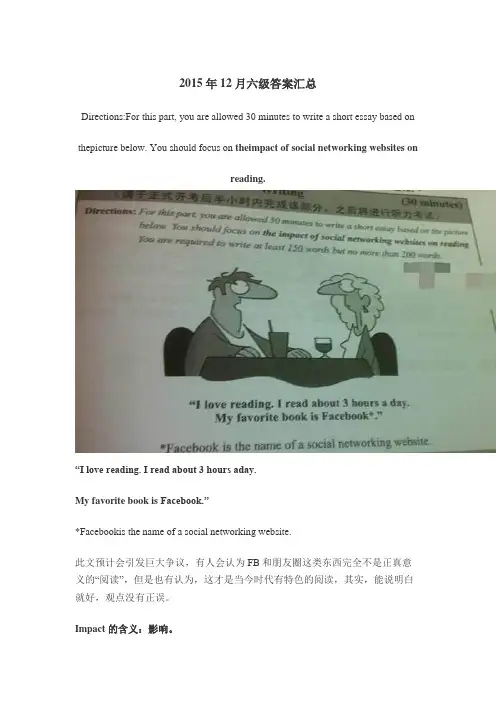
2015年12月六级答案汇总Directions:For this part, you are allowed 30 minutes to write a short essay based onthepicture below. You should focus on theimpact of social networking websites onreading.“I love reading. I read about 3 hours aday.My favorite book is Facebook.”*Facebookis the name of a social networking website.此文预计会引发巨大争议,有人会认为FB和朋友圈这类东西完全不是正真意义的“阅读”,但是也有认为,这才是当今时代有特色的阅读,其实,能说明白就好,观点没有正误。
Impact的含义:影响。
第一段: 描述漫画内容.强调网络阅读的趋势和现象第二段: 分析网络读书的原因. ( 或阐述不同的人的不同观点)在这一段,既可以把网络阅读的影响力归结为利大于弊,也可以归结为弊大于利,自圆其说即可。
第三段:双面总结,得出结论.Thepicture describes a conversation between two people, one of them said: “I readabout 3 hours a day. My favorite book is Facebook.” The picture intends toinform us that the Internet has exerted an important influence on reading forthe modern citizens.The phenomenon involves many factors, which canbe listed as the follows. To begin with, with the rapid development ofscientific technology, The Internet has become indispensable in our daily life.Undoubtedly, it provides people with many advantages and makes our life morecomfortable and efficient, including the way ofreading. What’s more, it is a moreadvanced way to get information needed by people, and an efficient way to searchfor materials. “I have hardly ever bought any books since 2003. I have beenreading online in recent years.” said professor Wang from Peking University.“With the click of the mouse, any stories or information that I want at anygiven time or place, is there.” she said. This may w ell explain why so manypeople now prefer to embrace the wonders of the Internet than read print copiesof book or any other reading material.Every coin hastwo sides, reading in social networking websites is no exception. Admittedly,there is false and useless information on the social networking websites, it isadvisable that we read more critically and carefully.For this part,you are allowed 30 minutes to write a short essay based on the picture be low. You should focus on the difficulty in acquiring useful information in spite ofadvanced information technology. You are required to write at least 150 words but no more than 200 words.第一段: 描述漫画内容.强调网络信息对我们生活的影响.第二段: 阐述网络信息技术找寻信息的弊端.第三段: 得出结论.The picture describes a conversation among several people, one of them complains: “we havelots of information technology; we just don’t have much useful information.” Itis safe to figure out that our lives are full of information technology, but weare supposed to have the ability to distinguish the useful ones from theuseless ones.The human beings are stepping into theinformation society. The information industry develops very rapidly, so does theinformation technology. Information technology brought us many benefits, as well as theunexpected side effects. First, when we search for information on the Internet,it comes out that the useful information and useless ones appear together. Italways takes us long time to separate them. What makes things worse is thatsome information on the Internet even misleads the people who cherish the hopeof acquiring the useful knowledge from theInternet. Thus,information technology becomes an impending important issue.Through the above analysis on information technology,I believe that the positive aspects far outweigh its negative ones though thetechnology does bring us some unwanted information. As college students, weshould enhance the awareness of recognizing the useful information when we are surfingthe net.第三版第一段: 描述漫画内容.强调误导信息的存在对我们的影响.第二段: 误导性信息对我们的影响的阐述. (可以结合具体的例子.)第三段: 提出方法解决这一问题It can be clearly seen that the coupleare discussing the information on the Internet, one of them said: “I just feelunfortunate to live in a world with so much misleading information.” Theconversation of the cartoon picture conveys the mess age that people attained informationfrom the Internet, some of which might be misleading.Along with the development of societyand technology, an increasing numberof problems are brought to our attention, one ofwhich is that misleading information exists on the Internet. Here is an exampleI got from my friend, which works well in the case. She expected to discover acure from the Internet when her mother got a certain disease. Unfortunately,that so called “cure” from the Wechat moments did not work at all a nd hermother’s healthy condition got worse. Such misleading information often wastepeople’s time and may result in even severe consequences.In view of the problem, effectivemeasures should be taken. For one thing, it is high time that we realized theimportance of ability to separate the useful information from the misleadingones. Thus, critical thinking is of great importance. For another, thegovernment should issue strict laws and regulations to put the situation undercontrol.六级翻译(贫困版)在帮助国际社会于2030年前消除极端贫困过程中,中国正扮演着越来越重要的角色。
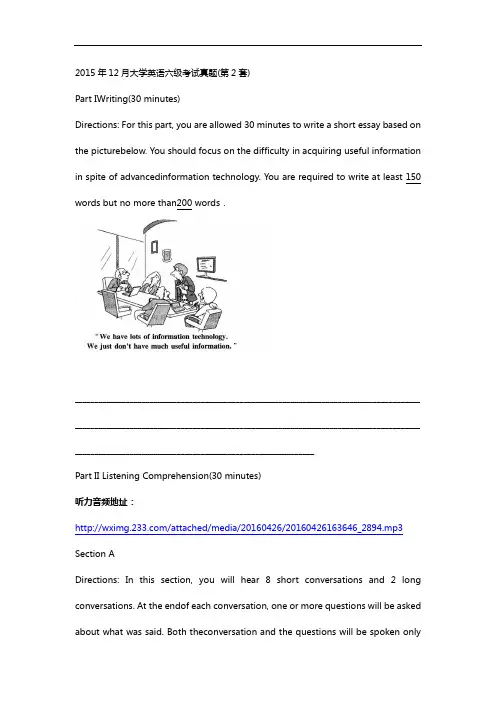
2015年12月大学英语六级考试真题(第2套)Part IWriting(30 minutes)Directions: For this part, you are allowed 30 minutes to write a short essay based on the picturebelow. You should focus on the difficulty in acquiring useful information in spite of advancedinformation technology. You are required to write at least 150 words but no more than200 words.________________________________________________________________________________________ ________________________________________________________________________________________ _____________________________________________________________Part II Listening Comprehension(30 minutes)听力音频地址:Section ADirections: In this section, you will hear 8 short conversations and 2 long conversations. At the endof each conversation, one or more questions will be asked about what was said. Both theconversation and the questions will be spoken onlyonce. After each question there will bea pause. During the pause, you must read the four choices marked A), B), C.and D.,and decide which is the best answer. Then mark the corresponding letter on AnswerSheet I with a single line through the centre.1. A.She is impatient to learn computer programming.B.She is unaware her operation system is outdated.C.She is unable to use the new computer program.D. She is amazed at the fast change of technology.2.A.He has long been fed up with traveling.B.He prefers to stay home for the holiday.C.He is going out of town for a couple of days.D. He is annoyed by the heavy traffic downtown.3.A.The challenges facing East Asia.B.The location for their new office.C.Their expansion into the overseas marketD. The living expenses in T okyo and Singapore.4. A.A number of cell phones were found after the last show.B.The woman forgot where she had left her cell phone.C.The woman was very pleased to find her cell phone.D. Reserved tickets could be picked up at the ticket counter.5.A.The building materials will be delivered soon.B.The project is being held up by bad weather.C.The construction schedule may not be met.D. Qualified carpenters are not easy to find.6.A.She is getting very forgetful these days.B.She does not hold on to bitterfeelings.C.She resents the way she is treated.D. She never intends to hurt anyone.7.A.The man wants to rent a small apartment.B.The woman has trouble getting a mortgage.C.The woman is moving to a foreign country.D.The man is trying to sell the woman a house.8. A.They are writing a story for the Morning News.B.They are facing great challenges to get re-elected.C.They are launching a campaign to attract women voters.D.They are conducting a survey among the women in town. Questions 9 to 11 are based on the conversation you have just heard.9.A.T ouch his heart.B.Make him cry.C.Remind him of his life.D.Make him feel young.10. A.He is good at singing operas.B.He enjoys complicated music:C.He can sing any song if he likes it.D.He loves country music in particular.11.A.Go to a bar and drink for hours.B.Go to an isolated place to sing blues.C.Go to see a performance in a concert hall.D.Go to work and wrap himself up in music.Questions 12 to 15 are based on the conversation you have just heard.12.A.How he became an announcer.B.How he writes news stories.C.How he makes his living.D.How he does his job.13.A.They write the first version of news stories.B.They gather news stories on the spot.C.They polish incoming news stories.D.They write comments on major news stories.14. A.Reading through the news stories in a given period of time.B.Having little time to read the news before going on the air.C.Having to change the tone of his voice from time to time.D.Getting all the words and phrases pronounced correctly.15.A.It shows where advertisements come in.B.It gives a signal for him to slow down.C.It alerts him to something important.D.It serves as a reminder of sad news.Section BDirections : In this section, you will hear 3 short passages. At the end of each passage, you will hearsome questions. Both the passage and the questions will be spoken only once. After youhear a question, you must choose the best answer from the four choices marked A), B),C).and D). Then mark the corresponding letter on Answer Sheet I with a single linethrough the centre.Passage OneQuestions 16 to 18 are based on the passage you have just heard.16. A.It gives pleasure to both adults and children.B.It is often carried around by small children.C.It can be found in many parts of the world.D.It was invented by an American Indian.17. A.They were made for earning a living.B.They were delicate geometric figures.C.They were small circus figures made of wire.D.They were collected by a number of museums.18.A.In art.B.In geometry.C.In engineering.D.In circus performance.Passage TwoQuestions 19 to 21 are based on the passage you have just heard.19. A.They offer students a wide variety of courses.B.They attract students from all over the world.C.They admit more students than they can handle.D.They have trouble dealing with overseas students.20. A.Everyone will benefit from education sooner or later.B.A good education contributes to the prosperity of a nation.C.A good education is necessary for one to climb the social ladder.D.Everyone has a right to an education appropriate to his potential.21. A.He likes students with high motivation.B.He enjoys teaching intelligent students.C.He tailors his teaching to students' needs.D.He treats all his students in a fair manner.Passage ThreeQuestions 22 to 25 are based on the passage you have just heard.22. A.It is mostly imported from the Middle East.B.It is a sure indicator of its economic activity.C.It has a direct impact on the international oil market.D.It equals more than 30 million barrels of oil each day.23. A.It eventually turns into heat.B.It is used in a variety of forms.C.Its use is chiefly responsible for air pollution.D.Part of it is lost in the process of transmission.24.A.When it is used in rural areas.B.When it is environment-friendly.C.When it operates at near capacity.D.When it operates at regular times.25.A.Traffic jams in cities.B.Inefficient use of energy.C.Fuel shortage.D.Global warming.Section CDirections: In this section, you will hear a passage three times. When the passage is read for thefirst time, you should listen carefully for its general idea. When the passage is read forthe second time, you are required to fill in the blanks with the exact words you have justheard. Finally, when the passage is read for the third time, you should check what youhave written.Graphics are used in textbooks as part of the language of the discipline, as in math or economics,or as study aids. Authors use graphic aids to26and expand on concepts taken up in the textbecause graphics are yet another way of portraying relationships and27connections.Graphics are used extensively in natural sciences and social sciences. Social scientists work withstatistics 28 data, and the best way to present these statistics is often in graphic form. Graphicsare included- not merely as a means of making the information easier for the student to grasp, but as anintegral part of the way social scientists think. Many textbooks,29those in economics, containappendixes that provide specific information on reading and working with graphic material.Make it a practice to30attentively the titles, captions, headings, and other materialconnected with graphics. These elements31and usually explain what you are looking at. Whenyou are examining graphics, the32questions to ask are (a.)What is this item about? and (b.)Whatkey idea is the author33?One warning: Unless you integrate your reading of graphics with the text, you may make a wrongassumption.34, from a chart indicating that 33 percent of firstborn children in a research sampledid not feel close to their fathers, you might assume that some dreadful influence was at work on thefirstborn children. However, a careful reading of the text35that most of the firstborn children inthe sample were from single-parent homes in which the father was absent.Part III Reading Comprehension(40 minutes)Section ADirections: In this section, there is a passage with ten blanks. You are required to select one wordfor each blank from a list of choices given in a word bank following the passage. Read thepassage through carefully before making your choices. Each choice in the bank isidentified by a letter. Please mark the corresponding letter for each item on AnswerSheet 2 with a single line through the centre. You may not use any of the words in thebank more than once.Questions 36 to 45 are based on the following passage.According to a report from the Harvard School of Public Health, many everyday products,including some bug sprays and cleaning fluids, could lead to an increased risk of brain and behavioraldisorders in children. The developing brain, the report says, is particularly36to the toxic effectsof certain chemicals these products may contain, and the damage they cause can be37.The official policy, however, is still evolving. Health and environmental38have long urgedU.S. government agencies to39the use of some of the 11 chemicals the report cites and called formore studies on their long-term effects. In 2001, for example, the Environmental Protection Agency40the type and amount of lead that could be present in paint and soil in homes and child-care41, after concerns were raised about lead poisoning. The agency is now42the toxic effects ofsome of the chemicals in the latest report.But the threshold for regulation is high. Because children's brain and behavioral disorders, likehyperactivity and lower grades, can also be linked to social and genetic factors, it's tough to pin themon exposure to specific chemicals with solid43evidence, which is what the EPA requires. Eventhe Harvard study did not prove a direct44but noted strong associations between exposure andrisk of behavioral issues.Nonetheless, it's smart to45caution. While it may be impossible to prevent kids from drinkingtap water that may contain trace amounts of chemicals, keeping kids away from lawns recently sprayedwith chemicals and freshly dry-cleaned clothescan't hurt.A.advocatespactC.correlationD.exerciseE. facilitiesF. interactionG. investigatingH. overwhelmedI. particlesJ. permanentK. restrictedL. simulatingM. statisticalN. tightenO. vulnerableSection BDirections : In this section, you are going to read a passage with ten statements attached to it. Eachstatement contains information given in one of the paragraphs. Identify the paragraphfrom which the information is derived. You may choose a paragraph more than once.Each paragraph is marked with a letter.Answer the questions by marking thecorresponding letter on Answer Sheet 2.The Impossibility of Rapid Energy Transitions[ A ] Politicians are fond of promising rapid energy transitions. Whether it is a transition from importedto domestic oil or from coal-powered electricity production to natural-gas power plants, politicianslove to talk big. Unfortunately for them (and often the taxpayers), our energy systems are a bitlike an aircraft carrier: they are unbelievably expensive, they are built to last for a very long time,they have a huge amount of inertia ( meaning it takes a lot of energy to set them moving ), andthey have a lot of momentum once they are set in motion. No matter how hard you try, you can'tturn something that large on a dime ( 10美分硬币), or even a few thousand dimes.[ B ] In physics, moving objects have two characteristics relevant to understanding the dynamics ofenergy systems: inertia and momentum. Inertia is the resistance of objects to efforts to changetheir state of motion. If you try to push a boulder ( 大圆石), it pushes you back. Once you havestarted the boulder rolling, it develops momentum, which is defined by its mass and velocity.Momentum is said to be "conserved," that is, once you build it up, it has to go somewhere. So a heavy object, like a football player moving at a high speed, has a lot of momentum-that is, once he is moving, it is hard to change his state of motion. If you want to change his course, you have only a few choices: you can stop him, transferring ( possibly painfully) some of his kinetic energy (动能) to your own body, or you can approach alongside and slowly apply pressure to gradually alter his course.[ C ] But there are other kinds of momentum as well. After all, we don't speak onlyof objects or people as having momentum; we speak of entire systems having momentum. Whether it's a sports team or a presidential campaign, everybody relishes having the big momentum, because it makes them harder to stop or change direction.[ D ] One kind of momentum is technological momentum. When a technology is deployed, its impacts reach far beyond itself. Consider the incandescent (白炽灯的) bulb, an object currently hated by many environmentalists and energy-efficiency advocates. The incandescent light bulb, invented by Thomas Edison, which came to be the symbol of inspiration, has been developed into hundreds, if not thousands, of forms. Today, a visit to a lighting store reveals a stunning array of choices. There are standard-shaped bulbs, flame-shaped bulbs, colored globe-shaped bulbs, and more. It is quite easy, with all that choice, to change a light bulb.[ E ] But the momentum of incandescent lighting does not stop there. All of those specialized bulbs ledto the building of specialized light fixtures, from the desk lamp you study by, to the ugly but beloved hand-painted Chinese lamp you inherited from your grandmother, to the ceiling fixture in your closet, to the light in your oven or refrigerator, and to the light that the dentist points at you. It is easy to change a light bulb, sure, but it is harder to change the bulb and its fixture.[ F ] And there is more to the story, because not only are the devices that house incandescent bulbs shaped to their underlying characteristics, but rooms and entire buildings have been designed in accordance with how incandescent lighting reflects off walls and windows.[ G ] As lighting expert Howard Brandston points out, “Generally, there are no bad light sources, only bad applications. " There are some very commendable characteristics of the CFL [ compact fluorescent (荧光的) light bulb ], yet the selection of any light source remains inseparable from the luminaire (照明装置) that houses it, along with the space in which both are installed, and lighting requirements that need to be satisfied. The lamp, the fixture, and the room, all three must work in concert for the true benefits of end-users. If the CFL should be used for lighting a particular space, or an object within that space, the fixture must be designed to work with that lamp, and that fixture with the room. It is a symbiotic (共生的) relationship. A CFL cannot be simply installed in an incandescent fixture and then expected to produce a visual appearance that is more than washed out, foggy, and dim. The whole fixture must be replaced-light source and luminaire-and this is never an inexpensive proposition.[ H ] And Brandston knows a thing or two about lighting, being the man who illuminated the Statue of Liberty.[ I ]Another type of momentum we have to think about when planning for changes in our energy systems is labor-pool momentum. It is one thing to say that we are going to shift 30 percent of our electricity supply from, say, coal to nuclear power in 20 years. But it is another thing to have a supply of trained talent that could let you carry out this promise. That is because the engineers,designers, regulators, operators, and all of the other skilled people needed for the new energy industry are specialists who have to be trained first ( or retrained, if they are the ones beinglaid off in some related industry), and education, like any other complicated endeavor, takes time.And not only do our prospective new energy workers have to be trained, they have to be trained in the right sequence. One needs the designers, and perhaps the regulators, before the builders and operators, and each group of workers in training has to know there is work waiting beyond graduation. In some cases, colleges and universities might have to change their training programs, adding another layer of difficulty.[ J ] By far the biggest type of momentum that comes into play when it comes to changing our energy systems is economic momentum. The major components of our energy systems, such as fuel production, refining, electrical generation and distribution, are costly installations that have lengthy life spans. They have to operate for long periods of time before the costs of development have been recovered. When investors put up money to build, say, a nuclear power plant, they expect to earn that money back over the planned life of the plant, which is typically between 40and 60 years. Some coal power plants in the United States have operated for more than 70 years!The oldest continuously operated commercial hydro-electric plant in the United States is on New York's Hudson River, and it went into commercial service in 1898. [ K ] As Vaclav Smil points out, "All the forecasts, plans, and anticipations cited above have failed so miserably because their authors and promoters thought the transitions they hoped to implement would proceed unlike all previous energy transitions, and that their progress could be accelerated in an unprecedentedmanner. "[ L ] When you hear people speaking of making a rapid transition toward any type of energy, whether it is a switch from coal to nuclear power, or a switch from gasoline-powered cars to electric cars, or even a switch.from an incandescent to a fluorescent light, understanding energy system inertia and momentum can help you decide whether their plans are feasible.46. Not only moving objects and people but all systems have momentum.47. Changing the current energy system requires the systematic training of professionals and skilled labor.48. Changing a light bulb is easier than changing the fixture housing it.49. Efforts to accelerate the current energy transitions didn't succeed as expected.50. To change the light source is costly because you have to change the whole fixture.51. Energy systems, like an aircraft carrier set in motion, have huge momentum.52. The problem with lighting, if it arises, often doesn't lie in light sources but in their applications.53. The biggest obstacle to energy transition is that the present energy system is too expensive to replace.54. The application of a technology can impact areas beyond itself.55. Physical characteristics of moving objects help explain the dynamics of energy systems.Section CDirections: There are 2 passages in this section. Each passage is followed by some questions or unfinished statements. For each of them there are four choices marked A), B), C),and D ). You should decide on the best choice and mark the corresponding letter on Answer Sheet 2 with a single line through the centre.Passage OneQuestions 56 to 60 are based on the following passage.One hundred years ago, "Colored" was the typical way of referring to Americans of African descent. Twenty years later, it was purposefully dropped to make way for "Negro. " By the late 1960s,that term was overtaken by "Black. " And then, at a press conference in Chicago in 1988, Jesse Jackson declared that "African American" was the term to embrace. This one was chosen because it echoed the labels of groups, such as "Italian Americans" and "Irish Americans," that had already beenfreed of widespread discrimination.A century's worth of calculated name changes point to the fact that naming any group is a politically freighted exercise. A 2001 study cataloged all the ways in which the term "Black" carried connotations (涵义) that were more negative than those of "African American. "But if it was known that "Black" people were viewed differently from "African Americans,"researchers, until now, hadn't identified what that gap in perception was derived from. A recent study, conducted by Emory University's Erika Hall, found that "Black" people are viewed more negatively.than "African Americans" because of a perceived difference in socioeconomic status. As a result,"Black" people arethought of as less competent and as having colder personalities.The study's most striking findings shed light on the racial biases permeating the professional world.Even seemingly harmless details on a resume, it appears, can tap into recruiters' biases. A job application might mention affiliations with groups such as the "Wisconsin Association of African-American Lawyers" or the "National Black Employees Association," the names of which apparently have consequences, and are also beyond their members' control.In one of the study's experiments, subjects were given a brief description of a man from Chicago with the last name Williams. T o one group, he was identified as "African-American," and another was told he was "Black. " With little else to go on, they were asked to estimate Mr. Williams's salary,professional standing, and educational background.The "African-American" group estimated that he earned about $ 37,000 a year and had a two-year college degree. The "Black" group, on the other hand, put his salary at about $ 29,000, and guessed that he had only "some" college experience. Nearly three-quarters of the first group guessed that Mr.Williams worked at a managerial level, while only 38.5 percent of the second group thought so.Hall's findings suggest there's an argument to be made for electing to use "African American,"though one can't help but get the sense that it's a decision that papers over the urgency of continued progress. Perhaps a new phrase is needed, one that can bring everyone one big step closer to realizing Du Bois's original, idealistic hope: "It's not the name-it's the Thing that counts. "56.Why did Jesse Jackson embrace the term "African American" for people of African descent?57. A.It is free from racial biases.B.It represents social progress.C.It is in the interest of common Americans.D.It follows the standard naming practice.57. What does the author say about the naming of an ethnic group ?A.It advances with the times.B.It is based on racial roots.C.It merits intensive study.D.It is politically sensitive.58.What do Erika Hall's findings indicate?A.Racial biases are widespread in the professional world.B.Many applicants don't attend to details on their resumes.C.Job seekers should all be careful- about their affiliations.D.Most recruiters are unable to control their racial biases.59. What does Erika Hall find in her experiment about a man with the last name Williams?A.African Americans fare better than many other ethnic groups.B.Black people's socioeconomic status in America remains low.C.People's conception of a person has much to do with the way he or she is labeled.D.One's professional standing and income are related to their educational background.60. What is Dr. Du Bois's ideal?A.All Americans enjoy equal rights.B.A person is judged by their worth.C.A new term is created to address African Americans.D.All ethnic groups share the nation's continued progress.Passage TwoQuestions 61 to 65 are based on the following passage.Across the board, American colleges and universities are not doing a very good job of preparing their students for the workplace or their post-graduation lives. This was made clear by the work of two sociologists, Richard Arum and Josipa Roksa.In 2011 they released a landmark study titled"Academically Adrift," which documented the lack of intellectual growth experienced by many people enrolled in college. In particular, Arum and Roksa found, college students were not developing the critical thinking, analytic reasoning and other higher-level skills that are necessary to thrive in today's knowledge-based economy and to lead our nation in a time of complex challenges and dynamic change.Arum and Roksa placed the blame for students' lack of learning on a watered-down college curriculum and lowered undergraduate work standards. Although going to college is supposed to be a Full-time job, students spent, on average, only 12 to 14 hours a week studying and many were skating through their semesters withoutdoing a significant amount of reading and writing. Students who take more challenging classes and spend more time studying do learn more. But the priorities of many undergraduates are with extracurricular activities, playing sports, and partying and socializing.Laura Hamilton, the author of a study on parents who pay for college, will argue in a forthcoming book that college administrations are overly concerned with the social and athletic activities of their students. In Paying for the Party, Hamilton describes what she calls the “arty pathway," which eases many students through college, helped-along by various clubs that send students into the party scene and a host of easier majors.By sanctioning this watered-down version of college, universities are"catering to the social and educational needs of wealthy students at the expense of others" who won't enjoy the financial backing or social connections of richer students once they graduate.These students need to build skills and knowledge during college if they are to use their degrees as a stepping-stone to middle-class mobility. But more privileged students must not waste this opportunity either. As recent graduates can testify, the job market isn't kind to candidates who can't demonstrate genuine competence, along with a well-cultivated willingness to work hard. Nor is the global economy forgiving of an American workforce with increasingly weak literacy, math and science abilities. College graduates will still fare better than those with only a high school education, of course. But a university degree unaccompanied by a gain in knowledge or skills is an empty achievement indeed. For students who have beencoasting through college, and for American universities that have been demanding less work, offering more attractions and charging higher tuition, the party may soon be over.61. What is Arum and Roksa's finding about higher education in America?A.It aims at stimulating the intellectual curiosity of college students.B.It fails to prepare students to face the challenges of modern times.C.It has experienced dramatic changes in recent years.D.It has tried hard to satisfy students' various needs.62. What is responsible for the students' lack of higher-level skills?A.The diluted college curriculum.B.The boring classroom activities.C.The absence of rigorous discipline.D.The outdated educational approach.63. What does Laura Hamilton say about college administrations?A.They fail to give adequate help to the needy students.B.They tend to offer too many less challenging courses.C.They seem to be out of touch with society.D.They prioritize non-academic activities.64. What can be learned about the socially and financially privileged students?A.They tend to have a sense of superiority over their peers.B.They can afford to choose easier majors in order to enjoy themselves.C.They spend a lot of time building strong connections with businesses.。
Part I Writing(30 minutes)Directions: For this part, you are allowed 30 minutes to write a short essay based on the should focus on the harm caused by misleading information arerequired to write at least 150 words but no more than 200 words.Part Ⅱ Listening Comprehension (30 minutes)听力音频地址:Section ADirections: In this section, you will hear 8 short conversations and 2 long the endof each conversation, one or more questions will be asked about what was theconversation and the questions will be spoken only each question there will bea the pause, you must read the four choices marked A), B), D),and decide which is the best mark the corresponding letter on AnswerSheet I with a single line through the centre.has completely recovered.went into shock after an operation.is still in a critical condition.is getting much better.a breakfast.a hotel room.a train ticket.a compartment.borrowers never returned the books to her.man is the only one who brought her book back.never expected anyone to return the books to her.of the books she lent out came back without jackets.left her work early to get some bargains last Saturday.attended the supermarket's grand opening ceremony.drove a full hour before finding a parking space.failed to get into the supermarket last Saturday.is bothered by the pain in his neck.cannot do his report without a computer.cannot afford to have a coffee break.feels sorry to have missed the report.top art students can show their works in the gallery.gallery space is big enough for the man's paintings.woman would like to help with the exhibition layout.man is uncertain how his art works will be received.woman needs a temporary replacement for her assistant.man works in the same department as the woman does.woman will have to stay in hospital for a few days.man is capable of dealing with difficult people.was better than the previous one.distorted the mayor's speech.exaggerated the city's economic problems.reflected the opinions of most economists.Questions 9 to 12 are based on the conversation you have just heard. inform him of a problem they face.request him to purchase control desks.discuss the content of a project report.ask him to flX the dictating machine.quote the best price in the market.manufacture and sell office furniture.cannot deliver the steel sheets on time.cannot produce the steel sheets needed.marking down the trait price.accepting the penalty clauses.allowing more time for delivery.promising better after-sales service.the customer a ten percent discount.compensation from the steel suppliers.the Buying Department to change suppliers.the contract with the customer.Questions 13 to 15 are based on the conversation you have just heard....computer programming.certain natural phenomena.global population growth.national financial health.different educational backgrounds.attitudes toward nature.theory and its applications.current global economic BDirections : In this section, you will hear 3 short the end of each passage, you will hearsome the passage and the questions will be spoken only youhear a question, you must choose the best answer from the four choices marked A), B), D ).Then mark the corresponding letter on Answer Sheet 1 with a single linethrough the centre. Passage OneQuestions 16 to 18 are based on the passage you have just heard. lay great emphasis on hard work.name 150 star engineers each year.require high academic degrees.have people with a very high IQ.years of job training.emotional intelligence.academic qualifications.to the advance of science.interpersonal relationships.working experience.equipment.motivation.Passage TwoQuestions 19 to 21 are based on the passage you have just heard. diary.fairy tale.history textbook.biography.was a sports fan.loved adventures.disliked school.liked hair-raising stories.people to undertake adventures.his colorful and unique life stories.people's environmental awareness.people to America's national parks.Passage ThreeQuestions 22 to 25 are based on the passage you have just heard.first infected victim.coastal village in Africa.doctor who lust identified it.river running through the Congo.exhibit similar symptoms.can be treated with the same drug.have almost the same mortality rate.have both disappeared for good.inhaling air polluted with the virus.contacting contaminated body fluids.drinking water from the Congo River.eating food grown in Sudan and Zalre.strains will evolve from the Ebola virus.will eventually fred cures for Ebola.Ebola epidemic may erupt sooner or later.infected, one will become immune to CDirections: In this section, you will hear a passage three the passage is read for the irst time, you should listen carefully for its general the passage is read forthe second time, you are required to fill in the blanks with the exact words you have , when the passage is read for the third time, you should check what youhave written.The ideal companion machine would not only look, feel, and sound friendly but would also beprogrammed to behave in an agreeable 26 that make interaction with other peopleenjoyable would be simulated as closely as possible, and the machine would 27 charming,stimulating, and informal conversational style would makeinteraction comfortable, andyet the machine would remain slightly 28 and therefore its first encounter it might besomewhat hesitant and unassuming, but as it came to know the user it would progress to a more 29 and intimate machine would not be a passive 30 but would add its ownsuggestions, information, and opinions; it would sometimes 31 developing or changing the topicand would have a personality of its own.The machine would convey presence: We have all seen how a computer's use of personal namesoften 32 people and leads them to treat the machine as if it were almost features areeasily written into the introducing 33 forcefulness and humor, the machine could bepresented as a vivid and unique character.Friendships are not made in a day, and the computer would be more acceptable as a friend if it 34 the gradual changes that occur when one person is getting to know an 35 timeit might also express the kind of affection that stimulates attachment and intimacy.Part m Reading Comprehension (40 minutes)Section ADirections: In this section, there is a passage with ten are required to select one wordfor each blank from a list of choices given in a word bank following the thepassage through carefully before making your choices. Each choice in the bank isidentified by a mark the corresponding letter for each item on AnswerSheet 2 with a single line through the may not use any of the words in thebank more than once. Questions 36 to 45 are based on the following passage.As it is, sleep is so undervalued that getting by on fewer hours has become a badge of , we live in a culture that 36 to the late-nighter, from 24-hour grocery stores to onlineshopping sites that never 's no surprise, then, that more than half of American adults don't getthe 7 to 9 hours of shut-eye every night as 37 by sleep experts.Whether or not we can catch up on sleep--on the weekend, say--is a hotly 38 topicamongsleep latest evidence suggests that while it isn't 39 , it might Liu, theUCLA sleep researcher and professor of medicine, brought 40 sleep-restricted people into the labfor a weekend of sleep during which they logged about 10 hours per night, they showed 41 in theability of insulin (胰岛素) to process blood suggests that catch-up sleep may undo somebut not all of the damage that sleep 42 causes, which is encouraging, given how many adults don'tget the hours they need each , Liu isn't 43 to endorse the habit of sleeping less andmaking up for it later.Sleeping pills, while helpful for some, are not 44 an effective remedy either."A sleeping pillwill 45 one area of the brain, but there's never going to be a perfect sleeping pill, because youcouldn't really replicate (复制 ) the different chemicals moving in and out of different parts of the brainto go through the different stages of sleep," says Collop, director of the Emory UniversitySleep Center.Section BDirections: In this section, you are going to read a passage with ten statements attached to contains information given in one of the the paragraphfrom which the information is may choose a paragraph more than paragraph is marked with a letter. Answer the questions by marking thecorresponding letter on Answer Sheet 2. Climate change may be real, but it's still not easy being greenHow do we convince our inner caveman to be greener? We ask some outstanding social scientists.[A] The road to climate hell is paved with our good may tackle polluters whilescientists do battle with carbon the most pervasive problem is less obvious: ourown get distracted before we can turn down the break our promise notto fly after hearing about a neighbour's trip to , we can't be bothered to changeour for the planet, social science and behavioural economics may be able todo that for us. [B] Despite mournful polar beats and charts showing carbon emissions soaring, most people find ithard to believe that global warming will affect them polls by the Pew ResearchCentre in Washington, DC, found that 75-80 per cent of participants regarded climate change as animportant respondents ranked it last on a list of priorities.[C] This inconsistency largely stems from a feeling of powerlessness."When we can't actually removethe source of our fear, we tend to adapt psychologically by adopting a range of defencemechanisms," says Tom Crompton, change strategist for the environmental organisation WorldWide Fund for Nature.[ D] Part of the fault lies with our inner has programmed humans to pay mostattention to issues that will have an immediate impact."We worry most about now because if wedon't survive for the next minute, we're not going to be around in ten years' time," says ProfessorElke Weber of the Centre for Research on Environmental Decisions atColumbia University in the Thames were lapping around Big Ben, Londoners would face up to the problem ofemissions pretty in practice, our brain discounts the risks--and benefits--associatedwith issues that lie some way ahead.[E] Matthew Rushworth, of the Department of Experimental Psychology at the University of Oxford,sees this in his lab every day."One of the ways in which all agents seem to make decisions is thatthey assign a lower weighting to outcomes that are going to be further away in the future," hesays."This is a very sensible way for an animal to make decisions in the wild and would havebeen very helpful for humans for thousands of years."[F] Not any the time we wake up to the threat posed by climate change, it could well betoo ff we're not going to make rational decisions about the future, others may have tohelp us to do so.[G] Few political libraries are without a copy of Nudge: Improving Decisions About Health, Wealthand Happiness, by Richard Thaler and Cass argue that governments shouldpersuade us into making better decisions--such as saving more in our pension plans--by changingthe default Weber believes that environmental policy can make use of , for example, building codes included green construction guidelines, most developerswould be too lazy to challenge them.[H] Defaults are certainly part of the social scientists are most concerned about craftingmessages that exploit our group mentality (,~, ~ )."We need to understand what motivatespeople, what it is that allows them to make change," says Professor Neil Adger, of the TyndallCentre for Climate Change Research in Norwich."It is actually about what their peers think ofthem, what their social norms are, what is seen as desirable in society." In other words, ourinner caveman is continually looking over his shoulder to see what the rest of the tribe are up to.[ I ] The passive attitude we have to climate change as individuals can be altered by counting us in--and measuring us against--our peer group."Social norms are primitive andelemental," says Cialdini, author of Influence: The Psychology of Persuasion."Birds flock together, fishschool together, cattle herd together...just perceiving norms is enough to cause people to adjusttheir behaviour in the direction of the crowd."[J] These norms can take us beyond good conducted a study in San Diego inwhich coat hangers bearing messages about saving energy were hung on people's ofthe messages mentioned the environment, some financial savings, others social was the ones that mentioned the actions of neighbours that drove down power use.[K] Other studies show that simply providing the facility for people to compare their energy use withthe local average is enough to cause them to modify their Conservatives plan toadopt this strategy by making utility companies print the average local electricity and gas usage onpeople's bills.[L] Social science can also teach politicians how to avoid our collective capacity for campaigns that tell us how many people drive SUVs unwittingly (不经意的) imply that this behaviour is widespread and thus recommends somecareful framing of the message."Instead of normalising the undesirable behaviour, the messageneeds to marginalise it, for example, by stating that if even one person buys yet another SUV, itreduces our ability to be energy-independent."[M] Tapping into how we already see ourselves is most successful environmental strategywill marry the green message to our own sense of your average trade unionmember, chances are they will be politically motivated and be used to collective action--muchlike Erica retired member of the Public and Commercial Services Union, she is settingup one of 1,i00 action groups with the support of Climate Solidarity, a two-year environmentalcampaign aimed at trade unionists.[N] Erica is proof that a great-grandmother can help to lead the revolution if you get the psychologyright--in this case, by matching her enthusiasm for the environment with a fondness for organisinggroups."I think it's a terrific idea,"she says of the campaign."The union backing it makesmembers think there must be something in it." She is expecting up to 20 people at the firstmeeting she has called, at her local pub in the Cornish village of Polperro.[O] Nick Perks, project director for Climate Solidarity, believes this sort of activity is where the futureof environmental action lies. "Using existing civil society structures or networks is a more effective way of creating change.., and obviously trade unions are one of the biggest civil societynetworks in the UK," he says. The " Love Food, Hate Waste" campaign entered into acollaboration last year with another such network--the Women's Rachel Taylorjoined the campaign with the aim of making new year on, the meetings have madelasting changes to what she throws away in her kitchen."It's always more of an incentive if you'redoing it with other people," she says."It motivates you more if you know that you've got toprovide feedback to a group."[P]The power of such simple psychology in fighting climate change is attracting attention across thepolitical the US, the House of Representatives Science Committee has approveda bill allocating $10 million a year to studying energy-related the UK, new studiesare in development and social scientists are regularly spotted in British government help of psychologists, there is fresh hope that we might go green after all.people find they are powerless to change a situation, they tend to live with it. be effective, environmental messages should be carefully framed.is the government's responsibility to persuade people into making environment-friendly decisions.are beginning to realise the importance of enlisting psychologists' help in fighting climatechange.find effective solutions to climate change, it is necessary to understand what motivates people to make change.their evolution, humans have learned to pay attention to the most urgent issues instead of long-term concerns.study shows that our neighbours' actions are influential in changing our behaviour. clear signs of global warming, it is not easy for most people to believe climate change will affect their own lives.should take our future into consideration in making decisions concerning climate change before it is too late.social networks can be more effective in creating change in people's C Directions: There are 2 passages in this passage is followed by some questions orunfinished each of them there are four choices marked A), B), ).You should decide on the best choice and mark the corresponding letter on AnswerSheet 2 with a single line through the centre.Passage OneQuestions 56 to 60 are based on the following passage.More than a decade ago, cognitive scientists John Bransford and Daniel Schwartz, both then atVanderbilt University, found that what distinguished young adults from children was not the ability toretain facts or apply prior knowledge to a new situation but a quality they called "preparation for futurelearning." The researchers asked fifth graders and college students to create a recovery plan to protectbald eagles from extinction. Shockingly, the two groups came up with plans of similar quality(although the college students had better spelling skills ). From the standpoint of a traditionaleducator, this outcome indicated that schooling had failed to help students think about ecosystems andextinction, major scientific ideas.The researchers decided to go deeper, asked both groups to generate questionsabout important issues needed to create recovery this task, they found large students focused on critical issues of interdependence between eagles and their hab/tats (栖息地).Fifth graders tended to focus on features of individual eagles ( "How big are they?" and "What dothey eat?" ).The college students had cultivated the ability to ask questions, the cornerstone of had learned how to learn.Museums and other institutions of informal learning may be better suited to teach this skill than elementary and secondary the Exploratorium in San Francisco, we recently studied howlearning to ask good questions can affect the quality of people's scientific found that whenwe taught participants to ask "What if?" and "How can?" questions that nobody present would knowthe answer to and that would spark exploration, they engaged in better inquiry at the next exhibit--asking more questions, performing more experiments and making better interpretations of their , their questions became more comprehensive at the new than merely askingabout something they wanted to try, they tended to include both cause and effect in their juicy questions appears to be a transferable skill for deepening collaborative inquiry into thescience content found in exhibits. This type of learning is not confined to museums or institutional learningenvironments tolerate failure better than many teachers have too little time to allowstudents to form and pursue their own questions and too much ground to cover in the must acquire this skill society depends on them being able to make criticaldecisions about their own medical treatment, say, or what we must do about global energy needs that, we have a robust informal learning system that gives no grades, takes all comers,and is available even on holidays and weekends.is traditional educators' interpretation of the research outcome mentioned in the first paragraph ?are not able to apply prior knowledge to new problems.students are no better than fifth graders in memorizing facts.has not paid enough attention to major environmental issues.has failed to lead students to think about major scientific ideas.what way are college students different from children?have learned to think critically.are concerned about social issues.are curious about specific features.have learned to work independently.is the benefit of asking questions with no ready answers?arouses students' interest in things around them.cultivates students' ability to make scientific inquiries.trains students' ability to design scientific experiments.helps students realize not every question has an answer.is said to be the advantage of informal learning?allows for failures.is entertaining.charges no tuition.meets practical needs.does the author seem to encourage educators to do at the end of the passage?students to think about global issues.more interactive classroom activities.full use of informal learning resources.collaborative inquiry in the TwoQuestions 61 to 65 are based on the following passage."There's an old saying in the space world: amateurs talk about technology, professionals talkabout insurance." In an interview last year with The Economist, George Whitesides, chief executive ofspace-tourism fu'm Virgin Galactic, was placing his company in the latter insurance willbe cold comfort following the failure on October 31st of VSS Enterprise, resulting in the death of onepilot and the severe injury to another.On top of the tragic loss of life, the accident in California will cast a long shadow over the future of space tourism, even before it has properly begun.The notion of space tourism took hold in 2001 with a $ 20 million flight aboard a Russianspacecraft by Dennis Tito, a millionaire engineer with an adventurous haft a dozen holiday-makers have reached orbit since then, for similarly astronomical price tags. But more recently,companies have begun to plan more affordable "suborbital" flights--briefer ventures just to the edge ofspace's vast Galactic had, prior to this week's accident, seemed closest to startingregular company has already taken deposits from around 800 would-be space tourists,including Stephen Hawking.After being dogged by technical delays for years, Sir Richard Branson, Virgin Galactic's founder,had recently suggested that a SpaceShipTwo craft would carry its first paying customers as soon asFebruary 2015. That now seems an impossible timeline. In July, a sister craft of the crashedspaceplane was reported to be about other half will have to walt, as authorities ofAmerica's Federal Aviation Administration National Transportation Safety Board work out:what went wrong.In the meantime, the entire space tourism industry will be on tenterhooks (坐立不安).The 2004Commercial Space Launch Amendments Act, intended to encourage private space vehicles andservices, prohibits the transportation secretary (and thereby the regulating the design oroperation of private spacecraft, unless they have resulted in a serious or fatal injury to crew means that the FAA could suspend Virgin Galactic's licence to could also insiston checking private manned spacecraft as thoroughly as it does commercial that may:make suborbital travel safer, it would add significant cost and complexity to an emerging industry thathas until now operated largely as the playground of billionaires and dreamy engineers. How Virgin Galactic, regulators and the public respond to this most recent tragedy will determinewhether and how soon private space travel can transcend that is nodoubt that space flight entails risks, and to pioneer a new mode of travel is to face those risks, and to reduce the benefit of hard-won experience.is said about the failure of VSS Enterprise?may lead to the bankruptcy of Virgin Galactic.has a strong negative impact on space tourism.may discourage rich people from space travel.has aroused public attention to safety issues.do we learn about the space-tourism firm Virgin Galactic?has just built a craft for commercial flights.has sent half a dozen passengers into space.was about ready to start regular business.is the first to launch "suborbital" flights.is the purpose of the 2004 Commercial Space Launch Amendments Act?ensure space travel safety.limit the FAA's functions.legalize private space explorations.promote the space tourism might the FAA do after the recent accident in California? more rigid safety standards.certifying new space-tourist agencies.its 2004 Commercial Space Launch Amendments Act.Virgin Galactic's licence to take passengers into space.does the author think of private space travel?is worth promoting despite the risks involved.should not be confined to the rich only.should be strictly regulated.is too risky to carry on.Part IV Translation(30 minutes)Directions: For this part, you are allowed 30minutes to translate a passage from Chinese should write your answer on Answer Sheet 2.在帮助国际社会于2030年前消除极端贫困过程中,中国正扮演着越来越重要的角色。