大学综合英语第二单元答案学习资料
- 格式:doc
- 大小:60.50 KB
- 文档页数:17
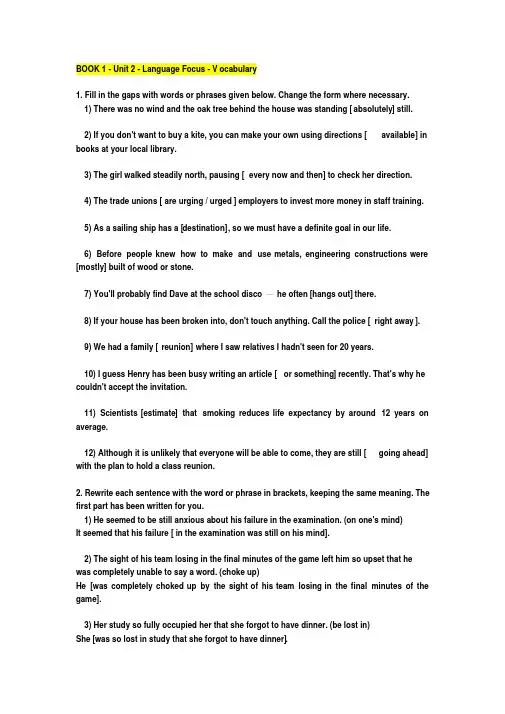
基础英语第二单元答案Unit 2 The Fun They HadPage 26I.AII. 1. T; 2. F; 3. T; 4. F; 5. T.III. 1. A real book is a very old book in which stories are printed on yellow and crinkly pages.2. They must be using telebooks, as is mentioned in the text.3. She hates school because she has been doing worse and worsein her tests of geography.4. She was disappointed because she had been hoping they wouldtake the teacher away altogether.5. It gave Margie an arithmetic lesson on the addition of properfractions.6. The schools in Margie’s day give classes by computer,assigning homework by computer software programs while studentsin the old days went to school to attend their lessons given byhuman teachers, experiencing interaction, friendliness and teamspirit instead of taking lessons alone at home as Tommy and Margiedo.IV. 1. Her mother asked the County Inspector to come over.2. The mechanical teacher worked out the mark very quickly.3. Tommy looked at Margie with an air which suggested he knew farbetter about school than others.,4. A teacher has to make necessary changes about what to teachand how to teach so as to meet the different needs of differentpupils.I. Vocabulary Analysis1. Phrase practice1. be through with = have sth. finished完成-have finished reading2. look over one’s shoulder = by looking from behind one's shoulder透过某人肩上看-by looking from behind his shoulder3. be good for = is capable of providing4. sent for = sent a message asking for the assistance of5. take … apart =dissemble拆开;粗暴对待-disassembled the mechanical teacher.4. be prepared to = like/ want to想要做-didn’t like / want toII.1. in no time;2. crinkly;3. scornful;4. neighborhood;5. awfully;6. adjusting;7. tuck;8. nonchalantly;9. punched;10. fit.III. Word comparison1.entitle:to give a title to a booktag:if you tag something, you attach something to it or mark it so that it can be identified laterhead:if a page is headed with a particular name, title, image, etc. it has it on the toplabel:to use a word or phrase to describe someone or something, but often unfairly or incorrectly2.scornful:if you are scornful of someone or something, you show contempt for themproud:feeling pleased about something that you have done or something that you own, or about someone or something you are involved with or insorrowful:very sadafraid:if you are afraid of someone or afraid to do something, you are frightened because you think that something very unpleasant is going to happen to you3.technical: a technical language is the one that is difficult for most people to understand because it is connected with one particular subject or used in one particular jobmechanical:describing machines or their partse.g.The plane appeared to have crashed because of a mechanical problem.sentimental:relating to or involving feelings such as pity or love, especially for things in the pastlogical:seeming reasonable and sensible4.code:a set of rules which are accepted as general principles, or a set of written rules which state how people in a particular organization or country should behavediscipline:the practice of making people obey rules or standards of behavior, and punishing them when they do notkey:the part of a plan, action, etc, that will make it possible for it to succeedprinciple:a basic idea or rule that explains or controls how something happens or works5.number:to give a number to something that is part of an ordered set or listcalculate:to judge the number or amount of something by using the information that you already have, and adding, multiplying, subtracting or dividing numbersfigure:to calculate an amountestimate:If you estimate a quantity or value, you make an approximate judgment or calculation of it.6.score:the number of points, goals, etc. achieved in a game or competitionpoint:one of the marks or numbers that shows your score in a game or sportmark:a point that is given for a correct answer or for doing something well in an exam or competitionnumber:one of a series of symbols used in counting, which is used to mark a particular example of something7.superior: used to describe someone who believes that they are better than other people and acts in such a waylofty:if you say that someone behaves in a lofty way, you are criticizing them for behaving in a proud and rather unpleasant way, as if they think they are very importantstupid:if you say that someone or something is stupid, you mean that they show a lack of good judgment or intelligence and they are not sensible at alladvanced:modern and well developed8.smart:intelligent or sensiblewise:a wise person is able to use their experience and knowledge in order to make sensible decisions and judgmentsintelligent:being able to learn and understand things easilymodern:made or done using the most recent designs or methodsIV.1. a. funny; b. interesting; c. interesting; d. funny.2. a. silent; b. silent; c. still; d. still.3. a. dispute; b. arguing; c. disputing; d. arguing.4. a. usual; b. usual; c. Regular; d. regular.V. Synonym / AntonymGive synonyms or antonyms of the word underlined in each sentence in the sense it is used.1. Today Tommy found a real book.Synonyms: actual, genuine, true2. They turned the pages, which were yellow and crinkly, and it was awfully funny to read words that stood still instead of moving the way they were supposed to—on a screen, you know.Antonyms: moving, movable, mobile, restless,3. They turned the pages, which were yellow and crinkly, and it was awfully funny to read words that stood still instead of moving the way they were supposed to—on a screen, you know.Synonyms: rough, coarse, uneven4. Margie always hated school, but now she hated it more than ever.Antonyms: like, love, enjoy5. Margie was scornful.Synonyms: disdainful, contemptuous6. Tommy looked at her with very superior eyes.Antonyms: inferior, subordinate, secondary7. “Maybe,” he said nonchalantly.Synonyms: indifferently, coldly, coolly, casually, offhandedly8. Little girls learned better if they learned at regular hours.Antonyms: irregular, uncertain, random4. Word derivationFill in the blank(s) in each sentence with an appropriate form of the given word in brackets.1. I t’s quite pointless to ask him again. He’ll never agree. (point)point (n.)点,要点,尖端,细节,目标pointless (adj.)不尖的,钝的,不得要领的pointy (adj.)非常尖的,有明显尖状突出部分的2. No, this is not the original; it’s a good reproduction, though. (produce)produce(v.)生产,提出,引起,生产product (n.)产品,成果production (n.)生产,产品,产量,作品,成果productivity (n.)生产率,生产能力productive (adj.)能生产的,有生产价值的,多产的reproduce (v.)复制,再生,生殖reproduction (n.)复制品,复制,繁殖,生殖3. We’d better go by train. The car is too unreliable for such a long journey. (rely)rely(v.)依赖,依靠reliable (adj.)可靠地,可信的reliability (n.)可靠性unreliable (adj.)不可靠的unreliability (n.)不可靠性,不安全性4. Thanks to your generosity we have now collected the money we need. (generous)generous(adj.)慷慨的,宽宏大量的,丰盛的,味浓的generousness (n.)慷慨,宽大,丰富,肥沃generosity (n.)慷慨,大方5. Jenny has sent me a very apologetic letter explaining why she didn’t do what she had promised. (apology)apology (n.)道歉;勉强的替代物apologize (v.)道歉,谢罪apologetical (adj.)辩解的apologetic (adj.)道歉的,认错的,赔罪的6. You must realize that such disobedience cannot be tolerated. (obey)obey (v.)服从,听从,顺从obedient (adj.)服从的,顺从的obedience (n.)服从,顺从disobedient (adj.)不服从的,不顺从的disobedience (n.)不服从,违抗7. I have never worked for such a considerate employer; I think all the other employees have the same opinion (employ)employ(v.)雇佣,使用employee (n.)雇员employment (n.)职业,雇佣,使用employer (n.)雇主employless (adj.)失业的,无业的unemployment (n.)失业率,失业人数unemploy (v.)解雇,使失业8. Without your encouragement he would never have been able to do it. (courage)courage (n.)勇敢,胆量courageous (adj.)勇敢的discourage (v.)使气馁,阻碍discouraged (adj.)泄气的,沮丧的encouragement (n.)鼓劲discouragement (n.)挫折II. Grammar Exercises1. Generic reference and specific reference of a/an, theWe usually use “the” when we talk about things that are unique: the sun, the sky, etc, and about things that are context specific and are known by both the speaker and the listener. If we want to describe a particular instance of these we can use “a/an”.e.g. I could see the plane (context specific, both the speaker and thelistener know about the plane that is mentioned) high up in the sky (unique).When I woke up there was a bright blue sky (an instance).2. "Go to school" or "go to the school"A/an, the and zero articles can all be used in set collocations or fixed collocations and idioms. Caution that collocations with different choices of articles can mean differently.e.g. A man is standing in the front of the house. (The man is in the house.)A tree is standing in front of the house. (The tree is outside the house.)I go to school every day. (=I go to the school to study every day.)I went to the school today. (=Today I went to some place and that place was a school.)I.1. the; the2. a;3. a; /;4. a;5. the;6. /; the;7. The; the /;8. the; the;9. a; a; a;10. a; a; a.II.1./; /; /;2./;3.the; /;4.the; /;5./; /;6.The;7.the;8.the; the;9.the; /;10./.III.1. Light;2. a noise;3. very good weather;4. bad luck;5. president;6. The vegetables;7. war;8. All the books;9. coffee; 10. poetry.IV.1./;2. the;3. /;4. the;5. the;6. /;7. /;8. the.V.1. A Briton falls to his death on the Matterhorn.2. An Olympic silver medalist dies in a crash.3. Callaghan recalls the British Ambassador from Chile.4. The army ends the chaos in the capital.5. A college student wins the first prize.III. Translation exercises1.玛吉的爷爷曾经说过,小时候他的爷爷告诉他,过去故事都是印刷在纸上的。