
甘地介绍【英文精品】
- 格式:ppt
- 大小:595.00 KB
- 文档页数:13


介绍甘地英语作文Mahatma Gandhi, known as the "Father of the Nation" in India, was a prominent leader who played a pivotal role in India's struggle for independence from British rule. His philosophy and strategy of non-violent resistance led to India's freedom and inspired civil rights movements around the world. In this essay, we will explore the life, principles, and impact of Mahatma Gandhi on the world.Early Life and Education:Gandhi was born on October 2, 1869, in Porbandar, a coastal town in present-day Gujarat, India. His given name was Mohandas Karamchand Gandhi. He was raised in a Hindu merchant caste family and was deeply influenced by Jainism, a religion that advocates for non-violence and respect for all life. Gandhi studied law in London and returned to India in 1891 to practice law, but he struggled to establish himself.South Africa and the Beginning of Activism:In 1893, Gandhi traveled to South Africa to work as a legal representative for an Indian merchant. It was in South Africa that he first encountered racism and discrimination against Indians. This experience awakened his political consciousness, and he began to fight for the civil rights of Indians livingin South Africa. His methods of peaceful protest and civil disobedience were first developed and tested during this time.Non-Violent Resistance and Indian Independence:Gandhi returned to India in 1915 and became involved in the Indian National Congress, a political party that was fighting for Indian self-rule. He advocated for "Swaraj," or self-rule, and used non-violent civil disobedience as a means to achieve it. His most famous campaigns include the Non-Cooperation Movement, the Salt March, and the Quit India Movement.The Salt March, in particular, was a significant event where Gandhi and his followers marched over 240 miles to theArabian Sea to make their own salt, defying the British monopoly on salt production. This act of civil disobedience captured the world's attention and became a symbol of resistance against colonial rule.Philosophy of Non-Violence:Gandhi's philosophy of non-violence, or "Ahimsa," was central to his approach to achieving social and political change. He believed that violence begets violence and that only through love and understanding could lasting peace be achieved.Gandhi's teachings emphasized the importance of truth, tolerance, and the inherent worth of all individuals.Global Impact and Legacy:Gandhi's methods of non-violent resistance have had aprofound impact on the world. His philosophy inspired leaders like Martin Luther King Jr. and Nelson Mandela, who usedsimilar strategies to fight for civil rights and endapartheid in their respective countries. Gandhi's life and teachings continue to inspire people to pursue social justice and equality through peaceful means.In conclusion, Mahatma Gandhi was a visionary leader whose legacy extends far beyond the borders of India. His commitment to non-violence and his unwavering belief in the power of peaceful protest have left an indelible mark on history. Gandhi's life serves as a reminder that change is possible when people stand together for a common cause, armed with the strength of their convictions and the courage of their hearts.。
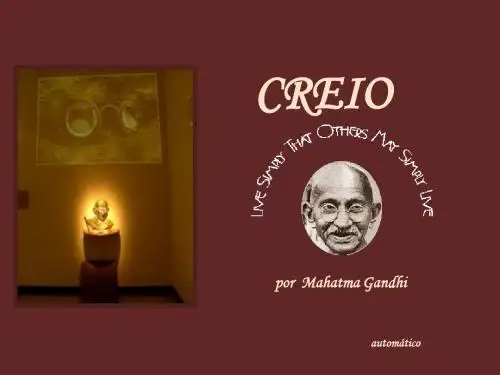

甘地的介绍的英文作文Mahatma Gandhi, also known as the Father of the Nation in India, was a prominent leader in the Indian independence movement against British rule. He was born on October 2, 1869, in Porbandar, India.Gandhi is best known for his philosophy of nonviolent resistance, which he called Satyagraha. He led various peaceful protests and civil disobedience campaigns, such as the famous Salt March in 1930, to challenge the British government's oppressive policies.In addition to his political activism, Gandhi was also a devout practitioner of Ahimsa, or nonviolence towards all living beings. He advocated for the rights of the untouchables, promoted religious harmony, and worked towards social and economic equality for all.Gandhi's influence extended beyond India, as heinspired civil rights movements and leaders around theworld, including Martin Luther King Jr. in the UnitedStates and Nelson Mandela in South Africa.Despite facing numerous hardships and being imprisoned several times, Gandhi remained steadfast in his commitmentto peaceful resistance and his belief in the power of love and truth to overcome injustice.Tragically, Gandhi was assassinated on January 30, 1948, by a Hindu nationalist who opposed his inclusive vision for an independent India. However, his legacy lives on as a symbol of hope, courage, and the transformative potentialof nonviolent activism.。

Mahatma Gandhi>Mahatma Gandhi Essay in English (ममममममममममममममममममममममममम): Mahatma Gandhi, an apostle of non-violence and preacher of truth, was born on October 2nd, 1869 in Gujarat. He belonged to a well-to-do family. Throughout his school days, he remained a shy boy but was a good and regular student. He later went to England to study law and became a barrister. Then he returned to India and began to practice at the Bombay High Court. But he was not very interested in the legal profession. So, he j oined the struggle for India’s Independence.Long and Short Essays About GandhijiHe went to South Africa. There, he made his best efforts to improve a lot of the Indians. He underwent all the sufferings but remained steadfast in his convictions.He could not bear the miserable plight of Indian masses suffering and starving under British rule. In order to uproot the Britishers from the Indian soil, Mahatma Gandhi sacrificed everything.His entire life is a saga of valor and sacrifices. Freedom was the br eath of Mahatma Gandhi’s life. In 1919 he started a non-violent andpeaceful movement. Hindu-Muslim unity, removal of untouchability and usage of Swadeshi (domestic-made) goods were his life-long missions. He launched the ‘Khadi Movement’ to encourage the use of handspun fibers like khadi or jute. ‘Khadi Movement’ was part of a bigger movement “Non¬co-operation Movement” which encouraged the use of Indian goods and boycotting of foreign goods.Get a > Mahatma Gandhi and >10 Lines on Mahatma Gandhi for Students and Children in EnglishEssay On Mahatma Gandhi in English (मममममममममममममममममममममममममम)Mahatma Gandhi was a man of sound and strong convictions. He had a noble soul. He wore very simple clothes and took simple vegetarian food. He was not only a man of words but also of action. He practiced what he preached. His approach to various problems was non-violent. He was a God-fearing person. He was the cynosure of all the eyes. He hated communalism in every shape or form. He was a friend of all and an enemy of none. He wasuniversally loved and liked. That’s why Indian masses bestowed him with the title ‘Mahatma’.The part played by Mahatma Gandhi on the stage of Indian politics is unforgettable. In those stormy days of the struggle for Indian Independence, Gandhi suffered and was imprisoned several times but freedom of his motherland remained his cherished goal. He guided many freedom struggles and launched the “Quit India Movement.”Conclusion on Mahatma Gandhi EssayHis tragic death on January 30th, 1948, plunged the entire nation into the gloom. He was assassinated by a Hindu frantic. His death was the greatest blow to the forces of peace and democracy. The memorable words of Lord Mountbatten are worth quoting, “India, indeed the world, will not see the likes of him perhaps for centuries.” His death left a great vacuum in the life of the nation. His birthday 2nd October is commemorated as ‘Gandhi Jayanti’, a national holiday in Indian, and worldwide as the ‘International Day of Non-violence’.The whole world still loves and respects this veteran of the twentieth century who has left an indelible mark on the sands of time.FAQ’s On Mahatma Gandhi EssayQuestion 1.What is the essay of Mahatma Gandhi?Answer:Mahatma Gandhi, an apostle of non-violence and preacher of truth, was born on October 2nd, 1869 in Gujarat. He belonged to a well-to-do family.Question 2.Why is Mahatma Gandhi called Father of Nation?Answer:Mahatma Gandhi is called as Father of Nation because he is the person who divides India from foreign dominations and established India as a nation.Question 3.Who was the father of the nation explain in a hundred words?Answer:Father of Nation is Mahatma Gandhi, his full name is Mohandas Karamchand Gandhi. He was conferred by Mahatma which means great soul and this name was given by his great friend Rabindranath Tagore. Gandhi was born at Porbandar in Gujarat in October 2nd, 1869.。