
第1章 指针与引用、函数重载
- 格式:ppt
- 大小:65.50 KB
- 文档页数:12

c++中的定义函数摘要:1.C++中函数的定义与调用2.函数的参数传递方式3.函数的返回值4.函数的传值机制5.函数重载与函数指针正文:C++中的函数定义与调用在C++中,函数是一段用于执行特定任务的代码。
函数可以通过定义和调用来实现代码复用,提高程序的模块化程度。
函数定义的基本语法如下:```返回类型函数名(参数类型参数名) {// 函数体return 返回值;}```例如,定义一个计算两个整数之和的函数:```int add(int a, int b) {return a + b;}```函数的参数传递方式C++中函数参数的传递方式分为值传递和引用传递两种。
1.值传递:函数接收的参数是实参的值复制,当函数执行完毕后,实参的值不会改变。
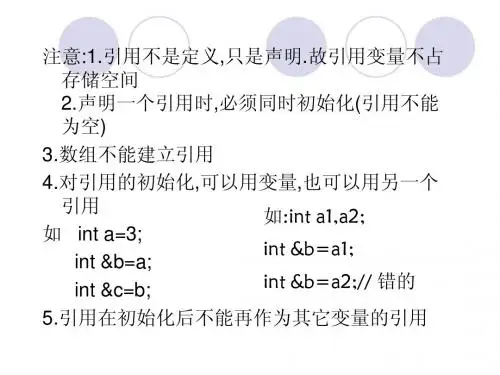
例如:```void swap(int x, int y) {int temp = x;x = y;y = temp;}```2.引用传递:函数接收的参数是实参的引用,当函数执行完毕后,实参的值会发生改变。
例如:```void swap(int &x, int &y) {int temp = x;x = y;y = temp;}```函数的返回值函数可以返回一个值,这个值可以是任意类型。
函数返回值的方式有多种,如返回局部变量、返回指针、返回数组等。
函数的传值机制C++中函数的传值机制分为两种:传值调用和引用调用。
1.传值调用:函数接收的参数是实参的值复制,当函数执行完毕后,实参的值不会改变。
这种调用方式不会影响实参的值。
2.引用调用:函数接收的参数是实参的引用,当函数执行完毕后,实参的值会发生改变。
这种调用方式会直接影响实参的值。
函数重载与函数指针1.函数重载:C++支持函数重载,即一个函数名可以对应多个函数体,但参数列表必须不同。
例如:```int add(int a, int b);double add(double a, double b);```2.函数指针:C++中可以用指针来存储函数的地址,通过指针可以调用函数。

如何获得新知识英语作文Expanding the Horizons of Knowledge: Strategies for Acquiring New Information.In an era characterized by rapid technological advancements and a deluge of information, the pursuit of knowledge has become increasingly essential for personal growth and societal progress. Acquiring new knowledge empowers us to navigate the complexities of the modern world, make informed decisions, and contribute meaningfully to our communities. However, the sheer volume of information available today can be overwhelming, andfinding effective strategies to filter and absorb knowledge can be a challenge.1. Active Reading and Critical Thinking:Engaging in active reading involves more than simply glancing over a text; it requires actively interrogating the material, questioning its assumptions, and seekingconnections with existing knowledge. Critical thinking skills enable us to analyze, evaluate, and synthesize information, separating facts from opinions and identifying biases. By questioning the author's purpose, evidence, and reasoning, we develop a deeper understanding of the subject matter.2. Immersive Learning Experiences:Immersive learning experiences provide opportunities to engage with knowledge in a tangible and interactive way. These experiences can take various forms, such as attending lectures, participating in workshops, conducting research, or engaging in hands-on activities. By immersing ourselves in the learning environment, we enhance retention andfoster a deeper connection with the material.3. Seek Out Diverse Perspectives:Exposing ourselves to multiple perspectives enriches our understanding by providing us with a broader context and challenging our existing beliefs. Reading from diversesources, including books, articles, podcasts, and online forums, allows us to consider different viewpoints and gain a more comprehensive picture of the topic. Engaging in respectful discussions with individuals from different backgrounds also promotes intellectual growth.4. Leverage Technology for Learning:Technology has opened up numerous avenues for knowledge acquisition. Online learning platforms, educational apps, and virtual reality simulations provide convenient and interactive ways to explore new subjects. These tools often offer personalized learning experiences tailored to individual interests and learning styles, enabling us to learn at our own pace and delve into areas that spark our curiosity.5. Practice Active Recall and Spaced Repetition:Active recall involves regularly testing our knowledge through methods such as flashcards, quizzes, or teaching the material to others. This process strengthens memory byforcing us to retrieve information from long-term storage. Spaced repetition involves reviewing previously learned material at increasing intervals, which helps to solidify knowledge and prevent forgetting.6. Set Learning Goals and Track Progress:Defining specific learning goals provides direction and motivation for knowledge acquisition. By setting clear objectives, we can prioritize our efforts and track our progress. Regular self-assessment helps us identify areas where further learning is needed and provides a sense of accomplishment as we achieve our goals.7. Engage in Meaningful Connections:Connecting new knowledge to existing experiences and knowledge structures helps to make it more personally relevant and memorable. By reflecting on how the new information relates to our personal values, beliefs, and past experiences, we create meaningful associations that enhance retention.8. Foster a Growth Mindset:Adopting a growth mindset, where we embrace challenges and view mistakes as opportunities for learning, is essential for continuous knowledge acquisition. By believing that our abilities can be developed through effort and persistence, we cultivate a lifelong love of learning.9. Find a Knowledge Partner or Mentor:Learning alongside a knowledge partner or mentor can provide valuable guidance and support. Sharing ideas, challenging each other's perspectives, and holding ourselves accountable for our learning progress can accelerate knowledge acquisition and foster a sense of community.10. Engage in Real-World Applications:Applying new knowledge to real-world situations notonly reinforces learning but also provides opportunities for practical implementation. By actively using the information we acquire, we refine our understanding and discover new ways to solve problems or create value.In conclusion, acquiring new knowledge is an ongoing journey that requires an inquisitive mindset, effective strategies, and a commitment to continuous learning. By embracing these practices, we unlock our potential to navigate the complexities of the modern world, make a meaningful impact on our communities, and live fulfilling and intellectually stimulating lives.。

c语言函数指针调用C语言中函数指针是一种非常有用的编程工具,它让我们可以将函数作为参数进行传递,灵活地实现各种算法和逻辑。
在本文中,我们将围绕“c语言函数指针调用”这个主题,逐步讲解如何使用函数指针。
1. 定义函数指针类型在C语言中,我们需要先定义函数指针类型,才能使用函数指针。
函数指针类型的定义方法与函数定义非常类似,只需要将函数名替换为一个变量名即可。
例如,下面的代码定义了一个函数指针类型int (*fun)(int, int),表示该指针指向一个返回值为int,接受两个int 类型参数的函数:```cint (*fun)(int, int);```2. 指针赋值定义好函数指针类型之后,我们可以将它与一个具体的函数进行绑定,这个过程称为指针赋值。
指针赋值的方法非常简单,直接将函数名赋给函数指针即可。
例如,下面的代码将函数add绑定到了指针fun中:```cint add(int a, int b) {return a + b;}// 将函数add绑定到函数指针fun中fun = add;```3. 调用函数指针指针赋值完成之后,我们就可以使用该函数指针来调用函数了。
调用函数指针的方法与调用函数非常类似,只需要使用函数指针的名称即可。
例如,下面的代码使用函数指针fun调用了函数add,并打印了结果:```cint result = fun(1, 2);printf("result = %d\n", result);```需要注意的是,在调用函数指针时,我们使用的是指针的名称而不是函数名。
这是因为函数指针本质上是一个变量,存储了函数的地址,因此我们需要通过指针来访问函数。
4. 函数指针作为参数函数指针还有一个非常重要的用途,就是作为函数的参数进行传递。
通过将函数指针作为参数,我们可以实现不同的函数之间的高度组合和灵活调用。
例如,下面的代码定义了一个函数calc,接受三个参数:两个int类型的数和一个函数指针,用来对这两个数进行计算:```cint calc(int a, int b, int (*fun)(int, int)) {return fun(a, b);}```在调用calc函数时,我们可以将任意的函数指针作为第三个参数进行传递,从而实现不同的计算。

【C++】C++函数重载的总结函数重载: 出现在相同作⽤域中的两个函数,如果具有相同的名字⽽形参表不同,则称为重载函数(overloaded function)。
⼀定要注意函数重载的两个关键词:形参列表和作⽤域。
任何程序有且仅有⼀个main函数的实例,main函数不能重载。
对于函数重载来说,它们应该在形参数量和形参类型上有所不同。
下⾯论述形参列表和作⽤域对函数重载的影响。
函数重载与形参列表 函数重载和函数声明的区别: 如果两个函数声明的返回类型和形参表完全匹配,则将第⼆个声明视为第⼀个的重复声明。
如果两个函数的形参列表相同(参数个数和类型)相同但是返回类型不同,那么第⼆个函数的声明将会出现编译错误。
函数不能仅仅基于不同的返回类型⽽实现重载。
基于const形参的重载: 当参数是⾮引⽤形参时,形参与const形参的两个同名函数不能构成函数重载。
下⾯的第⼆个函数只是第⼀个函数的重复声明。
1 A func(B);2 A func(const B); // 重复声明 仅当形参是引⽤或指针是,形参是否为const才有影响。
A func(B&);A func(const B&) //基于const引⽤形参的重载A func(B*);A func(const B*); //基于const指针形参的重载可基于函数的引⽤形参是指向const对象还是指向⾮const对象,实现函数重载。
将引⽤形参定义为const来重载函数是合法的,因为编译器可以根据实参是否为const确定调⽤哪⼀个函数。
如果实参为const对象,那么将调⽤const引⽤形参的版本。
如果实参为⾮const对象,⾮const对象既可以⽤于初始化const引⽤,也可以⽤于初始化⾮const引⽤。
但是将const引⽤初始化为⾮const对象,需要转换,因为⾮const形参的初始化则是精确匹配。
对于指针形参也是如出⼀辙。
如果实参是const对象,则调⽤带有const*类型形参的函数。