
ACCA F4 B2(2009)
- 格式:ppt
- 大小:303.50 KB
- 文档页数:56

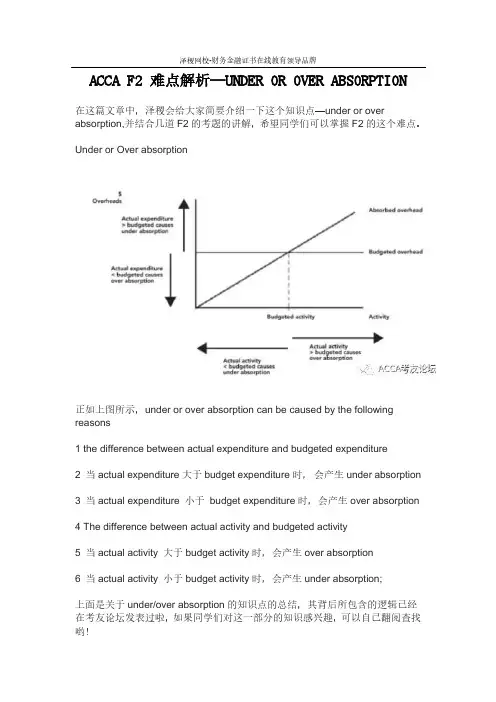
ACCA F2 难点解析—UNDER OR OVER ABSORPTION在这篇文章中,泽稷会给大家简要介绍一下这个知识点—under or over absorption,并结合几道F2的考题的讲解,希望同学们可以掌握F2的这个难点。
Under or Over absorption正如上图所示,under or over absorption can be caused by the following reasons1 the difference between actual expenditure and budgeted expenditure2 当actual expenditure大于budget expenditure时,会产生under absorption3 当actual expenditure 小于budget expenditure时,会产生over absorption4 The difference between actual activity and budgeted activity5 当actual activity 大于budget activity时,会产生over absorption6 当actual activity 小于budget activity时,会产生under absorption;上面是关于under/over absorption的知识点的总结,其背后所包含的逻辑已经在考友论坛发表过啦,如果同学们对这一部分的知识感兴趣,可以自己翻阅查找哟!Question practiceQuestion one:The following question was identified as being badly answered in a previous F2 Examiner’s report.A company uses absorption costing with a predetermined hourly fixed overhead absorption rate. Last year, the following situations arose:1.Actual overhead expenditure was less than the budgeted expenditure.2.Actual hours worked were less than the budgeted hours used to set the predetermined overhead absorption rate.Which of the following statements is correct?1.Both situations would cause the overheads to be under absorbed2.Both situations would cause the overheads to be over absorbed3.Situation (1) would cause the overheads to be under absorbed and situation (2) would cause the overhead to be over absorbed4.Situation (1) would cause the overheads to be over absorbed and situation (2) would cause the overhead to be under absorbedThe correct answer is 4答案解析:在考试中,很多考生都错误地选择了answer 2, 也就是说,同学们对于situation (1)所产生的over absorbed是可以理解的,但是没有真正地理解situation (2). 在situation (2)下,由于actual hours 比budget hours小,即:actual activity小于budget activity, 因此实际活动所吸收的overhead( absorbed overhead)是小于budget overhead, 因此就产生了under absorbed. Question two:A company uses an overhead absorption rate of $3.50 per machine hour, based on 32,000 budgeted machine hours for the period. During the same period the actual total overhead expenditure amounted to $108,875 and30,000 machine hours were recorded on actual production.By how much was the total overhead under or over absorbed for the period?A Under absorbed by $3,875B Under absorbed by $7,000C Over absorbed by $3,875D Over absorbed by $7,000The correct answer is A通过这道题目,可以很好地让同学们掌握这个方面的知识。

Course Notes 2016 Exams September 15 – June 17 ACCAPaper F2 - 双语讲义Management Accounting管理会计Tutor details2 Intro ductio n ACCA F 2No part of this publication may be reproduced, stored in a retrieval systemor transmitted, in any form or by any means, electronic, mechanical,photocopying, recording or otherwise, without the prior written permissionof First Intuition Publishing Ltd.Any unauthorised reproduction or distribution in any form is strictlyprohibited as breach of copyright and may be punishable by law.© First Intuition Publishing Ltd, 2015ACCA F 2Intro ductio n 3ContentsPageIntroduction 1Contents 31Course structure 52Course materials 53Qualification structure 64The exam 65Question types 76Exam tips 77How to study F2 88Study planner 91: Nature, source and purpose of management information 131Accounting for management 132Sources of data 153Cost classification 174Presenting information 262: Cost accounting techniques 331Accounting for material, labour and overheads 332Absorption and marginal costing 533Cost accounting methods 574Alternative cost accounting 703: Budgeting 751Nature and purpose of budgeting 752Statistical techniques 773Budget preparation 904Flexible budgets 975Capital budgeting and discounted cash flows 986Budgetary control and reporting 1107Behavioural aspects of budgeting 1134: Standard costing 1171Standard costing systems 1172Variance calculations and analysis 1183Reconciliation of budgeted and actual profit 1265: Performance measurement 1291Performance measurement overview 1292Performance measurement – application 1313Cost reductions and value enhancement 1414Monitoring performance and reporting 1424 Intro ductio n ACCA F 2Solutions to lecture examples 145Chapter 1 145 Chapter 2 146 Chapter 3 156 Chapter 4 164 Chapter 5 167Formulae sheets 169ACCA F 2Intro ductio n 5 1Course structureHome Study Introduction – How to Study F2To get off to the best possible start, we recommend you contact your tutor once you have receivedyour study materials. Your tutor will explain how to tackle your studies and get you started on yourfirst Study Session.If you prefer to get started straight away you should read “How to Study F2” below.Study sessionsThis study guide breaks down the syllabus into manageable study sessions, following the syllabus, andnumbered in accordance with the chapters in the Study notes. We tell you which chapters to read, andthen which questions to attempt from the Question Bank.It is not enough just to read the study notes. You must practise questions from the Question Bank asrecommended in each study session. The questions in the Question Bank are the same style as thosein the real exam and will give you exposure to all the possible pitfalls.It is better to attempt them as you go along, when the subject matter is fresh in your mind. You shouldcheck your answers with the answers and make sure you understand the suggested answer for anyquestions you get wrong.Revision sessionsWhen you have completed all the study sessions you should spend some time revising the core topicsWhen you are getting most of these right you are ready to attempt the Mock exam. If at all possibleyou should attempt this under real exam conditions, i.e. to the correct time and with no distractions.You can always come and sit your exam at First Intuition – just call your tutor to arrange a convenienttime.When you have completed the Mock you should check your answers. Make a note of any you getwrong and look at the model solution where given. If you still have any problems call your tutor orcome and see us for some final advice. If you score at least 60% in the Mock then you should be readyto take the real exam.2Course materialsYou will receive the following:First Intuition study notesFirst Intuition Question BankPasscards*Online Study Text (in conjunction with Kaplan EN-Gage)*produced by BPP Learning Media6 Intro ductio n ACCA F 23Qualification structureThe ACCA qualification is structured as follows.Fundamentals Level Knowledge Module F1 AB The Accountant in Business F2 MA Management Accounting F3 FA Financial AccountingFundamentals Level Skills Module F4 CL Corporate LawF5 PM Performance ManagementF6 TX TaxationF7 FR Financial ReportingF8 AA Audit & AssuranceF9 FM Financial Management Professional Level Essentials Module P1 PA Professional AccountantP2 CR Corporate ReportingP3 BA Business AnalysisProfessional Level Options Module (any two of these papers) P4 AFM Advanced Financial ManagementP5 APM Advanced Performance Management P6 ATX Advanced TaxationP7 AAA Advanced Audit & AssuranceAll papers are compulsory unless you gain exemptions from a relevant qualification. The modules must be attempted in the correct order, though you can sit the papers in any order. A maximum of fourpapers can be taken in any one exam sitting. Exams are in June and December each year. TheKnowledge Module subjects are examined by computer-based assessment and can be attempted atany time.4The examF2 is a two-hour computer-based or paper based examination.The paper is in two sectionsSection A contains 35 objective test questions. Each question is worth 2 marks (70 marks intotal)Section B contains 3 multi-task questions. Each question is worth 10 marks (30 marks in t otal).Multi task questions are a new question type which is being introduced in 2014. This newquestion type is explained more fully below.All questions are compulsory.The paper has a pass mark of 50%.ACCA F 2Intro ductio n 75 Question typesThe F2 exam consists of the following types of question: Objective test (OT) –These are single, short, automatically marked questions.Multiple task questions (MTQ) – These questions contain a series of tasks which relate t o one or more scenarios.The types of question that may be included are as follows:OT MTQMultiple Choice You are required to choose one answer from a list of options by clicking on the appropriate radio buttonMultiple Response You are required to select more than one response from the options provided by clicking the appropriate tick boxes Multiple Response Matching You are required to select a response to a number of related statements by clicking on the radio button whichcorresponds to the appropriate response for each statement Number Entry You are required to key in a numerical response to the questionGapfill You are required to enter answers into blank areas Hot SpotYou are required to choose one or more answers by clicking on the appropriate hotspot area/ areas on an imageEach of the above types of question are included in the companion Question Bank. Examples of each of the question types and how they are marked can also be found on the ACCA’s website at Specimen examThe ACCA’s specimen exam reflecting the new exam formats and incorporating all question types, is included in this Question Bank.6 Exam tipsRead the requirement very carefully . With calculation questions there are many opportunities for your examiner to confuse you or try and catch you out. It will be very easy to arrive at a result that is one of the options available.Manage your time . You have an average of 2 minutes and 24 seconds per question. S ome will take longer than others, particularly those that involve calculating a numerical answer. So if you get stuck on a question, make a note of the question number and move on. If you have time at the end of the exam you can go back and tackle the tricky questionsYou may be asked to choose one or more correct statements from a given list. Read each statement carefully. If you are unsure about one or more of them, move on and deal with the statements you do agree with. You may find the correct answer by process of elimination without needing to revisit the statements you are unsure about. In any event you should certainly be able to narrow down your choices.If you think you will run out of time, stop five minutes before the end and guess any remaining answers – remember you have a one in four chance of getting those questions right which could make the difference between a pass and a fail.8 Intro ductio n ACCA F 2 7How to study F2Plan your study timeGet your diary out and decide when, where and how often you want to study. If you followed a FirstIntuition course you would receive a minimum of five full days tuition, and be expected to doadditional work at home. Studying on your own is harder and will take longer. You should expect tospend at least 3 hours studying per week. On this basis it should take approximately two months tolearn the study material, then you should allow additional time for revision and final question practice.Most students should be ready to take the exam 3 months after commencing their studies.Set a target date for the examThis is very important with computer-based exams. If you don’t set a target there is a danger that you will spread your study time over too long a period, will lose momentum or simply not get around totaking the exam. When you set your target bear in mind how you wish to progress through thesyllabus, as from paper F4 onwards you are tied to the paper-based exam sittings in June andDecember. For example, if you wish to progress to the Skills level papers for a December sitting youshould complete your computer-based exams by 31 July.Make the most out of your study sessionsTry and complete each study session in one go so that you learn each topic in turn. Some sessions are longer than others, but make sure you take a break between sessions.Read the ACCA study guide at the start of each session so you know the learning outcomes for thatparticular session. Check the tutor tips for advice on how to tackle questions or which areas focus on.Then read the relevant chapter of the course notes.It is essential that you try the questions from the Question Bank where indicated. You will not passthe exam if you don’t attempt the questions. Check your answers and make sure you understand the workings for any that you get wrong. Often you will find that you got the wrong answer because youdidn’t read the question properly – the examiner does like to try and catch you out! If you get stuckgive your tutor a call and ask for advice.RevisionYou should attempt the additional question banks for each of the revision sessions as well as re-reading the study notes. When you are getting at least half of the questions right you are ready toattempt the Mock Exam. If you achieve at least 60% in the Mocks then you should be ready to attempt the real exam.The real examWhen are ready to attempt the real exam give us a call to arrange your CBE (or contact your nearestCBE centre). We hold weekly exam sessions but will do our best to be flexible so you can sit the examat a time that suits you.ACCA F 2Intro ductio n 9 8Study planner10 Intro ductio n ACCA F 2ACCA F 2Intro ductio n 118.1 Practical Experience Requirements (PER) and Performance ObjectivesACCA requires students to have 36 months’ practical experience in order to become members. Part ofthe practical experience requirements is achieving performance objectives that demonstrate that youcan apply what you’ve learnt when studying to real-life, work activities.ACCA has set out 20 performance objectives in 9 areas. You are required to achieve 13 performanceobjectives – all 9 Essentials performance objectives and any 4 Options performance objectives. ACCAhas provided guidance on which objectives are strongly linked to which exam. The relevant objectivesfor F2, which comprise Essentials and Options objectives, are:Manage self (relevant for all exams)(5)Communicate effectively (relevant for all exams)(6)Use information and communications technology (relevant for all exams)(12)Prepare financial information for management (relevant for F2, F5 and P5)(13)Contribute to budget planning and production (relevant for F2, F5 and P5)(14)Monitor and control budgets (relevant for F2, F5 and P5)No part of this publication may be reproduced, stored in a retrieval system or transmitted, in any form or by any means, electronic, mechanical, photocopying, recording or otherwise, without the prior written permission of First Intuition Publishing Ltd.Any unauthorised reproduction or distribution in any form is strictly prohibited as breach of copyright and may be punishable by law.© First Intuition Publishing1 Accounting for management(a)Describe the purpose and role of cost and management accounting within an organisation.(b)Compare and contrast financial accounting with cost and management a ccounting.The purpose of cost and management accounting is to assist the management in running theirbusiness to achieve its overall plans, make the correct decisions and to control the business.1 管理会计(a)描述组织内部成本会计和管理会计的目的与作用。
历史成本计量与公允价值计量摘要:本文阐述了历史成本计量与公允价值计量两种属性的产生背景,同时分析了各自的优缺点,在此基础上,以国内外的大环境为背景探讨了金融危机后对公允价值计量方法的重新审视,提出了双重计量属性的选择,即历史成本计量与公允价值计量并存。
然后针对金融危机中公允价值计量出现的漏洞和自身的缺点,提出了一些具体措施,以为决策者提供更为有用和可靠的信息。
关键词:历史成本公允价值金融危机计量属性双重计量模式传统会计中以历史成本计量为基础,但是随着会计环境的变化,特别是衍生金融工具的出现并广泛运用,公允价值计量成为了重要的计量方法,直到2008年全球金融危机的爆发,才让人们开始质疑公允价值,一些学者把危机爆发的矛头直指公允价值计量,提出重新回到历史成本计量,而且在2008年美国总统布什签署的《2008年紧急经济稳定法案》中也指出在极端必要情况下,停止执行公允价值会计准则,一时间公允价值计量面临巨大的挑战。
如何在公允价值计量与历史成本计量之间做出选择,也成了各方热议的话题,本文对此将做出深入的分析。
1.两种计量模式产生的历史背景传统的会计计量模式是以历史成本计量为基础的,亦称“历史成本会计”。
这一计量模式的产生背景源于美国1929—1933年的经济大危机。
20世纪20年代美国市场经济走向极端自由化,企业的放任式管理使会计变得无序,对外的财务报表欺诈愈演愈烈,最终虚假繁荣的经济泡沫破灭,一场空前的经济危机来临。
鉴于危机前会计弄虚作假的深刻教训,为了保证投资人能获得可靠相关的信息,采用历史成本计量成为最佳选择。
1940年,著名会计学家佩顿和利特尔顿于合写了经典会计名著《公司会计准则导论》,该书的问世为历史成本的引入奠定了坚实的理论基础。
至此,历史成本用于会计的基本计量属性,在自由放任的市场经济被政府干预的市场经济所取代后,历史成本成为财务会计与报表的主要计量属性。
自20世纪70年代以来,尤其是进入20世纪90年代,会计环境发生了巨大的变化。