
2011年秋C考试A卷Final
- 格式:doc
- 大小:81.00 KB
- 文档页数:10
201 1年9月全国计算机等级考试二级笔试试卷(1)下列叙述中正确的是( )。
A)算法就是程序B)设计算法时只需要考虑数据结构的设计C)设计算法时只需要考虑结果的可靠性D)以上三种说法都不对(2)下列关于线性链表的叙述中,正确的是( )。
A)各数据结点的存储空间可以不连续,但它们的存储顺序与逻辑顺序必须一致B)各数据结点的存储顺序与逻辑顺序可以不一致,但它们的存储空间必须连续C)进行插入与删除时,不需要移动表中的元素D)以上三种说法都不对(3)下列关于二叉树的叙述中,正确的是( )。
A)叶子结点总是比度为2的结点少一个 B)叶子结点总是比度为2的结点多一个c)叶子结点数是度为2的结点数的两倍 D)度为2的结点数是度为1的结点数的两倍(4)软件按功能可以分为应用软件、系统软件和支撑软件(或工具软件)。
下面属于应用软件的是( )。
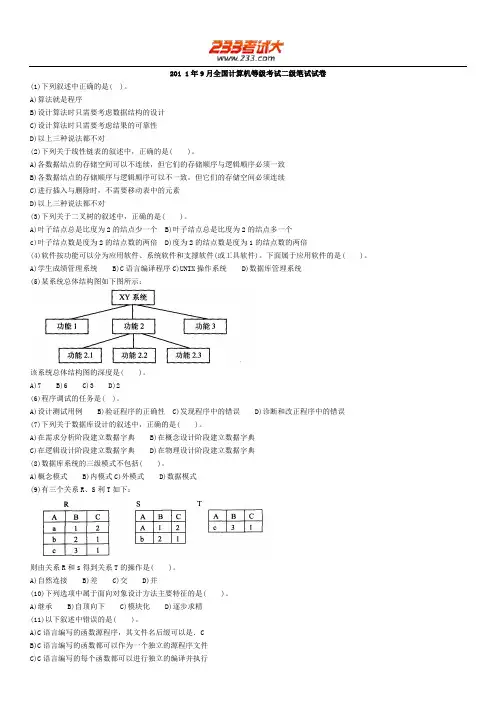
A)学生成绩管理系统 B)C语言编译程序C)UNIX操作系统 D)数据库管理系统(5)某系统总体结构图如下图所示:该系统总体结构图的深度是( )。
A)7 B)6 C)3 D)2(6)程序调试的任务是( )。
A)设计测试用例 B)验证程序的正确性 C)发现程序中的错误 D)诊断和改正程序中的错误(7)下列关于数据库设计的叙述中,正确的是( )。
A)在需求分析阶段建立数据字典 B)在概念设计阶段建立数据字典C)在逻辑设计阶段建立数据字典 D)在物理设计阶段建立数据字典(8)数据库系统的三级模式不包括( )。
A)概念模式 B)内模式C)外模式 D)数据模式(9)有三个关系R、S利T如下:则由关系R和s得到关系T的操作是( )。
A)自然连接 B)差 C)交 D)并(10)下列选项中属于面向对象设计方法主要特征的是( )。
A)继承 B)自顶向下 C)模块化 D)逐步求精(11)以下叙述中错误的是( )。
A)C语言编写的函数源程序,其文件名后缀可以是.CB)C语言编写的函数都可以作为一个独立的源程序文件C)C语言编写的每个函数都可以进行独立的编译并执行D)一个C语言程序只能有一个主函数(12)以下选项中关于程序模块化的叙述错误的是( )。


全国大学生英语竞赛C类考试2011年决赛试题Part I Listening Comprehension (30 marks)Section A (5 marks)In this section, you will hear five short conversations. Each conversation will be read only once. At the end of each conversation, there will be a twenty-second pause. During the pause, read the question and the three choices marked A, B and C, and decide which is the best answer. Then mark the corresponding letter on the answer sheet with a single line through the centre.1. How did the man get the ticket to travel into space?A. He went onto a TV game show.B. He won an Internet contest.C. He received it as a prize.2. Why is the man not keen to attend the event?A. He doesn’t like volunteering.B. He is not sure how he can help.C. He thinks he will be busy.3. Why does the woman have doubts about getting a hybrid car?A. They cost a lot of money.B. There are few good ones on the market.C. She thinks they use more gas than ordinary cars.4. How long does the Chunnel train take to get from Paris to London?A. About three hours.B. Under two hours.C. A little more than two hours.5. What do the police think happened to Martin?A. A thief broke into his house.B. His identity information was stolen.C. Somebody took his wallet.Section B (10 marks)In this section, you will hear two long conversations. Each conversation will be read only once. At the end of each conversation, there will be a one-minute pause. During the pause, read the questions, each with three choices marked A, B and C, and decide which is the best answer. Then mark the corresponding letter on the answer sheet with a single line through the centre. Conversation One6. Where are the speakers planning to go?A. Austin.B. Houston.C. New Orleans.7. Who is the woman going to call?A. The hotel.B. A taxi company.C. The airport.8. What will the woman make reservations for?A. A dinner.B. Two rooms.C. A taxi.Conversation Two9. What is Rachel’s extended essay about?A. Hospitals.B. Towns.C. Factories.10. What is Rachel’s main source of information for the essay?A. A book.B. The Internet.C. Magazines.11. Rachel is _____ with her essay at the moment.A. quite pleasedB. mostly satisfiedC. not at all happy12. Which part of the essay does Dr Jones like best?A. The introduction.B. The middle.C. The conclusion.13. Which part of the essay does Dr Jones most want Rachel to change?A. The statistical analyses.B. The essay structure.C. The topic sentences.14. Dr Jones thinks the bibliography _____.A. is too longB. is pretty goodC. needs some improvement15. When will Dr Jones get the essay back to Rachel?A. On April 21.B. On April 22.C. On April 23.Section C (5 marks)In this section, you will hear five short news items. After each item, which will be read only once, there will be a pause. During the pause, read the question and the three choices marked A, B and C, and decide which is the best answer. Then mark the corresponding letter on the answer sheet with a single line through the centre.16. Which company organized the meeting?A. Internet Forum.B. Broadband Forum.C. Industry Forum.17. In which subjects did students in Shanghai score the highest?A. Mathematics and science.B. Reading, mathematics and science.C. Science, mathematics and English.18. What was the population of America on April 1, 2010?A. 308,745,358.B. 308,754,583.C. 308,745,538.19. How long have the Harry Potter films been around?A. Almost ten years.B. Nearly eleven years.C. About twelve years.20. What percentage of rich people in the UK don’t want to retire?A. More than 65%.B. About 60%.C. Less than 55%.Section D (10 marks)In this section, you will hear a short passage. There are 10 missing words or phrases. Fill in the blanks with the exact words or phrases you hear. Remember to write the answers on the answer sheet.The success of a speech is often attributed to the skill of the speaker, with merit being given to speakers who are confident, articulate, knowledgeable and able to (21) _____ with conviction.Often, however, it is not the speakers who write (22) ______ speeches, but speechwriters. The field in which this practice is most common is that of politics. So, what does it take to be a political speechwriter?According to a recent job advertisement put out by the US Embassy in Britain, a political speechwriter needs to have (23) _____, be detail oriented and be able to demonstrate a profound knowledge of the subject. They must also be able to work closely with the speakers they write for, and be able to relate to an individual’s style.Some people believe that the best speechwriters have an inherent talent, a (24) _____, and that speech writing is an art form. So what about those of us who do not possess such genius? Can we still produce successful speeches?In an interview with the BBC, Dr Max Atkinson, a(25)_____, outlined a number of speech-writing techniques. He also illustrated how these techniques have been used in historic speeches.One such technique is (26)_____. This is especially useful in trying to put a positive spin on a negative issue. One of the most famous examples of this was presented in a speech given by former American President John F Kennedy: “Ask not what your country can do for, you, but what you can do for your country.”Another technique is the use of a (27) ____. Dr Atkinson explains that this can be an excellent way of adding finality and confirming a statement. Former British Prime Minister Tony Blair was a fan of this technique. One of his most famous (28)____ was “education, education, education”.These techniques can be used like tools—they can be chosen from a toolbox and applied as necessary. A few other techniques you might find in a speech writer’s toolbox are the use of imagery, anecdotes and (29)____. So next time you have to prepare a speech or (30)____, try applying one or more of these techniques and see if you have what it takes to be a winning speech writer.Part ⅡVocabulary and Structure (15 marks)There are 15 incomplete sentences in this section. For each blank there are four choices marked A, B, C and D. Choose the one that best completes the sentence. Then mark the corresponding letter on the answer sheet with a single line through the centre.31. I asked Charles what sponsoring the conference would ____ and he said we would have tohandle all of the advertising, as well as the set-up and registration.A. embodyB. encounterC. entailD. ensue32. Winter is coming and there is nothing we can do to change that. There is no stopping it. It is as____ as the approach of death.A. inseparableB. inexorableC. insatiableD. indispensable33. I went around sniffing at the other doors, trying to find out where the smell was coming from.I finally discovered it was ____ from the closet at the end of the hall.A. evaporatingB. emergingC. evolvingD. emanating34. Later in this chapter, cases ____ consumer complaints have resulted in changes in the law, arepresented.A. whereB. whenC. whoD. which35.____ your computer has a virus protection programme, you might still fall victim to e-mailscams or other malicious software.A. Not untilB. Even ifC. Now thatD. In case36. Three of the students have neither the intelligence nor the diligence to learn the requiredmaterial; ____ , they will be dismissed from the course.A. howeverB. furthermoreC. consequentlyD. similarly37. There must be some kind of technical problem. The film ____ by now.A. should have startedB. must have startedC. might have startedD. could have started38. I suggested that we ____ a meeting tonight but her face suggested that no meeting ____.A. should hold; is heldB. hold; is holdingC. hold; will be holdD. should hold; would be held39. A recent survey of problems on health ____ that outdoor exercise ____ of great importance topeople’s health.A. have shown; areB. are shown; areC. has shown; isD. is shown; is40. As far as I’m concerned, that is it! There is ____ more to say!A. nothingB. hardlyC. somethingD. much41. Sorry, but something important has ____ and I’ll have to ring you back.A. come offB. come upC. come acrossD. come down42. ____, everyone would probably have escaped from the building.A. Had it not been locked the fire doorB. Had not been locked the fire doorC. Had the fire door not been lockedD. Had the fire door not locked43. The students were ____ the prospect of having to do their projects all over again.A. faced withB. charged withC. related toD. accustomed to44. —Rose, mind your step! Jane slipped on the wet floor and broke her leg yesterday.—____.A. It’s none of your businessB. It doesn’t matter to meC. Thank you for telling meD. I don’t care at all45. —Oh, must you? Stay a bit longer.____.—Thanks anyway, but I’ve got an early start tomorrow morning.A. It’s been such fun having youB. Let’s get down to businessC. We welcome you with open armsD. Please, take a seatPart ⅢCloze (15 marks)Read the following passage and fill in each blank with one word. Choose the correct word in one of the following three ways: according to the context, by using the correct form of the given word, or by using the given letters of the word. Remember to write the answers on the answer sheet.One day I can hear the faint rustle of autumn coming. The next day I can’t. One evening summer leaks away into the cool night sky, but the next morning it’s back again. But there is headway. Birdsong has gone, and is (46) ____ (replace) by a whining bag-piping of insect creation.I look out across the pasture as dusk (47) ____ (begin) and see a shining galaxy of airborne bugs. What would it be like, I wonder, to have an (48) aware____ of the actual number of insects on this farm?I ask myself a version of this question every day: “Have you ever really looked at...?” You can (49) ____ in the blank yourself.Every day I am blinded by (50) familiar____. I open our beehive, which is filled with honey, and the particularity of the honeybees, and even of their community, somehow escapes me, if only because I’ve been living with honeybees a good part of my life. I remember the phrase, “keep your eyes (51) ____ (peel),” and maybe that’s what I need, a good peeling.Again and (52) ____, I find myself trying to really look at what I’m seeing. It happened the other afternoon, high on a nearby mountain. A dragonfly had settled on the denuded tip of a pine bough. It clung, still as only a dragonfly can be. Then it flicked upward and caught a midge and settled on the bough again, adjusting (53) ____ (precise) to the wind. I see dragonflies (54) ____ (quiver) in the insect clouds above my pasture, too. I am always aware, however, that there’s no such thing as really looking.What I want to see is invisible anyway: the prehistoric depth of time embodied in the form of those dragonflies, the pressure of life itself, the web of (55) ____ (relate) that bind us all together. I find myself trying to (56) wit____ the moment when the accident of life becomes a continued purpose. But this is a small farm, and, being human, I keep (57) ____ (come) up against the limits of what a human can see.This morning I found a spider resting—or perhaps hunting—on the leaf of a hydrangea, the axis of the spider’s abdomen perfectly aligned with the axis of the leaf. What I noticed was the symmetry of their placement, the way spider, and leaf resembled (58) ____ other. What I wanted to determine was the spider’s intent. If I (59) c____, I would have asked it, “What are you doing?” Or, better yet, “Who are you?” But all I could do was look—and realizing that I was looking—make the (60) b____ of what I’d seen.Part IV Reading Comprehension (40 marks)Read the following passages. Each passage is followed by several questions. Respond to the questions according to the passage. Remember to write the answers on the answer sheet.Section A (10 marks)Questions 61 to 65 are based on the following passage.On New Year’s Day, 1985, Michael Harrison phoned his father, Sir Ernest, to wish him a Happy New Year. Sir Ernest was chairman of Racal Electronics, the owner of V odafone, and his son was making the first-ever mobile phone call in the UK.Later that morning, comedian Ernie Wise made a very publicmobile phone call from St Katherine’s Dock, in East London, toannounce that V odafone was now open for business. A few dayslater, its only rival, Cellnet, a joint venture between BT andSecuricor, was also in business.At the time, mobile phones weighed almost a kilogram, costseveral thousand pounds and, in some cases, provided only 20minutes of “talk time”. The networks themselves were small; V odafone had just a dozen masts covering London and the area west of London, while Cellnet started with a single mast, stuck on the BT Tower. Neither company had any idea of the huge potential of wireless communication and the dramatic impact that mobile phones would have over the next quarter century.“We projected there would only be about a million ever sold, and that we would get about,35% of the market. BT projected there would be about half a million mobile phones sold and that they would get about 80% of the market,” remembers Sir Christopher Gent, former V odafone chief executive who was at St Katherine’s Dock a quarter of a century ago. “In the first year, we sold about 15,000 to 20,000 phones. The portable Motorola was about £3,000 but most of the phones we sold were car phones from companies such as Panasonic and Nokia.”Hardly anyone believed there would come a day when mobile phones were so popular that there would be more phones in the UK than there are people. But in 1999 one mobile phone was sold in the UK every four seconds, and by 2004 there were more mobile phones in the UK than people.The boom was a result of increased competition—which pushed prices lower and created innovations in the way that mobiles were sold, helping put them within the reach of the mass market—and the move to digital technology.Questions 61 to 65Decide whether the following statements are True or False.61. The first-ever mobile phone call in the UK was made by a comedian.62. V odafone and Cellnet were the first two mobile phone providers in the UK.63. Motorola was the first company to make car phones.64. There are now more mobile phones than people in the UK.65. Digital technology and increased competition allowed the mobile phone to become availableto everyone.Section B (10 marks)Questions 66 to 70 are based on the following passage.Alice’s Adventures in Wonderland (often shortened to Alice in Wonderland) is generally thought of as one of the greatest books for children in the history of English literature, and has also been enjoyed by many older readers. It was written by theEnglish writer Lewis Carroll (a pseudonym: his real namewas Charles Dodgson) in 1865, but still seems original todayand was recently made into a successful film by theAmerican director Tim Burton.The story of Alice in Wonderland takes place in astrange fantasy world that is sometimes amusing andsometimes a bit frightening. It contains all sorts of strangecharacters, including many talking animals. Few eventsseem to follow any logic, many characters talk in an oddway or ask questions that are impossible to answer, andnothing appears real.The main character is Alice, a seven-year-old girl. Onesummer day she is sitting by a river with her sister when shesees something very strange: a white rabbit wearing a coatand a watch. Curious, she runs after the rabbit and arrives at a large rabbit hole in the ground, which she decides to enter. She starts falling down the hole, and when she gets to the bottom she finds herself in a different world.Among the many bizarre things Alice finds in this different world are a liquid that makes her very small when she drinks it; a talking caterpillar sitting on a mushroom; a smiling cat thatdisappears but leaves its smile behind; a tea party that never ends; a game of croquet where the mallets are flamingoes and the balls are hedgehogs; and a playing card, the Queen of Hearts, that has come to life and has a very bad temper.At the end of the story Alice is suddenly back by the river again, with her sister telling her she has been asleep. We then understand that her strange journey was a dream.One big difference between the book and Tim Burton’s Alice in Wonderland is that in the film Alice is nineteen, not seven. The film also has some characters and events that are not from Alice’s Adventures in Wonderland but instead from the sequel that Lewis Carroll wrote in 1871: Through the Looking-Glass.Questions 66 to 70Answer the following questions with information given in the passage in a maximum of 10 words for each question.66. What was Lewis Carroll’s real first name?67. What kind of questions do many characters ask in the story?68. How old is Alice in the book and the film?69. What are flamingoes and hedgehogs used as in the book?70. Who speaks to Alice at the end of the story?Section C (10 marks)Questions 71 to 75 are based on the following passageTens of millions of television viewers around theworld have become familiar with the musical talent showThe X Factor, which originated in Britain in 2004 and hassince become an international franchise. In some countriesthe name is different—for example, Factor X in Spain andXSeer Al Najah in Arabic-speaking countries—but theformat is usually the same: aspiring pop singers or groupscompete in front of a small group of judges, and a largestudio audience, for the prize of a lucrative recording contract.The British version of the show has been enormously successful. Broadcast on Saturday evenings between August and December, it is watched by an average of around 13 million people—more than a fifth of the population. The studio audience is extremely enthusiastic (at times almost hysterical) and the four judges, who give their opinions immediately after each performance, are usually jeered if they make negative comments. The TV audience votes by telephone for their favourite singer, and on Sunday evening the results are announced in a follow-up show. The two singers who receive the fewest votes from the public normally have to perform again in the follow-up show, and then their fate is in the hands of the judges. The competitor the judges think has sung better stays in the competition, but the loser is eliminated.As the competition progresses, the performers are in the public eye far longer than two evenings a week. Their talents (or lack thereof), personalities and off-stage behaviour are also discussed endlessly by gossip magazines and tabloids, their faces frequently appearing on the front pages. Feelings run so high that campaigns for or against certain contestants are launched on social networking sites.In Britain, winning The X Factor guarantees that a singer or group will be able to make a lotof money from their music, at least in the short term. In most years, for example, a debut single by the winner, released in December, has reached the top of the singles charts by Christmas.Some people, however, think the programme has too much influence on the music-buying public, which is why in 2009 there was a successful campaign to encourage people to buy an alternative single and thereby ensure the song by The X Factor winner wouldn’t be number one at Christmas. The campaign is being repeated this year. In another kind of protest against the 2010 competition, a lot of people tried to undermine it by voting every week for the contestant with by far the worst singing voice—he was finally eliminated only in late November.Questions 71 to 75Complete the following sentences with the information given in the passage in a maximum of 10 words for each blank.71. The winners of the The X Factor competition will receive_____________.72. On average, _____________of the British population watches The X Factor on Saturdayevening.73. _____________endlessly discuss the contestants on The X Factor.74. In most years since The X Factor first appeared on British TV, _____________has quicklyreached number one in the singles charts.75. Advertising _____________in 2009 ensured that the song by The X Factor winner did notbecome number one by Christmas.Section D (10 marks)Questions 76 to 80 are based on the following passage.When your kids are advised to “get an education” if they want to earn a decent income, they are told only half of the truth. What is really meant is that they should get just enough education to provide manpower, for the society in which they live, but not so much that they become an embarrassment to that society.Get a high school diploma, at least. Without that, you will be occupationally dead, unless your name happens to be George Bernard Shaw or Thomas Alva Edison, and you can drop out of grade school and still be successful.Get a college degree, if possible, because with a BA, you are on the launching pad. After that, though, you have to start putting on the brakes. If you go for a master’s degree, make sure it is an MBA, and only from a first-rate university.Beyond this, the famous law of diminishing returns begins to take effect.Do you know, for instance, that long-haul truck drivers earn more per year than full professors? Yes, the average 2007 salary for truckers was $34, 000, while a full professor only earned $33, 930.[79] A PhD is the highest degree you can get, but except in a few specialized fields such as physics and chemistry, where the degree can quickly be turned to industrial or commercial purposes, you are facing a dim future. There are far more PhDs unemployed or underemployed in this country than in any other.If you become a doctor of philosophy in English, history, anthropology, political science, languages or—worst of all—philosophy, you are probably over-educated for our national demands—not for our needs, mind you, but for our demands.[80] Thousands of PhDs are selling shoes, driving cabs, waiting on tables and filling out fruitless applications month after month. Many of them end up taking a job in some high school orbackwater college that pays much less than the janitor earns.The level of income is proportional to one’s level of education only to a degree—to the degree, that is, that makes a person useful to the gross national product, but not to a degree that nobody can run much of a profit on such a person.Questions 76 to 78Choose the best answers according to the passage.76. According to the writer, society expects the education system to produce people who_______.A. will not be a disgrace to societyB. will become loyal citizensC. do not want to receive help from societyD. will meet the nation’s manpower demands77. Which of the following is NOT true?A. Bernard Shaw didn’t finish high school, nor did Edison.B. One must think carefully before pursuing a master’s degree.C. The higher your education level, the more money you will earn.D. If you are too well-educated, you’ll make things difficult for society.78. The writer is critical of_______.A. the education systemB. today’s societyC. people with PhDsD. employersQuestions 79 to 80Translate the underlined sentences in the passage into Chinese.79. A PhD is the highest degree you can get, but except in a few specialized fields such as physicsand chemistry, where the degree can quickly be turned to industrial or commercial purposes, you are facing a dim future.80. Thousands of PhDs are selling shoes, driving cabs, waiting on tables and filling out fruitlessapplications month after month.Part Ⅴ Translation (10 marks)Translate the following sentences into English, using the words given in the brackets. Remember to write your answers on the answer sheet.81. 收到我的电子邮件,请尽早回复。
2008 National English Contest for College Students(Level C--- Preliminary)Part I Listening Comprehension (25 minutes, 30 marks)Part II Vocabulary and Structures (10 minutes, 15 marks)There are 15 incomplete sentences in this part. For each blank there are four choices, marked A, B C and D. Choose the one that best completes the sentence, then mark the corresponding letter on the Answer Sheet with a single line through the center.31. They are looking for _______ man with _______ long dark hair. He is armed and dangerous.A. a; aB. the; aC. a; /D. /; the32. It was unfortunate, but she had no _____ but to act as she did.A. chance.B. opportunityC. optionD. solution33. The _____ driver thinks that accidents only happen to other people.A. generalB. usualC. commonD. average34. How did they manage to steal the V an Gogh? It was right ____ the security guard’s nose.A. belowB. beforeC. underD. beside35. The student ______ continuing his studies when he had to return to his home country unexpectedly.A. is consideringB. was consideringC. should considerD. has considered36. My friends and I enjoy doing many of the same things. In that respect, we have a lot _______.A. in similarB. in particularC. in commonD. in accordance37. Our planned visit to the United States _______ because we were unable to get the visas.A. fell overB. fell downC. fell throughD. fell on38. Lest anyone _____ it strange, let me assure you that it is quite true.A. thoughtB. should thinkC. had thoughtD. thinking39. When Sally ______ the criminal ______ her house, she screamed at the top of her voice because she didn’t want ______.A. saw; enter; killedB. saw; enter; to be killedC. sees; entering; be killedD. sees; enter; killing40. Tina’s children, _____ all live nearby, organized a big party for her eightieth birthday.A. whoB. thatC. whichD. as41. Sometimes it is necessary to be careful _______ the right date to sit for a test.A. when choosingB. when you will chooseC. when you have chosenD. when you chose42. Einstein’s theory of relativity seemed hard to believe at the time _______.A. when he first introducedB. that he first introduced itC. he first introducedD. which he first introduced it43. ________ really. I like both public transport and driving.A. On second thoughtsB. I could go either wayC. I will never learn to driveD. But then again44. _____ I’m getting married!A. Can you keep a secret?B. Well I never!C. Many happy returns.D. Congratulations!45. --- So, do you know where you’d like to go?--- Actually, I’ve heard that it’s very expensive and it’s cold all the time.A. I beg your pardon?B. Y eah, but it’s not very good.C. Do you know any good hotels?D. Do you have any suggestions?Part III Reading Comprehension (20 minutes, 40 marks)Section A (4 marks)There is one passage in this section with 4 questions. For each question, there are four choices marked A, B C and D. You should decide on the best choice, then mark the corresponding letter on the Answer Sheet with a single line through the center.Questions 46-49 are based on the following passage.Most sore throats are caused by an infection which treatment with antibiotics cannot cure. But with simple remedies the patient normally gets better in 4 or 5 days.Tonsillitis, however, usually starts with a sore throat which causes pain on swallowing. With children and some adults there may be a fever and the patient is obviously not feeling well. It may be possible to see white spots on the back of the throat. The neck may also swell, both of which are the normal response to infection.Sometimes a sore throat may occur with the common cold, and with influenza there may be dryness of the throat, pain on coughing and loss of voice.TREATMENTAspirin: To help relieve the pain on swallowing and (if there is one) the fever, use aspirin tablets dissolved in water, so that the patient can gargle before swallowing. Repeat the treatment every 4 hours.Drink: Encourage the patient to drink plenty of liquids.Food: Food should not be forced on a patient who does not want to eat.Steam: If there is pain in the throat on coughing, breathing in steam may help.CHILDRENY oung children, who may not be able to gargle, should be given aspirin dissolved in water every 4 hours at the right dose for their age.At one year: a single junior aspirin.At five years: half an adult aspirin.At eight years: one whole adult aspirin.WHEN TO SEE THE DOCTORIf the sore throat is still getting worse after 2 days.If the patient complains of earache.If the patient or parent is very worried.46. According to the passage, it would appear that most sore throats _________.A.require an immediate visit to a doctorB.respond quickly to treatment with an antibioticC.rarely turn out to be symptoms of serious illnessD.result in tonsillitis even when treated47. In order to treat a sore throat one should ________.A.prevent the patient from eating too muchB.give the patient up to 4 aspirin tablets every dayC.advise the patient to drink large amounts of liquidsD.make the patient gargle with hot liquids48. Y ou should call the doctor in if _________.A.swelling occurs in the region of the earsB.the patient’s condition worsens after 2 daysC.the patient’s throat is still sore after a weekD.the disease spreads to another member of the family49. What difference is there in the way adults and young children should be treated with aspirin?A.Y oung children should not be allowed to gargle with it.B.Adults should be given tablets to swallow whole.C.Y oung children should be given aspirin more often than adults.D.Adults should be given larger doses of aspirin than children.Section B (14 marks)There is one passage in this section with 10 questions. Go over the passage quickly and answer the questions on the Answer Sheet.For questions 50-55, markY (for YES) if the statement agrees with the information given in the passage;N (for NO) if the statement contradicts the information given in the passage;NG (for NOT GIVEN) if the information is not given in the passage.For questions 56-59, complete the sentences with the information given in the passage.In 1945 leaders from 51 countries met in San Francisco, California, and organized the United Nations (often called the UN). World War II had just ended. Millions of people had died, and there was destruction everywhere. People hoped they could build a future of world peace through this new organization.The United Nations has four main goals and purposes:1.To work together for international peace and to solve international problems;2.To develop friendly relations among nations;3.To work together for human rights for everyone of all races, religions, and of both sexes;4.To build a center where nations can work together for these goals.Today almost every country in the world is a member of the UN. Each country has signed an agreement that says:1. All members are equal.2. All members promise to solve international problems in a peaceful way.3. No member will use force against another member.4. All members will help the UN in its actions.5.The UN will not try to solve problems within countries except to enforce international peace.Obviously, the United Nations has not been completely successful in its goals. There have been several wars since 1945. However, the organization has helped bring peace to some countries that were at war. It has helped people who left their countries because of wars. It has helped bring independence to colonies.The main United Nations organization is in New Y ork City, but the UN has a ―family‖ of other related organizations all over the world. These organizations try to provide a better life for everyone. One example is UNICEF, an organization that provides food, medical care, and many other services for poor children wherever they live. Another example is the World Health Organization, which develops medical programs all over the world.There are thousands of UN workers in developing countries. They work as planners to increase production in farming and industry. They provide medical services, improve education programs, and spread scientific information. They develop programs that provide jobs and better living conditions. They help countries control their population growth.The United Nations also holds large international conferences, where people meet to discuss important world issues. One conference was about the uses and ownership of oceans. Another was about women. There are also International Y ears. In these special years, people work together to improve situations and solve problems. One year was the International Y ear of the Child.For centuries countries have fought each other, and powerful countries have taken control of weaker ones. It is very difficult to persuade nations to live together in peace. Nevertheless, the United Nations is attempting to do this. It is the only organization that unites the world in the search for peace.In this section, there is one passage followed by 5 questions. Read the passage carefully, and then answer the questions in as few words as possible (not more than 10 words). Remember to write the answers on the Answer Sheet.Questions 60-64 are based on the following passage.A language is a system of sounds, gestures, or characters used by humans to communicate their ideas and feelings. There are about 4,000 spoken languages in the world. Some are spoken by millions of people. Other languages have only a few speakers.All languages have rules for forming words and for ordering those words in sentences. In written languages, meaning is expressed through a system of characters and rules for combining those characters. In spoken languages, meaning is expressed through a system of sounds and rules for combining those sounds. Many deaf people use sign languages, in which gestures do the work of the sound system of spoken languages.Word order is more important in English than it is in some other languages, such as Russian. The sound system is very important in Chinese and in many languages spoken in West Africa.Languages are always changing, but they change very slowly. People invent new words for their language, borrow words from other languages, and change the meanings of words as needed. For example, the English word byte was invented by computer specialists in 1959. the English word tomato was borrowed from Nahuatl, and American Indian language spoken in Mexico. The English word meat once referred to food in general.There are several major language families in the world. The languages in each family are related, and scientists think they came from the same parent family. Language families come in different sizes. The Austronesian family contains at least 500 languages, including Pilipino, Malay, and Maori. The Basque language, spoken in northern Spain, is the only member of its language family.The Indo-European language family contains 55 languages, including Eng lish, German, Spanish, Russian, and Hindi.Another language family is Sino-Tibetan, which includes Chinese, Burmese, and Tibetan. The Afro-Asiatic family includes Arabic, Hebrew, and Amharic. There are about 150 American Indian languages spoken today. These languages have many differences and have been divided into more than 50 language families.People learn languages by listening, copying what they hear, and using the language. Most children learn their first languages easily, and sometimes other languages as well. Adults often must work harder at learning a second language.Questions:In this section, there is one passage followed by a summary. Read the passage carefully and complete the summary below by choosing a maximum of three words from the passage to fill in each of the spaces, 65-70. Remember to write the answers on the Answer Sheet.Questions 65-70 are based on the following passage.Welcome to “Software World” --- bringing you the very latest information on what is currently available on CD-ROM. Are you a director or producer looking for an unusual actor to play a part in a new movie project, or with that special look for a new commercial on TV? OK. The usual procedure would be to contact a theatrical agency, who would try and sell you the idea of using one of the actors listed on their books. Books? Tooold-fashioned for you? Then get yourself a copy of this latest electronic database called “The Electronic Curtain”.The brainchild of casting agent Fred Harkney of the Better Talent Agency, he says he got the idea of an actor’s directory from his son playing computer games. Noting that junior had to type in the details of the characters in his favorite game, he realized he could do the same for the actors he represents. Eventually, he came to include information on nearly three quarters of the approximately 34,000 actors registered and looking for work in Britain. With some theatrical agencies boasting that they represent over 500 performers, the need for this product is not hard to fathom. It can be a nightmare trying to remember just which actor has done what, or just what an actor can do. The database lists details of over 5,500 actors: TV shows they have appeared in, special skills they possess --- everything down to the color of their eyes and other distinguishing physical features. By entering the details of the type of person you are looking for, the database quickly locates only those persons with the particular qualities requested.One problem though, is that many actors feel it is too impersonal, and they could be missing out on much needed auditions for parts in theatrical shows. On the other hand, it might just get them that elusive job. The days of nervous nail-biting while waiting around to give an audition could well and truly be over. And all because of a small plastic disk. For product details ring this number now: 0171-379-60000.Summary:Part IV Cloze (15 minutes, 15 marks)Section A (5 marks)There are 5 blanks in the passage. Use the word given on the right-hand side to form a word that fits in eachblank. Remember to write the answers on the Answer Sheet.Section B (10 marks)There are 10 blanks in the passage. For each blank, one or more letters of the word have been given (not exceeding 3 letters). Read the passage below and decide which word best fits each blank, using only one word in each word in each blank. Remember to write the answers on the Answer Sheet.True relaxation is most certainly not a matter of flopping down in front of the television with a welcome drink. Nor is it about drifting into an exhausted sleep. Useful though these responses to tension and over-tiredness (76) mi_______ be, we should distinguish between them and conscious relaxation in (77) te_____ of quality and effect. Regardless of the level of tiredness, real relaxation is a state of alertness, yet, at the same (78) t______, passive awareness, in which our bodies are (79) a________ rest while our minds are awake.Moreover, it is as natural for a healthy person to be relaxed when moving as resting. (80) Be_____ relaxed in action means we bring the appropriate energy to everything we do, (81) W______ needs to be rediscovered is conscious relaxation. With this in (85) m______ we must apply ourselves to understanding stress and the nature of its causes, however deep-seated. Part V Translation (15 minutes, 15 marks)Section A (8 marks) Translate the underlined sentences of the following passage into Chinese. Remember to write the answers on the Answer Sheet. After my mother passed away, my dad tried even harder to stay healthy and active. Every morning, until the weather turned too cold, he swam in the turquoise pool in the complex where he lived. (86) Each day, no matter how he felt, he swam one more lap than the previous day, just to prove there was always room for improvement. Every few days he reported the new number of laps to me, pride edging his voice.By his late seventies, in spite of swimming and working six days a week, my dad had noticeably dwindled in strength and energy. By age eighty-one he was in poor health and had to retire. (87) He pretended he didn’t need to lean heavily on me for support as we walked slowly, and I pretended not to notice. His mind was clear, but conges tive heart problems and disabling arthritis had worn him down. One day he said, “In case of an emergency, I do not wish to be kept alive by any extraordinary means. I’ve signed an official paper to this effect.” He smiled his wonderful, broad grin and said, “I’ve been blessed to have had your mother as my wife and you as my only child, and I’m ready to go.”Less than a month later he had a heart attack. In the emergency room, he again reminded his doctor and me of his wishes, but I couldn’t imagine, in spite of this latest crisis, that he wouldn’t always be saying, “Have I told you yet today that I adore you?”(88) He was miserable in intensive care; tubes seemed to come from every opening. But my dad still had his sense of humor, asking me, “Does this mean we can’t keep our lunch date tomorrow?” His voice faltered.“I’ll be here to pick you up and we’ll go someplace special,” I answered, a lump in my throat.(89) Dad refused to look at me for the first time in his life and turned toward the blank green wall next to his hospital bed. There was a painful silence between us. He said, “I don’t want you to remember me like this. Promise me you won’t, darling! And please go now --- I’m so miserable.Section B (7 marks)Translate the following sentences into English, using the words given in the brackets. Remember to write the answers on the Answer Sheet.90. 她在阳光下只晒了一会儿,脸就开始变红了。