
conversion 翻译
- 格式:docx
- 大小:10.21 KB
- 文档页数:1

汉英翻译技巧之词类转换法 Conversion
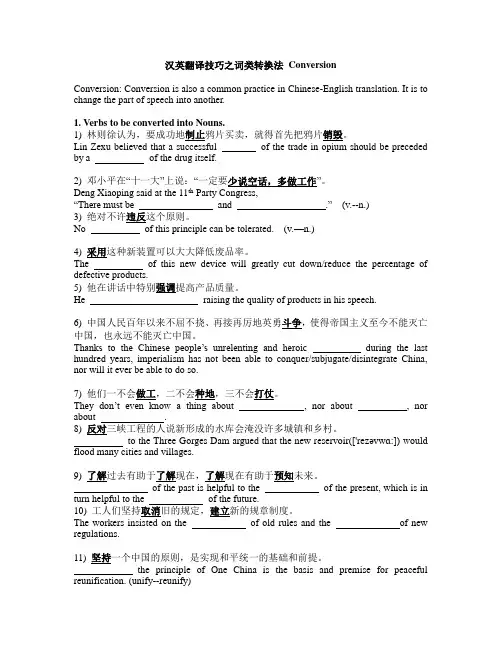
Conversion: Conversion is also a common practice in Chinese-English translation. It is to
change the part of speech into another.
1. Verbs to be converted into Nouns.
1) 林则徐认为,要成功地制止鸦片买卖,就得首先把鸦片销毁。
Lin Zexu believed that a successful of the trade in opium should be preceded
by a of the drug itself.
2) 邓小平在“十一大”上说:“一定要少说空话,多做工作”。
Deng Xiaoping said at the 11th Party Congress,
“There must be and .” (v.--n.)
3) 绝对不许违反这个原则。
No of this principle can be tolerated. (v.—n.)
4) 采用这种新装置可以大大降低废品率。
The of this new device will greatly cut down/reduce the percentage of
defective products.
5) 他在讲话中特别强调提高产品质量。
He raising the quality of products in his speech.
6) 中国人民百年以来不屈不挠、再接再厉地英勇斗争,使得帝国主义至今不能灭亡中国,也永远不能灭亡中国。

翻译常用的八种技巧
翻译常用的八种技巧
1.重译法(repetition)
2.增译法(amplification)
3.减译法(omission)
4.词类转移法(conversion)
5.词序调整法(inversion)
6.分译法(division)
7.正说反译、反说正译法(negation)
8.语态变换法(the change of the voices)
第一节重译法(repetition)
在翻译中,有时为了忠实于原文,不得不重复某些词语,否则就不能忠实地表达原文的意思。这种反复使用某些词语于翻译的方法就叫重译法。
重译法实际上也是一种增词法,只不过所增加的是上文出现的词。重译法有三个作用:一是为了明确;而是为了强调;三是为了生动。一、为了明确,有时需要重复宾语。在英语中,一句话里两个动词
共用一个宾语,宾语只在第二个动词之后出现一次。而在汉语中,这样的宾语要在每个动词后分别出现。定语后的名词亦是如此。
如:
1.We have to analyse and solve problems. 我们要分析问题,解决
问题。
2.I eat and drink whatever I like, and sleep when I can not
keep.我想
吃什么就吃什么,想喝什么就和什么,眼睛睁不开了就睡觉。
3.人类利用自然科学去了解自然、改造自然。People use natural
science to understand and change nature.
4.Aristocratic and democratic tendencies in a nation often show
themselves in its speech.民族的贵族倾向和民族倾向常在其言语中表现出来。
5.我们来修改安全规则和卫生规则吧。Let’s revise our safety
and

翻译技巧4词类转译法
英语与汉语的一个显著差异:
英语呈静态;汉语呈动态
从词汇用法上,英语中常用抽象名词、动词的同源名词、同源形容词、副词及介词等来表达动
态含义。而汉语的动词由于无形态变化,若要表示动作意义,往往只能采用动词。
Don’tbelievehim.Youshouldknowheisagoodkidder.不要相信他。你应该知道他很会骗人的。
I’mdoubtfulwhetherheisstillalive.我怀疑他是否还活着。
Motherisonthetelephonewithfather.母亲与父亲在通话。
一、词类的转译
(一)英语名词的转译
1.英语名词—〉汉语动词
名词化(nominalizationnominalization)成为英语使用中的普遍现象,构成了静态为主的语言特征。而汉
语是逻辑性语言,不受动词形态变化的约束,使用较多的动词,形成了明显的动态优势。英
译汉的过程就是在译文中强化原文动态色彩的过程,常常需要英语名词转换成汉语动词。
(1)具有动作意义的名词(actionnouns)
例1.I’mconvincedthatChina’sWTOmembershipwilldomorecontributionstothedevelopmentofglobaleconomy.
我坚信中国加入WTO将会对全球经济发展做出更大贡献。
例2.Parents’loveofchildrenisperfectandminute.(n.+of)
父母爱子女无微不至。
例3.ThereisnoshortcuttothemasteryofEnglishEnglish.(n.+of短语)
掌握英语无捷径。
(2)有些与感官动词(see,hear,think,know等)相联系的名词(sight,sound,glance,view,
knowledge等)通常转译成动词。
例1.Thesightandsoundofourjetplanesfilledmewithspeciallonging.
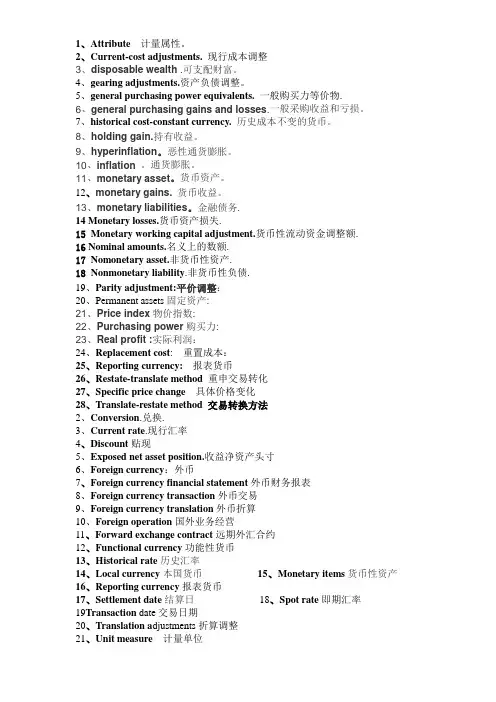
1、Attribute 计量属性。
2、Current-cost adjustments. 现行成本调整
3、disposable wealth .可支配财富。
4、gearing adjustments.资产负债调整。
5、general purchasing power equivalents. 一般购买力等价物.
6、general purchasing gains and losses.一般采购收益和亏损。
7、historical cost-constant currency. 历史成本不变的货币。
8、holding gain.持有收益。
9、hyperinflation。恶性通货膨胀。
10、inflation 。通货膨胀。
11、monetary asset。货币资产。
12、monetary gains. 货币收益。
13、monetary liabilities。金融债务.
14 Monetary losses.货币资产损失.
15 Monetary working capital adjustment.货币性流动资金调整额.
16 Nominal amounts.名义上的数额.
17 Nomonetary asset.非货币性资产.
18 Nonmonetary liability.非货币性负债.
19、Parity adjustment:平价调整:
20、Permanent assets固定资产:
21、Price index物价指数:
22、Purchasing power购买力:
23、Real profit :实际利润:
24、Replacement cost: 重置成本:
25、Reporting currency: 报表货币
26、Restate-translate method 重申交易转化
27、Specific price change 具体价格变化