
Chinese knotting
- 格式:pptx
- 大小:1.62 MB
- 文档页数:27
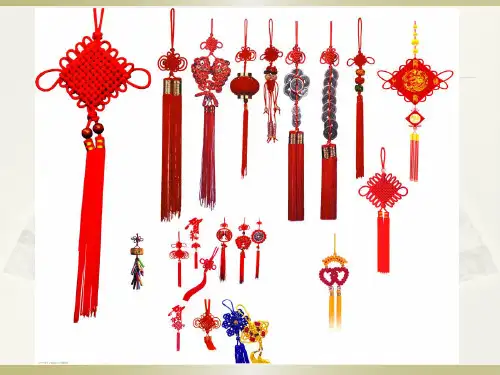

中国结英文作文英文:Chinese knot, also known as Chinese traditional decorative knot, is a unique art form that originated in ancient China. It is made by tying a series of knots with a single cord or multiple cords of different colors and textures. Chinese knotting has a long history and is widely used in various aspects of Chinese culture such as weddings, festivals, and home decoration.As a Chinese, I am proud of our cultural heritage and the art of Chinese knotting is one of my favorites. I remember when I was a child, my grandmother would teach me how to make different types of Chinese knots. She would patiently explain the meaning behind each knot and its significance in Chinese culture. One of my favorite Chinese knots is the Double Coin Knot, which symbolizes wealth and prosperity.Chinese knotting has also gained popularity in other parts of the world. Many people are fascinated by the intricate designs and the meaning behind each knot. In fact, I have seen Chinese knots being used as decorations in weddings and other special occasions in other countries.中文:中国结,也称中国传统装饰结,是一种独特的艺术形式,起源于中国古代。

中国结作文英语作文Chinese knot, also known as "中国结" in Chinese, is a traditional handicraft that dates back thousands of years. It is made by tying colorful threads or cords together in intricate patterns, symbolizing good luck, prosperity, and happiness.The art of Chinese knotting requires patience, precision, and creativity. Each knot is carefully crafted by hand, with the artisan paying close attention to detail and symmetry. It is a time-consuming process, but the end result is always a beautiful and intricate piece of art.Chinese knotting has a long history in Chinese culture, with different knots representing different meanings and symbols. For example, the Double Happiness knot is often used in weddings to symbolize the union of two people in marriage. The Mystic Knot is another popular design, symbolizing eternal love and harmony.In modern times, Chinese knotting has evolved into a popular form of decoration and accessory. You can find Chinese knots adorning everything from keychains and bookmarks to home decor and clothing. It adds a touch of traditional Chinese culture to everyday items, making them unique and special.Learning how to make Chinese knots can be a fun and rewarding experience. There are many tutorials and workshops available for those interested in trying their hand at this ancient art form. It is a great way to relax, unwind, and tap into your creative side.In conclusion, Chinese knotting is a beautiful and meaningful art form that has stood the test of time. It is a symbol of Chinese culture and tradition, and a way to bring luck and happiness into our lives. Whether you are a beginner or an expert, Chinese knotting is a craft that anyone can enjoy and appreciate.。
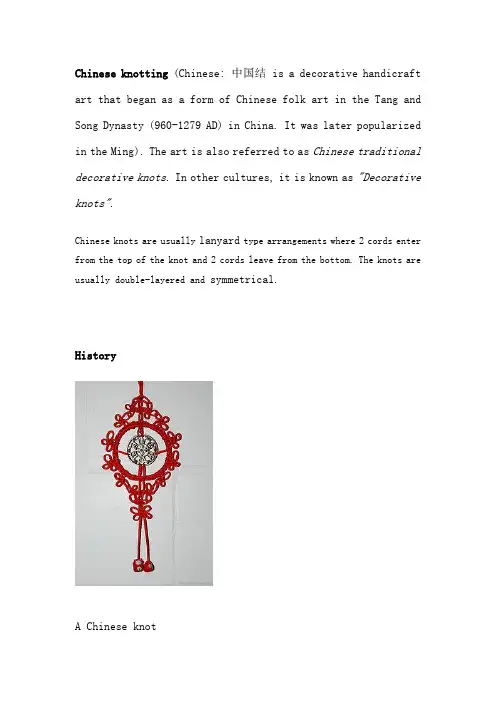
Chinese knotting (Chinese: 中国结 is a decorative handicraft art that began as a form of Chinese folk art in the Tang and Song Dynasty (960-1279 AD) in China. It was later popularized in the Ming). The art is also referred to as Chinese traditional decorative knots. In other cultures, it is known as "Decorative knots".Chinese knots are usually lanyard type arrangements where 2 cords enter from the top of the knot and 2 cords leave from the bottom. The knots are usually double-layered and symmetrical.HistoryA Chinese knotArchaeological studies indicate that the art of tying knots dates back to prehistoric times. Recent discoveries include 100,000-year old bone needles used for sewing and bodkins, which were used to untie knots. However, due to the delicate nature of the medium, few examples of prehistoric Chinese knotting exist today. Some of the earliest evidence of knotting have been preserved on bronze vessels of the Warring States period (481–221 BCE), Buddhist carvings of the Northern Dynasties period (317–581) and on silk paintings during the Western Han period (206 BCE–CE6).Further references to knotting have also been found in literature, poetry and the private letters of some of the most infamous rulers of China. In the 18th century, one book that talked extensively about the art was Dream of the Red Chamber.[3] The phenomenon of knot tying continued to steadily evolve over the course of thousands of years with the development of more sophisticated techniques and increasingly intricate woven patterns. During the Qing Dynasty (1644–1911) knotting finally broke from its pure folklore status, becoming an acceptable art form in Chinese society and reached the pinnacle of its success. Knotting continued to flourish up until aboutthe end of imperial China and the founding of the Republic of China in 1911 AD when China began its modernization period. From 1912 to the end of the Cultural Revolution in 1976, the art of Chinese knotting was almost lost.In the late 1970s, a resurgence of interest occurred in Taiwan, largely due to the efforts of Lydia Chen (Chen Hsia-Sheng 陈夏盛) of the National Palace Museum who founded the Chinese Knotting Promotion Center. In the 1980s, Mrs. Chen focused her energies on the knotting artifacts preserved during the Qing Dynasty. Currently, Chinese knotting enjoys wide popularity in Taiwan with numerous specialty shops to be found.Modern AdaptationsIn February 2008, Corra Liew from Malaysia seeking possibilities out from the traditional wire jewelry making technique, Chinese knotting is then merged and presented in wire form. She calls the technique as Wired Chinese Knot.。

chinese knotting英语作文Chinese knotting, also known as "Chinese decorative knots" or "Chinese traditional knots", is a unique and traditional folk art form that has been passed down for thousands of years in China. It is a decorative handicraft that involves tying knots in various intricate patterns and designs using silk or cotton cords.The art of Chinese knotting has a long history and is deeply rooted in Chinese culture. It is believed to have originated during the prehistoric era, and has been used for both practical and ornamental purposes throughout Chinese history. Chinese knots were originally used for fastening and tying, but over time they evolved into decorative ornaments with symbolic meanings.One of the most fascinating aspects of Chinese knotting is the symbolism behind the various knot designs. Each knot has its own unique meaning and significance, and different knots are used for different occasions and purposes. For example, the "endless knot" symbolizes longevity and eternity, while the "double happiness knot" is often used in weddings to symbolize double happiness and good fortune.In addition to their symbolic meanings, Chinese knots are also valued for their aesthetic beauty and intricate designs. The art of Chinese knotting requires a high level of skill and precision, as well as a deep understanding of the various knotting techniques and patterns. Mastering the art of Chinese knotting can take years of practice and dedication, and skilled artisans are highly respected in Chinese culture.Chinese knotting has also gained popularity in other parts of the world, and is now recognized as a unique and elegant form of decorative art. In recent years, there has been a growing interest in Chinese knotting among people from different cultural backgrounds, and many have taken up the art as a hobby or a form of meditation.The beauty of Chinese knotting lies not only in its visual appeal, but also in the meditative and therapeutic benefits it offers. The repetitive and rhythmic movements of tying knots can be calming and soothing, and many practitioners find it to be a form ofstress relief and relaxation. In addition, the intricate and delicate nature of Chinese knotting requires a high level of concentration and focus, making it a form of mindfulness practice.In conclusion, Chinese knotting is a timeless and elegant art form that holds great cultural and artistic significance. Its intricate designs, symbolic meanings, and meditative benefits make it a unique and valuable part of Chinese heritage. Whether used for decorative purposes, symbolic meanings, or personal enjoyment, Chinese knotting continues to captivate and inspire people around the world. It is a true testament to the enduring beauty and cultural richness of Chinese traditional arts.。