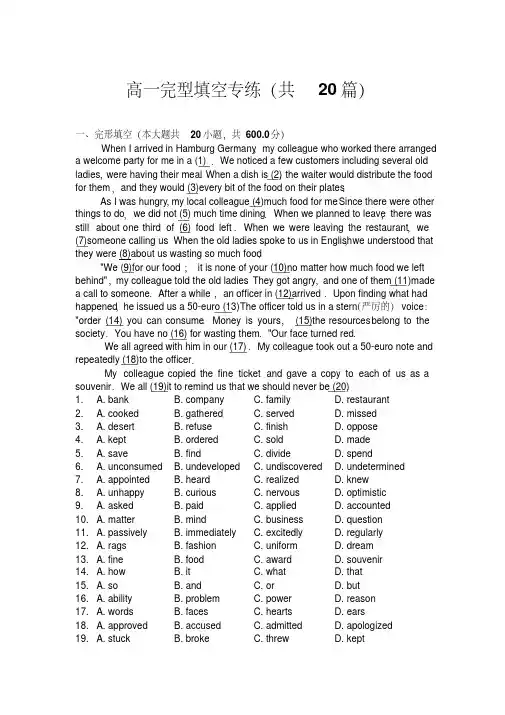
完型专练
- 格式:doc
- 大小:71.00 KB
- 文档页数:10
完形填空一.做题中的推测手段1.根据上下文的逻辑关系进行推测。
注意上下文的逻辑关系和文章的逻辑关系是做好完形填空题的关键,它要求考生在了解文章大意的基础上,联系上下文,运用思维逻辑进行比较、判断,找出既符合词义、句意,又符合上下文语境,合理的正确答案。
2.根据语篇标志进行推测。
语篇一般是指比单一句子长的语言单位,如句群、段落、篇章等。
语篇和语篇之间往往有标明其内在联系的词语,这些词语称为“语篇标志”,例如:表示结构层次的firstly, secondly 等,表示逻辑关系的therefore, so, but等,表示话题改变的by the way等。
在做完形填空题时,充分利用这些语篇标志可以迅速理清文章的脉络,弄清上下文之间的关系。
3.根据文化背景知识进行推测。
完形填空题考查的知识面较广,从文化、科学常识,到历史地理知识;从风俗民情到民族习惯等等,无所不考。
考生在做这类题时,要特别注意中西文化方面所存在的差异。
具备了一定的文化背景知识,才能比较准确地判断正确答案。
4.根据常识进行判断。
中学生已经掌握了较丰富的科学与生活常识,也具备了一定的判断能力。
在考查语言知识和技能的同时,考查这些简单的常识性的问题,也是对学生知识面的检测。
5.根据语法知识进行推测。
对于考查语法知识的考题,不仅要理解上下文的逻辑关系,更要有针对性地对语法结构、句式特点进行分析,并根据其语法结构和句式特点进行合理推测,从而迅速解决问题。
6.运用词汇知识推测答案。
完形填空题中对词汇知识的考查,主要集中在词语的搭配和同义词的辨析两大方面。
要做好这类题目,首先要有较大的词汇量,较强的词语搭配能力,以及在语句中理解词义的能力,做题时要结合上下文的语境,确定词的意义。
二.例题解析“Ring… ring…” the telephone suddenly rang. Sam got up to 1 the call. It was his aunt. “Sam, 2 are you still at home?” she asked surprisingly. Sam 1ooked at the clock. It was already 7:30 a. m. “Oh, my goodness! There’s an imp ortant 3 today,” Sam shouted out. He hurried to wash his face and get 4 . When he was going to leave the house, he 5 that he had not put away his books. He ran quickly to the 6 and put them into the bag. He then went to the bus stop to go to school as 7 as he could. When he got into the classroom, his classmates were 8 writing. “Why are you so 9 ?” asked the teacher . “I’m sorry, sir,” Sam answered, afraid of looking10 . “It was my clock.. It 11 to wake me up this morning and ....” “Don't say anything about it,” his teacher12 him. “Don’t try to come late next time!” Sam said yes and walked to his 13 quickly. But when he tried to do the paper, he could not 14 in a right way. He put his head on the desk and said, “Wh at a 15 day it has been for me!”( )1. A. find B. give C. put D. answer( )2. A. why B. how C. when D. where( )3. A. talk B. party C. exam D. meeting( )4. A. tired B. lost C. dressed D. rested( )5. A. forgot B. remembered C. understood D. thought( )6. A. classroom B. desk C. bus D. door( )7. A. carefully B. quietly C. early D. fast( )8. A. worried B. free C. busy D. careful( )9. A. 1ate B. ill C. lonely D. ready( )10. A. down B. up C. out D. back( )11. A. happened B. stopped C. failed D. pointed( )12. A. helped B. knew C. followed D. stopped( )13. A. room B. table C. seat D. teacher( )14. A. think B. sit C. turn D. speak( )15. A. short B. bad C. happy D. usual分析:这是一篇关于一个学生考试迟到的事。
短文一开始就是电话铃声,Sam应该起来接电话,所以第l空中应选D,这四个动词中只有answer能表示“接电话”这个含义。
第2空中要选择一个副词,句中已含有still at home等状语,故不能选择when,where, how 表示方式,如用在本句中则句意不通,所以选A。
第3空,从后文知,Sam是到学校去,故应选C。
对于学生来说,exam是学生最可能要做的事,并且后文说到其他学生在writing。
第4空,get dressed意为“穿衣服”,要注意这个短语的完整性。
第5空,从前一句中的动词leave以及后文中的一系列动作可知,本空中应填remembered才符合逻辑,其他词不能使文章通顺。
第6空要注意分析备选项的意义;从后文he had not put away his books 可知选B最合适,因书应该是放在课桌上。
第7空中应填fast,因Sam 要迟到了。
第8空中要注意在形容词后接writing,故选busy。
第9空,从上文知,Sam 已经迟到了,故老师应问他迟到的原因,选A。
第10空表明Sam的态度,他害怕抬头看老师,故选up。
第11空,Sam所陈述的理由是闹钟未响,故填C,failed。
第12空,从上文Sam的话没说完知道这时老师打断了他的话,故选D,stopped。
第13空,Sam 在教室里走去的当然是C,seat。
第14空,本空说明Sam 思维混乱,不能思考,选A。
第15空,综合上文可知Sam 感到这一天太糟糕,故选B 。
三.专项练习阅读下面的短文,理解大意,然后从各小题的四个选项中选出一个最佳答案,使短文连贯完整。
第(1)组A hot dog is one of the most popular American foods. It was named after frankfurter, a German food .You may hear “hot dog ” 1in other ways . People sometimes say “hot dog ” to express 2 . For example (例如), a friend may ask 3 you would like to go to the cinema . You might say, “Great ! I would love to go. ”Or , you could say , “ 4 ! I would love to go. ”People 5 use the expression to describe (描写)someone who is a “show-off” , who tries to show everyone else how 6 he is . You often hear such 7 called a “hot dog ”. He may be a baseball player for example, who 8 the ball with one hand , making a (n) 9 catch seem more difficult . You know he is a hot dog because when he makes such a catch , he bows (鞠躬)to the crowd , hoping to win their 10 .( )1. A. eaten B. used C. cooked D. picked( )2. A. strength B. practice C. pleasure D. reply( )3. A. if B. how C. when D. where( )4. A. Hot dog B. Don’t worry C. Never mind D. Excuse me( )5. A. ever B. also C. still D. yet( )6. A. hopeful B. careful C. kind D. great( ) 7. A. a dog B. a hand C. a person D. an action( )8. A. catches B. plays C. passes D. throws( )9. A. hard B. funny C. exciting D. easy( )10. A. thanks B. cheers C. medals D. matches第(2)组Mark Twain, the famous writer and speaker, liked to play jokes on others. But once a joke was played 1 him.One day Mark Twain gave a lecture in a small town. At lunch a young man told him that his uncle 2 laughed. Nobody and nothing could make his uncle 3 .But Twain said he was 4 he could make him laugh. He asked the young man to 5 his uncle to his house. That evening Mark Twain told some 6 stories. Everyone there laughed, 7 the old man never even smiled. Twain told the funniest stories, but the old man did not laugh, 8 . At last, he stopped. He was very tired.Some days later, Mark Twain told a friend of 9 about this story. His friend laughed and said that he knew that old man. He was 10 .( )1. A. at B. on C. with D. in( )2. A. always B. sometimes C. often D. never( )3. A. laugh B. cry C. speak D. read( )4. A. afraid B. sorry C. sure D. happy( ) 5. A. leave B. carry C. bring D. show( )6. A. unhappy B. terrible C. sad D. interesting( ) 7. A. so B. but C. and D. or( )8. A. too B. either C. also D. already( )9. A. theirs B. mine C. his D. hers( ) 10. A. deaf B. blind C. asleep D. dead第(3)组Traffic accidents killed more than 104,000 people in China last year. Chinese cities have 1 cars than before. Every day many people are 2 while they cross the road. Most of 3 are old people and children. Old people are often killed 4 they usually can’t see clearly or hear very well. 5are killed because they are careless.A car, truck or bus can’t stop very 6 if it is going very fast. The faster a car is traveling, 7 it takes to stop. But people walking in the street do not always understand this. It’s8 for people to know how fast a car is traveling.The new traffic laws were put into use 9 May 1st, 2004. The new traffic laws will 10 the streets safer for walking and driving.( )1. A. bigger B. more C. fewer D. smaller( )2. A. killed B. caught C. shot D. attacked( )3. A. it B. you C. them D. us( )4. A. when B. because C. if D. though( )5. A. Drivers B. Women C. Old people D. Children( )6. A. quickly B. hardly C. clearly D. slowly( )7. A. the faster B. the safer C. the farther D. the longer( )8. A. difficult B. easy C. dangerous D. true( )9. A. in B. at C. on D. for( )10. A. take B. make C. stop D. find第(4)组Imagine you receive an e-mail that looks something like this: ARE YOU GOING TO CLASS TODAY? How does 1 this message make you feel? Why did the sender use 2 capital(大写)letters? Was he or she angry, 3 did that person just 4 to turn off the “Caps Lock”(大写锁定)on the computer. This e-mail “sounds” like the 5is shouting because using all capital letters in an e-mail is 6 the way that people shout online.Knowing when and when not to 7 capital letters is just one 8 of online etiquette (礼仪).Don’t do anything online that you wouldn’t do in 9life. Don’t use information that someone else has written, and 10 it’s yours. Do share (分享)your knowledge of the Internet with others.( )1. A. reading B. typing C. watching D. leaving( )2. A. some B. all C. any D. none( )3. A. but B. or C. and D. so( ) 4. A. start B. begin C. forget D. remember( ) 5. A. writer B. worker C. nurse D. student( )6. A. hardly B. carefully C. silently D. usually( ) 7. A. copy B. believe C. double D. use( )8. A. mistake B. advice C. example D. game( )9. A. digital B. real C. quiet D. healthy( )10. A. speak B. tell C. talk D. say第(5)组On the morning of May 2, 1980, Rosalie Warren received the envelope(信封)with her grades(等第)in it. As she 1 it, Warren wanted to know whether her hundreds of 2 of studying had paid off. They had.“I 3five A’s,” she still remembers the moment happily. “I 4 fell on the floor.”Warren was born on August 29, 1900. Two years 5 she entered(进入)high school, her father died. Warren had to leave school for factory work to help support(支撑)her 6 Warren was a person who always 7 school. In 1975, when she was 75, she learned about Suffolk University’s(大学的)tuition-free(免学费的)program.Now she is not 8 with learning. “It’s my9 to go to school,” she says. Nancy Stoll, head of students, says, “Warren is a good10 for our younger students ——that learning is a lifetime activity(活动)….”( )1. A. wrote B. made C. opened D. bought( )2. A. dollars B. hours C. books D. grades( )3. A. spelt B. chose C. got D. guessed( )4. A. already B. always C. almost D. also( )5. A. before B. after C. till D. while( )6. A. family B. school C. factory D. classmates( )7. A. had B. liked C. built D. founded( )8. A. finished B. started C. left D. kept( )9. A. duty B. work C. life D. mistake( )10. A. visitor B. example C. member D. headmaster第(6)组Swimming is very popular in summer. People like swimming in summer because water makes them 1 cool. If you like swimming but swim in a 2 place, it may not be safe. These years, more than ten people 3 while they were enjoying themselves in the water and 4 of them were students. But some people are 5 not careful in swimming. They often think they swim so 6 that nothing can happen to them in water. Summer is here again. If you go swimming in summer, don't forget 7 better swimmers have died in water. They died because they were not careful, not because they 8 swim. So don't get into water when you are alone. 9 there is a "No Swimming" sign, don't get into water, 10 . If you remember these, swimming will be safer.( )1. A. felt B. to feel C. feeling D. feel( )2. A. difficult B. wrong C. right D. small( )3. A. have died B. die C. died D. will die( )4. A. much B. more C. lot D. most( )5. A. still B. already C. yet D. even( )6. A. will B. often C. fast D. hard( )7. A. what B. who C. which D. that( )8. A. needn't B. wouldn't C. couldn't D. mustn't( )9. A. Because B. If C. Whether D. Though( )10. A. also B. nor C. either D. too第(7)组Mr. Johnson was having trouble with his stomach (胃), 1 he went to see a doctor. The doctor examined (检查) his stomach 2 but couldn't find any problem. Then he said, "Well, Mr. Johnson, take it easy. There's 3 serious. Stop smoking and then you'll be all right very 4 .""But doctor," answered Mr. Johnson, "I 5 . I don't like smoking at all.""Oh, I see," said the doctor , "then stop drinking alcohol (酒) 6 .""But I don't drink alcohol, "answered Mr. Johnson."Don't drink 7 tea or coffee then," the doctor said to him."I 8 drink water," answered Mr. Johnson, "I don't like tea or coffee."The doctor 9 for a while and then said, "Well, what do you like to eat then?""Potatoes. I like potatoes very much," Mr. Johnson answered at once."All right, then stop 10 potatoes, "said the doctor as he got up to say goodbye to Mr. Johnson.( )1. A. so B. but C. or D. for( )2. A. slowly B. happily C. quickly D. carefully( )3. A. anything B. something C. nothing D. everything( )4. A. early B. soon C. late D. much( )5. A. won't smoke B. never smoked C. couldn't smoke D.needn't smoke( )6. A. from now on B. just now C. from then on D. until now( )7. A. any B. many C. some D. little( )8. A. will B. won't C. don't D. only( )9. A. thinks B. though C. is thinking D. has thought( )10. A. cutting B. buying C. eating D. washing第(8)组The bicycle is one of the simplest yet most useful inventions in the world. What is most surprising is that it was not 1 earlier, although the great inventor Leonardo da Vinci had drawn pictures for bicycles and also for flying machines and some other things. Those things were not produced 2 long after he died.A person riding a bicycle uses 3 energy(能源)to make the bicycle move, and there is no pollution(污染)at all when you are riding. Even so, in developed 4 , most people don't travel to work by bicycle. It is not because the bicycles are expensive or people feel 5 if they tide to work. It' s because 6 cars on the roads becomes larger. It certainly becomes 7 to ride a bicycle. As a result, more people put their bicycles away and go to work 8 their cars and , in this way, the situation(情形)is made more serious. __9 the best way to make tiding safer and more popular is to create paths(开设通道)only for bicycles, and to make 10 so difficult and expensive for drivers to take their cars into the city that they will go back to using their bicycles.( )1. A. invent B. inventing C. invented D. to invent( )2. A. before B. when C. since D. until( )3. A. much B. quite a lot of C. very. little D. many( )4. A. worm B. countries C. land D. earth( )5. A. lucky B. glad C. sorry D. tired( )6. A. the number of' B. a number of C. this kind of D. all kinds of( )7. A. safer B. more dangerous C. much dangerous D. safe( )8. A. by B. in C. use D. drive( )9. A. Hardly B. May be C. Perhaps D. Nearly( )10. A. it B. them C. us D. that专项练习参考答案:第(1)组:1—5 BCAAB 6—10 DCA DB第(2)组:1—5 BDACC 6—10 DBBCA第(3)组:1—5 BAC BD 6---10 ADAC B第(4)组:1—5 ABBCA 6—10 DDCBD第(5)组:1—5 C B C C B 6—10 A B A C B第(6)组:1—5 B D A. B C 6—10 C B A DA第(7)组:1—5 C B A D D 6---10 C C B D A第(8)组:1—5 C DC BD A 6—10 BB C A【一】(2006年沈阳市)Mrs. Ball had a son. His name was Mick. She___1___him very much and as he wasnot a___2___child, she was always___3___that he might be ill. ___4___she used to take him to see the best___5___in the town four times a year to be looked___6___.___7___one of these visits, the doctor gave Mick all kinds of tests and then said to him, “Have you had any___8___with your nose or ears recently?” Mick___9___for a second and then answered.” Yes,I____10___.”Mrs. Ball was very___31---.”But I’m sure you have___12___told me that, Mick!” She said worriedly. ”Oh, really?” said the doctor____13___.” And what trouble have you with your nose and ears, my boy?” “Well,” answered Mick, “I always have troubl e with them when I’m___14___my sweater off, because the___15___is very tight(紧的).”( )1A. loved B. hated C. missed D. looked( )2.A.rich B. clever C. strong D. happy( )3.A.afraid B. surprised C. glad D. sure( )4.A.Which B. For C. But D. So( )5.A.player B. teacher C. doctor D. lawyer( )6.A.round B. over C. for D. after( )7.A.At B. During C. For D. To( )8.A.answer B. thing C. word D. trouble( )9.A.waited B. thought C. stood D. looked( )10.A.did B. will C. have D. do( )11.A.excited B. interested C. pleased D. surprised( )12.A.already B. just C. never D. always( )13.A,angrily B. seriously C. happily D. carefully( )14.A.turning B. taking C. keeping D. putting( )15.A.collar(衣领) B. nose C. mouth D. ear【二】(06孝感市)When you’re a teenager(青少年), it seems that every time you say, “I want to …”, your parents answer, “No, you can’t.”Young people further complain that their parents do not ___1___ them. When something goes___2___, most parents just don’t believe in their children. ___3___ asking why, they think their kids are wrong. And not many parents allow their kids to choose for themselves.Yes, ___4___ is true that your parents sometimes treat you as a little child. But remember that not long ago you were really a child. Your parents still remember the childish __5__you used to make. They want to protect you ___6___you don’t want them to do so.So, if you want to get ___7___ freedom(自由), please try to understand your parents and don’t lie to them. Try a more friendly way. If you want them to___8___you to stay out late, don’t’ just say, “All__9___ kids can stay out late.” Tell them as much as you can about what you want to do and where you’ll be and ___10___it’s important for you to stay out late. Then they just might say, “yes”.1.A. enjoy B. prefer C. understand D. decide2.A. badly B. wrong C. nice D. clear3.A. Except B. Instead C. With D. Without4.A. it B. this C. that D. one5.A. uses B. differences C. minds D. mistakes6.A. if B. though C. because D. since7.A. most B. least C. more D. less8.A. allow B. hope C. wish D. ask9.A. another B. others C. the others D. the other10.A. how B. when C. why D. which【三】(05天津)Building a house is an operation which costs quite a lot of money. Suppose you plan to 1 a house, your first step is to find a suitable piece of 2 , You will probably try to find a sunny place, in a 3 situation, near stores and bus stops, not too far from your friends and the place where you work.Next you will find an 4 builder. And together with the builder you will make a 5 , The builder will draw it. The builder will also 6 the cost of your house. He will estimate(估计)the cost of the wood, the glass, and everything else that he must use in building the house. Later on, when he starts to build, this estimate must 7 , because the prices may the prices may 8 , and many other thing may happen between the time when he makes the estimate and the time when he builds the house.9 the builder gives you his estimate, you may wish to change your plan. You may find that some of the things you wanted at first cost too much, or that you can 10 a little more and add something to your original plan.1.A buy B decorate C build D find2.A floor B place C land D playground3. A mysterious B surprised C pleased D pleasant4.A excited B experienced C interesting D extra5.A map B plan C decision D discussion6. A find out B carry on C work out D work on7.A be corrected B be copied C be read D be written8.A swap B change C exist D influence9. A When B While C Until D Since10. A cost B spend C take D pay for【四】(05重庆)Mr. Johnson had a factory.He once 1 on TV that animals could he taught to 2 some work for people if they were given 3 to eat.He loved the idea.He thought it would be 4 to have a dog look after his 5 and an elephant do some heavy jobs 6 his factory. He bought a dog 7 an elephant in the market and decided to teach them to do some work for him.Of course.he 8 bought a lot of food for them.Several months later,the dog and the elephant 9 fatter and fatter,but they 10 do any work for him.At last,Mr. Johnson had to give up.1.A.saw B.asked C.met2.A.make B.do C.1et3.A.someone B.nothing C.something4.A.bad B.good C.1ate5.A.house B.shirt C.eyes6.A.in B.above C.under7.A.but B.or C.and8.A.also B.never C.yet9.A.smelt B.sounded C.became10.A.mustn’t B.couldn’t C.shouldn’t【五】(05年济宁市)Most adults(成人) once studied at school, had classes and did their homework everyday. The same thing is going on at school now. 1 it seems that doing weekend homework is 2 problem for the modern students.All the students should 3 that weekend homework should be abolished(取消).It is 4 for them to study at school five days a week. They have a lot of interests. With homework to do on Saturday and Sunday, when can they find 5 to help their parents do the housework, go and see a football or basketball game or a good film, join in family recreation(娱乐), or just have 6 at home? Because of these other activities, the homework can't be finished until 7 evening. So their weekend homework is usually done in such a hurry that on Monday teachers are 8 because many of the students know little about the 9 . If there were no weekend homework to do, they would be happy to go to school on Monday 10 two days' good rest and to learn what the teachers teach.1. A. Also B. But C. Still D. Though2. A. not a B. another C. one D. other3. A. agree B. decide C. understand D. disagree4. A. enjoyable B. enough C. good D. useful5. A. work B. time C. room D. money6. A. a rest B. an exam C. a lesson D. a picnic7. A. Monday B. Saturday C. Friday D. Sunday8. A. pleased B. sorry C. unhappy D. satisfied9. A. lessons B. games C. interests D. activities10. A. during B. until C. before D. after【六】(山东潍坊)When you write a letter or make a telephone call, your words 1 a message. People communicate with words. Do you think you can communicate 2 words? A smile 3 your face shows you are happy and friendly. Tears in your eyes tell 4 that you are sad. When you 5 your hand in class, the teacher knows you want to say something 6 ask questions. You shake your head, and people know you are saying no. You nod and people know you are saying 7 . Other things can also give some information. For example, a sign at the bus stop helps you to know which bus 8 . A sign on the wall of your school helps you to find the library. Signs on doors tell you 9 to go in or out. 10 you ever noticed that there are a lot of signs around you and that you receive messages 11 them all the time? People can, communicate 12 many other ways. 13 artist can use his drawing to tell about beautiful mountains, about the blue sea and many other things. Books 14 to tell you about all wonderful things in the world and also about people and their ideas. Books, magazines, TV and radio and films all help us to communicate with other people. They all help us to know 15 is going on in the world.1. A. take B. bring C. carry D. gives2. A. by B. with C. use D. without3. A. in B. on C. on D. over4. A. others B. the others C. other D. the other5. A. put on B. put out C. put up D. put down6. A. when B. or C. but D. if7. A. no B. hello C. yes D. nothing8. A. to B. to chose C. to have D. to take9. A. which B. where C. how D. what10. A. Do B. Did C. Had D. Have11. A. from B. of C. about D. for12. A. with B. by C. without D. in13. A. The B. An C. A D. Some14. A. write B. wrote C. is written D. are written15. A. what B. which C. that D. who【一】1.A 2.C3. A 4.D5.C6.B7.B8.D9.B10.C11.D12.C13.B14. B15.A 【二】1-10 CBDAD BCADC【三】1~5 CCDBB 6~10 CABAB【四】1~5 ABCBA 6~10 ACACB【五】1-5 BCABB 6~10 ADCAD【六】1.C2.D3.B4.A5.C6. B7.C8.D9.C10.D11. A12. B13. B14. D15. A。